QUICK INFO BOX
| Attribute | Details |
|---|---|
| Full Name | Ali Ghodsi |
| Nick Name | Ali |
| Profession | Tech Entrepreneur / CEO / Computer Scientist |
| Date of Birth | December 1978 |
| Age | 46-47 years (as of 2026) |
| Birthplace | Tehran, Iran |
| Hometown | Berkeley, California, USA |
| Nationality | Swedish-American |
| Religion | Not publicly disclosed |
| Zodiac Sign | Sagittarius/Capricorn |
| Ethnicity | Persian (Iranian) |
| Father | Doctor (Name not publicly disclosed) |
| Mother | Doctor (Name not publicly disclosed) |
| Siblings | Information not publicly available |
| Wife/Partner | American-Chinese (Name not publicly disclosed) |
| Children | At least one son |
| School | Stockholm area schools |
| College / University | Mid-Sweden University / KTH Royal Institute of Technology |
| Degree | MBA (2003), MSc Computer Engineering (2002), PhD Distributed Computing (2006) |
| First Startup | Peerialism AB (2006) |
| Current Company | Databricks |
| Position | Co-founder & CEO |
| Industry | Tech / AI / Data Analytics / Cloud Computing |
| Known For | Co-creating Apache Spark, Databricks CEO, Lakehouse Architecture |
| Years Active | 2006 – Present |
| Net Worth | $4.30 Billion (2025-2026 estimates) |
| Annual Income | Undisclosed (primarily equity-based) |
| Major Investments | Databricks equity (approximately 5%) |
| Not publicly active | |
| Twitter/X | Professional presence |
| @alighodsi |
1. Introduction
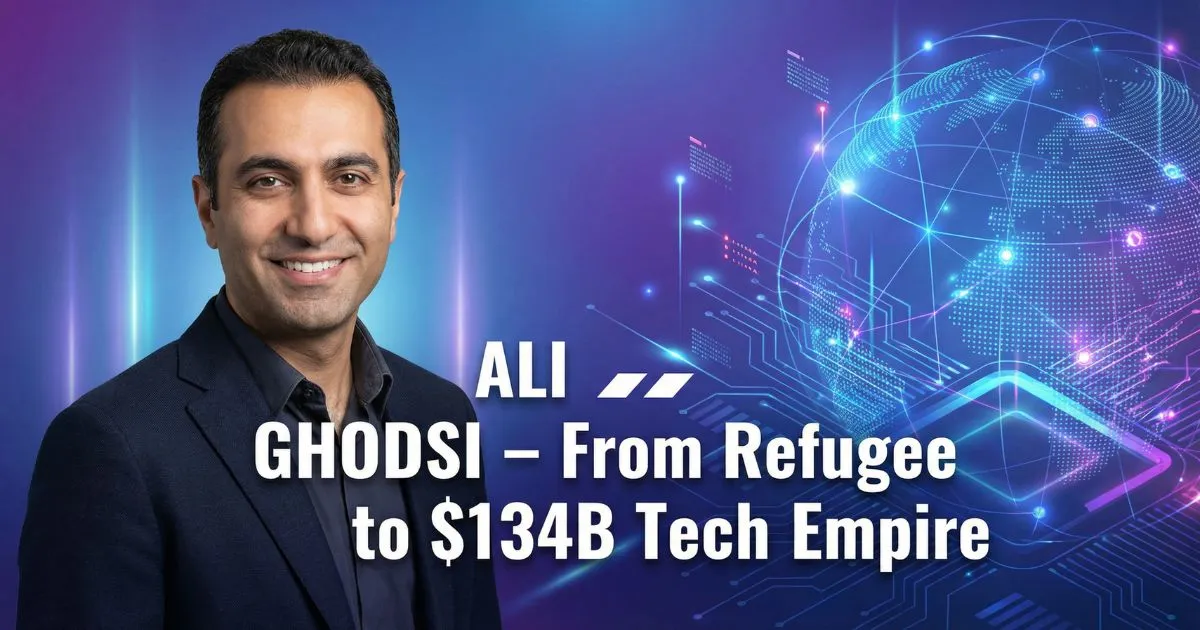
From a five-year-old refugee fleeing war-torn Iran with only 24 hours’ notice to the CEO of one of the world’s most valuable private tech companies, Ali Ghodsi’s journey embodies the transformative power of resilience, innovation, and vision. In December 2025, Databricks raised over $4 billion at a $134 billion valuation, making it one of the most valuable private companies alongside SpaceX, ByteDance, and OpenAI.
Ali Ghodsi is a Swedish-American computer scientist and entrepreneur who co-founded Databricks and serves as its CEO. He is celebrated as one of the original creators of Apache Spark, the revolutionary open-source data processing framework that transformed how companies handle big data. Under his leadership, Databricks has surpassed a $4.8 billion revenue run-rate, growing over 55% year-over-year.
Ghodsi is famous in the tech world for pioneering the “lakehouse” architecture—a paradigm that unified data lakes and data warehouses—and for his role in democratizing artificial intelligence and machine learning capabilities for enterprises worldwide. His academic contributions include influential papers on Apache Mesos and the concept of “Dominant Resource Fairness,” which became foundational to modern cloud infrastructure.
In this comprehensive biography, you’ll learn about Ali Ghodsi’s remarkable journey from programming on a broken Commodore 64 in Sweden to leading a company that processes trillions of data points daily. We’ll explore his career trajectory, the companies he built, his entrepreneurial philosophy, net worth, lifestyle, and his vision for the future of data and AI.
2. Early Life & Background
Ali Ghodsi was born in December 1978 in Tehran, Iran, during one of the most turbulent periods in the country’s history. He came from a privileged background—both his parents were doctors, and the family lived in one of Tehran’s affluent hillside neighborhoods with panoramic views of the city. However, this comfortable life was shattered by the Iranian Revolution and the subsequent Iran-Iraq War.
When Ali was approximately five years old, Iraq bombed Tehran, and he recalls the city going dark and windows shattering in their home. His family was given just 24 hours to flee the country. They escaped to Sweden, where Ali would spend his formative years.
The transition from upper-class Tehran to lower-class Sweden was jarring. The family moved between various student accommodations at Stockholm University and were evicted several times. Eventually, they settled in Bagarmossen, a suburb of Stockholm. The family struggled financially, relying on welfare assistance—a stark contrast to their previous life.
In Sweden, the Ghodsi family acquired a semi-broken Commodore 64 computer. Unable to afford games and with the tape recorder malfunctioning, young Ali turned to the instruction manuals. By the age of eight, he was writing his own computer games. This broken computer became his gateway to technology and would shape his entire future.
Ali’s early interest in technology was intense and all-consuming. He stayed up all night programming and conversing with people in the United States, resulting in a 70% absence rate in high school. Despite his poor attendance, he had found his passion and has been coding almost every day since childhood.
Growing up as an immigrant in Sweden wasn’t easy. Ali vividly remembers the sense of being an outsider, always feeling like it was “us and them”. This experience of exclusion became a powerful motivator. He felt he had to prove himself and worked much harder than his Swedish peers, who seemed more balanced and didn’t carry the same burden of needing to demonstrate their worth.
Ali’s childhood challenges forged a resilient character. The combination of fleeing war, adapting to a new country, overcoming financial hardship, and experiencing discrimination gave him an unrelenting drive to succeed. His early exposure to computers and his natural aptitude for problem-solving set him on a path that would eventually revolutionize how the world processes data.
3. Family Details
| Relation | Name | Profession |
|---|---|---|
| Father | Not publicly disclosed | Medical Doctor |
| Mother | Not publicly disclosed | Medical Doctor |
| Siblings | Not publicly disclosed | Unknown |
| Spouse | Not publicly disclosed | American-Chinese (profession unknown) |
| Children | At least one son | N/A |
Ali Ghodsi maintains significant privacy regarding his family life. He lives in Berkeley with his American-Chinese wife and their young son. While he avoids discussing personal wealth and family details publicly, he has mentioned that money is not something he cares about and doesn’t want it to affect his relationships with friends.
His parents, both doctors in Iran, sacrificed their professional standing and comfortable lifestyle to ensure their family’s safety by fleeing to Sweden. This sacrifice undoubtedly influenced Ali’s work ethic and appreciation for opportunity.
4. Education Background
Mid-Sweden University (1997-2003)
- Master of Science (MSc) in Computer Engineering (2002)
- Master of Business Administration (MBA) in Logistics and Strategic Marketing (2003)
Ali Ghodsi’s educational journey began at Mid-Sweden University, where he pursued dual degrees. An interesting turning point came when his college roommate told him that the business degree he was pursuing would one day make the roommate Ali’s boss. This comment sparked Ali’s determination to master both technical and business skills.
KTH Royal Institute of Technology, Stockholm (2003-2006)
- Doctor of Philosophy (PhD) in Distributed Computing (2006)
- Dissertation focus: Distributed systems and resource allocation
- Advisor: Professor Seif Haridi
At KTH, Ali conducted groundbreaking research on distributed systems. His work on “Dominant Resource Fairness” would later become foundational to Apache Mesos and modern cloud infrastructure. He received KTH’s Young Researcher of the Year Award in 2008 for his contributions.
Assistant Professor at KTH (2008-2009) After earning his PhD, Ali served as an assistant professor at KTH, teaching and conducting research. However, he found Swedish academia too constraining, with its emphasis on seniority and incremental research.
UC Berkeley (2009-present)
- Visiting Scholar (2009-2013)
- Adjunct Professor (2013-present)
In 2009, Ali joined UC Berkeley’s AMPLab (Algorithms, Machines, and People Laboratory) as a visiting scholar. This move would prove pivotal. At Berkeley, he collaborated with luminaries like Ion Stoica, Scott Shenker, Michael Franklin, and Matei Zaharia on cutting-edge distributed systems research. This is where Apache Mesos and Apache Spark were born.
Despite becoming CEO of Databricks, Ali maintains his position as an adjunct professor at UC Berkeley, where he occasionally teaches classes and continues to contribute to research. He serves on the board of UC Berkeley’s RISELab (Real-time Intelligent Secure Explainable systems Lab).
Ali’s education philosophy emphasizes the importance of statistics and mathematical foundations for future technologists. He believes that understanding statistical principles will be crucial for the next generation of computer scientists working with AI and data.
5. Entrepreneurial Career Journey
A. Early Career & First Startup
Peerialism AB (2006)
While still a PhD student, Ali co-founded Peerialism AB in Stockholm in 2006. The company focused on developing peer-to-peer data transfer systems, leveraging Ali’s research on distributed computing. This was his first venture into entrepreneurship, combining academic research with practical business applications. While Peerialism didn’t become a household name, it gave Ali valuable experience in building technology companies and understanding market needs.
Berkeley Research Years (2009-2013)
The journey to founding Databricks began in 2008 at UC Berkeley, where Ali and his team were collaborating with Silicon Valley tech companies and witnessing the groundbreaking potential of machine learning. They saw firsthand how companies like Facebook could predict user behavior using machine learning—technology that seemed almost magical at the time.
Working with companies like Facebook, Twitter, and Google exposed the team to massive data challenges. These companies needed engineers who could design scalable systems for managing vast data flows—a challenge perfectly aligned with Ghodsi’s expertise.
Ali contributed significantly to two groundbreaking open-source projects:
- Apache Mesos: A cluster manager for distributed applications
- Apache Spark: A unified analytics engine for large-scale data processing
The team published influential research papers, including the 2012 paper “Resilient Distributed Datasets,” which introduced Spark’s core innovation. Spark could execute machine learning algorithms 10-100 times faster than Hadoop MapReduce by caching datasets in memory.
B. Breakthrough Phase
Founding Databricks (2013)
In 2013, Ali co-founded Databricks alongside six other UC Berkeley researchers: Ion Stoica, Matei Zaharia, Reynold Xin, Andy Konwinski, Patrick Wendell, and Scott Shenker. The founding team made a crucial decision—they would open-source Apache Spark before attempting to commercialize it.
Ghodsi wanted to make data easy for everyone to use, with a simple goal to create tools that help businesses make sense of their data without the hassle. Initially, the team was idealistic, referring to themselves as “Berkeley hippies” who wanted to change the world by giving away free software.
The company’s early mission was to commercialize Apache Spark and make it the standard for data processing. However, adoption was initially slow. The first major challenge was convincing enterprises to migrate from Hadoop, which dominated the big data landscape at the time.
VP of Engineering and Product Management (2013-2015)
Ali served as Databricks’ VP of Engineering and Product Management during its founding years. The company struggled initially—even through their Series D funding round, they had barely $1 million in revenue. The team spent their first two or three years telling people that Hadoop technology was inadequate and Spark was the next generation.
By 2015, their persistence paid off. Spark became recognized as superior to Hadoop and began replacing it as the industry standard.
Becoming CEO (January 2016)
In November 2015, the Databricks board met in their San Francisco office to address the company’s challenges. Suddenly, Ben Horowitz of Andreessen Horowitz pointed at Ali and said: “Let’s go with Ali”.
Although Ali had already accepted a professorship at UC Berkeley and loved teaching, he realized the CEO role was a challenge he couldn’t pass up. It was the hardest decision of his life.
C. Expansion & Global Impact
Transformation Years (2016-2020)
Ali’s first years as CEO were transformative. He made dramatic changes to save and scale the company:
- Strategic Focus: Ali told the team they had to play to their strengths by building software around Apache Spark, where no one could beat them.
- Enterprise Sales: The company hired an experienced enterprise sales leader and focused on customers who would pay millions for meaningful improvements.
- Executive Team: Ali hired 12 new executives with deep experience in finance, sales, marketing, and customer success.
- Product Evolution: The team scrapped the old platform and developed an entirely new solution focused on AI and machine learning.
The results were stunning. Databricks quickly hit $10 million in revenue, then $40 million, and reached $100 million by 2018.
Innovation Leadership (2020-2025)
Under Ali’s leadership, Databricks pioneered several innovations:
- Lakehouse Architecture: Unified data lakes and data warehouses, eliminating the need for separate systems
- Delta Lake: Open-source storage layer providing ACID transactions for data lakes
- MLflow: Open-source platform for managing machine learning lifecycles
- Unity Catalog: Unified governance solution for data and AI assets
By Q3 2025, the company had crossed a $4.8 billion revenue run-rate, growing over 55% year-over-year, including over $1 billion from its Data Warehousing business and over $1 billion from AI products.
2025-2026: AI Agent Revolution
In 2025, Databricks introduced Agent Bricks, Lakebase, and Databricks Apps to help customers build Data Intelligent Applications:
- Lakebase: The first serverless Postgres database purpose-built for AI agents
- Agent Bricks: Platform for building and scaling high-quality AI agents
- Databricks Apps: Framework for building and deploying data and AI applications
In December 2025, Databricks raised over $4 billion in Series L funding at a $134 billion valuation, representing a 34% increase from its $100 billion valuation just three months earlier.
6. Career Timeline Chart
📅 CAREER TIMELINE

2006 ─── Co-founded Peerialism AB; Earned PhD from KTH
   │
2009 ─── Joined UC Berkeley as visiting scholar; began Apache Spark work
   │
2012 ─── Published influential "Resilient Distributed Datasets" paper
   │
2013 ─── Co-founded Databricks; Apache Spark donated to Apache Foundation
   │
2016 ─── Became CEO of Databricks (January)
   │
2018 ─── Databricks reached $100M revenue; unicorn status
   │
2021 ─── Series G funding at $28B valuation; became billionaire
   │
2023 ─── Series I funding at $43B valuation
   │
Aug 2025 ─── Series K at $100B valuation; $1B AI revenue run-rate
   │
Dec 2025 ─── Series L at $134B valuation; $4.8B revenue run-rate
   │
Present ─── CEO leading AI agent revolution; potential 2026 IPO
7. Business & Company Statistics
| Metric | Value |
|---|---|
| Companies Founded | 2 (Peerialism AB, Databricks) |
| Current Valuation | $134 billion (Dec 2025) |
| Revenue (Annual Run-Rate) | $4.8+ billion |
| Revenue Growth (YoY) | >55% |
| AI Products Revenue | $1+ billion run-rate |
| Data Warehousing Revenue | $1+ billion run-rate |
| Employees | 6,000+ (including 600 college graduates hired in 2026) |
| Countries Operated | Global presence across North America, Europe, Asia, Latin America |
| Customers | 10,000+ organizations |
| Market Position | 4th most valuable private US company |
| Free Cash Flow | Positive over last 12 months |
| Total Funding Raised | $10+ billion across multiple rounds |
8. Entrepreneur Comparison
📊 Ali Ghodsi vs Frank Slootman (Snowflake)
| Statistic | Ali Ghodsi | Frank Slootman |
|---|---|---|
| Company Valuation | $134B (private) | ~$50B (public market cap) |
| Companies Founded | 2 startups | 3 CEO positions |
| Revenue Growth | 55% YoY | 20-30% YoY |
| Innovation Impact | Created Apache Spark, lakehouse architecture | Scaled data warehousing |
| Background | Academic researcher turned CEO | Serial enterprise CEO |
| Approach | Open-source first, community-driven | Proprietary, enterprise-focused |
| AI Strategy | Deep AI integration, agent platforms | AI features add-on |
Analysis: While Frank Slootman excels at scaling traditional enterprise software companies, Ali Ghodsi’s approach represents a new paradigm. Ghodsi built Databricks on open-source foundations (Apache Spark), creating massive community adoption before monetization. His lakehouse architecture directly challenges Snowflake’s data warehouse model. With a higher private valuation and faster growth, Ghodsi’s strategy of democratizing data and AI through open standards appears to be winning against traditional proprietary approaches. However, Slootman has proven execution expertise with multiple successful IPOs. The competition between these leaders represents the broader industry tension between open-source innovation and proprietary control.
9. Leadership & Work Style Analysis
Leadership Philosophy
Ali Ghodsi’s leadership style blends academic rigor with entrepreneurial pragmatism. He believes in several core principles:
- Open Source First: Ghodsi championed making Apache Spark open-source before commercialization, building community and trust before revenue.
- Customer-Centric Innovation: He emphasizes listening to customers and solving their actual problems rather than building technology for technology’s sake.
- Long-term Thinking: Ghodsi states, “If all AI progress was frozen today, I think we have what we need to proceed with what we are doing”, focusing on practical applications over hype.
- Experimentation Culture: When he became CEO, Ali had “nothing to lose,” which enabled him to experiment with big, transformative changes.
Decision-Making Style
Ali makes decisions based on technical depth and market understanding. His dual background in computer science (PhD) and business (MBA) allows him to evaluate both technical feasibility and commercial viability. He’s willing to make bold moves, like scrapping entire platforms and hiring 12 new executives simultaneously.
Risk-Taking Ability
Ghodsi demonstrates calculated risk-taking. Opening Apache Spark as free software was risky but ultimately created unstoppable momentum. His willingness to completely restructure Databricks in 2016, despite having barely $1M in revenue, shows courage backed by conviction.
Innovation Mindset
Ali views databases from a unique angle. He articulated that the new users of databases aren’t just humans—they are AI agents. This insight drives Databricks’ product strategy around Lakebase and Agent Bricks.
Strengths
- Deep technical expertise in distributed systems
- Ability to bridge academia and industry
- Strategic patience (building community before monetization)
- Resilience from immigrant background
- Vision for future of data and AI
Weaknesses
- Initially reluctant to focus on business (preferred academic route)
- Sometimes idealistic about open-source (had to be convinced to charge for services)
- Private about personal life, which can limit brand-building opportunities
Expert Perspectives
TIME magazine described Databricks as “a quiet workhorse of the AI revolution” and Ghodsi as “a charismatic computer science professor who still teaches the occasional class at U.C. Berkeley”.
Investors clearly believe in his vision—the company raised over $10 billion across multiple rounds, with top-tier firms like Andreessen Horowitz, Fidelity, BlackRock, and Temasek competing to participate.
10. Achievements & Awards
Business & Tech Awards
- KTH Royal Institute of Technology’s Young Researcher of the Year Award (2008)
- ACM SIGMOD Best Paper Award (2012) – For research on distributed systems
- USENIX ATC Best Paper Award (2014) – For contributions to Apache systems
Global Recognition
- Forbes 30 Under 30 (2016) – Recognized as emerging leader in enterprise technology
- MIT Technology Review’s Innovators Under 35 (2017) – For pioneering work in big data and AI
- Forbes Billionaire List – Ranked #958 globally with $4.3B net worth
Records & Milestones
- Fastest Growing Enterprise Software Company – Databricks reached $1B revenue faster than most enterprise companies
- Highest Private Tech Valuation in Data/AI – $134B makes Databricks the 4th most valuable private US company
- Apache Spark Adoption – Most active open-source big data project, with contributions from thousands of developers globally
- Industry Impact – Co-authored papers with over 3,000 combined citations in academic literature
Company Recognition
Under Ghodsi’s leadership, Databricks has received:
- CNBC Disruptor 50 – Ranked #3 in 2025
- Forbes Cloud 100 – Consistently top-ranked
- Multiple “Best Places to Work” awards
11. Net Worth & Earnings
💰 FINANCIAL OVERVIEW
| Year | Net Worth (Estimated) |
|---|---|
| 2021 | $1-2 billion |
| 2023 | $3+ billion |
| 2024 | $4.0 billion |
| 2025-2026 | $4.3 billion |
Note: Net worth tied primarily to Databricks equity valuation
Income Sources
- Company Equity (Primary)
- Owns approximately 5% of Databricks
- Value: ~$6.7 billion at $134B valuation
- Actual liquid net worth: ~$4.3B (accounting for dilution and other factors)
- Salary & Compensation
- CEO salary (undisclosed, but likely modest compared to equity)
- Performance bonuses
- Stock options and grants
- Board Memberships
- UC Berkeley RISELab board member
- Advisory roles (compensation undisclosed)
- Academic Position
- Adjunct Professor salary at UC Berkeley
Major Investments
Ali Ghodsi maintains a relatively private investment profile. His primary wealth is concentrated in Databricks equity. He avoids discussing personal wealth, stating “The money is tied up in the company, and it’s not something I care about. I don’t want it to affect me or my friends”.
Unlike many tech billionaires, Ghodsi hasn’t publicly disclosed investments in:
- Other tech startups
- Real estate portfolios
- Venture capital funds
- Cryptocurrency
This suggests he maintains focus on Databricks and his academic work rather than diversifying into angel investing or venture capital.
Financial Philosophy
Ali’s approach to wealth reflects his immigrant background and academic roots. He views money as a byproduct of solving important problems rather than an end goal. His continued teaching at Berkeley despite billionaire status demonstrates that intellectual contribution matters more to him than pure financial accumulation.
12. Lifestyle Section
🏠 ASSETS & LIFESTYLE
Properties
Ali Ghodsi maintains a notably private lifestyle compared to other tech billionaires. He lives in Berkeley with his wife and son, choosing to remain in the university town rather than relocating to exclusive areas like Atherton, Palo Alto, or San Francisco’s Pacific Heights.
While specific property details aren’t publicly disclosed, Berkeley real estate for someone of his wealth likely includes:
- Primary residence in Berkeley Hills (estimated $3-8 million)
- Properties near UC Berkeley campus
- Possible additional properties (undisclosed)
Cars Collection
Unlike many tech billionaires who showcase exotic car collections, Ali keeps a low profile regarding vehicles. No public information exists about luxury car ownership or collections, suggesting a modest approach to material possessions.
Hobbies & Interests
- Soccer: Big fan of soccer (football), enjoys watching and following the sport
- Guitar: Plays guitar as a creative outlet
- Teaching: Continues teaching at UC Berkeley despite CEO responsibilities
- Reading: Focus on technology, distributed systems, and innovation literature
- Travel: International travel for Databricks business expansion
Daily Routine
While specific details aren’t public, we can infer Ali’s routine:
- Work Hours: Long days typical of tech CEOs, but balanced with teaching commitments
- Teaching: Occasional classes at UC Berkeley in evenings or specific semesters
- Family Time: Lives in Berkeley to be close to campus and family
- Exercise: Likely includes soccer/football-related activities
- Coding: Has been coding almost every day since age eight, likely continues hands-on technical work
Lifestyle Philosophy
Ali’s lifestyle reflects his values:
- Privacy: Deliberately avoids publicity about personal wealth
- Community: Chose Berkeley over more exclusive neighborhoods
- Balance: Maintains academic teaching alongside CEO duties
- Simplicity: No flashy displays of wealth reported
- Purpose: Focused on impact over image
13. Physical Appearance
| Attribute | Details |
|---|---|
| Height | Approximately 5’9″ – 5’10” (170-178 cm) |
| Weight | ~165-175 lbs (75-80 kg) |
| Eye Color | Dark Brown |
| Hair Color | Dark Brown/Black |
| Body Type | Average/Athletic build |
| Distinctive Features | Beard (often maintained), professional appearance |
Ali Ghodsi maintains a professional yet approachable appearance typical of tech industry leaders. He typically appears in business casual attire for conferences and professional events, reflecting Silicon Valley’s relaxed dress culture. His Persian heritage is evident in his features, and he often wears glasses for public appearances.
14. Mentors & Influences
Early Mentors
- Seif Haridi – PhD advisor at KTH Royal Institute of Technology, guided Ali’s foundational research in distributed computing
- College Roommate – The roommate who told Ali that a business degree would make him Ali’s boss became an unexpected motivator
Berkeley Collaborators
- Ion Stoica – Co-founder of Databricks, key collaborator on Apache Mesos and Spark
- Scott Shenker – Renowned computer scientist, worked with Ali at Berkeley on distributed systems
- Michael Franklin – Database systems expert who contributed to Ali’s understanding of data architecture
- Matei Zaharia – Created Apache Spark, now Databricks CTO and Stanford professor
Business Advisors
- Ben Horowitz – Andreessen Horowitz co-founder who championed Ali as CEO
- Marc Andreessen – Key investor and advisor through Andreessen Horowitz
Inspirations
Ali has referenced the following influences:
- Academic rigor from Swedish and American universities
- Open-source philosophy from Berkeley’s culture
- Immigrant drive from his experience fleeing Iran
- Silicon Valley innovation from observing companies like Facebook, Google, and Twitter
Leadership Lessons Learned
- Play to your strengths – Build around what you do best
- Community before commercialization – Open-source first strategy
- Experimentation with nothing to lose – Willingness to make bold changes
- Balance technical and business – Importance of his dual MBA/PhD background
- Long-term thinking – Focus on sustainable innovation over hype
15. Company Ownership & Roles
| Company | Role | Years | Status |
|---|---|---|---|
| Peerialism AB | Co-founder | 2006-2013 | Previous venture (peer-to-peer systems) |
| Databricks | Co-founder, VP Engineering | 2013-2015 | Current |
| Databricks | CEO & Co-founder | 2016-Present | Current |
| UC Berkeley | Adjunct Professor | 2013-Present | Academic role |
| UC Berkeley RISELab | Board Member | Present | Advisory |
Databricks Ownership Structure
- Ali Ghodsi: Approximately 5% ownership (per Forbes estimates)
- Other Co-founders: Significant stakes held by Ion Stoica, Matei Zaharia, and others
- Venture Capital Firms: Major stakes held by Andreessen Horowitz, Insight Partners, Thrive Capital, Fidelity, etc.
- Employees: Substantial employee equity pool
Leadership Philosophy
As CEO, Ali focuses on:
- Product vision for AI and data platforms
- Strategic direction in competitive landscape
- Customer relationships with major enterprise clients
- Technology roadmap leveraging his technical expertise
- Culture building that blends academic rigor with startup agility
- Global expansion into Asia, Europe, and Latin America
16. Controversies & Challenges
Business Controversies
1. Competition with Snowflake Databricks and Snowflake engage in intense competition in the data warehousing market. While not a “controversy” per se, the rivalry has led to aggressive positioning and competitive claims by both companies.
2. Open Source vs. Commercial Tension Some in the open-source community have criticized Databricks for commercializing Apache Spark and building proprietary features. However, Databricks continues to contribute significantly to open-source projects.
3. Culture Comments Ali sparked some controversy by claiming that a company’s culture mirrors its CEO’s personality, a statement that drew both support and criticism for potentially oversimplifying organizational dynamics.
4. IPO Timing Questions Despite massive valuation and revenue, Databricks remains private, leading to questions about IPO timing and access for public investors. Some critics argue the company is delaying to avoid public market scrutiny.
Regulatory & Legal Issues
Databricks has generally avoided major legal controversies. However, like all large tech companies, it faces:
- Data privacy compliance challenges (GDPR, CCPA)
- Enterprise contract disputes (typical in B2B software)
- Competitive positioning and marketing claims
Public Criticism
Handling of Challenges
Ali has handled controversies professionally:
- Transparency: Maintains open communication about product direction
- Customer Focus: Prioritizes customer needs over competitive drama
- Continued Innovation: Responds to criticism through product excellence
- Community Engagement: Maintains strong relationships with open-source community
Lessons Learned
- Balance open-source and commercial interests carefully
- Maintain focus on customer value amid competitive noise
- Build sustainable business model while respecting open-source roots
- Communicate clearly about product direction and strategy
Overall, Ali Ghodsi has maintained a remarkably clean public profile with minimal controversy for a tech CEO leading a company of Databricks’ scale.
17. Charity & Philanthropy
Education Initiatives
Ali Ghodsi’s philanthropic approach focuses primarily on education and democratizing access to technology:
- UC Berkeley Support: Through his continued teaching and advisory roles, Ali contributes intellectual capital to Berkeley’s computer science programs
- Open Source as Philanthropy: By keeping Apache Spark and related technologies free and open-source, Databricks enables smaller companies and researchers to access enterprise-grade data tools
Technology Access
- Databricks Academic Alliance: Provides free access to Databricks platform for educational institutions globally
- Community Edition: Free tier of Databricks for learning and experimentation
- Training Programs: Free courses and certifications to help people develop data skills
Refugee Support
Given Ali’s background as a refugee from Iran, he likely has personal interest in supporting refugee causes, though specific donations aren’t publicly disclosed.
Philanthropy Philosophy
Unlike some tech billionaires who establish high-profile foundations, Ali maintains a lower profile in philanthropy. His approach appears to be:
- Knowledge sharing through teaching and open-source
- Opportunity creation through accessible technology
- Community building through education and training
As his net worth has grown substantially only in recent years (billionaire status since ~2021), major philanthropic initiatives may emerge as his wealth matures.
18. Personal Interests
| Category | Favorites |
|---|---|
| Food | Not publicly disclosed |
| Movie | Not publicly disclosed |
| Book | Technical literature, distributed systems research |
| Travel Destination | Sweden (homeland), international for business |
| Technology | Apache Spark, distributed systems, AI/ML frameworks |
| Sport | Soccer/Football (big fan) |
| Music | Plays guitar |
| Hobby | Coding (still codes almost daily) |
Interests in Detail
Technology Passion: Ali has been coding almost every day since age eight. He maintains hands-on involvement with technology even as CEO.
Soccer/Football: As someone who grew up in Sweden and Iran, soccer holds cultural significance. Ali follows professional soccer and enjoys the sport recreationally.
Music: Ali plays guitar as a creative outlet, providing balance to his technical and business responsibilities.
Teaching: Continues to teach occasional classes at UC Berkeley despite billionaire status and CEO responsibilities, demonstrating genuine passion for education.
Academic Research: Maintains active interest in distributed systems research, staying connected to Berkeley’s RISELab.
19. Social Media Presence
| Platform | Handle | Followers (2026) | Activity Level |
|---|---|---|---|
| Not active | N/A | Private/Personal only | |
| Twitter/X | Professional presence | Moderate following | Business-focused |
| @alighodsi | 100K+ | Professional updates | |
| YouTube | Conference talks | N/A | Speaking engagements |
Social Media Strategy
Ali Ghodsi maintains a professional, low-key social media presence:
- LinkedIn: Primary professional channel for company updates, industry insights, and thought leadership
- Twitter/X: Occasionally shares Databricks news and technical perspectives
- Instagram: Not publicly active; maintains privacy
- Conference Content: Numerous keynotes and interviews available on YouTube through conference channels
Content Focus
- Databricks product announcements
- Industry trends in AI and data
- Open-source community engagement
- Academic research updates
- Occasional personal reflections on entrepreneurship
Ali’s social media approach contrasts with more flamboyant tech CEOs, reflecting his preference for substance over personal brand building.
20. Recent News & Updates (2025–2026)
December 2025: Historic $4B Funding Round Databricks raised over $4 billion in Series L funding at a $134 billion valuation, representing a 34% increase from its $100 billion valuation just three months prior. This made Databricks the 4th most valuable private US company after SpaceX, ByteDance, and OpenAI.
Q4 2025: Revenue Milestone The company exceeded a $4.8 billion annual revenue run-rate with 55%+ year-over-year growth. Both AI products and data warehousing businesses each surpassed $1 billion run-rates.
2025: AI Agent Platform Launch Databricks introduced revolutionary products:
- Lakebase: First serverless Postgres database purpose-built for AI agents
- Agent Bricks: Platform for building and scaling high-quality AI agents
- Databricks Apps: Framework for building and deploying data and AI applications
2025: Campus Recruitment Databricks hired over 600 college graduates in 2026 across engineering and go-to-market roles, demonstrating continued growth ambitions.
2025: Global Expansion Continued expansion into Asia, Europe, and Latin America markets with new data centers and regional offices.
IPO Speculation Bloomberg and other outlets report that Databricks is targeting a potential IPO in 2026, though the company maintains flexibility to remain private given its strong cash position and access to capital.
Industry Recognition
- Ranked #3 on CNBC Disruptor 50 list (2025)
- Named leader in Gartner Magic Quadrant for multiple categories
- Featured in TIME magazine as “a quiet workhorse of the AI revolution”
Strategic Partnerships Enhanced partnerships with major cloud providers (AWS, Azure, Google Cloud) and AI companies to integrate Databricks into broader ecosystems.
Future Plans (2026)
- Potential IPO (timing flexible)
- Further AI agent platform development
- International market expansion
- Continued open-source community investment
- New product innovations in data intelligence
21. Lesser-Known Facts
- Fled Iran at Age 5 – Ali and his family had only 24 hours to escape Tehran after Iraq bombed the city during the Iran-Iraq War.
- Learned Programming from a Broken Computer – His family’s semi-broken Commodore 64 couldn’t play games, forcing young Ali to learn programming from instruction manuals at age eight.
- Terrible High School Attendance – Ali had a 70% absence rate in high school because he stayed up all night programming and talking to people in the United States.
- Reluctant CEO – Ali had already accepted a professorship at UC Berkeley and loved teaching. Becoming CEO was the “hardest decision of his life.”
- Still Codes Almost Daily – Despite being CEO of a $134 billion company, Ali maintains his childhood habit of coding nearly every day.
- Three Degrees – Holds an MBA, MSc in Computer Engineering, and PhD in Distributed Computing—unusual combination of business and technical credentials.
- Chose Berkeley Over Luxury – Lives in Berkeley with his family rather than moving to exclusive Silicon Valley neighborhoods like Atherton or Woodside.
- “Berkeley Hippies” – The Databricks founding team called themselves “Berkeley hippies” who wanted to change the world by giving away free software.
- Barely $1M Revenue at Series D – When Ali became CEO in 2016, Databricks had raised significant funding but had less than $1 million in revenue.
- Plays Guitar – Uses music as a creative outlet alongside his technical and business work.
- Soccer Fan – Passionate about soccer/football, reflecting his upbringing in Sweden and Iranian heritage.
- Doesn’t Care About Money – Despite $4.3B net worth, Ali states: “The money is tied up in the company, and it’s not something I care about. I don’t want it to affect me or my friends.”
- AI Databases Insight – Recognized that “the new users of databases are not just humans—they are AI agents,” driving Lakebase development.
- Academic Awards – Won KTH’s Young Researcher of the Year Award in 2008 for distributed systems research.
- Immigrant Motivation – Credits his success partly to feeling like an outsider in Sweden: “I always felt it was us and them…I had to work much harder.”
22. FAQs
Who is Ali Ghodsi?
Ali Ghodsi is a Swedish-American computer scientist, entrepreneur, and CEO of Databricks, one of the world’s most valuable private companies valued at $134 billion. He co-created Apache Spark and pioneered the lakehouse architecture for data analytics.
What is Ali Ghodsi’s net worth in 2026?
Ali Ghodsi’s net worth is approximately $4.3 billion as of 2025-2026, primarily from his ownership stake in Databricks, which was valued at $134 billion in December 2025.
How did Ali Ghodsi start Databricks?
Ali co-founded Databricks in 2013 with six other UC Berkeley researchers after developing Apache Spark. They open-sourced Spark first to build community adoption, then commercialized a cloud-based data analytics platform. Ali became CEO in January 2016.
Is Ali Ghodsi married?
Yes, Ali Ghodsi is married to an American-Chinese woman (name not publicly disclosed) and they have at least one son. The family lives in Berkeley, California.
What companies does Ali Ghodsi own?
Ali Ghodsi co-founded and owns approximately 5% of Databricks (valued at $134 billion). He previously co-founded Peerialism AB in 2006. He also serves as an adjunct professor at UC Berkeley.
Where was Ali Ghodsi born?
Ali Ghodsi was born in Tehran, Iran in December 1978. He fled Iran as a refugee at age five during the Iran-Iraq War and grew up in Sweden.
What is Apache Spark and who created it?
Apache Spark is an open-source unified analytics engine for large-scale data processing. Ali Ghodsi was one of the original creators alongside his UC Berkeley colleagues in 2009, revolutionizing big data processing by enabling 10-100x faster performance than previous technologies.
When will Databricks IPO?
Databricks is reportedly targeting a potential IPO in 2026, though exact timing remains undisclosed. The company remains flexible about going public given its strong private market access and positive cash flow.
23. Conclusion
Ali Ghodsi’s journey from a five-year-old refugee fleeing Tehran with his family to the CEO of a $134 billion company represents one of the most remarkable success stories in modern technology. His path wasn’t linear—from a broken Commodore 64 in Sweden to a PhD in distributed computing, from reluctant CEO to billionaire entrepreneur—each chapter built on resilience, intellectual curiosity, and unwavering commitment to innovation.
Under Ali’s leadership, Databricks has transformed from a struggling startup with barely $1 million in revenue to one of the fastest-growing enterprise software companies in history, processing over $4.8 billion annually. His vision of the “lakehouse architecture” unified two previously separate paradigms in data management, and his insight that AI agents represent the new database users positions Databricks at the forefront of the AI revolution.
Ali’s impact extends far beyond Databricks’ valuation. Apache Spark, which he helped create and open-sourced, powers data processing for thousands of organizations worldwide. His commitment to democratizing data and AI through open-source technology has enabled countless startups, researchers, and enterprises to leverage advanced analytics that would otherwise be inaccessible.
What makes Ali’s story particularly inspiring is his authenticity. Despite becoming a billionaire, he continues teaching at Berkeley, codes almost daily, and lives modestly in a university town. He views wealth as incidental to solving important problems, maintains close connections to his immigrant roots, and prioritizes intellectual contribution over financial accumulation.
Looking ahead, Ali Ghodsi and Databricks stand at the epicenter of the AI revolution. With products like Agent Bricks and Lakebase, the company is building infrastructure for an AI-driven future. Whether Databricks goes public in 2026 or remains private, Ali’s legacy as a technologist, entrepreneur, and educator is already secure. He proved that deep technical expertise, combined with business acumen and resilience, can transform entire industries.
Share this inspiring story of resilience, innovation, and entrepreneurial success. Explore more about data democratization and AI leadership, or follow Databricks’ journey toward revolutionizing how organizations harness their data. Leave a comment below with your thoughts on Ali Ghodsi’s remarkable career journey!