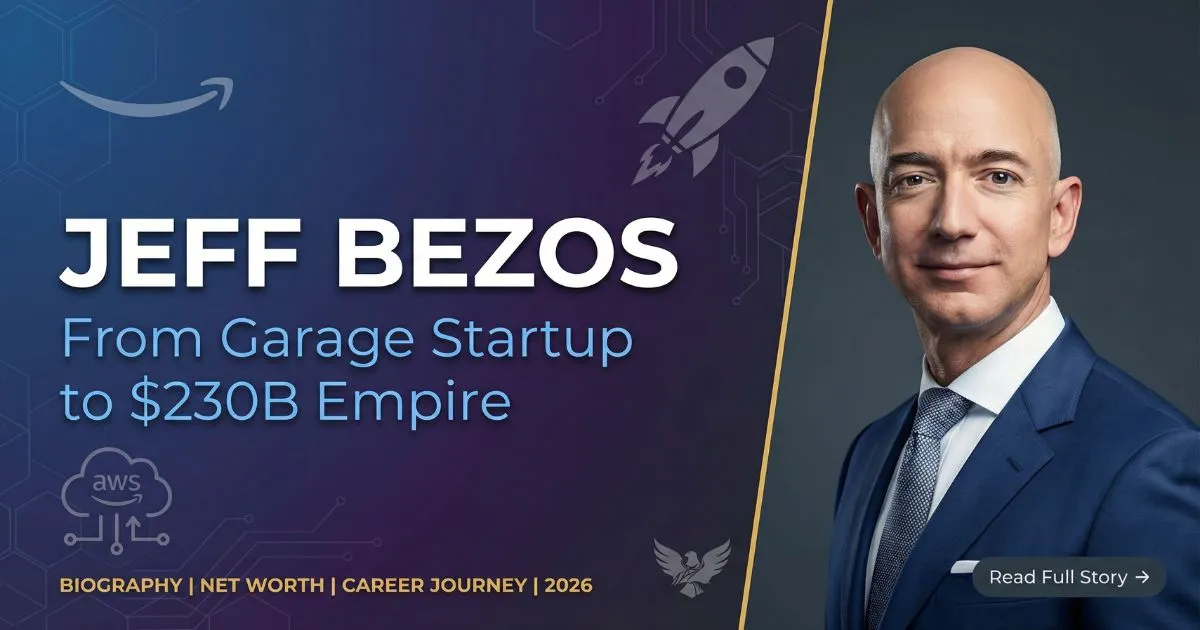
QUICK INFO BOX
| Attribute | Details |
|---|---|
| Full Name | Jeffrey Preston Bezos |
| Nick Name | Jeff |
| Profession | Tech Entrepreneur / Investor / Space Entrepreneur |
| Date of Birth | January 12, 1964 |
| Age | 62 years (as of 2026) |
| Birthplace | Albuquerque, New Mexico, USA |
| Hometown | Miami, Florida |
| Nationality | American |
| Religion | Christian |
| Zodiac Sign | Capricorn |
| Ethnicity | White (Danish, German descent) |
| Father | Ted Jorgensen (biological), Miguel “Mike” Bezos (adoptive) |
| Mother | Jacklyn Gise Bezos |
| Siblings | Christina Bezos, Mark Bezos |
| Partner | Lauren Sánchez (fiancée) |
| Children | 4 (3 sons, 1 daughter adopted from China) |
| School | Miami Palmetto High School |
| College / University | Princeton University |
| Degree | B.S. in Electrical Engineering and Computer Science |
| First Startup | Amazon.com (1994) |
| Current Company | Blue Origin, Bezos Expeditions |
| Position | Executive Chairman (Amazon), Founder & CEO (Blue Origin) |
| Industry | E-commerce / Cloud Computing / Aerospace |
| Known For | Founding Amazon, World’s richest person, Space exploration |
| Years Active | 1986–present |
| Net Worth | ~$230 billion (2026 estimate) |
| Annual Income | $1.6 million salary + stock appreciation |
| Major Investments | Blue Origin, Washington Post, Altos Labs, Google, Uber |
| @jeffbezos | |
| Twitter/X | @JeffBezos |
| Jeff Bezos |
1. Introduction
When Jeff Bezos started selling books from his Seattle garage in 1994, few could have predicted he would build the world’s largest e-commerce empire and amass a fortune exceeding $230 billion. Today, Bezos stands as one of the most influential entrepreneurs of the digital age, having transformed not just how we shop, but how we read, watch entertainment, and even think about space exploration.
Who is Jeff Bezos? He’s the visionary founder of Amazon.com, which evolved from an online bookstore into a global technology conglomerate dominating e-commerce, cloud computing (AWS), streaming entertainment, artificial intelligence, and logistics. Beyond Amazon, Bezos owns aerospace company Blue Origin, The Washington Post, and maintains a diverse investment portfolio through Bezos Expeditions.
Why is Jeff Bezos famous in the tech world? His relentless focus on customer obsession, long-term thinking, and willingness to experiment with ambitious projects has made him a model for modern entrepreneurship. From pioneering one-click shopping to making space tourism a reality, Bezos has consistently pushed boundaries.
In this comprehensive biography, you’ll discover Bezos’s journey from a curious child taking apart his crib to becoming one of the world’s wealthiest individuals, his leadership philosophy, the companies he’s built, his current lifestyle, and his vision for humanity’s future in space.
2. Early Life & Background
Jeffrey Preston Jorgensen was born on January 12, 1964, in Albuquerque, New Mexico, to Jacklyn Gise and Ted Jorgensen. His biological father was a bike shop owner and circus performer, but his parents divorced when Jeff was just a toddler. His mother remarried Miguel “Mike” Bezos, a Cuban immigrant who arrived in the United States at age 16 as part of Operation Pedro Pan. Mike Bezos adopted Jeff, giving him the surname that would become synonymous with e-commerce innovation.
Growing up, young Jeff displayed an exceptional curiosity and mechanical aptitude. At age three, he attempted to dismantle his crib with a screwdriver because he wanted a “real bed.” This early problem-solving mindset would become a hallmark of his approach to business. The family moved to Houston, Texas, where Jeff spent much of his childhood, and later to Miami, Florida.
Jeff’s maternal grandfather, Lawrence Preston Gise, played a crucial role in shaping his interests. Gise was a regional director for the U.S. Atomic Energy Commission, and Jeff spent summers at his 25,000-acre ranch in Cotulla, Texas. There, he learned to fix windmills, lay pipes, and perform veterinary tasks on cattle. These formative experiences taught him self-reliance, resourcefulness, and the value of hands-on problem-solving.
From an early age, Bezos showed intense interest in technology and science. He rigged an electric alarm to keep his younger siblings out of his room, turned his parents’ garage into a laboratory for science projects, and devoured science fiction novels. In high school, he was valedictorian, a National Merit Scholar, and won a science prize from the University of Florida for his work on the effects of zero gravity.
His childhood dream wasn’t to run an online bookstore—it was to become a space entrepreneur. This dream, temporarily shelved for his e-commerce ambitions, would resurface decades later with Blue Origin. Even as a teenager working at McDonald’s, Bezos demonstrated his analytical mindset, studying customer flow patterns and efficiency improvements.
3. Family Details
| Relation | Name | Profession |
|---|---|---|
| Biological Father | Ted Jorgensen | Bike shop owner (deceased 2015) |
| Adoptive Father | Miguel “Mike” Bezos | Exxon engineer (retired) |
| Mother | Jacklyn Gise Bezos | Homemaker |
| Brother | Mark Bezos | Senior Vice President at Robin Hood Foundation |
| Sister | Christina Bezos | Private |
| Ex-Wife | MacKenzie Scott | Novelist, Philanthropist |
| Fiancée | Lauren Sánchez | Media personality, Helicopter pilot, Entrepreneur |
| Children | Preston Bezos, 2 other sons, 1 daughter | Students/Private |
4. Education Background
Jeff Bezos attended River Oaks Elementary School in Houston before the family relocated to Miami, where he enrolled at Miami Palmetto High School. During high school, he excelled academically and graduated as valedictorian in 1982. His valedictory speech revealed his ambitious vision: he spoke about colonizing space, building hotels and amusement parks in orbit, and preserving Earth as a residential zone.
Bezos attended Princeton University with the initial intention of studying physics, inspired by his fascination with theoretical physics and cosmology. However, after struggling with some of the advanced quantum mechanics coursework and realizing he wasn’t destined to be a world-class theoretical physicist, he switched his major to electrical engineering and computer science—a decision that would prove fortuitous.
At Princeton, Bezos graduated summa cum laude in 1986 with a Bachelor of Science degree in Electrical Engineering and Computer Science. He was also inducted into Phi Beta Kappa, the prestigious academic honor society. His senior thesis explored computational complexity theory, demonstrating his deep interest in how systems scale and optimize.
During his college years, Bezos spent a summer interning at IBM and another working at Andersen Consulting (now Accenture). These experiences gave him exposure to corporate technology environments, though he would soon discover that startups and entrepreneurship aligned better with his risk-taking personality.
Rather than pursuing a traditional engineering path or doctoral studies, Bezos chose to enter the financial technology sector after graduation—a decision that would ultimately lead him to recognize the internet’s commercial potential and launch Amazon.
5. Entrepreneurial Career Journey
A. Early Career & First Startup
After graduating from Princeton in 1986, Jeff Bezos joined Fitel, a fintech telecommunications startup building a network for international trade. He quickly advanced to head of development and director of customer service, demonstrating his leadership abilities early. However, the startup experience taught him both the excitement and precariousness of young companies.
In 1988, Bezos moved to Bankers Trust, where he became the youngest vice president in the company’s history at age 26. He led the development of computer systems for managing the bank’s $250 billion in assets. While successful, Bezos felt constrained by the traditional corporate environment.
The pivotal moment came in 1990 when he joined D.E. Shaw & Co., a quantitative hedge fund using mathematical models for investment decisions. As a vice president, Bezos explored emerging business opportunities for the internet, which was experiencing explosive growth. In 1994, he came across a statistic that changed his life: web usage was growing at 2,300% per year.
Bezos recognized this as a once-in-a-lifetime opportunity. He drew up a list of 20 products that could be sold online, eventually settling on books because of their universal appeal, low price points, and the vast number of titles available (over 3 million in print). Despite having a lucrative career and being on track to become the youngest senior vice president at D.E. Shaw, Bezos decided to take the leap.
His boss, David Shaw, tried to dissuade him, suggesting he think about it over a weekend walk. Bezos employed what he calls the “regret minimization framework”—imagining himself at 80 years old and asking whether he would regret not trying. The answer was clear. In July 1994, Bezos, his wife MacKenzie, and their dog drove cross-country from New York to Seattle, with Jeff typing the Amazon business plan in the passenger seat.
B. Breakthrough Phase
Amazon.com officially launched from Bezos’s garage in Bellevue, Washington, on July 16, 1995. The name “Amazon” was chosen because it started with “A” (good for alphabetical listings), evoked the world’s largest river (reflecting Bezos’s ambition), and sounded exotic. The original business plan was modest—Bezos estimated a 70% chance of failure.
The company’s first book sale was “Fluid Concepts and Creative Analogies” by Douglas Hofstadter, shipped to a customer’s garage in Seattle. Within the first month, Amazon had shipped books to all 50 states and 45 countries. The site’s unique features—customer reviews, personalized recommendations, one-click shopping—set it apart from competitors.
Initial funding came from Bezos’s parents, who invested $245,000 of their retirement savings despite admitting they didn’t understand the internet. Bezos gave them the realistic assessment that there was a 70% chance they would lose it all. (That investment would eventually be worth billions.) Additional early investors included Tom Alberg and Nick Hanauer, Seattle-based angels who contributed crucial funding.
By 1997, Amazon went public at $18 per share, raising $54 million. The IPO came despite the company losing money, as Bezos prioritized growth over profitability—a strategy that became controversial but ultimately vindicated. In his first letter to shareholders, Bezos outlined his philosophy: “It’s all about the long term,” emphasizing customer obsession, operational excellence, and a willingness to make bold bets.
The breakthrough came as Amazon expanded beyond books into music, videos, electronics, and toys. The company survived the dot-com crash of 2000-2001, which bankrupted many online retailers, by focusing on operational efficiency and customer loyalty. Critics who called it “Amazon.bomb” were proven wrong as the company reached profitability in 2001.
C. Expansion & Global Impact
From 2002 onward, Amazon transformed from an online retailer into a technology conglomerate. Key milestones included:
Amazon Web Services (AWS) – Launched in 2006, AWS began offering cloud computing services that would eventually become Amazon’s most profitable division. What started as excess server capacity became the backbone of the internet, powering Netflix, NASA, and millions of businesses.
Kindle – Introduced in 2007, the Kindle e-reader revolutionized publishing. It sold out in 5.5 hours and remained out of stock for five months. Bezos envisioned a device that could hold every book ever printed and download new titles in 60 seconds.
Acquisitions – Amazon acquired Zappos ($1.2 billion, 2009), Kiva Systems robotics ($775 million, 2012), Twitch ($970 million, 2014), and most notably Whole Foods ($13.7 billion, 2017), signaling its expansion into physical retail and groceries.
Prime membership – Launched in 2005 with unlimited two-day shipping for $79/year, Prime evolved into a comprehensive ecosystem including video streaming, music, and exclusive deals. By 2026, Prime has over 200 million members worldwide.
Global expansion – Amazon established operations in Canada, UK, Germany, Japan, France, China, India, and dozens of other countries, becoming truly global.
Under Bezos’s leadership, Amazon pioneered innovations like anticipatory shipping (where algorithms predict purchases and pre-position inventory), voice commerce through Alexa, cashier-less Amazon Go stores, and drone delivery experimentation. The company’s market capitalization grew from $438 million at IPO to over $2 trillion by 2026.
In July 2021, Bezos stepped down as CEO, transitioning to Executive Chairman, and handed daily operations to Andy Jassy (former AWS chief). This move allowed Bezos to focus on Blue Origin, his space venture, and other passion projects including climate initiatives and The Washington Post, which he purchased in 2013 for $250 million.
6. Career Timeline Chart
📅 CAREER TIMELINE

1986 ─── Graduated Princeton; joined Fitel
   │
1990 ─── Joined D.E. Shaw & Co. as VP
   │
1994 ─── Founded Amazon.com in Seattle garage
   │
1997 ─── Amazon IPO ($18/share, $438M valuation)
   │
2000 ─── Founded Blue Origin (space company)
   │
2006 ─── Launched Amazon Web Services (AWS)
   │
2013 ─── Purchased The Washington Post ($250M)
   │
2017 ─── Acquired Whole Foods ($13.7B)
   │
2018 ─── Became world's richest person
   │
2021 ─── Stepped down as Amazon CEO; first crewed Blue Origin flight
   │
2026 ─── Executive Chairman Amazon; focused on Blue Origin & philanthropy
7. Business & Company Statistics
| Metric | Value |
|---|---|
| Companies Founded | Amazon (1994), Blue Origin (2000), Bezos Expeditions (2005) |
| Amazon Valuation | ~$2 trillion (2026) |
| Amazon Revenue (Annual) | ~$620 billion (2025) |
| Amazon Employees | 1.6+ million worldwide |
| Countries Operated | 20+ direct operations, ships to 100+ countries |
| AWS Market Share | ~32% of cloud computing market |
| Prime Members | 200+ million globally |
| Blue Origin Valuation | Estimated $10-15 billion (private) |
8. Entrepreneur Comparison Section
📊 Jeff Bezos vs Elon Musk
| Statistic | Jeff Bezos | Elon Musk |
|---|---|---|
| Net Worth | ~$230 billion | ~$250 billion |
| Companies Founded | Amazon, Blue Origin | PayPal, Tesla, SpaceX, Neuralink, Boring Co. |
| Market Cap Created | $2+ trillion (Amazon) | $1.5+ trillion (Tesla, SpaceX combined) |
| Space Innovation | Suborbital tourism, lunar landers | Orbital flights, Mars missions, Starlink |
| Industry Disrupted | Retail, cloud computing, media | Automotive, aerospace, payments |
| Global Influence | E-commerce dominance, AWS infrastructure | EV revolution, space exploration |
Winner: Both entrepreneurs have transformed multiple industries in fundamentally different ways. Bezos built the definitive model for e-commerce and cloud infrastructure, creating one of history’s most valuable companies and establishing systems that underpin modern digital life. Musk has pursued a broader portfolio of moonshot ventures with more visible public impact in transportation and space. Bezos focused on operational excellence and customer obsession; Musk prioritizes rapid innovation and existential risk mitigation. Each represents a distinct approach to entrepreneurship, making them complementary rather than directly comparable titans of the tech age.
9. Leadership & Work Style Analysis
Jeff Bezos’s leadership philosophy centers on several core principles that have become legendary in business circles:
Customer Obsession Over Competitor Focus – Bezos famously keeps an empty chair in meetings representing the customer, reminding everyone whose interests come first. He reads customer complaint emails and forwards them to relevant executives with just a question mark—a practice that strikes terror throughout Amazon.
Long-Term Thinking – Bezos operates on timescales that frustrate Wall Street analysts but create lasting value. He’s comfortable with short-term losses if they enable long-term strategic positioning, whether that’s AWS infrastructure investment or Prime membership perks.
High Standards and the “Day 1” Mentality – In every annual shareholder letter, Bezos signed off with “It’s still Day 1,” meaning Amazon should maintain startup urgency regardless of size. “Day 2 is stasis, followed by irrelevance, followed by decline, followed by death,” he wrote. This mindset demands constant reinvention.
Decision-Making Framework – Bezos distinguishes between Type 1 decisions (irreversible, requiring careful deliberation) and Type 2 decisions (reversible, should be made quickly by small teams). He advocates moving fast on Type 2 decisions to maintain organizational velocity.
Willingness to Be Misunderstood – Bezos accepts that bold bets like AWS, Kindle, and Amazon Studios would be criticized initially. He’s comfortable being misunderstood for years if the long-term vision is sound.
The “Two-Pizza Team” Rule – He believes teams should be small enough to be fed by two pizzas, ensuring agility and clear accountability.
Writing Culture Over PowerPoint – Amazon meetings begin with silent reading of six-page narratives because Bezos believes writing forces clearer thinking than slide decks, which can obscure weak ideas with presentation polish.
Relentless Innovation – Bezos encourages failure, saying “If you’re going to take bold bets, they’re going to be experiments. And if you know in advance that it’s going to work, it’s not an experiment.”
His strengths include visionary thinking, operational discipline, and an exceptional ability to identify and exploit emerging trends. Weaknesses include a reputation for demanding work environments, aggressive competitive tactics, and criticism over Amazon’s labor practices and market dominance. Former employees describe a culture of high performance expectations where mediocrity isn’t tolerated.
Industry experts like Bill Gates have praised Bezos’s ability to “think bigger and take a longer-term view than almost anyone else,” while Warren Buffett has called him “the most remarkable businessperson of our age.”
10. Achievements & Awards
Business & Tech Awards
- TIME Person of the Year (1999) – Recognized for revolutionizing e-commerce
- Heinlein Prize for Advances in Space Commercialization (2016) – $250,000 award for Blue Origin
- Harvard Business Review CEO of the Year (multiple times)
- Edison Achievement Award (2011) – For innovation in e-commerce
- The Business Person of the Year – Fortune Magazine (2012)
- Axel Springer Award (2018) – For exceptional innovation
Global Recognition
- Forbes World’s Most Powerful People – Consistently ranked in top 10 (2013-2024)
- Forbes Real-Time Billionaires List – #1 or #2 richest person globally (2017-2026)
- TIME 100 Most Influential People – Multiple appearances
- Bloomberg 50 – Most influential people in business
- Vanity Fair New Establishment List – Regular top rankings
Records Held
- Largest single-day wealth gain – $13 billion (July 2020) when Amazon stock surged
- Most expensive divorce settlement – $38 billion transfer to MacKenzie Scott (2019)
- Oldest person to fly to space – At 57 (briefly held before William Shatner at 90)
- Largest e-commerce company by revenue – Amazon’s dominance continues
- First person to exceed $200 billion net worth – Achieved in 2020
11. Net Worth & Earnings
💰 FINANCIAL OVERVIEW
| Year | Net Worth (Est.) |
|---|---|
| 2020 | $185 billion |
| 2021 | $177 billion |
| 2022 | $171 billion |
| 2023 | $168 billion |
| 2024 | $208 billion |
| 2025 | $225 billion |
| 2026 | ~$230 billion |
Income Sources
Amazon Equity – Bezos owns approximately 9% of Amazon stock (down from 16% before divorce), representing the vast majority of his wealth. Amazon’s stock appreciation drives most net worth fluctuations.
Base Salary – Bezos’s Amazon salary has remained $81,840 since 1998, with additional security costs of $1.6 million covered by the company. This modest salary is symbolic of his wealth coming from ownership, not compensation.
Blue Origin – Bezos funds his space company primarily by selling approximately $1-2 billion in Amazon stock annually. Blue Origin remains private, with Bezos as sole owner.
The Washington Post – Purchased for $250 million in 2013, the newspaper has returned to profitability under his ownership, though exact financial details remain private.
Bezos Expeditions – His personal venture capital firm has invested in Airbnb, Twitter, Uber, Google, and dozens of startups, generating substantial returns.
Real Estate Holdings – Estimated $500+ million in properties across multiple states.
Major Investments
Altos Labs – $3 billion investment in anti-aging research and cellular rejuvenation technology
Arrived Homes – Real estate investment platform
GRAIL – Cancer detection technology
Remitly – International remittance service
General Fusion – Nuclear fusion energy company
Workday – Cloud-based human capital management
Business Insider – Early investor before sale to Axel Springer
Google – $250,000 angel investment in 1998 (worth billions at IPO)
12. Lifestyle Section
🏠 ASSETS & LIFESTYLE
Properties
Indian Creek Island Mansion – Miami, Florida ($177 million for two adjacent properties, 2023-2024) – His primary residence on the exclusive “Billionaire Bunker” island with Tom Brady and Ivanka Trump as neighbors
Beverly Hills Estate – Los Angeles, California ($165 million, 2020) – The Warner Estate, a 13,600 sq ft mansion designed for Jack Warner, one of the most expensive residential purchases in LA history
Washington D.C. Mansion – Kalorama neighborhood ($23 million, 2016) – The former Textile Museum, largest home in the capital, 27,000 sq ft
Medina, Washington Estate – Seattle area ($10 million, 1998) – 29,000 sq ft waterfront property on Lake Washington
New York Penthouse – Manhattan ($80 million, 2019) – Multiple units in a Fifth Avenue building
Maui Properties – Hawaii ($78 million) – 14 acres of pristine coastal land
West Texas Ranch – 165,000 acres serving as Blue Origin’s launch facility
Estimated Total Real Estate Value: ~$600 million across multiple properties
Car Collection
Pagani Huayra – ~$2.5 million – Limited production Italian hypercar
Koenigsegg CCXR Trevita – ~$4.8 million – One of only two produced
Bugatti Veyron Mansory – ~$3.4 million – Custom modified hypercar
Lamborghini Veneno Roadster – ~$4.5 million – Ultra-rare supercar
Ferrari Pininfarina Sergio – ~$3 million – One of six ever made
1997 Honda Accord – Bezos famously drove this modest car even after becoming a billionaire, symbolizing his practical mindset
Despite his hypercar collection, Bezos has been known for relatively modest personal spending compared to net worth until recent years, when he began acquiring trophy assets.
Hobbies
Space Exploration – His primary passion, dedicating billions to Blue Origin and personally participating in the first crewed flight
Reading – Voracious reader across science fiction, business, and philosophy; hosts book clubs and promotes reading culture
Physical Fitness – Underwent significant physical transformation in his 50s, working with personal trainers and nutritionists
Flying – Licensed helicopter pilot, often flies with fiancée Lauren Sánchez who is also a pilot
Ocean Exploration – Funded the recovery of Apollo 11 F-1 engines from the ocean floor in 2013
Sailing – Commissioned a $500 million custom superyacht (Koru), one of the world’s largest sailing yachts
Daily Routine
Morning Routine – Bezos prioritizes 8 hours of sleep, calling it his most important productivity tool. He doesn’t set alarms, wakes naturally, and does “puttering” in the morning—reading newspapers, drinking coffee, and having breakfast with his family before starting work.
Work Hours – Even as CEO, Bezos focused on making a few high-quality decisions rather than many decisions. He schedules high-IQ meetings before lunch when his energy is peak.
“Wandering” Time – Bezos deliberately schedules unstructured time for creativity, believing breakthroughs come from wandering rather than always being efficient.
Exercise – Regular strength training and cardio, typically in afternoons
Productivity Habits – Avoids early morning meetings, limits scheduled time to allow for spontaneous problem-solving, practices “disagree and commit” to avoid consensus-seeking delays
13. Physical Appearance
| Attribute | Details |
|---|---|
| Height | 5’7″ (171 cm) |
| Weight | ~165 lbs (75 kg) – varies with fitness regimen |
| Eye Color | Brown |
| Hair Color | Bald (by choice since late 1990s) |
| Body Type | Athletic/Muscular (transformed physique in 50s) |
| Distinctive Features | Bald head, distinctive laugh, muscular build developed later in life |
Bezos’s physical transformation became notable in his mid-50s when he developed a significantly more muscular physique, coinciding with his divorce and relationship with Lauren Sánchez. His distinctive, loud laugh and animated expressions have become part of his public persona.
14. Mentors & Influences
Lawrence Preston Gise (Maternal Grandfather) – Former DARPA administrator who taught young Jeff self-reliance, mechanical skills, and rigorous problem-solving during ranch summers
David E. Shaw – Founder of D.E. Shaw & Co., who hired Bezos and exposed him to quantitative analysis and internet opportunities, though he tried to dissuade the Amazon venture
Warren Buffett – Bezos has cited Buffett’s long-term investment philosophy and shareholder letters as influential to his own annual letters and thinking
Sam Walton – The Walmart founder’s autobiography profoundly impacted Bezos’s retail philosophy, particularly customer obsession and operational efficiency
Jim Sinegal (Costco founder) – Influenced Amazon’s membership model and low-margin, high-volume strategy
Steve Jobs – While competitors, Jobs’s product perfectionism and willingness to cannibalize existing products influenced Bezos’s approach to Kindle and hardware
Isaac Asimov – The science fiction author’s vision of humanity’s spacefaring future inspired Bezos’s Blue Origin ambitions
Brad Stone – While a journalist rather than mentor, Stone’s books on Amazon provided external perspective that Bezos has engaged with
Key Leadership Lessons Learned:
- Customer obsession beats competitor obsession
- Long-term thinking requires patience and conviction
- High standards are contagious and teachable
- Willingness to fail is essential for innovation
- Operational excellence enables strategic vision
15. Company Ownership & Roles
| Company | Role | Years | Ownership |
|---|---|---|---|
| Amazon.com | Founder, CEO (1994-2021), Executive Chairman (2021-present) | 1994-present | ~9% equity (~$180B value) |
| Blue Origin | Founder & CEO | 2000-present | 100% private ownership |
| Nash Holdings LLC | Owner (holding company for Washington Post) | 2013-present | 100% |
| The Washington Post | Owner | 2013-present | Via Nash Holdings |
| Bezos Expeditions | Founder & Managing Partner | 2005-present | Personal investment vehicle |
| Bezos Earth Fund | Founder | 2020-present | $10B commitment to climate |
| Day One Fund | Founder | 2018-present | $2B for homelessness & education |
| Altos Labs | Major Investor & Board Member | 2021-present | Undisclosed stake |
16. Controversies & Challenges
Labor Practices and Working Conditions – Amazon has faced sustained criticism over warehouse working conditions, including reports of grueling productivity targets, inadequate breaks, injuries, and anti-union activities. Bezos has defended Amazon’s $15 minimum wage and benefits while acknowledging room for improvement.
Antitrust and Market Dominance – Regulatory scrutiny intensified as Amazon gained market power. The company has faced investigations over alleged anticompetitive practices, self-preferencing Amazon products in search results, and using third-party seller data to develop competing products. Bezos testified before Congress in 2020 defending Amazon’s practices.
Tax Controversy – ProPublica’s 2021 report revealed Bezos paid zero federal income tax in 2007 and 2011 despite wealth growth, sparking debate over wealth taxation. Bezos has called for higher corporate taxes while defending legal tax optimization.
Divorce and Personal Life – His 2019 divorce from MacKenzie Scott followed National Enquirer’s publication of texts between Bezos and Lauren Sánchez. Bezos accused the tabloid’s parent company of “extortion and blackmail” in a dramatic Medium post, launching an investigation into how his private messages were obtained.
The Washington Post Controversies – Bezos faced criticism in 2024 when the Post declined to endorse a presidential candidate despite a tradition of doing so, leading to subscriber cancellations and staff resignations. Bezos defended the decision as returning to the paper’s roots of non-endorsement.
Environmental Criticism – Despite the $10 billion Bezos Earth Fund, Amazon has been criticized for its carbon footprint from delivery operations and packaging waste. Critics call it “greenwashing” given Amazon’s logistics-heavy model.
Space Rivalry and Penis Jokes – The Blue Origin spacecraft’s phallic design sparked endless jokes and comparisons with SpaceX’s progress. Bezos’s space ambitions have been portrayed as a billionaire vanity project rather than serious scientific endeavor, though Blue Origin has secured NASA contracts.
How Challenges Were Handled: Bezos typically responds to criticism with data-driven defenses while making incremental improvements. He raised Amazon’s minimum wage to $15/hour, committed to carbon neutrality by 2040, and increased transparency around workplace safety. However, he maintains that criticism comes with ambition and scale.
Lessons Learned: Bezos has acknowledged that success brings scrutiny and that no company of Amazon’s size can please everyone. He’s maintained focus on long-term value creation rather than short-term PR wins, though this approach sometimes amplifies controversies.
17. Charity & Philanthropy
Jeff Bezos has historically been criticized for relatively modest philanthropy compared to peers like Bill Gates, but his giving has accelerated dramatically in recent years:
Major Foundations and Initiatives
Bezos Earth Fund (2020) – $10 billion commitment to combat climate change, the largest philanthropic pledge in his career. Has distributed $2+ billion to date supporting:
- Environmental justice organizations
- Restoration of landscapes and seascapes
- Food system transformation
- Climate science and monitoring
Day One Fund (2018) – $2 billion commitment split between:
- Day 1 Academies Fund: Building Montessori-inspired preschools in underserved communities
- Day 1 Families Fund: Supporting organizations providing shelter and services to young homeless families
Bezos Academy – Network of tuition-free preschools in underserved communities, focusing on early childhood education with Montessori approach
Specific Donations and Causes
Food Security – $100 million to Feeding America (2020), $200 million to food banks during COVID-19
Homelessness – $123 million to organizations combating homelessness, including Mary’s Place in Seattle
Education – $33 million to TheDream.US scholarships for Dreamers, $35 million to Fred Hutchinson Cancer Research Center
COVID-19 Relief – Over $300 million in pandemic-related giving
Maui Wildfire Relief – $100 million to recovery efforts (2023)
Dolly Parton’s Imagination Library – $100 million (2022)
Eva Longoria Foundation – $50 million (2024)
José Andrés’s World Central Kitchen – $100 million (2021)
Giving Pledge Notably, Bezos has NOT signed the Giving Pledge (Warren Buffett and Bill Gates’s initiative for billionaires to donate majority of wealth), though he’s indicated intentions to give away most of his fortune. Ex-wife MacKenzie Scott has given away over $16 billion since their divorce and signed the Giving Pledge.
Approach to Philanthropy
Bezos has stated he prefers to fund solutions with measurable impact rather than traditional charity models, applying his business mindset to philanthropy. Critics argue his giving represents a small fraction of his wealth and came late in his career compared to contemporaries.
18. Personal Interests
| Category | Favorites |
|---|---|
| Food | Octopus, Mediterranean cuisine, enjoys cooking breakfast for family |
| Movies | Star Trek franchise, science fiction films, James Bond series |
| Books | “The Remains of the Day” by Kazuo Ishiguro, “Built to Last” by Jim Collins, science fiction classics by Asimov and Heinlein |
| Travel Destinations | Space (Blue Origin flights), Maldives, Norway fjords, Italian coast |
| Technology | AI and machine learning, robotics, space propulsion systems, longevity research |
| Sports | Hiking, weight training, tennis |
| Authors | Isaac Asimov, Robert Heinlein, Kazuo Ishiguro, Jim Collins |
| Music | Classic rock, eclectic taste across genres |
| Hobbies | Helicopter flying, scuba diving, reading science fiction, tinkering with mechanical projects |
19. Social Media Presence
| Platform | Handle | Followers (2026) |
|---|---|---|
| @jeffbezos | ~6.5 million | |
| Twitter/X | @JeffBezos | ~7.2 million |
| Jeff Bezos | ~3.8 million | |
| YouTube | Blue Origin channel | ~800k subscribers |
Bezos maintains a relatively modest social media presence compared to other tech billionaires like Elon Musk. His posts typically focus on Blue Origin updates, Amazon milestones, personal adventures with Lauren Sánchez, and occasional political commentary. He gained notoriety for posting his first Instagram photo in 2017 with the caption “My beautiful baby” next to a Blue Origin rocket, showcasing his personality and humor.
20. Recent News & Updates (2025–2026)
Blue Origin Lunar Lander Development – Blue Origin’s Blue Moon lunar lander secured additional NASA contracts for Artemis program missions, with crewed lunar landing targeted for 2027
Amazon’s AI Push – Amazon integrated Claude AI (Anthropic) more deeply into AWS offerings and Alexa, competing aggressively with Microsoft and Google in AI infrastructure
Orbital Reef Space Station – Blue Origin’s commercial space station partnership with Sierra Space progressed toward 2028 launch target
Bezos-Sánchez Wedding Plans – Speculation around the couple’s wedding intensified after multi-year engagement, with rumors of a lavish destination ceremony
Climate Investment Acceleration – Bezos Earth Fund announced $500 million in new climate tech investments, focusing on carbon removal technologies
Washington Post Leadership Changes – Following subscriber losses from non-endorsement controversy, Bezos brought in new editorial leadership to stabilize the publication
Amazon’s Return-to-Office Mandate – As Executive Chairman, Bezos supported CEO Andy Jassy’s controversial five-day in-office requirement starting 2025
Real Estate Expansion – Continued building compound in Indian Creek Island, consolidating Miami as his primary base
Anti-Aging Investment – Altos Labs, Bezos’s longevity science company, published breakthrough research on cellular reprogramming
Philanthropic Commitments – Announced plans to accelerate giving, responding to criticism about pace of charitable donations
Future Plans – Bezos has indicated focus on three areas: making space travel routine through Blue Origin, combating climate change through Earth Fund investments, and improving early childhood education through Bezos Academy network. He’s also expressed interest in media evolution and preserving journalism’s role in democracy through The Washington Post.
21. Lesser-Known Facts
- Regret Minimization Framework – Bezos’s life decisions are guided by imagining himself at 80 and asking what he’d regret not trying, a framework that led him to leave his hedge fund career for Amazon
- Star Trek Cameo – Bezos appeared as a Starfleet official in “Star Trek Beyond” (2016), fulfilling a lifelong dream as a Trek superfan
- Montessori Education Advocate – He credits his Montessori education for teaching self-directed learning and credits it as inspiration for Bezos Academy schools
- First Online Purchase – Bezos’s first internet purchase was in 1994: a book about conducting business on the web, demonstrating his early recognition of e-commerce potential
- Laugh Trademark – His distinctive, booming laugh has become famous; colleagues describe it as infectious and genuine
- Apollo 11 Engine Recovery – Funded deep-sea expedition that recovered F-1 engines from Apollo 11 rocket from Atlantic Ocean floor at 14,000 feet depth
- $10,000 Clock – Funding construction of a 10,000-year clock inside a Texas mountain to symbolize long-term thinking, designed by inventor Danny Hillis
- Garage Legend – Amazon’s garage founding story is somewhat mythologized; Bezos actually rented a house specifically to work from the garage, and initial coding was done in the home office
- Cuban Roots – Adoptive father Mike Bezos arrived in America alone at 16 from Cuba during Operation Pedro Pan, influencing Jeff’s appreciation for immigrant opportunity
- Washington Post Rescue – Purchased the struggling Post for $250 million cash personally (not through Amazon), turning it profitable through digital transformation
- Alexa Naming – Chose “Alexa” for Amazon’s voice assistant partly because the “X” sound makes it easier to recognize, and named after the ancient Library of Alexandria
- Princeton Club Member – Was president of the Students for the Exploration and Development of Space (SEDS) chapter at Princeton
- Original Business Plan – Amazon’s first business plan projected $74 million in sales by 2000 if things went “very well.” Actual 2000 revenue: $2.76 billion
- Email Discipline – Bezos reads random customer service emails weekly and forwards troubling ones to executives with just “?” – a practice that terrifies Amazon leaders
- No PowerPoint – Banned PowerPoint presentations at Amazon in 2004, requiring six-page narrative memos that meetings begin by reading silently
- Walks Without Guards – Despite his wealth, Bezos often walks around Seattle without visible security, preferring normalcy when possible
- Ownership Philosophy – Maintained Amazon ownership well above other founder-CEOs; even post-divorce 9% stake is unusually high retention
- Name Almost Changed – Amazon was almost named “Cadabra” (as in abracadabra), but was changed after his lawyer misheard it as “cadaver”
- Kindle Development – Personally pushed Kindle development despite internal skepticism, insisting it should be better than paper books, not just equivalent
- Space Childhood Dream – Has said his space ambitions predate Amazon, viewing his e-commerce success as funding mechanism for his true passion: space exploration
22. FAQs
Who is Jeff Bezos?
Jeff Bezos is an American tech entrepreneur, founder and Executive Chairman of Amazon, the world’s largest e-commerce and cloud computing company. He also founded Blue Origin, a space exploration company, and owns The Washington Post. With a net worth exceeding $230 billion, he is one of the world’s wealthiest individuals and most influential business leaders.
What is Jeff Bezos’s net worth in 2026?
Approximately $230 billion as of early 2026, making him one of the two richest people globally alongside Elon Musk. His wealth fluctuates with Amazon’s stock price.
How did Jeff Bezos start Amazon?
Bezos left his lucrative job at hedge fund D.E. Shaw in 1994 after discovering internet usage was growing 2,300% annually. He drove cross-country to Seattle, wrote a business plan during the drive, and launched Amazon from his garage on July 16, 1995, initially selling books online before expanding into the e-commerce giant it is today.
Is Jeff Bezos married?
No, Bezos is currently engaged to Lauren Sánchez, a media personality and helicopter pilot. He was previously married to novelist MacKenzie Scott from 1993 to 2019, with whom he has four children.
What companies does Jeff Bezos own?
Bezos owns approximately 9% of Amazon (valued around $180 billion), 100% of Blue Origin (his private space company), The Washington Post (through Nash Holdings), and manages various investments through Bezos Expeditions including stakes in Airbnb, Google, Uber, and numerous other companies.
Why did Jeff Bezos step down as Amazon CEO?
Bezos stepped down as CEO in July 2021 to focus on other passions including Blue Origin space ventures, the Bezos Earth Fund for climate initiatives, The Washington Post, and other philanthropic efforts. He remains Executive Chairman, maintaining strategic oversight.
What is Blue Origin?
Blue Origin is Jeff Bezos’s privately funded aerospace company founded in 2000, focused on making space travel accessible and routine. It develops reusable rockets for suborbital tourism and is building lunar landers for NASA’s Artemis program. Bezos personally flew on Blue Origin’s first crewed flight in July 2021.
How much does Jeff Bezos make per day?
Bezos’s wealth changes with Amazon’s stock price rather than daily salary. During strong market periods, his net worth can increase by $10-15 billion in a single day, though it also decreases during market downturns. His actual Amazon salary has been just $81,840 annually since 1998.
What is Jeff Bezos’s management philosophy?
Bezos’s philosophy centers on customer obsession over competition, long-term thinking, maintaining “Day 1” startup mentality, high standards, willingness to be misunderstood, and data-driven decision making. He emphasizes the importance of being willing to fail and values writing over PowerPoint presentations for clearer thinking.
How did Jeff Bezos become the richest person?
Bezos became the world’s richest person in 2018 primarily through his Amazon ownership as the company’s stock price soared due to AWS growth, Prime membership expansion, and e-commerce dominance. His wealth accumulation represents one of the fastest wealth creations in history, growing from millionaire to hundred-billionaire in roughly 20 years.
23. Conclusion
Jeff Bezos’s journey from a curious child dismantling his crib to becoming one of history’s wealthiest and most influential entrepreneurs represents a masterclass in long-term thinking, customer obsession, and willingness to take calculated risks. Through Amazon, he fundamentally transformed global retail, cloud computing, logistics, and entertainment, creating a company that touches billions of lives daily and serves as infrastructure for much of the modern internet through AWS.
Beyond e-commerce, Bezos’s impact spans multiple domains: revitalizing journalism through The Washington Post, pioneering commercial space travel with Blue Origin, and committing billions to combat climate change through the Bezos Earth Fund. His leadership philosophy—emphasizing Day 1 mentality, high standards, customer centricity, and data-driven decision making—has influenced a generation of entrepreneurs and reshaped business thinking globally.
While controversies around labor practices, market dominance, and wealth inequality continue to generate debate, Bezos’s entrepreneurial achievements remain undeniable. He built Amazon from a garage startup into a $2 trillion company that employs over 1.6 million people and serves hundreds of millions of customers. His transition from CEO to Executive Chairman in 2021 marked a new chapter focused on space exploration, climate solutions, and philanthropy.
As he enters his early 60s, Bezos’s legacy continues to evolve. Whether colonizing space through Blue Origin, combating climate change, or shaping public discourse through The Washington Post, he remains committed to long-term thinking and ambitious goals. His story exemplifies how visionary thinking, operational excellence, customer obsession, and patience to weather criticism can transform industries and create enduring value.
For aspiring entrepreneurs, Bezos demonstrates that the boldest visions often face the harshest skepticism, that short-term losses can enable long-term dominance, and that maintaining startup urgency regardless of scale remains essential for continued innovation.
What’s your take on Jeff Bezos’s entrepreneurial journey and leadership philosophy? Share your thoughts in the comments below, and explore our other profiles of tech industry pioneers who have shaped the digital age.