QUICK INFO BOX
| Attribute | Details |
|---|---|
| Full Name | Timothy Donald Cook |
| Nick Name | Tim |
| Profession | Tech Executive / CEO / Investor |
| Date of Birth | November 1, 1960 |
| Age | 65 years (as of 2026) |
| Birthplace | Mobile, Alabama, USA |
| Hometown | Robertsdale, Alabama |
| Nationality | American |
| Religion | Baptist (upbringing) |
| Zodiac Sign | Scorpio |
| Ethnicity | Caucasian |
| Father | Donald Cook (Shipyard worker) |
| Mother | Geraldine Cook (Pharmacy worker) |
| Siblings | Two brothers |
| Partner | Private (publicly came out as gay in 2014) |
| Children | None |
| School | Robertsdale High School |
| College / University | Auburn University, Duke University |
| Degree | BS Industrial Engineering, MBA |
| Career Start | IBM (1982) |
| Current Company | Apple Inc. |
| Position | Chief Executive Officer |
| Industry | Technology / Consumer Electronics |
| Known For | Apple CEO, Supply Chain Innovation, LGBTQ+ Advocacy |
| Years Active | 1982–Present (44 years) |
| Net Worth | ~$2.1 billion (2026 est.) |
| Annual Income | $60-70 million (salary + stock) |
| Major Investments | Apple stock, philanthropic ventures |
| Twitter/X | @tim_cook |
| Tim Cook |
1. Introduction
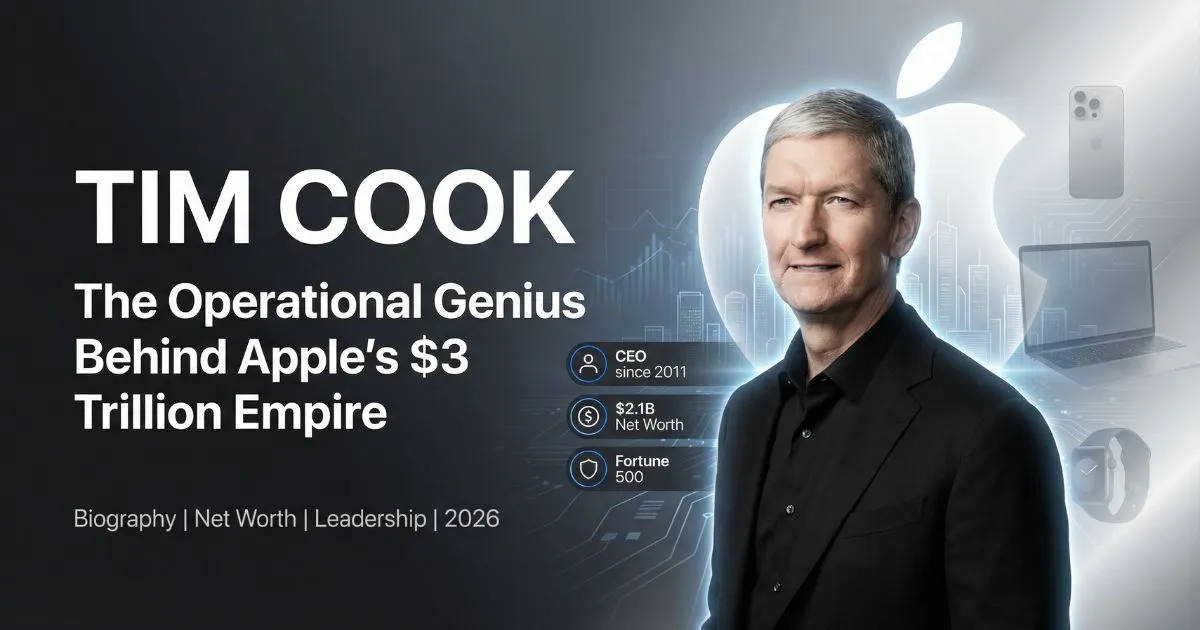
When Tim Cook took the helm of Apple in August 2011, skeptics wondered if anyone could follow Steve Jobs. More than a decade later, Cook has silenced doubters by transforming Apple into the world’s first $3 trillion company, expanding its services ecosystem, and championing privacy and sustainability while navigating global supply chain challenges and geopolitical complexities.
Tim Cook is the CEO of Apple Inc., the most valuable technology company in the world. He’s famous not for creating flashy product launches like his predecessor, but for operational excellence, strategic vision, and building Apple into a services powerhouse alongside its iconic hardware. Under his leadership, Apple has doubled down on privacy, environmental responsibility, and social issues including LGBTQ+ rights.
This comprehensive biography explores Cook’s journey from a small town in Alabama to leading one of history’s most influential companies, his management philosophy, net worth trajectory, lifestyle choices, and the legacy he’s building beyond quarterly earnings reports.
2. Early Life & Background
Timothy Donald Cook was born on November 1, 1960, in Mobile, Alabama, and raised in nearby Robertsdale, a small town in Baldwin County. His father, Donald Cook, worked at a shipyard, while his mother, Geraldine, worked at a pharmacy. Growing up in the American South during the civil rights era deeply influenced Cook’s later advocacy for equality and human rights.
Cook’s childhood was modest but stable. Robertsdale, with a population of just a few thousand, provided a close-knit community environment. He delivered newspapers as a boy and learned the value of hard work early. Cook was academically gifted, particularly excelling in mathematics and science, which would later guide his career path toward engineering.
His first exposure to systematic thinking came through observing manufacturing processes and logistics, which fascinated him even as a teenager. Cook has spoken about visiting local businesses and being intrigued by how products moved from creation to customer. There wasn’t a single “eureka moment” with computers or coding in his early years; instead, Cook was drawn to efficiency, process optimization, and problem-solving.
The young Tim Cook was quiet, methodical, and intensely focused. Teachers remembered him as diligent and disciplined. Growing up in Alabama during a time of significant social change also instilled in him a strong sense of justice and equality that would later define his public stances on civil rights issues.
His role models weren’t flashy entrepreneurs but rather people who demonstrated integrity and excellence in their work. The combination of Southern upbringing, working-class roots, and academic talent created the foundation for Cook’s future success in the corporate world.
3. Family Details
| Relation | Name | Profession |
|---|---|---|
| Father | Donald Cook | Shipyard worker |
| Mother | Geraldine Cook | Pharmacy employee |
| Siblings | Two brothers | Private |
| Spouse | Not married | — |
| Children | None | — |
Tim Cook is intensely private about his personal life. He publicly came out as gay in October 2014, becoming the first openly gay CEO of a Fortune 500 company. Cook has never publicly disclosed romantic relationships or partnerships, maintaining strict boundaries between his public role and private life. He has no children and has stated that Apple and his work consume most of his time and energy.
4. Education Background
Robertsdale High School (Robertsdale, Alabama) Cook was an excellent student, graduating second in his class in 1978. He was involved in the school’s band and demonstrated early leadership qualities.
Auburn University (1978-1982) Cook earned a Bachelor of Science degree in Industrial Engineering from Auburn University. He chose industrial engineering because it combined his love of mathematics with practical applications in manufacturing and operations. At Auburn, Cook was part of the co-op program, which gave him early exposure to real-world engineering challenges. His academic performance was outstanding, and he graduated with honors.
Duke University – Fuqua School of Business (1986-1988) After working at IBM for several years, Cook pursued an MBA at Duke’s prestigious Fuqua School of Business, graduating as a Fuqua Scholar in 1988. This program refined his strategic thinking and business acumen, preparing him for executive leadership roles.
Cook didn’t drop out of school or follow the stereotypical “college dropout entrepreneur” path. Instead, he pursued traditional education rigorously, understanding that in operations and supply chain management, formal training in engineering and business would be invaluable. His internships and co-op experiences at Auburn gave him practical knowledge that complemented his academic learning.
5. Entrepreneurial Career Journey
A. Early Career & Foundation (1982-1998)
IBM (1982-1994) Tim Cook’s career began at IBM, where he spent 12 years rising through the ranks in the company’s Personal Computer division. He worked in manufacturing and distribution, honing his skills in supply chain management and operational efficiency. At IBM, Cook learned how large-scale technology manufacturing worked, managing factories, suppliers, and distribution networks. He became known for his analytical approach and ability to streamline complex processes.
Intelligent Electronics (1994-1997) Cook left IBM to become Chief Operating Officer of the Reseller Division at Intelligent Electronics, a computer products distributor. This role gave him executive experience and exposure to the rapidly evolving personal computer market from a different perspective.
Compaq Computer (1997-1998) In 1997, Cook joined Compaq as Vice President of Corporate Materials, responsible for procuring and managing the company’s product inventory. During his brief time at Compaq, he demonstrated his ability to optimize supply chains in highly competitive environments.
B. The Apple Transformation (1998-2011)
Joining Apple (March 1998) When Steve Jobs recruited Tim Cook to Apple in early 1998, it seemed like a risky move. Apple was struggling, losing money, and its future was uncertain. Cook himself has said that meeting with Jobs for just five minutes convinced him to join, abandoning the “safe” choice at Compaq for the unpredictable challenge at Apple.
As Senior Vice President of Worldwide Operations, Cook revolutionized Apple’s supply chain. He closed factories and warehouses, outsourced manufacturing (particularly to China), and reduced inventory from months to days. Cook’s approach was ruthless efficiency: he believed inventory was “fundamentally evil” because it tied up capital and became obsolete quickly in the fast-paced tech industry.
Supply Chain Mastery Cook transformed Apple’s operations by:
- Reducing suppliers from hundreds to a select few reliable partners
- Implementing just-in-time manufacturing
- Securing exclusive rights to manufacturing components
- Building strategic relationships with Asian suppliers
- Creating one of the most efficient supply chains in corporate history
Executive Progression
- 2000: Named Executive Vice President of Worldwide Sales and Operations
- 2005: Named Chief Operating Officer (COO)
- 2009-2011: Served as interim CEO during Steve Jobs’ medical leaves
During Jobs’ absences, Cook demonstrated he could lead Apple effectively, dispelling concerns about who would succeed the iconic founder.
C. CEO Era & Global Expansion (2011-Present)
Becoming CEO (August 24, 2011) Steve Jobs officially resigned as CEO on August 24, 2011, recommending Tim Cook as his successor. Jobs passed away on October 5, 2011, just weeks later. Cook inherited both enormous opportunity and impossible expectations.
Product Evolution Under Cook’s leadership, Apple has:
- Launched the Apple Watch (2015), now the world’s best-selling smartwatch
- Introduced AirPods (2016), dominating the wireless earbuds market
- Developed Apple Silicon (M1, M2, M3, M4 chips), revolutionizing Mac performance
- Released Vision Pro (2024), Apple’s entry into spatial computing
- Expanded iPhone lineup with multiple models annually
- Grew iPad and Mac product lines substantially
Services Transformation Cook recognized that hardware alone wouldn’t sustain growth. He dramatically expanded Apple’s services:
- Apple Music
- Apple TV+
- Apple Arcade
- Apple Fitness+
- iCloud storage
- Apple Pay and Apple Card
Services revenue grew from $10 billion annually in 2011 to over $90 billion by 2024, becoming Apple’s second-largest revenue source and highest-margin business.
Financial Milestones
- Apple became the first US company to reach $1 trillion valuation (August 2018)
- First to reach $2 trillion (August 2020)
- First to reach $3 trillion (January 2022, briefly; solidified in 2024)
- Stock price increased more than 10x during Cook’s tenure
- Company has returned hundreds of billions to shareholders through dividends and buybacks
Global Challenges Cook has navigated significant challenges:
- US-China trade tensions and tariffs
- COVID-19 pandemic and supply chain disruptions
- Regulatory pressures in EU and US regarding App Store practices
- Privacy battles with governments (FBI iPhone unlock case, 2016)
- Expanding manufacturing beyond China to India and Vietnam
6. Career Timeline Chart
📅 CAREER TIMELINE

1982 ─── Joined IBM (manufacturing & operations)
   │
1994 ─── COO at Intelligent Electronics
   │
1997 ─── VP at Compaq Computer
   │
1998 ─── Joined Apple as SVP Operations
   │
2000 ─── Promoted to EVP Worldwide Sales/Operations
   │
2005 ─── Named Chief Operating Officer (COO)
   │
2011 ─── Became Apple CEO (August 24)
   │
2014 ─── Came out publicly as gay
   │
2018 ─── Apple reaches $1 trillion valuation
   │
2020 ─── Apple reaches $2 trillion valuation
   │
2024 ─── Apple Vision Pro launch
   │
2026 ─── Leading Apple at age 65, focusing on AI & spatial computing
7. Business & Company Statistics
| Metric | Value |
|---|---|
| Companies Founded | 0 (Executive/Leader) |
| Current Company Valuation | $3.2+ trillion (2026) |
| Apple Revenue (Annual) | ~$400 billion (FY 2024) |
| Employees | 161,000+ |
| Countries Operated | 175+ countries/regions |
| Market Share | #1 in premium smartphones, smartwatches |
8. Entrepreneur Comparison Section
📊 Tim Cook vs Satya Nadella
| Statistic | Tim Cook (Apple) | Satya Nadella (Microsoft) |
|---|---|---|
| Net Worth | ~$2.1 billion | ~$1 billion |
| Company Valuation | $3.2+ trillion | $3.1+ trillion |
| CEO Since | 2011 | 2014 |
| Innovation Focus | Hardware + Services | Cloud + AI |
| Stock Growth | 10x+ under tenure | 7x+ under tenure |
Winner: Both leaders have transformed their companies remarkably, but Cook has the longer tenure and slightly higher valuation. However, Nadella’s cultural transformation at Microsoft and pivot to cloud computing represents one of the greatest corporate turnarounds in history. Each excels in different areas: Cook in operational excellence and brand building, Nadella in strategic pivots and developer ecosystems.
9. Leadership & Work Style Analysis
Leadership Philosophy Tim Cook’s leadership is defined by collaboration, operational precision, and values-driven decision-making. Unlike Jobs’ visionary, top-down approach, Cook delegates extensively and empowers his executive team. He believes in long-term thinking over quarterly pressures and has repeatedly stated that Apple’s purpose is “to make the best products that enrich people’s lives.”
Decision-Making Style Cook is methodical and data-driven. He reviews metrics obsessively, asking detailed questions about every aspect of operations. Former colleagues describe meetings where Cook would drill into supply chain minutiae or customer satisfaction data. He’s known for long, thoughtful pauses before answering questions—sometimes unsettling in interviews but reflecting his careful consideration.
Risk-Taking Ability Cook is calculated rather than reckless. Major risks taken include:
- Investing billions in Apple Silicon development
- Launching Vision Pro at $3,499 despite skepticism
- Publicly fighting FBI on encryption
- Massive capital returns to shareholders
- Expanding manufacturing to new countries
Innovation Mindset While critics argue Cook lacks Jobs’ product vision, he’s evolved Apple’s innovation model. Under Cook, Apple perfects existing categories rather than inventing new ones (iPhone wasn’t first smartphone, Watch wasn’t first smartwatch, but Apple made them mainstream). He focuses on integration, ecosystem, and services innovation.
Strengths
- World-class operational execution
- Supply chain genius
- Calm crisis management
- Strong relationships with suppliers and partners
- Clear communication with investors
- Principled stance on privacy and values
Weaknesses
- Less product visionary compared to Jobs
- Sometimes overly cautious in new categories
- Product announcements can feel incremental
- Challenged by regulatory scrutiny globally
Expert Quotes “Tim Cook is the best operational executive I’ve ever seen,” said former board member Bill Campbell. Analyst Gene Munster noted: “Cook doesn’t get credit for innovation because he innovates in business model and operations, not just products.”
10. Achievements & Awards
Business & Tech Awards
- Financial Times Person of the Year (2014)
- Fortune’s World’s Greatest Leader (2015)
- TIME 100 Most Influential People (2013, 2015)
- Auburn University Distinguished Alumni (multiple years)
- Human Rights Campaign Visibility Award (2014)
Global Recognition
- Forbes Most Powerful People (regularly ranked top 20)
- Fortune CEO of the Year (multiple times)
- Newsweek’s Pride 50 LGBTQ+ Trailblazer (2014-present)
Records Held
- CEO of first $3 trillion company
- Presided over largest corporate stock buyback program in history
- Highest-paid CEO in several years (through stock grants)
- First openly gay Fortune 500 CEO
Honorary Degrees
- Doctorate from Auburn University
- Honorary degree from University of Glasgow (for human rights work)
11. Net Worth & Earnings
💰 FINANCIAL OVERVIEW
| Year | Net Worth (Est.) |
|---|---|
| 2020 | $1.0 billion |
| 2023 | $1.8 billion |
| 2024 | $2.0 billion |
| 2025 | $2.1 billion |
Income Sources
Company Equity Most of Cook’s wealth comes from Apple stock accumulated through compensation. He has sold shares regularly for tax obligations and philanthropy, preventing his net worth from reaching tens of billions like founders.
Salary & Bonuses
- Base salary: $3 million annually
- Cash bonus: $10-12 million (performance-based)
- Stock awards: $40-50 million annually (vesting over time)
- Total annual compensation: $60-70 million range
Investments Cook invests conservatively, primarily in index funds and philanthropic ventures. He’s not known for flashy startup investments or venture capital activities.
Board Memberships
- Nike Board of Directors (compensation ~$350,000 annually)
Major Investments
Cook keeps investments private but is known to support:
- Renewable energy projects
- Education initiatives
- LGBTQ+ advocacy organizations
- His disclosed plan to give away his wealth during his lifetime
12. Lifestyle Section
🏠 ASSETS & LIFESTYLE
Properties
- Palo Alto Home: Modest home in Palo Alto, California (estimated value $2-3 million). Cook famously lives relatively simply compared to other tech billionaires.
Cars Collection Cook is not known for expensive car collections. He’s been seen driving:
- BMW 5 Series (practical, understated)
- Focus on functionality over luxury
Hobbies
- Fitness: Avid gym-goer, starts workdays at 4:30 AM with exercise
- Cycling: Regular cyclist in California
- Hiking: Enjoys outdoor activities
- Reading: Voracious reader of business and history books
Daily Routine
- 4:30 AM: Wake up, review global sales data and customer feedback emails
- 5:00 AM: Gym workout
- 6:30 AM: Email management (sends hundreds daily)
- 7:30 AM: Breakfast while reading news
- 8:00 AM – 7:00 PM: Meetings, product reviews, operations
- Evening: Dinner, more emails, reading
- 9:30 PM: Sleep
Cook is disciplined about sleep, health, and routine. He prioritizes fitness and mental clarity, viewing them as essential to effective leadership.
13. Physical Appearance
| Attribute | Details |
|---|---|
| Height | 6’3″ (190 cm) |
| Weight | ~185 lbs (84 kg) |
| Eye Color | Blue |
| Hair Color | Gray/Silver |
| Body Type | Athletic, fit |
Cook maintains an athletic build through regular exercise. His tall stature and calm demeanor contribute to his commanding presence in business settings. He typically dresses in business casual attire—button-down shirts, slacks—rarely wearing suits unless at formal events.
14. Mentors & Influences
Steve Jobs The most significant influence on Cook’s career. Jobs recruited him, mentored him, and ultimately chose him as successor. Cook learned product philosophy, customer focus, and bold decision-making from Jobs, while bringing his own operational brilliance.
Mike Duke (Walmart) During his IBM days, Cook studied Walmart’s supply chain efficiency under Duke’s leadership, applying those principles at Apple.
Peter Drucker Cook has cited management theorist Peter Drucker as an influence on his thinking about organizational effectiveness and purpose-driven business.
Robert F. Kennedy Cook has spoken about RFK’s advocacy for social justice as an inspiration, particularly given Cook’s Alabama upbringing during the civil rights era.
Key Leadership Lessons
- Excellence in execution matters as much as vision
- Operational discipline creates competitive advantage
- Values and profits can coexist
- Long-term thinking beats quarterly optimization
- Quiet confidence is more sustainable than charisma
15. Company Ownership & Roles
| Company | Role | Years |
|---|---|---|
| Apple Inc. | Chief Executive Officer | 2011–Present |
| Apple Inc. | Chief Operating Officer | 2005–2011 |
| Apple Inc. | SVP Worldwide Operations | 1998–2000 |
| Nike Inc. | Board of Directors | 2005–Present |
Cook owns approximately 3.3 million Apple shares (worth ~$600-700 million depending on stock price), a relatively modest stake for a long-time CEO. He’s sold shares regularly for tax obligations and philanthropic giving.
16. Controversies & Challenges
Business Controversies
China Relationship Critics have challenged Cook’s close relationship with China, where Apple manufactures most products. Concerns include:
- Removing VPN apps from China App Store
- Storing Chinese user data on government-controlled servers
- Navigating tensions between US-China trade policies
- Dependence on Chinese manufacturing
Cook defends engagement as better than isolation, arguing Apple can positively influence labor conditions and environmental practices.
App Store Monopoly Allegations Apple faces global regulatory scrutiny over App Store policies:
- 30% commission on digital purchases
- Prohibition on alternative payment systems
- Epic Games lawsuit (2020-2021)
- EU Digital Markets Act compliance challenges
Cook maintains that App Store policies ensure security and privacy, though Apple has made concessions under pressure.
Labor Conditions Foxconn factory conditions in China, including worker suicides (2010-2012), happened early in Cook’s CEO tenure. Apple responded with audits, improved monitoring, and supplier requirements, though critics argue more is needed.
Tax Strategy Apple’s use of Irish subsidiaries to minimize tax bills drew criticism and EU legal action. Cook testified before Congress defending Apple’s tax practices as legal while supporting tax reform.
Right to Repair Apple has faced criticism for making products difficult to repair independently, though the company has recently launched self-service repair programs in response.
How Challenges Were Handled
Cook typically responds to controversies with calm, measured statements rather than defensive reactions. He’s testified before Congress, engaged with regulators, and made incremental policy changes while defending Apple’s core positions on privacy and security. His approach prioritizes long-term reputation over short-term PR wins.
Lessons Learned
Cook has learned that transparency and engagement matter, even when defending controversial positions. Apple now publishes detailed supplier responsibility reports, environmental progress updates, and has become more open about challenges rather than maintaining a wall of secrecy.
17. Charity & Philanthropy
Foundations & Giving Approach
Tim Cook pledged to donate his entire fortune during his lifetime, estimated to be worth over $2 billion. Unlike many tech billionaires who create eponymous foundations, Cook gives relatively quietly through direct donations and advocacy.
Causes Supported
Education
- Major donations to Auburn University and other educational institutions
- Support for coding education and STEM programs
- Scholarship programs for underrepresented students
LGBTQ+ Rights
- Human Rights Campaign support
- Anti-discrimination legislation advocacy
- Global LGBTQ+ rights organizations
Environmental Sustainability
- Cook has led Apple to 100% renewable energy for operations
- Support for environmental advocacy organizations
- Conservation initiatives
Social Justice
- Racial Equity and Justice Initiative ($100 million Apple commitment)
- Criminal justice reform organizations
- Voting rights advocacy
Disaster Relief
- Hurricane relief donations
- COVID-19 response efforts
- Support for communities affected by natural disasters
Donations & Impact
Cook has donated tens of millions personally and directed Apple to give hundreds of millions. His influence extends beyond money—his advocacy and Apple’s corporate policies on environmental and social issues create ripple effects across the tech industry.
18. Personal Interests
| Category | Favorites |
|---|---|
| Food | Southern cuisine, healthy meals |
| Movie | Does not publicly discuss favorites |
| Book | Business biographies, history |
| Travel Destination | National Parks, China (business) |
| Technology | All Apple products (naturally) |
| Sport | Cycling, Auburn football |
Cook is intensely private about entertainment preferences. He’s known to be a passionate Auburn University football fan and attends games when possible. His travels are mostly business-related, visiting Apple facilities and partners worldwide.
19. Social Media Presence
| Platform | Handle | Followers |
|---|---|---|
| Twitter/X | @tim_cook | 15+ million |
| Not active publicly | — | |
| Tim Cook | 3+ million | |
| YouTube | Apple events only | — |
Cook uses Twitter/X primarily for Apple announcements, social advocacy, and occasionally sharing photos from his travels. His posts are professional, on-brand, and carefully crafted. He doesn’t engage in social media controversies or casual posting, maintaining the same measured approach as in business.
20. Recent News & Updates (2025–2026)
Product Launches
- Apple Vision Pro Expansion: After launching in the US in 2024, Vision Pro expanded to additional countries throughout 2025
- iPhone 17 Series: Latest iPhone with advanced AI features launched September 2025
- M4 Mac Lineup: Completed transition of entire Mac line to Apple Silicon with M4 chips
Strategic Initiatives
- Apple Intelligence: Major AI features integrated across iOS, iPadOS, and macOS
- India Manufacturing: Continued expansion of iPhone production in India, reducing China dependence
- Services Growth: Apple continues pushing services, with TV+ winning multiple Emmy and Academy Awards
Leadership Discussions
At 65, speculation continues about Cook’s succession planning. While he’s given no indication of retiring soon, Apple’s board is undoubtedly preparing for eventual transition. Names like Jeff Williams (COO) and John Ternus (Hardware Engineering) appear as potential successors.
Regulatory Environment
Apple continues navigating EU’s Digital Markets Act, US antitrust discussions, and global app store regulations. Cook has emphasized Apple’s commitment to privacy while adapting to regulatory requirements.
Future Plans
Cook has indicated Apple’s long-term focus on:
- Artificial Intelligence and machine learning
- Health and wellness technologies
- Spatial computing evolution
- Sustainability goals (carbon neutral by 2030)
- Services ecosystem expansion
21. Lesser-Known Facts
- Early Riser: Cook wakes at 4:30 AM daily and has maintained this schedule for decades, believing morning hours are most productive.
- Email Machine: He sends hundreds of emails daily to Apple employees at all levels, staying connected to operations across the company.
- First Job: Cook’s first job was delivering newspapers in Robertsdale, Alabama, teaching him discipline and work ethic.
- Gift from Jobs: Steve Jobs offered Cook part of his liver when Jobs needed a transplant (Cook was a match). Jobs refused, but the gesture demonstrated Cook’s loyalty and character.
- Private Jet Travel: Despite wealth, Cook typically flies commercial when possible for shorter trips, only using private aviation for security or efficiency on international routes.
- Sports Fan: Passionate Auburn Tigers football fan, rarely misses games when schedule allows.
- Collector of Nothing: Unlike many executives who collect art, cars, or watches, Cook lives relatively simply with few material indulgences.
- Office Location: Cook’s office at Apple Park is not particularly large or ostentatious—consistent with his understated style.
- Meeting Style: Known for long silences in meetings while thinking, which can make people uncomfortable but reflects his careful consideration.
- Language Skills: Speaks only English fluently, though he’s learned basic phrases in Mandarin for China business.
- Political Engagement: Has met with multiple US presidents (Obama, Trump, Biden) advocating for immigration reform, privacy legislation, and trade policy.
- Fitness Fanatic: Works out 6-7 days per week without fail, viewing physical health as essential to mental clarity and leadership stamina.
- Reading Habit: Reads constantly, preferring business biographies and historical accounts to fiction.
- Customer Feedback: Reads customer emails regularly and has been known to personally respond to some.
- No Social Media Persona: Despite having Twitter, Cook doesn’t use social media casually—every post is strategic and professional.
22. FAQs
Who is Tim Cook?
Tim Cook is the CEO of Apple Inc., the world’s most valuable technology company. He succeeded Steve Jobs in 2011 and has led Apple to unprecedented financial success, growing it into the first $3 trillion company while expanding its product line and services business.
What is Tim Cook’s net worth in 2026?
Tim Cook’s net worth is estimated at approximately $2.1 billion in 2026, primarily from Apple stock accumulated through executive compensation over his 26+ years with the company.
How did Tim Cook start his career?
Tim Cook began his career at IBM in 1982 after earning an industrial engineering degree from Auburn University. He spent 12 years at IBM in manufacturing and distribution roles before moving to Intelligent Electronics, then Compaq, and finally joining Apple in 1998.
Is Tim Cook married?
No, Tim Cook is not married and has no children. He publicly came out as gay in 2014, becoming the first openly gay CEO of a Fortune 500 company. He keeps his personal life private.
What companies does Tim Cook own?
Tim Cook doesn’t own companies as a founder; he’s a career executive. He’s the CEO of Apple Inc. and serves on Nike’s Board of Directors. His wealth comes primarily from Apple stock compensation.
What is Tim Cook’s salary?
Tim Cook’s annual compensation ranges from $60-70 million, including a $3 million base salary, $10-12 million cash bonus, and $40-50 million in stock awards (which vest over time).
Did Steve Jobs choose Tim Cook as his successor?
Yes, Steve Jobs explicitly recommended Tim Cook as his successor before resigning in August 2011. Jobs had confidence in Cook’s operational expertise and leadership abilities based on Cook’s performance during Jobs’ previous medical leaves.
What time does Tim Cook wake up?
Tim Cook wakes up at 4:30 AM every day, using early morning hours for exercise, reviewing sales data, and managing email before the business day officially begins.
What is Tim Cook’s management style?
Cook’s management style emphasizes collaboration, data-driven decision-making, operational excellence, and values-based leadership. He delegates extensively to his executive team while maintaining deep involvement in operational details and metrics.
Will Tim Cook retire soon?
As of 2026, Cook (age 65) has given no indication of imminent retirement. While succession planning is underway at Apple, Cook remains actively engaged and committed to leading the company’s AI and spatial computing initiatives.
23. Conclusion
Tim Cook’s journey from a small Alabama town to leading the world’s most valuable company represents a masterclass in operational excellence, strategic leadership, and values-driven business. While he lacked Steve Jobs’ messianic product vision, Cook brought something equally valuable: the ability to scale, optimize, and sustain a global technology empire through manufacturing brilliance, services innovation, and steady leadership.
Under Cook’s tenure, Apple hasn’t just survived the transition from its legendary founder—it has thrived beyond anyone’s expectations, tripling in value and expanding into new markets while maintaining the brand excellence Jobs established. Cook’s legacy extends beyond financial metrics: he’s championed privacy as a human right, made Apple carbon neutral in operations, and used his platform to advocate for social justice and LGBTQ+ rights.
As Cook enters his third decade with Apple and plans his eventual succession, his impact on both the company and the broader tech industry is undeniable. He proved that operational genius and quiet determination can be just as transformative as charismatic vision. For aspiring leaders, Cook demonstrates that discipline, integrity, and excellence in execution create sustainable success that outlasts hype and headlines.
👉 What aspect of Tim Cook’s leadership style resonates with you most? Share your thoughts in the comments, and explore more stories of tech leaders who transformed industries through operational excellence rather than just innovation.