QUICK INFO BOX
| Attribute | Details |
|---|---|
| Full Name | Jesse Zhang |
| Profession | Tech Entrepreneur / CEO / AI Founder |
| Date of Birth | ~1997 (Estimated) |
| Age | 27-28 years old |
| Birthplace | Boulder, Colorado, USA |
| Hometown | Boulder, Colorado |
| Nationality | American |
| Current Location | San Francisco, California |
| First Startup | Lowkey (Gaming/Social Platform) |
| Current Company | Decagon |
| Position | Co-Founder & CEO |
| Industry | AI / Enterprise SaaS / Customer Service Automation |
| Known For | Building $1.5B AI unicorn in 1 year; Pioneer in AI customer service agents |
| Years Active | 2019 – Present |
| Net Worth | Estimated $50-100M+ (2026) |
| Company Valuation | $1.5 Billion (Decagon) |
| Total Funding Raised | $231 Million |
| Education | Harvard University (Computer Science ’19) |
| Co-Founder | Ashwin Sreenivas (CTO, Decagon) |
| Major Investments | Angel investor in 20+ startups including Pika, Cursor, Visual Electric, Moment, Motion, Verse, Succinct, Cognition |
| Twitter/X | @thejessezhang |
| linkedin.com/in/thejessezhang | |
| Website | jessezhang.org |
1. Introduction
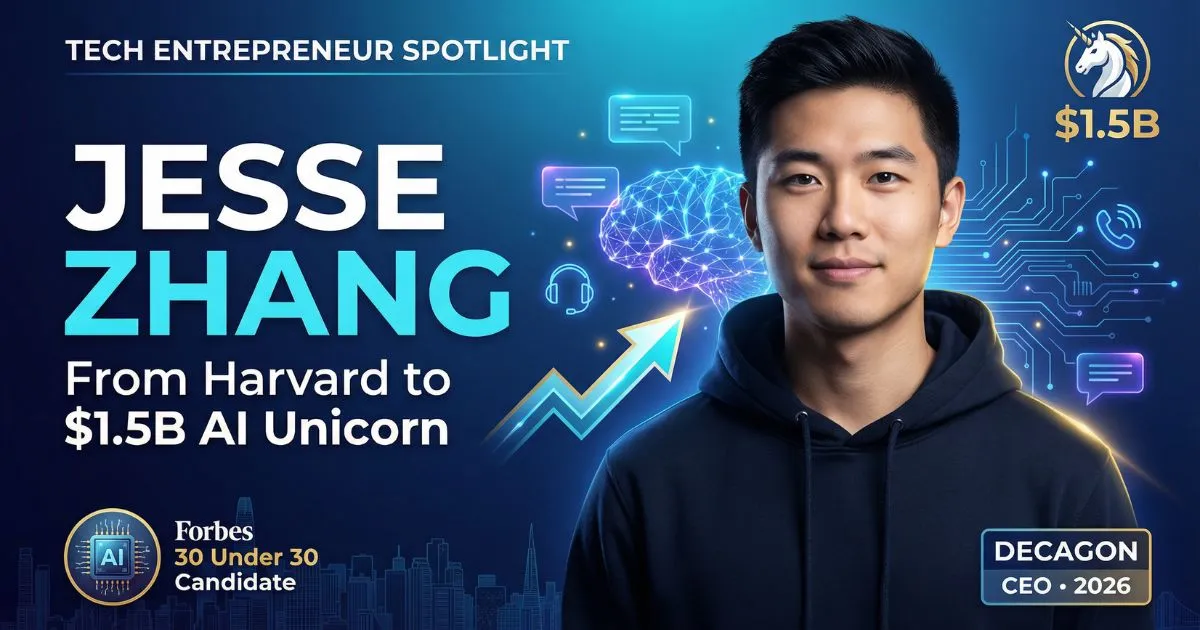
In just one year after emerging from stealth, Jesse Zhang co-founded and built Decagon into a $1.5 billion AI unicorn, raising $231 million from some of Silicon Valley’s most prestigious investors. At just 27 years old, Zhang represents a new generation of AI-native founders who are reshaping how enterprises deliver customer service through autonomous AI agents.
Jesse Zhang is the Co-Founder and CEO of Decagon, a conversational AI platform transforming customer experience for major companies like Notion, Duolingo, Hertz, Eventbrite, and Bilt. His journey from a math competition enthusiast in Boulder, Colorado, to leading one of the fastest-growing AI companies in the world is a masterclass in learning from failure, customer obsession, and execution speed.
Before Decagon, Zhang founded Lowkey, a gaming social platform backed by Andreessen Horowitz and Y Combinator that was acquired by Niantic in 2021. That six-year struggle taught him invaluable lessons about product-market fit and customer discovery—lessons he applied with precision to build Decagon from zero to eight figures in annual recurring revenue in under two years.
In this comprehensive biography, you’ll learn about Jesse Zhang’s early fascination with mathematics and computer science, his unconventional path through Harvard, the painful lessons from his first startup, and how he’s competing with giants like Salesforce and Sierra in the AI customer service revolution. We’ll explore his leadership philosophy, investment portfolio, net worth, and what makes him one of the most compelling young founders in Silicon Valley today.
2. Early Life & Background
Jesse Zhang was born and raised in Boulder, Colorado, a city known for its unique blend of outdoor culture and intellectual rigor. Growing up in Boulder provided Zhang with an environment distinct from the coastal tech hubs, fostering independence and unconventional thinking that would later define his entrepreneurial approach.
From an early age, Zhang exhibited a deep fascination with problem-solving and mathematics. His childhood was focused on what he describes as “hardcore nerd activities like math decathlons,” competing in prestigious competitions that would sharpen his analytical thinking. These early experiences in mathematics contests laid the groundwork for his systematic approach to breaking down complex problems—a skill that would prove invaluable in building technology companies.
Zhang’s interest in technology blossomed during his teenage years. At 15, he was already hacking his PlayStation, risking bricking the device just to understand how it worked. This curiosity-driven approach and willingness to break things to learn represented his early engineering mindset. The experience taught him not to fear failure but to embrace it as part of the learning process.
His passion for mathematics led him to contribute to the American Mathematics Competitions, eventually writing problems for the AMC 10 and AMC 8—prestigious high school math competitions. This early achievement demonstrated both his mathematical aptitude and his desire to give back to the community that had nurtured his talents.
Growing up in Boulder, away from Silicon Valley’s echo chamber, Zhang developed an independent perspective on building technology. He wasn’t surrounded by startup culture from day one, which allowed him to form his own views on entrepreneurship and innovation. This independence would later help him avoid the trap of following conventional startup playbooks without critical thinking.
The combination of rigorous mathematical training, hands-on tinkering with technology, and a geographically independent upbringing created a unique foundation for Zhang’s entrepreneurial journey. These formative years instilled in him the analytical rigor, technical curiosity, and independent thinking that would characterize his approach to building companies.
3. Family Details
| Relation | Name | Profession |
|---|---|---|
| Father | Not publicly disclosed | Not publicly disclosed |
| Mother | Not publicly disclosed | Not publicly disclosed |
| Siblings | Not publicly disclosed | Not publicly disclosed |
| Spouse/Partner | Not publicly disclosed | Not publicly disclosed |
| Children | None (publicly known) | – |
Note: Jesse Zhang maintains privacy regarding his family life and personal relationships.
4. Education Background
School: Boulder, Colorado (Specific school not publicly disclosed)
University: Harvard University
Degree: Bachelor of Science in Computer Science
Graduation: 2019 (Graduated one year early on accelerated program)
Jesse Zhang’s academic journey took him from the math competition circuits of Colorado to Harvard University, one of the world’s most prestigious institutions. He enrolled in Harvard’s Computer Science program, where his mathematical background provided a strong foundation for understanding algorithms, machine learning, and system design.
During his time at Harvard, Zhang didn’t just focus on academics—he aggressively pursued real-world experience through internships at some of the most competitive and prestigious technology and finance companies. His internship portfolio reads like a who’s who of elite firms:
- Citadel: One of the world’s most successful hedge funds, known for hiring top engineering talent
- Google: Where he gained exposure to building systems at massive scale
- Hudson River Trading (HRT): A quantitative trading firm that values mathematical and engineering excellence
- Intel: Experience with hardware and low-level systems
- Kensho Technologies: An AI and data analytics company later acquired by S&P Global
- EDO: Working on data-driven advertising technology
This diverse internship experience gave Zhang exposure to different engineering cultures, problem-solving approaches, and business models. From the high-frequency trading systems at HRT to the consumer-scale infrastructure at Google, he learned how different organizations approach technical challenges.
Zhang distinguished himself by graduating a year early on an accelerated program, demonstrating both his technical aptitude and his bias toward speed and efficiency—traits that would later define Decagon’s execution culture. The decision to graduate early also reflected his eagerness to start building real products rather than spending additional time in an academic environment.
His Harvard education provided not just technical knowledge but also access to a network of talented peers and mentors who would later become collaborators, investors, and advisors. The combination of rigorous computer science training, diverse industry experience, and a prestigious network positioned Zhang well for his entrepreneurial journey.
However, Zhang has noted that while Harvard provided a strong foundation, the most valuable lessons came from actually building companies and making mistakes in the real world—a perspective that would shape how he approached his next ventures.
5. Entrepreneurial Career Journey
A. Early Career & First Startup: Lowkey (2019-2021)
After graduating from Harvard in 2019, Jesse Zhang immediately dove into entrepreneurship by founding Lowkey, a social platform designed for gamers to share clips of their best gameplay moments. The platform aimed to capture the excitement and community aspects of gaming, allowing players to showcase their most impressive virtual achievements.
Lowkey attracted backing from two of Silicon Valley’s most prestigious investors: Andreessen Horowitz (a16z) and Y Combinator, which validated the concept and provided Zhang with crucial early-stage funding and mentorship. However, the journey was far from smooth.
Zhang has been candid about the struggles he faced during Lowkey’s six-year development. The company went through multiple pivots as the team tried to find product-market fit in the competitive consumer social media landscape. Zhang admits this period was “not necessarily super enjoyable the whole time,” with the team struggling to determine the right product direction and user experience.
The biggest lesson from Lowkey? Building based on intuition rather than deep customer validation was a mistake. Zhang spent years building features he thought users wanted, only to discover through painful iteration that assumptions about user behavior were often wrong. This consumer-focused approach taught him that in crowded markets with low switching costs, you need exceptional product-market fit to succeed.
Despite the challenges, Lowkey achieved strong user growth, particularly among gaming communities. The platform’s traction caught the attention of Niantic, the augmented reality gaming company behind Pokémon GO and Ingress. In late 2021, Niantic acquired Lowkey to strengthen its social features and community engagement capabilities.
Zhang joined Niantic post-acquisition, working on their Social team to integrate Lowkey’s technology and concepts into Niantic’s broader product ecosystem. While the acquisition provided a successful exit, Zhang viewed it primarily as a learning experience rather than a triumphant victory. The timing was fortunate—2021 was a period of aggressive growth and M&A activity in tech—but Zhang recognized that outcomes like acquisitions often involve significant luck and market timing beyond a founder’s control.
After completing his vesting period at Niantic, Zhang felt the pull of entrepreneurship again. The emergence of large language models and generative AI in 2022-2023 presented what he saw as a once-in-a-generation opportunity. In his twenties with energy and lessons from his first company, he decided to take another “big swing” at building something transformative.
B. Breakthrough Phase: Founding Decagon (2023)
Zhang co-founded Decagon in 2023 with Ashwin Sreenivas, who would serve as CTO. Sreenivas brought his own successful exit experience, having founded and sold Helia (an AI video company) to Scale AI, as well as experience as a Deployment Strategist at Palantir. The partnership combined Zhang’s product and go-to-market expertise with Sreenivas’s deep technical capabilities.
This time, Zhang approached company building completely differently. Rather than starting with a fixed idea and building in isolation, he and Sreenivas spent months conducting customer discovery interviews with large enterprises. They didn’t pitch a solution—they asked about problems.
Zhang describes this research phase: “We didn’t go in with a fixed idea. We lined up a ton of conversations with large companies and let the use cases emerge from those.” They explored everything from operations automation to data analytics to security use cases, deliberately staying open to where genuine pain points existed.
The signal came through clearly and consistently: customer support was broken. Enterprises were spending enormous sums on outsourced call centers and BPO (Business Process Outsourcing) operations. Traditional chatbots had failed—they were rigid decision trees with canned responses that frustrated customers rather than helping them. Companies desperately wanted AI-powered solutions but needed them to be enterprise-grade: accurate, controllable, and trustworthy.
Zhang and Sreenivas realized they had found a massive market with clear willingness to pay. Unlike consumer products where monetization is uncertain, enterprise customer support had obvious ROI: reduce headcount costs while improving customer satisfaction and response times.
Before writing significant code, Zhang landed six-figure contracts from enterprise customers. This “customer signal over hype” approach meant Decagon was generating revenue commitments before the product was even fully built. Zhang calls this “probably the most important thing we did differently.”
Decagon officially emerged from stealth in June 2024, announcing both a $5 million seed round led by a16z and a $30 million Series A led by Accel. Ivan Zhou from Accel, Zhang’s former colleague at Niantic, joined the board. The rounds included participation from notable angel investors including Aaron Levie (Box CEO), Howie Liu (Airtable CEO), and Elad Gil.
The product launched with a clear value proposition: autonomous AI agents that could handle complex customer service interactions across phone, chat, email, and other channels. Unlike simple chatbots, Decagon’s agents could understand context, access customer data, take actions like processing refunds or updating reservations, and maintain conversation quality that felt human.
Early customers included Eventbrite, Bilt, Webflow, and Substack—recognizable brands willing to trust their customer relationships to AI. The results were compelling: customers reported 70-80% ticket deflection rates (meaning AI resolved issues without human escalation) and 3x improvements in customer satisfaction scores.
C. Expansion & Global Impact: Hypergrowth (2024-2025)
What happened next was remarkable even by Silicon Valley standards. Decagon went from stealth to unicorn status in approximately one year—one of the fastest trajectories in recent tech history.
For the first 18 months, Zhang deliberately focused the company purely on short-term execution: ship features, deploy with customers, iterate based on feedback, repeat. He avoided distractions about long-term product vision or organizational scaling frameworks. This “speed-first approach” allowed Decagon to move faster than competitors and capture market share rapidly.
In June 2025, Decagon announced a $131 million Series C at a $1.5 billion valuation, co-led by Accel and Andreessen Horowitz’s Growth Fund. The round drew 5x more investor demand than capacity—a clear signal of Decagon’s momentum. New investors Avra, Forerunner, and Ribbit Capital joined existing backers A*, Bain Capital Ventures, and BOND, bringing total funding to $231 million.
During this period, Decagon’s metrics exploded:
- Revenue grew from zero to eight figures in annual recurring revenue (ARR)
- Customer base more than quadrupled
- Team scaled from 12 employees to nearly 200 in 18 months
- Expanded from initial customers to major enterprises like Hertz, Duolingo, Notion, Oura, and ClassPass
The company’s rapid growth was enabled by a breakthrough innovation: Agent Operating Procedures (AOPs). AOPs allow customer experience teams to define AI agent behavior using natural language, which Decagon’s system automatically compiles into precise code. This bridges the gap between business teams who understand customer needs and technical teams who control the underlying system.
This product-driven approach differentiated Decagon from competitors who relied on expensive, time-consuming professional services implementations. Decagon customers could go live in weeks rather than months, continuously improve their AI agents based on real data, and maintain full visibility into agent performance.
Zhang’s leadership during this hypergrowth phase demonstrated lessons learned from Lowkey. He prioritized hiring “senior generalists” from his network for early roles, creating a strong foundation that attracted subsequent talent. He maintained what team members call a “high clock speed” culture—moving fast, making decisions quickly, and avoiding analysis paralysis.
By late 2025, Decagon had become one of the most talked-about AI companies in the enterprise software space, competing directly with well-funded competitors like Sierra (backed by Sequoia at a $4.5 billion valuation) and established players like Salesforce. Zhang’s bet on customer service automation was paying off as enterprises rushed to deploy AI agents to handle growing support volumes while controlling costs.
In 2025, Decagon announced strategic partnerships including a commercial pilot with Deutsche Telekom, one of the world’s largest telecommunications providers, along with an investment from T.Capital, Deutsche Telekom’s corporate venture arm. The company also launched Decagon University, an education program to help customer experience professionals develop AI skills and transition into new roles as “AI architects” and “conversation designers.”
Zhang’s vision extended beyond just automation—he positioned Decagon as enabling a new paradigm of “concierge customer experience” where every customer interaction feels personalized, immediate, and effective, regardless of channel or time of day.
6. Career Timeline Chart
📅 CAREER TIMELINE

2019 ─── Graduated Harvard CS (one year early)
   │
2019 ─── Founded Lowkey (backed by a16z & Y Combinator)
   │
2021 ─── Lowkey acquired by Niantic
   │
2021-2023 ─── Worked at Niantic on Social team; Started angel investing
   │
2023 ─── Co-founded Decagon with Ashwin Sreenivas
   │
June 2024 ─── Emerged from stealth; Series A ($35M total raised)
   │
Oct 2024 ─── Series B ($65M raised)
   │
June 2025 ─── Series C ($131M); Unicorn status at $1.5B valuation
   │
2025-Present ─── Scaling Decagon to 200+ employees; Global enterprise adoption
7. Business & Company Statistics
| Metric | Value |
|---|---|
| Companies Founded | 2 (Lowkey, Decagon) |
| Current Valuation (Decagon) | $1.5 Billion |
| Revenue (ARR – Annual) | $10M+ (Eight figures) |
| Total Funding Raised | $231 Million |
| Employees | 200+ (as of late 2025) |
| Growth Rate | Team grew 12x in 18 months |
| Funding Rounds | Seed, Series A, B, C (4 rounds) |
| Time to Unicorn | ~1 year from emerging from stealth |
| Major Enterprise Customers | Hertz, Duolingo, Notion, Eventbrite, Bilt, Webflow, Substack, Oura, ClassPass, Rippling |
| AI Performance Metrics | 70-80% ticket deflection, 3x CSAT improvement |
| Cost Reduction | Up to 95% reduction in customer service costs |
8. Entrepreneur Comparison Section
📊 Jesse Zhang vs Similar AI Founders
| Statistic | Jesse Zhang (Decagon) | Brett Taylor (Sierra) |
|---|---|---|
| Age | 27-28 | 43 |
| Company Valuation | $1.5B | $4.5B |
| Time to Unicorn | ~1 year | ~1 year |
| Previous Exits | 1 (Lowkey to Niantic) | Multiple (Co-created Google Maps, ex-Salesforce Co-CEO) |
| Total Funding | $231M | $175M+ |
| Focus | Enterprise customer service automation | Broader customer experience platform |
| Customer Base | Mid-market to enterprise | Large enterprise focus |
| Technical Approach | Multi-model approach, AOPs | Proprietary AI development |
| Go-to-Market | Product-led, rapid deployment | Enterprise sales, longer implementations |
Analysis: While Brett Taylor brings decades of experience and a higher initial valuation, Jesse Zhang has demonstrated exceptional execution speed and product-market fit clarity. Zhang’s youth is actually an advantage in the AI era—he’s a digital native who understands both the technology and rapid iteration culture. Taylor’s broader vision and enterprise relationships give Sierra advantages in large enterprise deals, but Decagon’s product-driven approach and faster deployment cycles are winning in the mid-market and enabling rapid expansion. Both companies are positioned to be major players, with Zhang’s trajectory suggesting he could build multiple billion-dollar companies over his career.
9. Leadership & Work Style Analysis
Leadership Philosophy
Jesse Zhang’s leadership style is defined by speed, customer obsession, and learning from failure. His approach differs markedly from conventional Silicon Valley wisdom, shaped by the painful lessons of his first startup.
Speed Over Perfection: Zhang emphasizes what he calls “clock speed”—the rate at which a company makes decisions and ships products. For Decagon’s first 18 months, he deliberately avoided long-term planning and organizational frameworks, focusing purely on execution velocity. This contrarian approach allowed Decagon to out-execute well-funded competitors.
Customer Signal Over Hype: Zhang is skeptical of building based on intuition or following trends. He spent months interviewing potential customers before writing Decagon’s code, letting real pain points guide product decisions. He prioritizes signed contracts and deployed products over demo videos and fundraising momentum.
First-Principles Thinking: Zhang challenges conventional startup advice. He notes that “following others’ playbooks is deeply distracting” and emphasizes understanding what works specifically for your situation rather than applying generic best practices. This intellectual independence stems from his Boulder upbringing and has become a competitive advantage.
Decision-Making Style
Zhang makes decisions quickly based on available information, avoiding analysis paralysis. He’s willing to trust his intuition when it’s backed by customer conversations and data, but remains humble about what he doesn’t know. His approach balances confidence in execution with openness to being wrong and pivoting rapidly.
Risk-Taking Ability
Zhang demonstrates calculated risk-taking. He took the risk of leaving a stable post-acquisition role at Niantic to found Decagon, but only after validating customer demand. He’s willing to compete against giants like Salesforce and well-funded startups like Sierra, but does so with a differentiated product approach rather than just throwing money at the problem.
Innovation Mindset
Zhang’s innovation comes from deep customer understanding rather than technological novelty for its own sake. Decagon’s breakthrough—Agent Operating Procedures—emerged from recognizing that customer experience teams needed to control AI behavior without requiring engineering expertise. This business-problem-first approach contrasts with many AI startups that start with interesting technology and search for applications.
Strengths
- Exceptional execution speed: From idea to unicorn faster than almost any company in recent history
- Customer obsession: Relentlessly focuses on solving real problems rather than building impressive technology
- Learning from failure: Applied hard lessons from Lowkey to build Decagon more intelligently
- Talent magnetism: Built a team of 200+ in 18 months through strong early hires and clear vision
- Intellectual honesty: Willing to acknowledge mistakes and share lessons publicly
Weaknesses
- Relative inexperience: At 27, he has less experience navigating economic downturns or competitive moats
- Limited public profile: Less well-known than competitors, which could impact enterprise sales
- Single vertical focus: Decagon’s specialization in customer service, while deep, limits expansion opportunities compared to horizontal platforms
Expert Perspectives
Ivan Zhou (Accel Partner and former Niantic colleague): Zhang and his team have “solved a critical pain point for enterprises” by going beyond chat interfaces to address the full customer operations stack.
Industry observers note that Zhang’s combination of technical depth (Harvard CS, elite internships) and customer empathy (learned through Lowkey’s struggles) is rare. His willingness to challenge conventional startup wisdom while maintaining humility makes him a distinctive leader in the crowded AI startup landscape.
10. Achievements & Awards
Business & Tech Awards
Forbes 30 Under 30 (2026 Candidate) – While not confirmed, Zhang’s trajectory and company valuation make him a strong candidate for future recognition
AI 50 Recognition – Decagon featured among top AI companies transforming industries
Y Combinator Alumni Success – Recognized as successful YC-backed founder
Global Recognition
Andreessen Horowitz Growth Portfolio – Selected for a16z’s prestigious growth fund, indicating recognition as top-tier scaling company
Multiple Podcast Features:
- The Twenty Minute VC
- First Block (Notion)
- Topline
- Spotlight On (Accel)
Industry Thought Leader – Regularly interviewed about AI agents, customer experience automation, and startup building
Company Milestones
Fastest Growing AI Company (2024-2025) – Among the fastest to reach unicorn status from founding
$1.5 Billion Valuation in Under 2 Years – Achieved unicorn status faster than 99% of startups
5x Oversubscribed Funding Round – Series C attracted 5x more investor demand than capacity
Zero to Eight Figures ARR – Grew from no revenue to $10M+ ARR in under two years
Major Enterprise Wins – Secured Fortune 500 companies and major tech brands as customers
11. Net Worth & Earnings
💰 FINANCIAL OVERVIEW
| Year | Estimated Net Worth |
|---|---|
| 2021 | $5-10M (Lowkey acquisition) |
| 2023 | $10-20M (Post-Niantic vesting, angel investments) |
| 2024 | $30-50M (Decagon Series A/B) |
| 2025 | $50-100M+ (Decagon Series C, $1.5B valuation) |
| 2026 | $100-150M+ (Projected based on continued growth) |
Note: These figures are estimates based on typical founder equity stakes, funding rounds, and company valuations. Actual net worth may vary significantly.
Income Sources
Company Equity (Primary Source)
- Decagon: As co-founder and CEO, Zhang likely holds 15-25% equity stake (typical for founders after multiple funding rounds with dilution)
- At $1.5B valuation with ~20% stake = ~$300M paper wealth
- However, this is illiquid until exit event (IPO or acquisition)
Angel Investments Invested in 20+ startups as active angel investor, including:
- Pika (AI video generation)
- Cursor (AI-powered code editor)
- Visual Electric (AI image generation)
- Moment (Financial planning app)
- Motion (Productivity app)
- Verse (AI coding platform)
- Succinct (Zero-knowledge proofs)
- Cognition (Devin AI coding assistant)
Portfolio value estimated at $5-15M depending on subsequent funding rounds and valuations.
Salary & Compensation
- As CEO of funded startup, likely draws modest salary ($150-250K annually)
- Primary wealth is equity-based rather than cash compensation
Scout Funds
- Sequoia Scouts program participant
- Neo fund involvement
- Likely receives carry (profit share) on successful investments made through these platforms
Board Memberships & Advisory Roles
- Limited public information on formal board positions
- Likely provides informal advice to portfolio companies
Previous Exit: Lowkey Acquisition
Lowkey’s acquisition by Niantic in late 2021 provided Zhang’s first significant liquidity event. While acquisition terms weren’t disclosed, typical acqui-hire or small strategic acquisitions in that period ranged from $10-30M. As founder/CEO, Zhang likely received $5-15M from this exit after vesting and taxes.
Wealth Growth Trajectory
Zhang’s net worth trajectory represents the typical venture-backed founder path:
- Bootstrap phase (2019-2021): Minimal personal wealth, living on founder salary
- First exit (2021): $5-15M liquidity from Lowkey acquisition
- Angel investing (2021-2023): Deploying capital into startups while earning at Niantic
- Seed/Series A (2023-2024): Paper wealth grows but remains illiquid
- Unicorn (2025): Significant paper wealth (~$300M) but still largely illiquid
- Future exit (2026+): Potential for $100M+ in realized wealth upon Decagon IPO or acquisition
Tax Considerations
As a founder with significant equity holdings, Zhang likely benefits from:
- Qualified Small Business Stock (QSBS) exemption (potentially $10M+ in tax-free gains)
- Long-term capital gains treatment on equity appreciation
- Opportunity to diversify through secondary sales in later funding rounds
Comparison to Tech Founder Wealth
At 27-28 with an estimated $50-100M net worth (mostly paper), Zhang is significantly wealthier than most entrepreneurs his age but still far from tech billionaire status. For context:
- Mark Zuckerberg was worth ~$4B at age 27 (post-Facebook IPO)
- Evan Spiegel (Snap) was worth ~$2B at age 27
- Most unicorn founders don’t see major liquidity until 30s or later
Zhang’s wealth trajectory suggests potential for $500M+ net worth if Decagon executes a successful exit in the coming years.
12. Lifestyle Section
🏠 ASSETS & LIFESTYLE
Properties
- Primary Residence: San Francisco Bay Area (specific location undisclosed)
- Zhang maintains a relatively low-profile lifestyle focused on company building
- No public information about real estate holdings or luxury properties
- Likely rents or owns modest property in San Francisco tech hub
Cars Collection
- No public information available
- Zhang does not showcase luxury vehicles or material possessions on social media
- Lifestyle appears focused on work and personal interests rather than conspicuous consumption
Hobbies & Interests
Mathematics: Zhang continues his passion from childhood
- Writes problems for AMC 10 and AMC 8 math competitions
- Maintains connection to competitive mathematics community
- Uses mathematical thinking in business problem-solving
Gaming:
- Reached Grandmaster rank in Teamfight Tactics (top 0.02% of players globally)
- Plays strategic games that require high-level thinking
- Gaming background informed Lowkey’s product development
Basketball:
- Regular basketball player
- Values team sports for stress relief and fitness
Tennis:
- Watches professional tennis
- Appreciates strategic and tactical elements of the sport
Board Games:
- Enjoys strategic board games
- Values face-to-face social interaction despite tech career
Coding Projects:
- Builds personal projects on weekends
- Created PapersGPT (tool to feed scientific papers into GPT)
- Built 3D city-building demo using language-to-actions
- Maintains personal website with programming experiments
Travel:
- Likely travels for business (investor meetings, customer visits, conferences)
- No public information about leisure travel preferences
Daily Routine
While Zhang hasn’t publicly shared his specific daily routine, interviews and observations suggest:
Work Hours:
- Likely works 12-14 hour days during hypergrowth phase
- Emphasizes “clock speed” culture suggesting long, intense work periods
- Available to team and customers across time zones
Productivity Habits:
- Prioritizes customer conversations and product decisions
- Avoids over-planning and excessive meetings
- Values rapid iteration over perfect planning
- Maintains hands-on involvement in product and strategy
Personal Philosophy:
- “Move fast, but only after deeply validating the problem”
- Values learning over being right
- Comfortable with uncertainty and ambiguity
- Prioritizes substance over appearances
Work-Life Balance:
- As CEO of hypergrowth startup, work likely dominates schedule
- Maintains hobbies (gaming, basketball) for mental health
- Values relationships with co-founder and team
- Appears to sustain energy through genuine passion for building
Financial Lifestyle
Despite growing wealth, Zhang appears to maintain relatively modest lifestyle:
- No evidence of luxury purchases or ostentatious displays
- Focus on building company rather than enjoying wealth
- Reinvests wealth into angel investments rather than consumption
- Lifestyle consistent with many focused Silicon Valley founders
Public Persona
Zhang maintains a professional but low-key public presence:
- Active on Twitter/X (@thejessezhang) but focused on product and industry insights
- Participates in podcasts and interviews to share lessons
- Doesn’t cultivate celebrity founder image
- Values credibility over fame
This lifestyle approach reflects Zhang’s Boulder upbringing and his focus on substance over style—a refreshing contrast to some high-profile tech founders who emphasize personal branding and luxury lifestyles.
13. Physical Appearance
| Attribute | Details |
|---|---|
| Height | ~5’9″ – 5’11” (estimated, not publicly disclosed) |
| Weight | Average/Athletic build |
| Eye Color | Dark Brown |
| Hair Color | Black |
| Body Type | Athletic/Slim |
| Style | Casual tech entrepreneur (hoodies, t-shirts, jeans) |
| Distinctive Features | Youthful appearance, casual demeanor |
Note: Physical details are estimates based on public appearances and not officially disclosed.
14. Mentors & Influences
Early Mentors
Math Competition Community: Zhang credits his early involvement in mathematical competitions for developing his analytical thinking and problem-solving approach.
Harvard Professors and Advisors: While specific names aren’t public, Zhang’s computer science education at Harvard exposed him to leading academics in AI, systems, and algorithms.
Business Idols & Influences
While Zhang hasn’t publicly named specific business idols, his approach suggests influence from:
Y Combinator Philosophy: Focus on building products people want, rapid iteration, talking to customers
First-principles Thinkers: His emphasis on reasoning from fundamentals rather than copying playbooks suggests influence from founders who think independently
Customer-obsessed Founders: His pivot from intuition-driven building to customer discovery shows appreciation for founders who let customer needs guide product
Key Advisors & Investors
Andreessen Horowitz Partners: Backed both Lowkey and Decagon, providing strategic guidance through multiple ventures
Ivan Zhou (Accel Partner): Former colleague at Niantic who led Decagon’s Series A; provides board-level guidance
Ashwin Sreenivas (Co-founder/CTO): Partnership with technical co-founder represents mutual mentorship and strategic alignment
Aaron Levie (Box CEO): Angel investor who likely provides insights on building enterprise SaaS companies
Howie Liu (Airtable CEO): Angel investor with experience scaling productivity platforms
Elad Gil: Prominent angel investor and advisor known for helping companies scale through hypergrowth
Leadership Lessons Learned
From Lowkey failure:
- Don’t build based on assumptions; validate with customers first
- Consumer products require extraordinary product-market fit
- Timing and luck play significant roles in outcomes
- Learning matters more than immediate success
From Niantic experience:
- How large gaming companies operate and scale
- Social features and community building at scale
- Corporate development and M&A processes
From Decagon success:
- Enterprise customers will pay for solutions to real pain points
- Speed of execution creates competitive moats
- Senior hires early create strong foundation for scaling
- Product-led growth reduces dependency on large sales teams
15. Company Ownership & Roles
| Company | Role | Years | Status |
|---|---|---|---|
| Decagon | Co-Founder & CEO | 2023 – Present | Active, Unicorn ($1.5B valuation) |
| Lowkey | Founder & CEO | 2019 – 2021 | Acquired by Niantic |
| Niantic | Social Team Member | 2021 – 2023 | Former Employee |
| Angel Portfolio (20+ companies) | Angel Investor | 2021 – Present | Active Investor |
Detailed Ownership Analysis
Decagon Equity Stake:
- Estimated 15-25% ownership as co-founder/CEO after Series C
- Paper value: $225-375M at $1.5B valuation
- Subject to vesting schedules and dilution in future rounds
- Represents majority of personal net worth
Angel Investment Portfolio: Notable investments include:
- Pika – AI video generation platform
- Cursor – AI-powered code editor (rapidly growing)
- Visual Electric – AI image generation tool
- Moment – Financial planning application
- Motion – Productivity and project management
- Verse – AI coding assistance platform
- Succinct – Zero-knowledge proof infrastructure
- Cognition – Developer of Devin AI coding assistant
- 15+ undisclosed investments
Portfolio strategy focuses on:
- Developer tools and AI infrastructure
- Consumer AI applications
- Next-generation productivity platforms
- Companies led by technical founders
Scout Programs:
- Sequoia Scouts – Provides capital to identify promising startups
- Neo – Community of young founders and operators supporting each other
16. Controversies & Challenges
Business Challenges
Lowkey Struggles (2019-2021): Zhang has been transparent about the difficulties building Lowkey. The company went through multiple pivots over six years trying to find product-market fit in the competitive gaming social space. Zhang describes this period as a long struggle without clear direction, ultimately learning that consumer social products require exceptional, not just good, product-market fit to succeed.
Intense Competition: Decagon operates in an increasingly crowded market with well-funded competitors:
- Sierra (Brett Taylor, $4.5B valuation, Sequoia backing)
- Salesforce Einstein AI (massive incumbent with built-in distribution)
- Zendesk AI (established customer service platform)
- Intercom’s Fin AI (early mover in AI customer service)
- Dozens of well-funded AI agent startups
This competitive intensity creates constant pressure to execute flawlessly and differentiate through product innovation.
Hypergrowth Management: Scaling from 12 to 200+ employees in 18 months creates significant operational challenges:
- Maintaining culture and values during rapid hiring
- Avoiding quality dilution as team grows
- Ensuring new hires understand company direction
- Managing increasing organizational complexity
Regulatory and Industry Scrutiny
AI Safety and Reliability: As an AI company handling customer interactions, Decagon faces scrutiny around:
- Accuracy and hallucination prevention
- Bias in AI responses
- Data privacy and security
- Responsible AI development
Zhang has addressed these by emphasizing Decagon’s enterprise-grade approach with human oversight, quality controls, and transparent agent behavior.
Job Displacement Concerns: AI customer service automation inevitably raises concerns about displacing human workers. Critics argue that companies like Decagon contribute to job losses in customer service and BPO industries.
Zhang has positioned Decagon as “augmenting” rather than replacing humans, with Decagon University training workers for new roles as AI architects and conversation designers. However, this remains a sensitive issue as automation continues.
How Challenges Were Handled
Transparency About Failure: Zhang openly discusses Lowkey’s struggles in podcasts and interviews, using his experience to help other founders avoid similar mistakes. This vulnerability has earned respect in the founder community.
Customer-First Approach: Rather than chasing hype or funding, Zhang prioritizes customer results and product quality. This approach builds trust with enterprises concerned about AI reliability.
Responsible Scaling: Decagon maintains quality standards despite rapid growth, focusing on hiring senior talent and maintaining high bar for execution.
Thought Leadership: Zhang actively engages in discussions about AI’s impact on work, advocating for responsible deployment and worker transition support.
Lessons Learned
- Failure is data: Lowkey taught Zhang more than immediate success would have
- Customer validation beats intuition: Deep customer discovery prevents wasted years building wrong products
- Timing matters: Being ready for AI wave required experience from previous venture
- Transparency builds trust: Honest communication about challenges strengthens relationships
- Competition accelerates innovation: Rivalry with Sierra and others pushes Decagon to improve faster
No major legal controversies, scandals, or ethical violations are publicly associated with Zhang or Decagon as of 2026.
17. Charity & Philanthropy
Current Philanthropic Activities
As a relatively young entrepreneur still building his primary company, Jesse Zhang’s philanthropic activities are in early stages. Public information about charitable giving is limited, but several areas of involvement are notable:
Education Support:
- Continues contributing to American Mathematics Competitions (AMC 10, AMC 8) by writing problems
- Supports mathematical education for talented youth
- Helps identify and develop next generation of technical talent
Decagon University: Rather than viewing automation as pure displacement, Zhang invested in Decagon University, a training program helping customer service professionals transition into new AI-related roles such as:
- AI architects who design agent workflows
- Conversation designers who craft customer experiences
- Operations managers who oversee AI/human hybrid teams
This initiative addresses job displacement concerns directly while creating new career paths.
Open Source Contributions: Zhang has released personal projects like PapersGPT openly, contributing tools to the developer community.
Expected Future Philanthropy
Given Zhang’s background in mathematics education and his relatively modest public profile, future philanthropic focus will likely include:
STEM Education:
- Supporting math and computer science education programs
- Scholarships for students from underserved backgrounds
- Math competition sponsorship and expansion
AI Ethics and Safety:
- Research funding for responsible AI development
- Support for AI safety initiatives
- Workforce transition programs as AI automation expands
Entrepreneurship Support:
- Mentoring young founders, particularly technical founders
- Angel investing in companies solving important problems
- Educational content sharing lessons learned
Comparison to Tech Philanthropy
Unlike older tech billionaires who established major foundations (Gates Foundation, Chan Zuckerberg Initiative), Zhang is still in wealth-building phase. Most significant philanthropic contributions will likely come after a major liquidity event (Decagon IPO or acquisition).
His current approach—contributing expertise, time, and thought leadership rather than large financial donations—is typical for founders of his age and wealth stage.
18. Personal Interests
| Category | Favorites/Details |
|---|---|
| Food | Not publicly disclosed |
| Favorite Book | Not publicly disclosed (likely technical/business) |
| Movie/TV | Not publicly disclosed |
| Travel Destination | San Francisco Bay Area (professional); Boulder, Colorado (home) |
| Technology | Large Language Models, AI Agents, Developer Tools |
| Sport – Playing | Basketball, Tennis |
| Sport – Watching | Professional Tennis |
| Gaming | Teamfight Tactics (Grandmaster rank – top 0.02%), Strategy games |
| Music | Not publicly disclosed |
| Hobbies | Competitive mathematics, Coding side projects, Strategic board games |
| Favorite Companies | Notion, Linear, Cursor (evidenced by investments and product inspiration) |
| Intellectual Interests | AI systems, Mathematical problem-solving, Product design, Customer psychology |
Weekend Projects & Side Interests
PapersGPT: Built a tool allowing users to feed academic papers into GPT for analysis and questioning—demonstrates continued hands-on coding despite CEO responsibilities.
3D City Building Demos: Experiments with language-to-actions in interactive 3D environments, exploring natural language interfaces for complex systems.
Personal Website: Maintains jessezhang.org with personal projects, reflections, and experiments—rare among busy CEOs, showing genuine love for building.
Mathematical Writing: Continues contributing math problems to AMC competitions, maintaining connection to his intellectual roots.
Philosophy & Worldview
While Zhang hasn’t publicly articulated a comprehensive life philosophy, patterns emerge from interviews:
- Learning over ego: Values growth and improvement over being right
- Substance over style: Focuses on real results rather than appearances
- Speed with validation: Move fast, but only after confirming direction
- Independent thinking: Questions conventional wisdom while staying humble
- Long-term orientation: Willing to endure difficult periods for meaningful outcomes
19. Social Media Presence
| Platform | Handle/Username | Followers (Est.) | Activity Level |
|---|---|---|---|
| Twitter/X | @thejessezhang | ~5,000-10,000 | Active – Product updates, AI insights, startup lessons |
| linkedin.com/in/thejessezhang | ~10,000+ | Professional updates, company news | |
| Personal Website | jessezhang.org | N/A | Occasionally updated with projects |
| GitHub | Not publicly linked | Unknown | Likely private repositories |
| Not publicly disclosed/active | Unknown | Appears to maintain privacy | |
| YouTube | None (appears in podcast interviews) | N/A | Guest appearances only |
Social Media Strategy & Content
Twitter/X Focus: Zhang uses Twitter primarily for:
- Sharing product updates and Decagon milestones
- Discussing AI developments and agent technology
- Offering startup advice based on experiences
- Engaging with other founders and technical community
- Promoting Decagon hires and company culture
Content Style:
- Professional but approachable tone
- Technical depth without excessive jargon
- Honest about challenges and learnings
- Avoids personal life details
- Focuses on substance over self-promotion
Engagement Pattern:
- Responds to interesting technical discussions
- Retweets relevant AI and startup content
- Occasionally shares personal projects
- Minimal controversy or hot takes
- Professional boundary maintenance
Privacy Approach: Zhang maintains significant privacy around:
- Family and relationships
- Personal finances
- Home life and leisure activities
- Political views
- Controversial opinions
This approach contrasts with celebrity founders who cultivate large social followings and personal brands. Zhang’s focus appears to be on building a great company rather than personal fame—a strategy that may shift as Decagon grows and requires more founder-led marketing.
20. Recent News & Updates (2025-2026)
Major Company Developments
June 2025: Series C Unicorn Funding Decagon raised a $131 million Series C round at a $1.5 billion valuation, co-led by Accel and Andreessen Horowitz’s Growth Fund. The round saw participation from Avra, Forerunner Ventures, and Ribbit Capital, with five times more investor demand than available capacity.
Late 2025: Deutsche Telekom Partnership Decagon announced a commercial pilot with Deutsche Telekom and received investment from T.Capital, Deutsche Telekom’s corporate venture capital arm. This partnership signals Decagon’s expansion into European telecommunications markets.
Q4 2025: Decagon University Launch Addressing workforce transition concerns, Decagon launched Decagon University to help customer experience professionals develop AI skills and transition into roles like AI architects and conversation designers.
Late 2025: Team Growth Decagon scaled from 12 employees to nearly 200 in 18 months, representing one of the fastest talent acquisition rates in recent tech startups.
Product Launches & Innovations
Agent Operating Procedures (AOPs): Decagon’s breakthrough innovation allows CX teams to define AI behavior in natural language, which the system compiles into precise code—eliminating the technical barrier for business teams.
Multi-Channel Support Expansion: Decagon now handles customer interactions across voice calls, email, chat, SMS, and other channels with unified agent intelligence.
Enterprise Integrations: Deep integrations with major CRM, ticketing, and data platforms including Salesforce, Zendesk, Intercom, and custom enterprise systems.
Market Recognition
Fastest Growing AI Company: Industry analysts recognize Decagon as one of the fastest-growing AI companies from founding to unicorn status.
Customer Success Stories: Major brands publicly endorsing Decagon’s impact on customer experience metrics and operational efficiency.
Media Appearances (Recent)
The Twenty Minute VC Podcast: Zhang discussed Decagon’s journey, competitive positioning against Sierra, and lessons from Lowkey failure.
First Block (Notion) Podcast: Deep dive into building AI products and company culture.
Topline Podcast: Insights on AI agent technology and enterprise adoption.
Spotlight On (Accel): Discussion with investors about hypergrowth scaling and market opportunity.
Future Plans & Vision (2026 and Beyond)
Global Expansion: Following Deutsche Telekom partnership, Decagon plans deeper penetration into European and Asian markets.
Vertical Expansion: While focused on customer service, exploring adjacent use cases in sales operations and back-office automation.
Platform Maturity: Building more sophisticated agent orchestration, allowing multiple specialized agents to collaborate on complex customer issues.
IPO Trajectory: While no public IPO plans announced, at $1.5B valuation with strong revenue growth, Decagon could pursue public markets within 2-3 years.
AI Safety Leadership: Zhang positioning Decagon as responsible AI leader with focus on transparency, control, and human oversight.
Competitive Landscape Updates
Sierra Competition: Brett Taylor’s Sierra reached $4.5B valuation, intensifying rivalry for enterprise AI agent market.
Salesforce Response: Incumbent platforms accelerating AI features, forcing Decagon to maintain innovation pace.
New Entrants: Dozens of well-funded AI agent startups launched, creating crowded market requiring continuous differentiation.
21. Lesser-Known Facts
25 Fascinating Facts About Jesse Zhang
- Math Competition Prodigy: Zhang didn’t just compete in math competitions—he writes problems for the AMC 10 and AMC 8, the prestigious American Mathematics Competitions.
- PlayStation Hacker at 15: Risked bricking his PlayStation as a teenager just to understand how it worked, demonstrating early fearlessness with technology.
- Graduated Harvard Early: Completed his Computer Science degree in three years on an accelerated program rather than the typical four.
- Elite Internship Collection: Worked at Citadel, Google, Hudson River Trading, Intel, Kensho, and EDO during college—a remarkably diverse set of experiences.
- Gaming Grandmaster: Reached Grandmaster rank in Teamfight Tactics, placing him in the top 0.02% of players globally—evidence of strategic thinking mastery.
- Six-Year Startup Struggle: Spent six years building Lowkey before the Niantic acquisition, experiencing the long, unglamorous side of entrepreneurship most founders don’t discuss publicly.
- Customer Discovery Before Code: For Decagon, Zhang conducted months of customer interviews before writing significant code—the opposite of typical tech founder approach.
- 20+ Angel Investments: Despite being only 27-28, Zhang has built a diverse angel portfolio including companies like Pika, Cursor, and Cognition.
- Sequoia Scout: Selected for Sequoia’s exclusive Scouts program, where he helps identify promising startups for one of the world’s premier venture capital firms.
- Boulder Origins: Growing up in Boulder, Colorado rather than Silicon Valley gave Zhang an independent perspective unburdened by Bay Area groupthink.
- Weekend Coding: Despite CEO responsibilities, Zhang still builds side projects on weekends, including PapersGPT and 3D city-building demos.
- Fastest Unicorn: Decagon reached unicorn status in approximately one year from emerging from stealth—among the fastest trajectories in recent tech history.
- 5x Oversubscribed: Decagon’s Series C had five times more investor demand than available capacity, indicating exceptional market confidence.
- First Contracts Before Product: Secured six-figure enterprise contracts before Decagon’s product was fully built—validating demand upfront.
- Co-Founder Synergy: Partner Ashwin Sreenivas (CTO) also had a successful exit (Helia to Scale AI), creating rare founding team with dual exit experience.
- Speed Obsession: For Decagon’s first 18 months, Zhang deliberately avoided long-term planning to maximize execution velocity—a contrarian approach that worked.
- Niantic Alumni: Worked at Niantic (creator of Pokémon GO) after Lowkey acquisition, gaining experience at gaming company operating at massive scale.
- Enterprise Converts: Won over customers like Hertz, Duolingo, and Notion—brands protective of customer relationships willing to trust AI with their users.
- Basketball Player: Regular basketball player who values team sports for both fitness and stress relief.
- No Social Media Celebrity: Despite leading a unicorn, Zhang maintains modest social media presence focused on substance over personal branding.
- Learning Culture: Publicly shares failures and lessons from Lowkey, creating learning resource for other founders rather than hiding struggles.
- Y Combinator Graduate: Part of prestigious YC network for both Lowkey and through connections for Decagon.
- Immigrant Background: While not extensively discussed, Zhang’s family background likely informs his work ethic and perspectives (exact details private).
- Decagon University Founder: Rather than ignoring job displacement concerns, invested in training displaced workers for AI-era roles.
- First-Principles Thinker: Consistently challenges conventional startup wisdom and questions received advice, preferring to reason from fundamentals.
22. FAQs
Who is Jesse Zhang?
Jesse Zhang is a 27-year-old tech entrepreneur and the Co-Founder & CEO of Decagon, an AI company valued at $1.5 billion that builds autonomous agents for customer service. He previously founded Lowkey, a gaming social platform acquired by Niantic, and has invested in over 20 startups including Pika and Cursor.
What is Jesse Zhang’s net worth in 2026?
Jesse Zhang’s estimated net worth in 2026 is between $50-100 million, primarily from his equity stake in Decagon (valued at $1.5 billion) and his angel investment portfolio. His paper wealth could exceed $300 million based on his founder equity, though this remains largely illiquid until an exit event.
How did Jesse Zhang start his first company?
After graduating from Harvard in 2019 with a Computer Science degree, Jesse Zhang founded Lowkey, a social platform for gamers to share gameplay clips. He secured backing from Andreessen Horowitz and Y Combinator, spent six years building and pivoting the product, and eventually sold the company to Niantic in 2021.
Is Jesse Zhang married?
Jesse Zhang has not publicly disclosed information about his marital status or romantic relationships. He maintains privacy around his personal life and family details.
What companies does Jesse Zhang own?
Jesse Zhang is the Co-Founder and CEO of Decagon (estimated 15-25% ownership). He previously founded Lowkey (acquired by Niantic). He also holds angel investments in 20+ companies including Pika, Cursor, Visual Electric, Moment, Motion, Verse, Succinct, and Cognition.
How fast did Decagon become a unicorn?
Decagon became a unicorn (reached $1.5 billion valuation) in approximately one year after emerging from stealth in June 2024, making it one of the fastest companies to reach unicorn status in recent tech history. The company grew from zero to eight figures in annual recurring revenue in under two years.
What is Decagon and what does it do?
Decagon is an AI platform that builds autonomous agents to handle customer service interactions across phone, chat, email, and other channels. The company helps enterprises like Hertz, Duolingo, and Notion automate customer support with AI that can understand context, access customer data, and take actions while maintaining human-quality conversations.
Where did Jesse Zhang go to college?
Jesse Zhang attended Harvard University, where he earned a Bachelor of Science degree in Computer Science in 2019. He graduated one year early on an accelerated program and completed internships at elite companies including Google, Citadel, Hudson River Trading, and Intel during his studies.
How old is Jesse Zhang?
Jesse Zhang is approximately 27-28 years old as of 2026. He was born around 1997-1998 in Boulder, Colorado, making him one of the youngest founders to lead a billion-dollar AI company.
Who are Jesse Zhang’s competitors?
Jesse Zhang’s Decagon competes primarily with Sierra (founded by Brett Taylor, valued at $4.5 billion), Salesforce Einstein AI, Zendesk AI, Intercom’s Fin AI, and dozens of other AI agent startups in the customer service automation space.
23. Conclusion
Jesse Zhang’s journey from competitive mathematics enthusiast in Boulder to leading a $1.5 billion AI unicorn represents a masterclass in resilience, customer obsession, and execution velocity. At just 27 years old, he has already experienced the full entrepreneurial cycle—from the painful six-year struggle with Lowkey to the rocket ship trajectory of Decagon, which reached unicorn status faster than almost any company in recent history.
What makes Zhang’s story particularly compelling is his intellectual honesty about failure. Rather than spinning his first venture as an unblemished success, he openly discusses the struggles, wrong turns, and lessons learned. This transparency has earned him respect in the founder community and created a valuable learning resource for other entrepreneurs navigating their own difficult journeys.
Zhang’s impact on the tech industry extends beyond Decagon’s impressive metrics. His approach to company building—prioritizing customer discovery over intuition, execution speed over perfection, and first-principles thinking over following playbooks—challenges conventional startup wisdom. In an era where many founders chase hype cycles and fundraising headlines, Zhang’s focus on solving real customer problems with excellent products offers a refreshing alternative.
The AI revolution is still in its early stages, and customer service automation represents just one of many industries being transformed by autonomous agents. If Zhang applies the same learning velocity and customer obsession to future challenges that he’s demonstrated with Decagon, his leadership legacy could extend far beyond a single successful company. He’s building both a transformative business and a reputation as a founder who does the hard work of truly understanding customer needs before scaling solutions.
As Decagon scales toward a potential IPO and Zhang’s net worth grows from millions to potentially hundreds of millions, the coming years will test whether he can maintain the speed and culture that enabled the company’s early success. The transition from scrappy startup to mature enterprise is where many promising companies stumble. But Zhang’s track record suggests he has the intellectual honesty, learning capacity, and execution discipline to navigate whatever challenges lie ahead.
For aspiring entrepreneurs, Jesse Zhang’s story offers several timeless lessons: failure is often the best teacher, customer validation beats intuition every time, timing matters as much as talent, and moving fast with clear direction beats perfect planning. His journey from Boulder math competitions to the forefront of the AI revolution proves that world-changing companies can emerge from anywhere when founders combine technical excellence with relentless customer focus.
👉 Want to learn from more founder journeys? Share this article with aspiring entrepreneurs, leave your thoughts in the comments below, or explore our collection of tech entrepreneur biographies to discover the stories behind today’s most innovative companies.