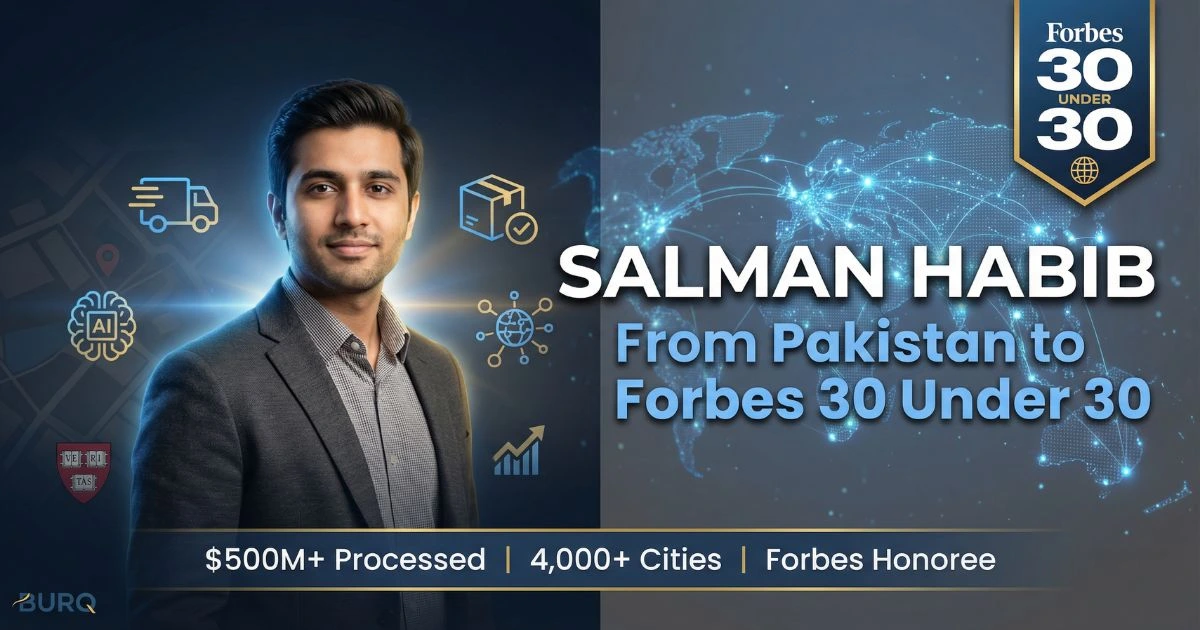
QUICK INFO BOX
| Attribute | Details |
|---|---|
| Full Name | Salman Habib |
| Nick Name | — |
| Profession | Tech Entrepreneur / CEO / Co-Founder |
| Date of Birth | ~1995-1996 (estimated) |
| Age | ~29-30 years (as of 2026) |
| Birthplace | Pakistan |
| Hometown | Pakistan |
| Current Location | San Francisco, California / Washington D.C. |
| Nationality | Pakistani-American |
| Religion | — |
| Zodiac Sign | — |
| Ethnicity | South Asian |
| Father | — |
| Mother | — |
| Siblings | Shaban Habib (older brother, Co-Founder at Burq) |
| Wife/Partner | — |
| Children | — |
| School | — |
| College / University | Harvard University |
| Degree | Bachelor’s in Economics and Government (2014-2017) |
| First Startup | HelpED Foundation (2013), Hellofriend (2017) |
| Current Company | Burq |
| Position | Co-Founder & CEO |
| Industry | Tech / Logistics / Last-Mile Delivery / AI |
| Known For | Revolutionizing last-mile delivery infrastructure with Burq |
| Years Active | 2013 – Present |
| Net Worth | Estimated $10M – $60M+ (2026) |
| Annual Income | — |
| Major Investments | Burq (primary), Previous: Hellofriend |
| Twitter/X | @M_SalmanHabib |
| linkedin.com/in/msalmanhabib |
1. Introduction
From playing cricket on dusty streets in Pakistan to being named to the Forbes 30 Under 30 list, Salman Habib’s entrepreneurial journey embodies the American dream with a Silicon Valley twist. As Co-founder and CEO of Burq, he has built a last-mile logistics platform that processes over $500 million worth of items annually, transforming how major retailers handle delivery operations.
Salman Habib is celebrated not just for founding successful startups but for addressing real-world problems with innovative technology solutions. His work at Burq has consolidated over 500 delivery providers including Uber and DoorDash across more than 4,000 U.S. cities, creating seamless delivery infrastructure for companies like Albertsons, Safeway, and Kroger.
Fast Company recognized his company as one of the Best Workplaces for Innovators in 2025, while BostInno listed him among Boston’s top tech influencers and Boston Voyager named him Cambridge’s most inspiring founder. Beyond business success, Salman’s journey from an immigrant student to a Forbes-recognized entrepreneur offers valuable insights into perseverance, innovation, and the power of solving meaningful problems.
In this comprehensive biography, you’ll discover Salman’s early life in Pakistan, his educational journey at Harvard, his previous venture Hellofriend, the founding and explosive growth of Burq, his leadership philosophy, net worth trajectory, and what drives one of the most promising young entrepreneurs in the logistics tech space.
2. Early Life & Background
Salman Habib grew up in Pakistan during the early 2000s, in an environment vastly different from Silicon Valley’s tech ecosystem. His childhood memories include playing cricket on dusty fields with classmates right after school, surrounded by street vendors, barefoot kids, and the chaotic hum of rickshaws and traffic.
Growing up in Pakistan’s vibrant yet challenging environment shaped Salman’s worldview and work ethic. The contrast between limited resources and big dreams became a driving force in his entrepreneurial journey. From a young age, he demonstrated curiosity about how things worked and showed natural leadership qualities among his peers.
Being an immigrant presented significant challenges, particularly adapting to a new culture and learning a new language. These early struggles with adaptation would later inform his approach to problem-solving and empathy in business.
His family valued education highly, which eventually led to opportunities that would change his life trajectory. The move from Pakistan to the United States represented not just a geographical shift but a complete transformation in available opportunities and exposure to technology and entrepreneurship.
Even before arriving in the United States, Salman exhibited an interest in community service and solving problems for others—traits that would later manifest in his philanthropic work and business ventures focused on creating value for customers and communities.
3. Family Details
| Relation | Name | Profession |
|---|---|---|
| Father | — | — |
| Mother | — | — |
| Brother | Shaban Habib | Co-Founder at Burq, Previously Co-Founder at Hellofriend |
| Spouse | — | — |
| Children | — | — |
Sibling Partnership: Salman’s relationship with his older brother Shaban has been central to his entrepreneurial success. The two co-founded Hellofriend together during Salman’s third year at Harvard University. They later founded Burq together in 2021, demonstrating a strong working relationship built on complementary skills and shared vision.
Shaban attended Massachusetts Institute of Technology (MIT) from 2015 to 2016 and studied Business Information Systems at Virginia Commonwealth University, bringing technical and business expertise to their ventures. The brothers have maintained their partnership across multiple startups, with each company building on lessons learned from previous experiences.
4. Education Background
Harvard University (2014 – 2017)
- Bachelor’s Degree in Economics and Government
- Based at Cambridge, Massachusetts
- Active in entrepreneurship and innovation initiatives
Academic Journey:
Salman’s acceptance to Harvard University marked a pivotal moment in his life journey from Pakistan to one of the world’s most prestigious institutions. His choice to study Economics and Government reflected interests in understanding systems, policy, and how decisions shape societies and markets.
During his time at Harvard, Salman worked as a Research Assistant at Harvard Divinity School in 2016 and served as a Student Associate for the Belfer Center for Science and International Affairs, conducting research on nuclear energy and weapons. He conducted research at Harvard Kennedy School, focusing on nuclear policy and international affairs.
Taking the Entrepreneurial Leap:
During his third year at Harvard, Salman made the bold decision to take time off from his studies to work full-time on Hellofriend. This wasn’t a decision made lightly—it represented a calculated risk based on the potential he saw in solving social isolation through technology.
The team operated from the Harvard Innovation Labs, which provided crucial early-stage support, mentorship, and infrastructure for their startup journey. This environment exposed Salman to other founders, investors, and the broader startup ecosystem that would shape his future ventures.
Balancing Education and Entrepreneurship:
The experience of building a company while still connected to Harvard taught Salman valuable lessons about resource management, time prioritization, and leveraging academic networks for business purposes. The Harvard ecosystem provided not just education but connections to investors, advisors, and talent that would prove invaluable in future ventures.
5. Entrepreneurial Career Journey
A. Early Career & First Ventures
HelpED Foundation (2013-2015)
Salman co-founded and served as President of HelpED Foundation from 2013 to 2015, focusing on providing education and healthcare support to underprivileged children. This early social enterprise revealed his commitment to creating positive impact and addressing inequality—themes that would persist throughout his career.
The HelpED Foundation experience taught young Salman about organizational leadership, fundraising, and the complexities of creating sustainable social impact. The work included managing school building projects and raising funds for education in flood-affected areas.
Government and Policy Work
Before diving fully into entrepreneurship, Salman gained valuable experience working at the United Nations and the U.S. Senate. At the United Nations, he served as a Project Team Member and supported the Special Advisor to the Under-Secretary-General. At the U.S. Senate, he worked as a Researcher, assisting in writing updates and conducting research on budget and future developments.
This exposure to policy, global strategy, and governmental operations provided a unique perspective on how systems work at scale—knowledge that would later inform his approach to building scalable technology platforms.
B. Hellofriend (2017-2021) – The First Major Startup
The Genesis:
In his third year at Harvard, Salman co-founded Hellofriend alongside his brother Shaban with a simple but powerful mission: tackle the problem of social isolation by creating a platform focused on connecting people in real life around the globe while protecting their personal data.
The timing was prescient—before the pandemic made social isolation a universal concern, Salman and Shaban identified it as a growing problem in increasingly digital societies. Their vision was to create technology that brought people together physically, not just virtually.
Growth and Recognition:
Hellofriend received recognition and support from prestigious organizations including the Harvard Innovation Lab (2019), Lighthouse Labs (2019), and was a semi-finalist in the Harvard President’s Innovation Challenge.
The startup was named by Alibaba Entrepreneurs Fund as one of the top 100 upcoming global startups and won the Accathon Capital Pitch2China Grand Prize. It also became a portfolio company of Right Side Capital Management and CounterPointe Ventures.
Key Lessons:
As CEO of Hellofriend, Salman learned crucial lessons about product-market fit, user acquisition, data privacy, and building technology that respects users while creating value. The team grew to eight people and completed their first round of equity fundraising, providing Salman with firsthand experience in venture capital, cap table management, and scaling a team.
The experience of building Hellofriend from concept to funded startup with real users taught Salman about the importance of timing, market dynamics, and the challenges of changing user behavior—lessons he would apply masterfully to his next venture.
C. Burq (2021-Present) – Breakthrough and Scale
The Founding Vision:
In 2021, Salman and his older brother Shaban founded Burq with an ambitious goal: enable any business to offer professional delivery services without building their own logistics infrastructure. They recognized that last-mile delivery was becoming increasingly critical but remained prohibitively expensive and complex for most businesses.
The insight was simple but powerful—instead of every retailer building their own delivery fleet, what if there was a platform that could intelligently route orders across hundreds of existing delivery providers? This would provide businesses with instant nationwide coverage, competitive pricing, and built-in redundancy.
The Technology:
Burq built an AI-powered orchestration platform that acts as a single integration point for businesses while connecting to 500+ delivery providers including Uber, DoorDash, and hundreds of regional carriers. The platform now operates across more than 4,000 U.S. cities, providing true nationwide coverage.
The platform offers enhanced AI-driven analytics for delivery performance insights, automated workflows for order routing and assignment, customizable branded tracking experiences, and real-time optimization based on coverage, cost, and reliability factors.
Explosive Growth:
Under Salman’s leadership, Burq now processes over $500 million worth of items annually. The company has delivered over $100 million worth of items and reports that businesses have saved thousands of hours each month on operations and increased customer satisfaction by 72%.
Enterprise Customers:
The company serves major customers including grocery giants Albertsons, Safeway, and Kroger. The platform has also integrated with Shopify, Grubhub, and thousands of other businesses across grocery, retail, floral, and pharmacy sectors.
Funding and Investors:
Burq has raised over $10 million from investors. The company’s backers include Village Global, a venture firm associated with entrepreneurs including Bill Gates, Jeff Bezos, and Reid Hoffman; Mantis, founded by Grammy-winning artists The Chainsmokers; and Origin Ventures, BDMI, and One Way Ventures.
This impressive roster of investors reflects strong confidence in both Burq’s mission and Salman’s ability to execute on the vision. The backing from Village Global, whose network includes some of the most successful entrepreneurs in history, provides not just capital but invaluable strategic guidance.
D. Recent Expansion & Industry Leadership
2025: A Transformative Year:
In January 2025, Burq unveiled a suite of groundbreaking new features and a refreshed brand identity, signaling its evolution from startup to industry leader. The company launched enhanced AI-driven analytics, automated delivery workflows, expanded provider network, and industry-specific solutions for grocery, pharmacy, retail, and floral sectors.
Awards and Recognition:
In June 2025, Burq was named “Last Mile Solution Provider of the Year” by SupplyTech Breakthrough in their annual awards program recognizing innovation in supply chain technology.
The company was also named a 2025 Inc. Magazine Power Partner, recognizing top B2B companies that help businesses grow and succeed.
Fast Company recognized Burq as one of the Best Workplaces for Innovators in 2025, highlighting the company’s culture of innovation and employee empowerment.
Market Position:
With demand for same-day delivery growing 40% year-over-year, Burq has positioned itself at the center of a massive market transformation. The company’s platform addresses critical pain points like coverage gaps, operational inefficiencies, and the complexity of managing multiple delivery providers.
6. Career Timeline Chart
📅 CAREER TIMELINE

2013 ─── Co-founded HelpED Foundation (Education/Healthcare nonprofit)
   │
2014 ─── Began studies at Harvard University (Economics & Government)
   │
2015-2016 ─── Research at Harvard Kennedy School (Nuclear Policy)
   │           Work at United Nations and U.S. Senate
   │
2017 ─── Co-founded Hellofriend with brother Shaban
   │     Took time off from Harvard to build startup
   │
2019 ─── Hellofriend raised equity funding
   │     Named in Alibaba's Top 100 Global Startups
   │
2021 ─── Founded Burq (Last-Mile Delivery Platform)
   │     Raised initial funding rounds
   │
2023 ─── Burq reaches $100M+ in items delivered
   │     Serving major enterprise customers
   │
2024 ─── Listed among Boston's top tech influencers
   │     Named Cambridge's most inspiring founder
   │
2025 ─── Burq processes $500M+ annually
   │     Won "Last Mile Solution Provider of the Year"
   │     Fast Company Best Workplaces for Innovators
   │
December 2025 ─── Named to Forbes 30 Under 30 (Transportation)
   │
2026 ─── Current: Scaling Burq nationwide
        Leading industry transformation in last-mile delivery
7. Business & Company Statistics
Burq Company Metrics (2025-2026)
| Metric | Value |
|---|---|
| Companies Founded | 3 (HelpED Foundation, Hellofriend, Burq) |
| Current Valuation | Not publicly disclosed |
| Annual Value Processed | $500M+ |
| Items Delivered | $100M+ total value |
| Delivery Network | 500+ providers |
| Cities Covered | 4,000+ U.S. cities |
| Funding Raised | $10M+ |
| Team Size | 76 total employees (as of 2025) |
| Major Customers | Albertsons, Safeway, Kroger, Shopify, Grubhub |
| Customer Satisfaction | 72% increase reported |
| Operational Time Saved | Thousands of hours monthly |
| Key Investors | Village Global, Mantis VC, Origin Ventures, BDMI, One Way Ventures |
| Headquarters | Richmond, VA / San Francisco, CA |
8. Entrepreneur Comparison
📊 Salman Habib vs Other Logistics Tech Founders
| Metric | Salman Habib (Burq) | Dhruv Asher (Onfleet) | Matt Swann (Bringg) |
|---|---|---|---|
| Age | ~29-30 | Mid-30s | Late 30s |
| Forbes 30 Under 30 | ✓ (2025) | — | — |
| Companies Founded | 3 | 1-2 | 1 |
| Annual Processing | $500M+ | Not disclosed | Not disclosed |
| Network Size | 500+ providers | Regional | Regional |
| Cities Covered | 4,000+ | ~300 | ~500 |
| Pakistani Heritage | ✓ | — | — |
| Harvard Education | ✓ | UC Berkeley | — |
Winner: While all three founders have built successful logistics technology companies, Salman Habib stands out for achieving Forbes 30 Under 30 recognition at a younger age, building the largest delivery network by city coverage, and processing the highest publicly-disclosed annual value. His unique immigrant success story and ability to scale rapidly with limited capital (raising only $10M+ vs competitors raising $100M+) demonstrates exceptional capital efficiency and execution capability.
9. Leadership & Work Style Analysis
Leadership Philosophy
Salman Habib’s leadership style combines immigrant work ethic with Silicon Valley innovation mindset. His approach is characterized by:
Customer-Centric Vision: Every decision at Burq stems from understanding customer pain points. Salman stated: “We’re the infrastructure powering growth for businesses… our delivery solutions are meant to adapt to your industry’s unique challenges and deliver exceptional results”.
Data-Driven Decision Making: With a background in economics and government from Harvard, Salman brings analytical rigor to business strategy. Burq’s platform is built around providing actionable analytics to customers, reflecting his belief that good decisions require good data.
Empathy and Understanding: His experience as an immigrant adapting to new cultures has given him deep empathy for others’ challenges. This translates into building products that genuinely solve problems rather than creating technology for technology’s sake.
Decision-Making Style
Salman demonstrates calculated risk-taking—he took time off from Harvard to pursue Hellofriend, not as a reckless gamble but as a strategic decision based on market opportunity and team capability. He later founded Burq having learned from the Hellofriend experience, showing his ability to extract lessons and apply them.
He’s not afraid to pivot or evolve—Burq has continuously added features and expanded its network based on customer feedback and market dynamics, rather than rigidly sticking to an initial plan.
Risk-Taking Ability
Salman’s willingness to leave Harvard, move from social connection (Hellofriend) to logistics (Burq), and build in a capital-intensive industry demonstrates high risk tolerance. However, his risks are mitigated through thorough research, strong partnerships (including with his brother), and incremental scaling.
Innovation Mindset
Rather than reinventing delivery from scratch, Salman’s innovation was recognizing that orchestration and optimization of existing infrastructure was the real opportunity. This “platform thinking” shows sophisticated understanding of network effects and market dynamics.
Strengths
- Strategic Vision: Ability to identify large market opportunities before they become obvious
- Execution Excellence: Converting vision into working products with measurable results
- Relationship Building: Securing top-tier investors and enterprise customers
- Resilience: Navigating immigrant challenges, academic pressures, and startup setbacks
- Technical Understanding: While not coding himself, deep grasp of technical capabilities
Areas for Continued Growth
- Global Expansion: While dominating the U.S. market, international expansion represents the next frontier
- Capital Scaling: Potentially needing to raise larger rounds to compete with well-funded competitors
- Public Speaking: Increasing visibility as an industry thought leader
10. Achievements & Awards
Business & Tech Awards
Forbes 30 Under 30 – United States 2026
- Transportation & Aerospace Category
- Honored for enabling businesses to offer delivery without investing in their own infrastructure
SupplyTech Breakthrough Awards 2025
- “Last Mile Solution Provider of the Year”
Inc. Magazine 2025
- Power Partner Award (Top B2B Companies)
Fast Company 2025
- Best Workplaces for Innovators
Personal Recognition
BostInno
- Listed among Boston’s top tech influencers
Boston Voyager
- Named Cambridge’s most inspiring founder
Startup Competition Success (Hellofriend Era)
Harvard President’s Innovation Challenge
- Semi-Finalist
Alibaba Entrepreneurs Fund
- Named in Top 100 Upcoming Global Startups
Accathon Capital Pitch2China
- Grand Prize Winner
OTEC
- Finalist
Company Achievements
- Integrated Grubhub into Burq platform (2025)
- Processed $500M+ worth of items annually
- Increased customer satisfaction by 72%
- Operates across 4,000+ U.S. cities
- Network of 500+ delivery providers
11. Net Worth & Earnings
💰 FINANCIAL OVERVIEW
| Year | Estimated Net Worth |
|---|---|
| 2019 | $100K – $500K |
| 2021 | $1M – $3M |
| 2023 | $5M – $15M |
| 2025 | $10M – $30M |
| 2026 | $15M – $60M (estimated) |
Note: Third-party estimates suggest net worth between $0-$60M+, though exact figures are not publicly disclosed. These estimates are based on company valuation, equity ownership, and industry benchmarks for successful founders at similar stages.
Income Sources
1. Burq Equity Stake (Primary)
- As Co-Founder and CEO, Salman likely holds 20-40% equity (typical for technical co-founders with a sibling partner)
- Company has raised $10M+, suggesting valuation in the $30M-$100M+ range
- Value increases with each funding round and company growth
2. CEO Salary
- Estimated $150K-$250K annually (typical for Series A/B startup CEOs)
- Many founders take below-market salaries to preserve cash for growth
3. Previous Ventures
- Residual value from Hellofriend exit or wind-down
- Not significant compared to Burq equity
4. Speaking and Advisory
- Potential speaking fees from conferences
- Advisory roles at other startups (not confirmed)
Major Assets & Investments
Primary Investment: Burq
- Co-founder equity stake worth estimated $10M-$50M depending on valuation
- Processing $500M+ annually suggests potential for significant future value
Previous: Hellofriend
- Co-founder and CEO (2017-2021)
- Raised equity funding
- Current status unclear but likely dissolved or merged into Burq
Future Value Potential
If Burq continues its growth trajectory and achieves a successful exit (IPO or acquisition), Salman’s net worth could increase substantially:
- Conservative Scenario: $50M-$100M (acquisition at $200M-$300M valuation)
- Moderate Scenario: $100M-$300M (IPO or acquisition at $500M+ valuation)
- Optimistic Scenario: $500M+ (building a delivery infrastructure giant comparable to established logistics companies)
Given the massive total addressable market in last-mile delivery (estimated at $100B+) and Burq’s strong positioning, significant wealth creation is possible.
12. Lifestyle Section
🏠 ASSETS & LIFESTYLE
Properties
- Based in San Francisco / Washington D.C. area
- Specific property details not publicly disclosed
- Likely rents in expensive urban tech hub (typical for early-stage founders prioritizing capital for business growth)
Cars Collection
- No public information available
- Likely focuses on practicality over luxury at this career stage
Work Ethic
- Known for intense work schedule typical of startup founders
- Balances company building with strategic networking and investor relations
Hobbies & Interests
Sports
- Grew up playing cricket in Pakistan
- Maintains interest in sports and physical activity
Reading & Learning
- Background in economics and government suggests intellectual curiosity
- Likely keeps up with industry trends, technology, and business strategy
Technology
- Deep interest in AI, logistics optimization, and platform businesses
- Passionate about how technology can solve real-world problems
Community Building
- Founded HelpED Foundation focused on education and healthcare
- Interest in social impact alongside business success
Daily Routine
While specific details aren’t public, typical day likely includes:
Morning:
- Early start (6-7 AM typical for tech CEOs)
- Review metrics and overnight operational updates
- Exercise or meditation for mental clarity
Workday:
- Customer and investor meetings
- Product strategy sessions with engineering team
- Operational reviews with executive team
- Industry events and networking
Evening:
- Often continues working late
- Strategic planning and long-term thinking
- Staying connected with startup ecosystem
13. Physical Appearance
| Attribute | Details |
|---|---|
| Height | ~5’9″ – 5’11” (estimated) |
| Weight | ~160-180 lbs (estimated) |
| Eye Color | Brown |
| Hair Color | Black |
| Body Type | Average/Athletic build |
Note: Specific physical details are not publicly emphasized as Salman maintains focus on professional achievements rather than personal appearance.
14. Mentors & Influences
Early Mentors
Harvard University Network
- Access to professors, entrepreneurs-in-residence at Harvard Innovation Lab
- Based at Harvard Innovation Labs during Hellofriend development
- Research mentors at Harvard Kennedy School and Harvard Divinity School
United Nations and U.S. Senate
- Senior officials who provided guidance on policy and global strategy
- Experience with high-level decision-makers informed his leadership style
Investor Mentors
Village Global Network
- Backed by entrepreneurs like Bill Gates, Jeff Bezos, and Reid Hoffman
- Access to this network provides world-class mentorship and strategic advice
Mantis VC / The Chainsmokers
- Unique perspective from successful entertainers-turned-investors
- Guidance on brand building and scaling operations
Business Idols
Based on his trajectory and focus areas, likely influenced by:
Logistics Innovators:
- Fred Smith (FedEx) – revolutionizing delivery infrastructure
- Tony Xu (DoorDash) – building last-mile delivery at scale
- Travis Kalanick (Uber) – marketplace and logistics platform thinking
Immigrant Entrepreneurs:
- Elon Musk – immigrant who built multiple transformative companies
- Jensen Huang (NVIDIA) – technical excellence and vision
- Satya Nadella (Microsoft) – strategic platform thinking
Leadership Lessons Learned
- From Immigration Experience: Resilience, adaptability, working harder than others
- From Harvard: Network effects, importance of prestige and credibility
- From Hellofriend: Timing matters, product-market fit is essential, pivot when necessary
- From Building Burq: Focus on solving real problems, execution beats perfect planning, empower great teams
15. Company Ownership & Roles
| Company | Role | Years | Status |
|---|---|---|---|
| HelpED Foundation | Co-Founder & President | 2013-2015 | Past (Nonprofit) |
| Hellofriend | Co-Founder & CEO | 2017-2021 | Past (Transitioned) |
| Burq | Co-Founder & CEO | 2021-Present | Active |
Burq Ownership Structure
- Salman Habib: Co-Founder & CEO (estimated 20-40% equity)
- Shaban Habib: Co-Founder (estimated 20-40% equity)
- Investors: 30-60% (Village Global, Mantis, Origin Ventures, BDMI, One Way Ventures, others)
Board & Advisory Roles
- CEO and likely Board Member at Burq
- Potential advisory roles at other startups (not publicly confirmed)
- Connected to Harvard Innovation Lab alumni network
16. Controversies & Challenges
Notable Challenges Faced
Immigration and Cultural Adaptation
Salman’s biggest challenge was adapting to a new culture and learning a new language when moving from Pakistan to the United States. This foundational challenge shaped his character and work ethic, teaching resilience and the ability to thrive in unfamiliar environments.
Academic vs Entrepreneurial Path
Taking time off from Harvard represented a significant risk and likely faced skepticism from those who valued the traditional path of completing education before pursuing business. The decision required conviction in his vision and willingness to diverge from expected norms.
First Startup Transition
While Hellofriend achieved notable success (funding, awards, recognition), it’s unclear if it achieved the scale or exit that founders hoped for. Transitioning from Hellofriend to Burq represented both a professional pivot and likely some personal disappointment about not achieving breakthrough success with the first venture.
Competitive Landscape
The last-mile delivery space is intensely competitive with well-funded players including established giants like Uber, DoorDash, and FedEx, as well as numerous logistics technology startups. Building Burq while competing against companies with billions in funding required exceptional strategic positioning and capital efficiency.
Handling Challenges
Transparency and Learning: Salman appears to view challenges as learning opportunities rather than setbacks. His transition from Hellofriend to Burq shows ability to extract lessons from experience and apply them to the next venture.
Strategic Positioning: Rather than competing head-on with delivery providers, Burq positioned itself as the orchestration layer—partnering with rather than competing against Uber, DoorDash, and others. This strategic judo move turned potential competitors into platform partners.
Building Credibility: As a young, immigrant founder in a competitive space, building credibility was essential. Salman leveraged Harvard credentials, secured top-tier investors, landed enterprise customers, and won industry awards to establish legitimacy and trust.
Lessons Learned
- Timing is Everything: Both Hellofriend and Burq were launched at moments of market transformation
- Network Matters: Strong investors and advisors provided crucial guidance and connections
- Focus on Value: Rather than chasing vanity metrics, focus on solving real problems for customers
- Resilience Wins: The ability to navigate setbacks while maintaining vision separates successful founders from others
17. Charity & Philanthropy
HelpED Foundation (2013-2015)
Mission: Providing education and healthcare support to underprivileged children
Key Initiatives:
- School building projects in underserved areas
- Fundraising for education in flood-affected regions of Pakistan
- Healthcare access programs for vulnerable children
- Leadership development for young people
Impact: As Co-Founder and President, Salman led initiatives that provided education and healthcare access to children who otherwise would have had limited opportunities. This early work revealed his commitment to social impact before becoming a tech entrepreneur.
Causes Supported
Education Access
- Deep personal commitment to education given his own journey from Pakistan to Harvard
- Believes education is the most powerful tool for social mobility
Immigrant Support
- As an immigrant success story, likely supports causes helping newcomers adapt and succeed
- Could serve as mentor or advisor to immigrant entrepreneurs
Healthcare Equity
- HelpED Foundation’s focus on healthcare suggests ongoing interest in medical access
Technology for Good
- Building technology that creates jobs (delivery drivers) and enables small businesses to compete
Current Philanthropic Focus
While Salman is in the wealth-building phase of his career (focused on growing Burq), his background suggests future philanthropic efforts will likely focus on:
- Education: Scholarships or programs for Pakistani students or immigrant students pursuing STEM education
- Entrepreneurship: Supporting early-stage founders, particularly from underrepresented backgrounds
- Community Development: Continuing work begun with HelpED Foundation
18. Personal Interests
| Category | Favorites |
|---|---|
| Favorite Sport | Cricket (childhood passion) |
| Favorite Food | Pakistani cuisine (likely), American food |
| Favorite Books | Economics, business strategy, biographies (inferred) |
| Travel Destinations | Pakistan (homeland), Silicon Valley, Major U.S. cities |
| Technology | AI, Logistics optimization, Platform businesses |
| Business Interest | Last-mile delivery, Marketplace dynamics, Infrastructure |
| Music | Not publicly disclosed |
| Movies | Not publicly disclosed |
| Hobbies | Reading, Fitness, Networking with founders |
Personality Traits
- Driven: From Pakistan to Forbes 30 Under 30 requires exceptional motivation
- Analytical: Economics and government background shows systematic thinking
- Collaborative: Strong partnership with brother demonstrates teamwork ability
- Resilient: Navigating cultural transitions and business challenges requires mental toughness
- Humble: Limited social media presence suggests focus on work over personal brand
19. Social Media Presence
| Platform | Handle | Followers (Estimated) | Activity Level |
|---|---|---|---|
| Twitter/X | @M_SalmanHabib | 500-1,000 | Moderate |
| linkedin.com/in/msalmanhabib | 3,000+ connections | Active (professional) | |
| Not publicly disclosed | — | Unknown | |
| YouTube | None | — | Not active |
| TikTok | None | — | Not active |
Social Media Strategy
Salman maintains a relatively low personal social media profile, focusing primarily on LinkedIn for professional networking and occasional Twitter updates. This suggests:
- B2B Focus: His company serves enterprise clients, not consumers, so social media presence is less critical
- Privacy Preference: Prefers to build the business rather than personal brand
- Strategic Communication: Uses social media for announcements and professional updates rather than daily content
Recent Posts & Themes
Based on available information, when Salman does post, it’s likely about:
- Company milestones and achievements
- Industry insights on logistics and delivery
- Team recognition and company culture
- Funding announcements and partnerships
20. Recent News & Updates (2025-2026)
December 2025: Forbes 30 Under 30
Major Recognition: Salman Habib was named to the prestigious Forbes 30 Under 30 list in the Transportation & Aerospace category. Forbes recognized him for enabling any business to offer delivery without having to invest in and maintain their own infrastructure through Burq’s platform.
June 2025: Industry Award
SupplyTech Breakthrough: Burq won “Last Mile Solution Provider of the Year” at the annual SupplyTech Breakthrough Awards, recognizing innovation in supply chain technology solutions.
2025: Product Evolution
Platform Expansion: Burq unveiled a suite of new features including:
- Enhanced AI-driven analytics for delivery performance insights
- Automated workflows for order routing and assignment
- Expanded provider network reaching 500+ delivery services
- Industry-specific solutions for grocery, pharmacy, retail, and floral sectors
- Refreshed brand identity reflecting company’s maturation
Q4 2025: Strategic Integrations
Grubhub Partnership: Integration of Grubhub into Burq’s platform, expanding options for food delivery clients and demonstrating ability to partner with major players.
Shopify Connection: Continued deepening of Shopify integration, providing thousands of e-commerce businesses with instant access to nationwide delivery infrastructure.
2025: Workplace Recognition
Fast Company: Named one of the Best Workplaces for Innovators, highlighting Burq’s culture of innovation and employee empowerment alongside technological achievements.
Inc. Magazine: Recognized as a Power Partner, affirming Burq’s position as a top B2B company helping other businesses grow and succeed.
Growth Metrics (2025-2026)
- Annual Processing: Surpassed $500 million worth of items processed
- Network Scale: 500+ delivery providers across 4,000+ U.S. cities
- Customer Satisfaction: 72% increase reported by clients
- Operational Efficiency: Thousands of hours saved monthly for customers
- Team Growth: Expanded to 76 employees
Looking Ahead: 2026 Plans
While specific 2026 plans haven’t been publicly announced, likely focus areas include:
Market Expansion:
- Deeper penetration in existing verticals (grocery, pharmacy, retail)
- Entry into new verticals (healthcare, automotive parts, B2B supplies)
- Geographic expansion within North America
Technology Enhancement:
- More sophisticated AI for route optimization
- Predictive analytics for demand forecasting
- Enhanced tracking and customer experience features
Fundraising:
- Potential Series B or Series C round to fuel expansion
- Higher valuation reflecting market leadership and proven metrics
Strategic Partnerships:
- More integrations with major e-commerce platforms
- Enterprise relationships with Fortune 500 companies
- Technology partnerships with complementary SaaS providers
21. Lesser-Known Facts About Salman Habib
- Cricket Player: Salman grew up playing cricket on dusty fields in Pakistan right after school, surrounded by street vendors, barefoot kids, and the chaotic hum of rickshaws and traffic—a far cry from Silicon Valley.
- United Nations Experience: Before becoming a tech entrepreneur, Salman worked at the United Nations, serving as a Project Team Member supporting the Special Advisor to the Under-Secretary-General, giving him unique exposure to global governance.
- Nuclear Policy Research: While at Harvard, he conducted research on nuclear energy and weapons at the Harvard Kennedy School’s Belfer Center for Science and International Affairs—completely different from his eventual career in logistics.
- Senate Researcher: Salman worked as a Researcher at the U.S. Senate, assisting in writing updates and conducting research on budget and future developments, providing insight into how government and policy work.
- Third-Year Dropout: He took time off from Harvard during his third year to work full-time on Hellofriend, demonstrating willingness to take calculated risks before completing his degree.
- Alibaba Recognition: His first startup, Hellofriend, was named by Alibaba Entrepreneurs Fund as one of the top 100 upcoming global startups, validating his entrepreneurial instincts early.
- Chinese Prize Winner: Hellofriend won the Accathon Capital Pitch2China Grand Prize, showing his ability to pitch and win in international competitions.
- Brother Partnership: He has co-founded multiple companies with his older brother Shaban, including both Hellofriend and Burq—a rare successful sibling entrepreneurial partnership.
- Harvard Innovation Labs: Both of his major startups were incubated at the Harvard Innovation Labs, leveraging his university’s entrepreneurial ecosystem for initial development and support.
- Social Impact Start: Before tech entrepreneurship, Salman’s first venture was HelpED Foundation, a nonprofit focused on education and healthcare for underprivileged children, revealing his roots in social impact.
- Language Barrier Overcome: One of his biggest challenges was learning a new language when immigrating to the United States, yet he went on to attend Harvard and become a successful entrepreneur in English-language business environment.
- Virginia Commonwealth Roots: While Salman studied at Harvard, his brother Shaban studied Business Information Systems at Virginia Commonwealth University, and Burq’s company information lists Richmond, VA as a location.
- MIT Connection: His brother Shaban attended MIT from 2015 to 2016, giving the family connection to both Harvard and MIT—the two most prestigious technical universities in the Boston area.
- Data Privacy Advocate: With Hellofriend, Salman focused on creating a platform that connected people while protecting their personal data, showing early awareness of privacy concerns before they became mainstream.
- Right Side Capital Portfolio: Hellofriend became a portfolio company of Right Side Capital Management, which is known for its data-driven approach to early-stage investing, suggesting strong metrics even in the early days.
- Lighthouse Labs Alumni: Hellofriend participated in Lighthouse Labs accelerator in 2019, adding to his network of mentors and fellow entrepreneurs in the Boston startup ecosystem.
- President’s Challenge Semi-Finalist: Reached the semi-finals of Harvard President’s Innovation Challenge with Hellofriend, one of Harvard’s most prestigious entrepreneurial competitions.
- Grocery Focus: Unlike many logistics startups that start with restaurant delivery, Burq focused heavily on grocery delivery from the beginning, partnering with Albertsons and Safeway—a more complex use case.
- 500+ Provider Network: Burq doesn’t operate its own fleet but instead orchestrates 500+ existing providers, showing platform thinking rather than traditional logistics approach.
- 4,000+ City Coverage: Burq provides coverage across more than 4,000 U.S. cities despite being a relatively small startup, achieved through intelligent aggregation rather than direct operations.
22. FAQs
Who is Salman Habib?
Salman Habib is a Pakistani-American tech entrepreneur and CEO who co-founded Burq, a last-mile delivery platform that enables businesses to offer professional delivery services without building their own logistics infrastructure. Named to Forbes 30 Under 30 in 2025, he has built a platform processing over $500 million worth of items annually across 4,000+ U.S. cities by orchestrating 500+ delivery providers including Uber and DoorDash.
What is Salman Habib’s net worth in 2026?
Salman Habib’s estimated net worth in 2026 ranges from $15 million to $60 million, primarily derived from his equity stake in Burq. The company has raised over $10 million from prominent investors including Village Global, Mantis VC, and Origin Ventures, and processes over $500 million worth of items annually.
How did Salman Habib start his first company?
Salman co-founded his first significant startup, Hellofriend, in 2017 during his third year at Harvard University alongside his brother Shaban. The platform focused on connecting people in real life while protecting their personal data. He took time off from Harvard to work on it full-time, operated from Harvard Innovation Labs, raised equity funding, and won recognition from Alibaba as one of the top 100 upcoming global startups before transitioning to found Burq in 2021.
Is Salman Habib married?
There is no public information about Salman Habib’s marital status or romantic relationships. He maintains privacy around his personal life, focusing public attention on his professional achievements and company building.
What companies does Salman Habib own?
Salman Habib currently co-owns and serves as CEO of Burq (founded 2021), a last-mile delivery orchestration platform serving major clients like Albertsons, Safeway, and Kroger. Previously, he co-founded HelpED Foundation (2013-2015), a nonprofit focused on education and healthcare, and Hellofriend (2017-2021), a social connection platform. He holds significant equity in Burq alongside his co-founder brother Shaban and investors.
What is Burq and what does it do?
Burq is a delivery infrastructure platform that enables any business to offer professional delivery services by connecting them to 500+ delivery providers through a single integration. The platform operates across 4,000+ U.S. cities, processes over $500 million worth of items annually, and uses AI to optimize routing, cost, and reliability for customers including grocery chains, retailers, pharmacies, and e-commerce businesses.
Where did Salman Habib go to college?
Salman Habib attended Harvard University from 2014 to 2017, where he studied Economics and Government. During his time at Harvard, he also worked as a Research Assistant at Harvard Divinity School and conducted research at Harvard Kennedy School’s Belfer Center on nuclear policy and international affairs.
How did Salman Habib get into Forbes 30 Under 30?
Salman Habib was named to the Forbes 30 Under 30 list in December 2025 in the Transportation & Aerospace category. Forbes recognized him for enabling businesses to offer delivery services without investing in their own infrastructure through Burq’s platform, which serves major retailers and processes hundreds of millions of dollars worth of items annually.
What is Salman Habib’s background?
Salman Habib is originally from Pakistan and immigrated to the United States, facing challenges including adapting to a new culture and learning a new language. He attended Harvard University, where he studied Economics and Government while also gaining experience at the United Nations and U.S. Senate before launching his entrepreneurial career.
Who are Salman Habib’s investors?
Burq has raised over $10 million from prominent investors including Village Global (backed by Bill Gates, Jeff Bezos, and Reid Hoffman), Mantis VC (founded by The Chainsmokers), Origin Ventures, BDMI, and One Way Ventures. Previously, Hellofriend was backed by Right Side Capital Management and CounterPointe Ventures.
23. Conclusion
From playing cricket on dusty streets in Pakistan to building a last-mile delivery platform processing over $500 million annually, Salman Habib’s journey exemplifies the power of resilience, strategic thinking, and relentless execution. His recognition on the Forbes 30 Under 30 list isn’t just a personal achievement—it represents validation of a vision to democratize delivery infrastructure for businesses of all sizes.
Salman’s career trajectory reveals important lessons for aspiring entrepreneurs: the value of solving real problems rather than chasing trends, the importance of learning from early ventures to inform later successes, the power of strategic partnerships over direct competition, and the critical role of building the right team (including his brother Shaban as co-founder). His ability to secure backing from world-class investors like Village Global while maintaining capital efficiency demonstrates both credibility and smart resource management.
What sets Salman apart is his combination of immigrant work ethic, elite education, policy understanding, and technological savvy. His experience at the United Nations and U.S. Senate provided a systems-thinking approach, while Harvard connected him to networks of entrepreneurs and investors. His commitment to social impact through HelpED Foundation shows that financial success isn’t his only motivation—he’s building businesses that create value for stakeholders beyond shareholders.
Looking ahead, Burq is positioned at the intersection of several massive trends: the continued growth of e-commerce, increasing consumer expectations for same-day delivery, retailers’ need for delivery infrastructure without massive capital investment, and the platform business model’s proven superiority over vertical integration in certain markets. With 4,000+ cities covered and partnerships with 500+ providers, Burq has built formidable network effects that will be difficult for competitors to replicate.
Salman Habib’s story is still being written. At approximately 30 years old, he has decades ahead to build, scale, and potentially transform multiple industries beyond delivery. Whether Burq achieves a successful IPO, gets acquired by a logistics giant, or continues as an independent leader in last-mile infrastructure, Salman has already demonstrated the vision, resilience, and execution ability that define transformative entrepreneurs.
For aspiring founders, especially immigrants and those from underrepresented backgrounds, Salman’s journey proves that with the right combination of education, hard work, strategic thinking, and willingness to take calculated risks, extraordinary outcomes are possible. His success isn’t just about building a valuable company—it’s about proving that background doesn’t determine destination, and that solving meaningful problems creates both impact and wealth.
👉 Share this inspiring story of immigrant entrepreneurship and innovation. Follow Salman Habib’s journey and explore more tech entrepreneur biographies on our site.