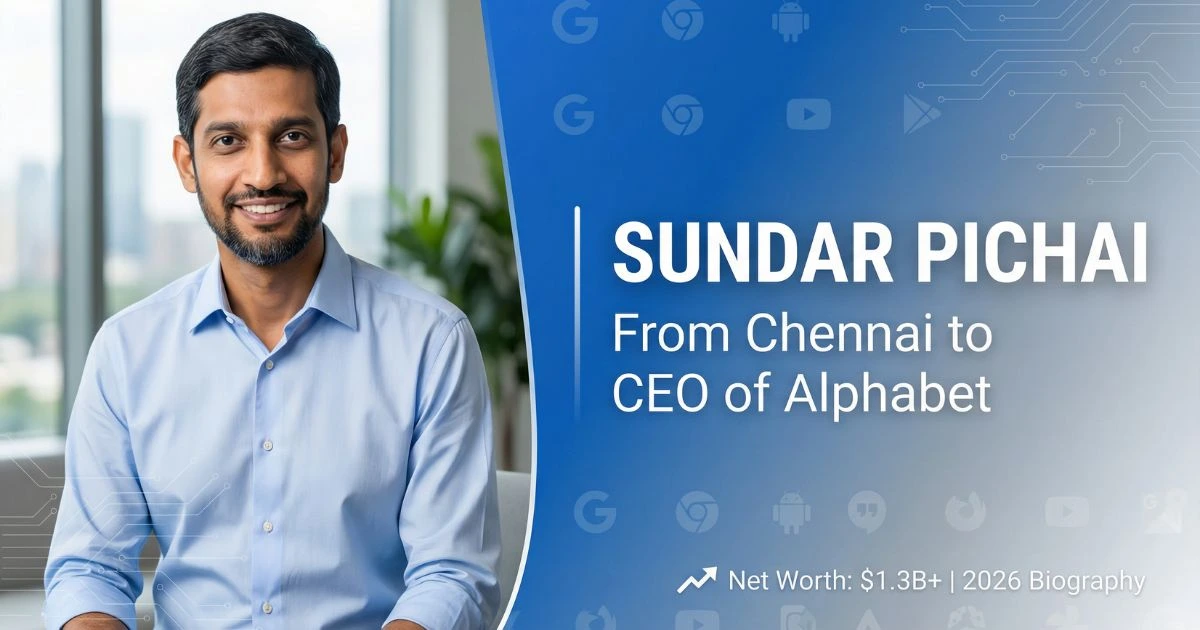
QUICK INFO BOX
| Attribute | Details |
|---|---|
| Full Name | Pichai Sundararajan |
| Nick Name | Sundar |
| Profession | Tech CEO / Business Executive |
| Date of Birth | June 10, 1972 |
| Age | 53 years (as of 2026) |
| Birthplace | Madurai, Tamil Nadu, India |
| Hometown | Chennai, Tamil Nadu, India |
| Nationality | American (Indian-born) |
| Religion | Hinduism |
| Zodiac Sign | Gemini |
| Ethnicity | South Asian (Tamil) |
| Father | Regunatha Pichai (Electrical Engineer) |
| Mother | Lakshmi Pichai (Stenographer) |
| Siblings | One younger brother |
| Wife/Partner | Anjali Pichai |
| Children | Two (Kavya and Kiran) |
| School | Jawahar Vidyalaya, Chennai |
| College / University | IIT Kharagpur, Stanford, Wharton |
| Degree | B.Tech (Metallurgical Engineering), MS (Material Sciences), MBA |
| First Company | Applied Materials (Product Manager) |
| Current Company | Alphabet Inc. |
| Position | CEO of Alphabet & Google |
| Industry | Tech / AI / Cloud Computing / Software |
| Known For | Leading Google & Alphabet, Chrome browser, Android OS, AI innovation |
| Years Active | 2004–Present (at Google/Alphabet) |
| Net Worth | ~$1.3 Billion (2026 est.) |
| Annual Income | $200M+ (salary + stock compensation) |
| Major Investments | Private tech startups, AI ventures |
| @sundarpichai | |
| Twitter/X | @sundarpichai |
| linkedin.com/in/sundarpichai |
1. Introduction
From a modest two-room apartment in Chennai to leading one of the world’s most powerful technology companies, Sundar Pichai’s journey represents the ultimate tech success story. As CEO of both Google and its parent company Alphabet Inc.—with a combined market valuation exceeding $2 trillion—Pichai oversees products used by billions globally, from Search and Android to YouTube and Google Cloud.
Who is Sundar Pichai? He’s the Indian-American executive who rose through Google’s ranks to become one of the most influential leaders in technology. Known for his calm demeanor, strategic vision, and product expertise, Pichai has steered Google through critical transformations including the mobile revolution, cloud computing expansion, and the current AI revolution.
Why is Sundar Pichai famous? Beyond leading Alphabet, Pichai championed products like Chrome (now the world’s dominant browser), Chrome OS, and oversaw Android’s evolution into the world’s most-used mobile operating system. Under his leadership, Google has aggressively pursued AI innovation with products like Gemini, competing directly with OpenAI and Microsoft.
In this comprehensive biography, you’ll discover Pichai’s remarkable rise from humble beginnings in India, his educational journey across three continents, career milestones at Google, leadership philosophy, net worth breakdown, and his low-key yet influential lifestyle in Silicon Valley.
2. Early Life & Background
Pichai Sundararajan was born on June 10, 1972, in Madurai, Tamil Nadu, India, and grew up in a modest middle-class family in Chennai. His father, Regunatha Pichai, worked as an electrical engineer at the British conglomerate GEC, while his mother, Lakshmi, was a stenographer before becoming a homemaker. The family lived in a cramped two-room apartment in Ashok Nagar, Chennai, without many modern luxuries.
Humble Beginnings: Pichai’s childhood was marked by simplicity—his family didn’t own a car or television until he was in his teens, and a telephone arrived when he was 12. Despite financial constraints, his parents prioritized education and fostered curiosity. Young Sundar showed exceptional memory from an early age, notably remembering every phone number he ever dialed.
Early Interest in Technology: His fascination with technology began when his father brought home components and circuit boards from work. Pichai would observe and ask questions, developing an intuitive understanding of how things worked. He excelled academically, particularly in mathematics and science, consistently ranking at the top of his class.
First Exposure to Innovation: As a student, Pichai was captivated by how technology could solve real-world problems. He spent hours reading about inventions and dreamed of creating products that millions would use. His intellectual curiosity and problem-solving abilities set him apart from peers.
Childhood Challenges: Growing up in modest circumstances taught Pichai the value of hard work and perseverance. The family’s limited resources meant sacrifices—his father saved for years to afford Sundar’s flight to the United States for graduate studies. These experiences instilled humility and gratitude that colleagues say remain defining traits today.
Role Models: Pichai deeply admired his father, whose dedication to engineering and integrity shaped his worldview. He also looked up to pioneers like scientists and innovators who used technology to improve lives globally.
3. Family Details
| Relation | Name | Profession |
|---|---|---|
| Father | Regunatha Pichai | Electrical Engineer (GEC) |
| Mother | Lakshmi Pichai | Stenographer (later homemaker) |
| Siblings | Younger brother | Information not public |
| Spouse | Anjali Pichai (née Haryani) | Chemical Engineer, homemaker |
| Children | Kavya Pichai | Student |
| Kiran Pichai | Student |
Marriage: Sundar met Anjali during his time at IIT Kharagpur, where she was also studying engineering. They maintained a long-distance relationship while he pursued graduate studies in the US, marrying later in a traditional ceremony. Anjali has been described as Sundar’s pillar of support throughout his career journey.
4. Education Background
School: Jawahar Vidyalaya, Chennai, India
Pichai attended this well-regarded Chennai school where he consistently achieved top marks, particularly excelling in science and mathematics. Teachers remember him as exceptionally bright and curious.
College: Indian Institute of Technology (IIT) Kharagpur (1989–1993)
Degree: Bachelor of Technology (B.Tech) in Metallurgical Engineering
Despite his interest in computers, Pichai pursued metallurgy—a decision influenced by career prospects at the time. He graduated with a silver medal and was captain of his class. At IIT, he balanced academics with sports, playing cricket and participating in technical competitions.
Graduate Studies – Stanford University (1993–1995)
Degree: Master of Science (MS) in Material Sciences and Engineering
Pichai won a scholarship to Stanford, though funding his journey required his family to spend nearly a year’s income on airfare. At Stanford, he shifted focus toward semiconductors and technology management, recognizing the explosive potential of Silicon Valley innovation.
Business School – Wharton School, University of Pennsylvania (2000–2002)
Degree: MBA (Master of Business Administration)
Pichai was named a Siebel Scholar and Palmer Scholar at Wharton, prestigious recognitions for academic excellence and leadership potential. The MBA equipped him with business strategy skills that proved crucial in his later executive roles.
Early Work Experience: Before Google, Pichai worked as an engineer and product manager at Applied Materials (a semiconductor equipment company) and then as a management consultant at McKinsey & Company, where he advised tech and telecom clients.
5. Entrepreneurial Career Journey
A. Joining Google – Early Career (2004–2008)
Joining Google: In 2004, Sundar Pichai joined Google as a product manager, initially working on the Google Toolbar—a browser plugin that brought Google Search to Internet Explorer and Firefox users. Though seemingly modest, this role proved pivotal.
First Major Contribution: Pichai recognized that relying on third-party browsers was risky and advocated for Google to build its own browser. Despite internal skepticism, he championed the idea persistently. This vision led to the creation of Google Chrome, launched in 2008.
Chrome’s Success: Chrome revolutionized web browsing with its speed, simplicity, and security. By 2026, Chrome commands over 65% global market share, becoming one of Google’s most strategically important products. Pichai’s foresight demonstrated his product instincts and long-term thinking.
B. Rise Through the Ranks (2008–2015)
Expanding Influence: Following Chrome’s success, Pichai took on increasing responsibilities:
- 2008–2011: Led development of Chrome OS, targeting the laptop market with cloud-based computing
- 2011: Promoted to Senior Vice President, overseeing Chrome and Apps
- 2013: Added Android to his portfolio after Andy Rubin’s departure, unifying Google’s mobile and browser strategies
Android Leadership: Under Pichai’s leadership, Android expanded rapidly in emerging markets, deepening integration with Google services. He championed Android One (affordable smartphones) and streamlined the fragmented ecosystem, strengthening Google’s mobile dominance.
Strategic Vision: Colleagues praised Pichai’s ability to bridge technical depth with business strategy. He fostered collaboration between previously siloed teams (Chrome, Android, Search) and earned trust across Google’s notoriously opinionated engineering culture.
C. Becoming Google CEO (2015)
Historic Appointment: On August 10, 2015, Google co-founders Larry Page and Sergey Brin announced a major restructuring, creating Alphabet Inc. as a holding company. Sundar Pichai was appointed CEO of Google, overseeing the core business (Search, Ads, YouTube, Android, Cloud).
Why Pichai? Page and Brin recognized Pichai’s exceptional product judgment, diplomatic leadership style, and ability to manage Google’s growing complexity. His appointment signaled continuity and focus on core products amid Alphabet’s diversification into “moonshot” ventures.
Early CEO Achievements:
- Accelerated investment in AI and machine learning
- Expanded Google Cloud to compete with Amazon AWS and Microsoft Azure
- Launched Google Assistant and Pixel smartphone line
- Navigated regulatory scrutiny and privacy concerns
D. Alphabet CEO & Current Leadership (2019–Present)
Dual Role: In December 2019, Page and Brin stepped back from day-to-day operations, appointing Pichai as CEO of both Google and Alphabet. This unprecedented move made him one of the most powerful executives in global technology.
Major Initiatives Under Pichai:
- AI Revolution: Positioned Google as a leader in artificial intelligence
- Launched Gemini (formerly Bard), competing with ChatGPT
- Integrated AI across Search, Gmail, Docs, and other products
- Invested heavily in DeepMind and AI research
- Cloud Computing Growth: Google Cloud reached $35+ billion annual revenue by 2025, becoming a major profit center
- Privacy & Regulation: Managed antitrust lawsuits, privacy regulations (GDPR, CCPA), and congressional testimony while maintaining growth
- Quantum Computing: Achieved quantum supremacy milestones, advancing next-generation computing
- Cost Optimization: In 2023, laid off 12,000 employees (6% of workforce) to streamline operations amid economic uncertainty—a difficult but necessary decision
Current Focus (2026): Pichai is steering Alphabet through the AI transformation, competing intensely with Microsoft/OpenAI and emerging challengers while defending market position against antitrust actions.
6. Career Timeline Chart
📅 CAREER TIMELINE

2004 ─── Joined Google as Product Manager
   │
2008 ─── Launched Google Chrome browser
   │
2013 ─── Took over Android, unifying mobile strategy
   │
2015 ─── Appointed CEO of Google
   │
2019 ─── Became CEO of Alphabet Inc.
   │
2023 ─── Led AI transformation with Gemini/Bard launch
   │
2026 ─── Continues leading Alphabet through AI revolution
7. Business & Company Statistics
| Metric | Value |
|---|---|
| Companies Founded | 0 (Executive, not founder) |
| Current Company Valuation | $2+ Trillion (Alphabet Inc.) |
| Revenue (Annual 2025) | $350+ Billion |
| Employees | ~180,000+ |
| Countries Operated | 190+ countries |
| Market Share | Search: ~92%, Mobile OS (Android): ~70% |
8. CEO Comparison Section
📊 Sundar Pichai vs Satya Nadella
| Statistic | Sundar Pichai (Alphabet) | Satya Nadella (Microsoft) |
|---|---|---|
| Net Worth | ~$1.3 Billion | ~$1 Billion |
| Company Market Cap | $2+ Trillion | $3+ Trillion |
| Annual Compensation | $200M+ | $50M+ |
| Years as CEO | 11 years (Google), 7 (Alphabet) | 12 years |
| Innovation Impact | AI, Chrome, Android, Cloud | Azure, AI, Cloud transformation |
| Global Influence | Search & mobile dominance | Enterprise & productivity leader |
Winner: Both leaders have transformed their respective companies, but Nadella slightly edges in market cap growth and enterprise transformation, while Pichai commands broader consumer reach through Search, Android, and YouTube. Their parallel journeys from India to leading trillion-dollar companies inspire millions globally.
9. Leadership & Work Style Analysis
Leadership Philosophy: Pichai is known for his consensus-driven, collaborative approach. Unlike aggressive, visionary CEOs, he excels at listening, building consensus, and empowering teams. Former colleagues describe him as someone who makes others feel heard and valued.
Decision-Making Style: Analytical and deliberate. Pichai thoroughly examines data, consults diverse perspectives, and considers long-term implications before major decisions. This methodical approach sometimes draws criticism for being slow, but supporters argue it prevents costly mistakes.
Risk-Taking Ability: Moderate to calculated. While not known for bold, disruptive bets like Elon Musk, Pichai takes strategic risks—investing billions in AI, challenging Amazon in cloud, and launching hardware (Pixel). He balances innovation with protecting Google’s core revenue streams (Search, Ads).
Innovation Mindset: Product-first thinking. Pichai believes great products solve real problems elegantly. His focus on user experience, simplicity, and accessibility has guided Google’s product evolution. He champions “10x thinking”—solving problems 10 times better, not just incrementally.
Strengths:
- Exceptional product intuition and technical depth
- Strong interpersonal skills and emotional intelligence
- Ability to manage complex organizations and bridge divides
- Calm under pressure, maintaining composure during crises
- Diplomatic in navigating regulatory and political challenges
Weaknesses:
- Sometimes criticized for being too cautious or slow to act
- Faces challenges with workplace culture issues (employee activism, layoffs)
- Struggles with balancing innovation against regulatory constraints
- Perceptions of Google losing ground to Microsoft/OpenAI in AI race initially
Expert Quotes:
“Sundar has this unique ability to take a complex problem, break it down, and explain it simply. That’s a rare gift.” – Former Google executive
“He’s not the loudest voice in the room, but he’s often the smartest. People underestimate him at their peril.” – Tech industry analyst
10. Achievements & Awards
Business & Tech Awards
- CEO of the Year – Multiple publications (2015, 2020)
- Fortune’s Businessperson of the Year (2016)
- Financial Times’ Person of the Year (2016)
- Global Leadership Award – US-India Business Council (2019)
Global Recognition
- Time 100 Most Influential People (2016, 2020)
- Forbes World’s Most Powerful People – Consistently ranked in top 50
- Padma Bhushan – India’s third-highest civilian honor (2022)
Records Held
- One of the highest-paid executives globally (compensation exceeding $200M annually)
- First person of Indian origin to lead a trillion-dollar tech company (alongside Microsoft’s Satya Nadella)
- Oversaw Chrome’s rise from 0% to 65%+ global browser market share
11. Net Worth & Earnings
💰 FINANCIAL OVERVIEW
| Year | Net Worth (Est.) |
|---|---|
| 2023 | $1.1 Billion |
| 2024 | $1.2 Billion |
| 2025 | $1.3 Billion |
| 2026 | $1.3+ Billion |
Income Sources
- Company Equity: Majority of wealth comes from Alphabet stock holdings and vested RSUs (Restricted Stock Units)
- Salary & Bonuses: Base salary ~$2M, with performance bonuses bringing annual cash compensation to $10M+
- Stock Compensation: Annual stock awards ranging $180M–$240M based on performance
- Investments: Private investments in AI startups and tech ventures (details private)
- Board Memberships: Limited external roles to focus on Alphabet
Major Investments
- AI & Machine Learning Startups (specific companies undisclosed)
- Education Technology ventures in India
- Clean Energy projects (personal interest)
Note: Pichai’s compensation peaked at $281 million in 2019, making him one of the world’s highest-paid CEOs. However, his actual liquid wealth is more modest compared to founder-CEOs like Zuckerberg or Musk, since most compensation is stock-based and subject to vesting schedules.
12. Lifestyle Section
🏠 ASSETS & LIFESTYLE
Properties:
- Los Altos Hills Mansion, California – $40+ million estate in Silicon Valley’s most exclusive neighborhood, featuring swimming pool, home theater, and expansive grounds
- Apartment in Chennai, India – Maintains property in hometown for family visits
Cars Collection: Pichai maintains a surprisingly modest car collection compared to tech billionaire peers:
- Tesla Model S (~$100K) – Daily driver
- BMW 7-Series (~$90K) – Family vehicle
- Porsche Taycan (~$150K) – Personal favorite
Hobbies:
- Reading: Voracious reader of fiction, history, and technology books
- Cricket: Avid cricket fan, follows Indian Premier League closely
- Travel: Enjoys family vacations in Europe and India
- Fitness: Regular gym-goer and walking enthusiast
Daily Routine:
- Work Hours: Typically 8 AM–7 PM, with evening calls for global teams
- Productivity Habits: Starts mornings reading news and emails; blocks deep work time; known for extensive preparation before meetings
- Family Time: Prioritizes dinner with family when possible; weekends reserved for children’s activities
Personality: Despite immense wealth and power, Pichai maintains a remarkably low profile. He avoids flashy displays, doesn’t seek media attention, and colleagues describe him as “the same humble person he was 20 years ago.”
13. Physical Appearance
| Attribute | Details |
|---|---|
| Height | 5’11” (180 cm) |
| Weight | ~165 lbs (75 kg) |
| Eye Color | Dark Brown |
| Hair Color | Black (graying) |
| Body Type | Average/Athletic build |
Style: Professional business casual—typically seen in button-down shirts, dark jeans or slacks, and sneakers. Rarely wears traditional suits except for formal events or government meetings.
14. Mentors & Influences
Early Mentors:
- Parents (Regunatha & Lakshmi Pichai): Instilled values of hard work, education, and humility
- IIT Professors: Encouraged pursuing opportunities abroad
Business Idols:
- Larry Page & Sergey Brin: Google co-founders who promoted Pichai and entrusted him with their legacy
- Eric Schmidt: Former Google CEO who mentored Pichai in executive leadership
Key Advisors:
- Ruth Porat: Alphabet CFO, close collaborator on financial strategy
- Sundar Maddan: Long-time friend and advisor (engineering background)
Leadership Lessons Learned:
- “It’s important to follow your dreams and heart. Do something that excites you.” – Core belief from his journey
- “Wear your failure as a badge of honor.” – Learned resilience from setbacks
- Importance of listening more than speaking—developed through years observing effective leaders
15. Company Ownership & Roles
| Company | Role | Years |
|---|---|---|
| Google LLC | CEO | 2015–Present |
| Alphabet Inc. | CEO | 2019–Present |
| Alphabet Board of Directors | Member | 2017–Present |
Stock Ownership: Pichai owns less than 1% of Alphabet (approximately 0.03%), as the company is publicly traded with dispersed ownership. Co-founders Page and Brin retain significant voting control through super-voting shares.
16. Controversies & Challenges
1. Antitrust & Regulatory Scrutiny (Ongoing)
- Issue: Google faces multiple antitrust lawsuits in US and EU alleging monopolistic practices in search, advertising, and app distribution
- Pichai’s Response: Testified before Congress multiple times, defending Google’s practices while committing to cooperation
- Status: Cases ongoing; potential outcomes include fines or business restructuring
2. Employee Activism & Walkouts (2018–2020)
- Issue: Thousands of Google employees protested handling of sexual harassment cases and controversial government contracts
- Pichai’s Response: Ended forced arbitration for harassment cases, increased transparency
- Criticism: Some felt responses were insufficient; tensions around workplace culture persist
3. Project Dragonfly – Censored Search in China (2018)
- Issue: Internal revolt over secretive plan to build censored search engine for Chinese market
- Pichai’s Response: Project was eventually shelved amid backlash
- Lesson: Reinforced need for transparency in ethically sensitive decisions
4. Mass Layoffs (2023)
- Issue: Laid off 12,000 employees (6%) amid economic uncertainty and overhiring
- Pichai’s Response: Took responsibility publicly, acknowledging misjudgment in growth projections
- Impact: Necessary for cost control but damaged morale and public perception
5. AI Competition Concerns (2023–2024)
- Issue: Critics claimed Google was slow responding to ChatGPT, losing AI leadership to Microsoft/OpenAI
- Pichai’s Response: Accelerated AI product launches (Bard/Gemini), restructured teams, increased investment
- Status: Google has since regained competitive ground with Gemini models
Lessons Learned: Pichai’s tenure demonstrates the challenges of leading a massive organization under intense scrutiny. He’s evolved from avoiding controversy to addressing issues more directly, though critics argue he could be more decisive.
17. Charity & Philanthropy
Foundations & Initiatives:
- Google.org: Oversees Google’s philanthropic arm, funding education, crisis response, and economic opportunity initiatives
- Personal Giving: Reportedly donates millions privately, though specific amounts aren’t publicized
- IIT Kharagpur Donations: Contributed to infrastructure and scholarships at his alma mater
Causes Supported:
- Education: Funds computer science education globally, particularly in India and underserved US communities
- COVID-19 Relief: Google committed $800M+ for pandemic response, small business support
- Climate & Sustainability: Alphabet’s commitment to carbon neutrality and renewable energy
- Digital Literacy: Initiatives training people in digital skills across developing nations
Notable Commitments:
- Google Career Certificates: Providing free job training in high-demand fields
- Grow with Google: Training millions in digital skills globally
- STEM Education: Funding coding programs in schools
Philosophy: Pichai believes technology should be accessible and beneficial to everyone, driving initiatives that democratize access to information and opportunity.
18. Personal Interests
| Category | Favorites |
|---|---|
| Food | South Indian cuisine (dosa, idli), Italian food |
| Movie | Enjoys Christopher Nolan films, Indian cinema |
| Book | The Remains of the Day by Kazuo Ishiguro; biographies of leaders |
| Travel Destination | India (hometown Chennai), Japan, Switzerland |
| Technology | AI innovations, quantum computing advancements |
| Sport | Cricket (huge fan), soccer |
Fun Fact: Despite leading one of the world’s most powerful companies, Pichai remains an avid cricket enthusiast and rarely misses major India matches. He’s been spotted at cricket stadiums and follows Indian Premier League closely.
19. Social Media Presence
| Platform | Handle | Followers (2026 est.) |
|---|---|---|
| N/A | Not publicly active | |
| Twitter/X | @sundarpichai | 6+ Million |
| linkedin.com/in/sundarpichai | 3+ Million | |
| YouTube | N/A | Appears in Google/Alphabet videos |
Social Media Strategy: Pichai maintains a professional, measured social media presence. He primarily uses Twitter/X for official Google/Alphabet announcements, industry commentary, and occasional personal reflections. He avoids controversy and political debates, focusing on technology and leadership topics.
Notable Posts: Product launches, AI developments, responses to major news, and occasional personal stories (like remembering his journey from India).
20. Recent News & Updates (2025–2026)
January 2026 – Gemini Ultra 2.0 Launch
Alphabet announced major upgrades to its Gemini AI model, showcasing capabilities rivaling GPT-5 in reasoning and multimodal tasks. Pichai emphasized Google’s commitment to “responsible AI leadership.”
December 2025 – Quantum Computing Breakthrough
Google Quantum AI achieved error-correction milestone, bringing practical quantum computing closer. Pichai called it “one of the most significant technical achievements in Alphabet’s history.”
November 2025 – Regulatory Victory
EU reduced proposed fines against Google in Shopping antitrust case from €2.4B to €1.5B following appeals. Pichai expressed relief but acknowledged “ongoing need for regulatory dialogue.”
October 2025 – Google Cloud Profit Milestone
Google Cloud reported first-ever annual profit ($5B+), validating Pichai’s multi-billion dollar investment strategy against Amazon AWS and Microsoft Azure.
September 2025 – AI Safety Council
Pichai announced formation of external AI Safety Council with ethicists, researchers, and policymakers to guide responsible AI development amid growing concerns.
Future Plans (2026–2027):
- Continue AI integration across all Google products
- Expand Google Cloud internationally, targeting emerging markets
- Launch new Pixel devices with advanced AI features
- Navigate antitrust remedies while maintaining growth
- Invest in next-generation computing (quantum, AI chips)
21. Lesser-Known Facts
- Remembered Every Number: As a child, Pichai possessed photographic memory for phone numbers—he could recall every number he ever dialed, impressing family and friends.
- Almost Worked for Twitter: In 2011, Twitter reportedly tried to recruit Pichai as CPO (Chief Product Officer), but Google promoted him and increased compensation to retain him.
- Cricket Captain Dream: Young Sundar wanted to be Indian cricket captain before realizing his strengths lay in academics and technology.
- First Flight Experience: Pichai’s first airplane ride was to the United States at age 21 for Stanford, having never flown before.
- Metallurgy Background: Despite leading a software company, Pichai’s undergraduate degree was in metallurgical engineering—unusual for a tech CEO.
- McKinsey Stint: Before Google, he worked at McKinsey & Company, advising tech clients on strategy.
- Chrome Origin Story: Pichai pitched Chrome browser internally for years before getting approval, facing skepticism it would cannibalize Firefox partnership.
- Low-Key Lifestyle: Worth over $1 billion, Pichai drives himself to work and maintains surprisingly modest lifestyle compared to tech billionaire peers.
- Family Values: Insisted on maintaining work-life balance despite CEO demands; prioritizes family dinners and children’s school events.
- Language Skills: Fluent in English, Tamil, and Hindi; studied some Spanish and German.
- Nickname Origin: “Sundar” means “beautiful” or “handsome” in Tamil/Hindi—fitting for someone colleagues describe as having “beautiful problem-solving abilities.”
- Early Google Doubts: Pichai initially had reservations about joining Google in 2004, worried it was “just a search company.” Friends convinced him of its potential.
- Scholarship Pressure: Siebel and Palmer Scholar designations at Wharton came with immense pressure to excel—Pichai graduated top of class.
- Meditation Practice: Practices occasional meditation and mindfulness exercises to manage stress.
- Favorite Indian Dish: Cannot resist good dosa (South Indian crepe) and remains loyal to Tamil cuisine despite global exposure.
22. FAQs
Who is Sundar Pichai?
Sundar Pichai is the CEO of Alphabet Inc. and Google, leading one of the world’s most valuable technology companies. Born in India in 1972, he joined Google in 2004, championed products like Chrome browser and Android, and became CEO of Google in 2015 and Alphabet in 2019.
What is Sundar Pichai’s net worth in 2026?
Sundar Pichai’s net worth is estimated at approximately $1.3 billion in 2026, primarily from Alphabet stock holdings and annual compensation exceeding $200 million.
How did Sundar Pichai start his career at Google?
Pichai joined Google in 2004 as a product manager working on the Google Toolbar. He championed the idea of building Chrome browser, which launched in 2008 and became globally dominant. This success propelled his rise through Google’s leadership ranks.
Is Sundar Pichai married?
Yes, Sundar Pichai is married to Anjali Pichai, his college sweetheart from IIT Kharagpur. They have two children together, Kavya and Kiran, and maintain a private family life in California.
What companies does Sundar Pichai lead?
Sundar Pichai serves as CEO of both Google LLC and its parent company Alphabet Inc., overseeing products including Google Search, YouTube, Android, Chrome, Google Cloud, and AI initiatives like Gemini.
What is Sundar Pichai’s educational background?
Pichai earned a B.Tech in Metallurgical Engineering from IIT Kharagpur (India), an MS in Material Sciences from Stanford University (USA), and an MBA from Wharton School, University of Pennsylvania.
What are Sundar Pichai’s major achievements?
Major achievements include launching Chrome browser (now 65%+ market share), leading Android OS globally, steering Google through AI transformation with Gemini, growing Google Cloud to $35B+ revenue, and becoming first person of Indian origin to lead both Google and Alphabet.
How much does Sundar Pichai earn annually?
Sundar Pichai’s annual compensation exceeds $200 million, including base salary (~$2M), bonuses, and stock awards. His compensation peaked at $281 million in 2019.
Where does Sundar Pichai live?
Sundar Pichai resides in Los Altos Hills, California, in a $40+ million mansion in Silicon Valley. He also maintains property in his hometown Chennai, India.
What is Sundar Pichai known for?
Sundar Pichai is known for his product expertise (Chrome, Android), calm and diplomatic leadership style, navigating regulatory challenges, leading Google/Alphabet’s AI transformation, and his inspiring journey from modest beginnings in India to leading a trillion-dollar company.
23. Conclusion
Sundar Pichai’s journey from a two-room apartment in Chennai to the helm of a $2 trillion technology empire represents one of the most remarkable leadership stories in modern business history. His path—marked by excellence at every stage, from IIT Kharagpur to Stanford to Google—demonstrates that exceptional talent, humility, and perseverance can overcome any barrier.
Career Recap: Over two decades at Google/Alphabet, Pichai transformed from product manager to CEO, championing products that billions use daily. Chrome revolutionized web browsing, Android democratized smartphones, and now Gemini AI positions Google for the next computing paradigm. His leadership through regulatory scrutiny, employee activism, technological disruption showcases resilience and strategic acumen.
Impact on Tech Industry: Pichai’s influence extends beyond Alphabet. His success, alongside Satya Nadella at Microsoft, has inspired millions in India and globally, proving that immigrants and diverse leaders bring immense value to technology. His emphasis on responsible AI development, accessibility, and ethical technology sets important precedents.
Leadership Legacy: Unlike founder-CEOs who dominate headlines, Pichai leads through collaboration, consensus, and empowering others. His “quiet strength” approach may seem less glamorous but has proven effective managing one of the world’s most complex organizations through unprecedented challenges.
Future Outlook: As artificial intelligence reshapes computing, Pichai faces perhaps his greatest leadership test—competing with Microsoft/OpenAI, managing regulatory constraints, and maintaining Google’s dominance. His deliberate, product-focused approach will be critical as Alphabet navigates this transformation.
From remembering phone numbers in Chennai to steering the AI revolution from Silicon Valley, Sundar Pichai’s story reminds us that origin doesn’t determine destination. His journey inspires the next generation of technologists, leaders, and dreamers worldwide.
👉 What aspect of Sundar Pichai’s leadership inspires you most? Share your thoughts in the comments, and explore more inspiring tech entrepreneur stories on our site!