QUICK INFO BOX
| Attribute | Details |
|---|---|
| Full Name | Vinod Khosla |
| Nick Name | Vinod |
| Profession | Venture Capitalist / Tech Entrepreneur / Investor |
| Date of Birth | January 28, 1955 |
| Age | 71 years (as of 2026) |
| Birthplace | Pune, Maharashtra, India |
| Hometown | New Delhi, India |
| Nationality | American (Indian-born) |
| Religion | Hindu |
| Zodiac Sign | Aquarius |
| Ethnicity | Indian |
| Father | Officer in Indian Army |
| Mother | Homemaker |
| Siblings | Three siblings |
| Wife/Partner | Neeru Khosla (m. 1980) |
| Children | Four children |
| School | Mount St. Mary’s School, New Delhi |
| College / University | IIT Delhi, Carnegie Mellon University, Stanford GSB |
| Degree | B.Tech (Electrical Engineering), MS, MBA |
| First Startup | Daisy Systems |
| Current Company | Khosla Ventures |
| Position | Founder & Managing Partner |
| Industry | Venture Capital / CleanTech / AI / Biotech |
| Known For | Co-founding Sun Microsystems, Green tech investing |
| Years Active | 1980–Present (46 years) |
| Net Worth | $7.5 Billion (2026 estimate) |
| Annual Income | $200–300 Million |
| Major Investments | Square, Affirm, Instacart, OpenAI, Impossible Foods |
| Not publicly active | |
| Twitter/X | @vkhosla |
| vinod-khosla |
1. Introduction
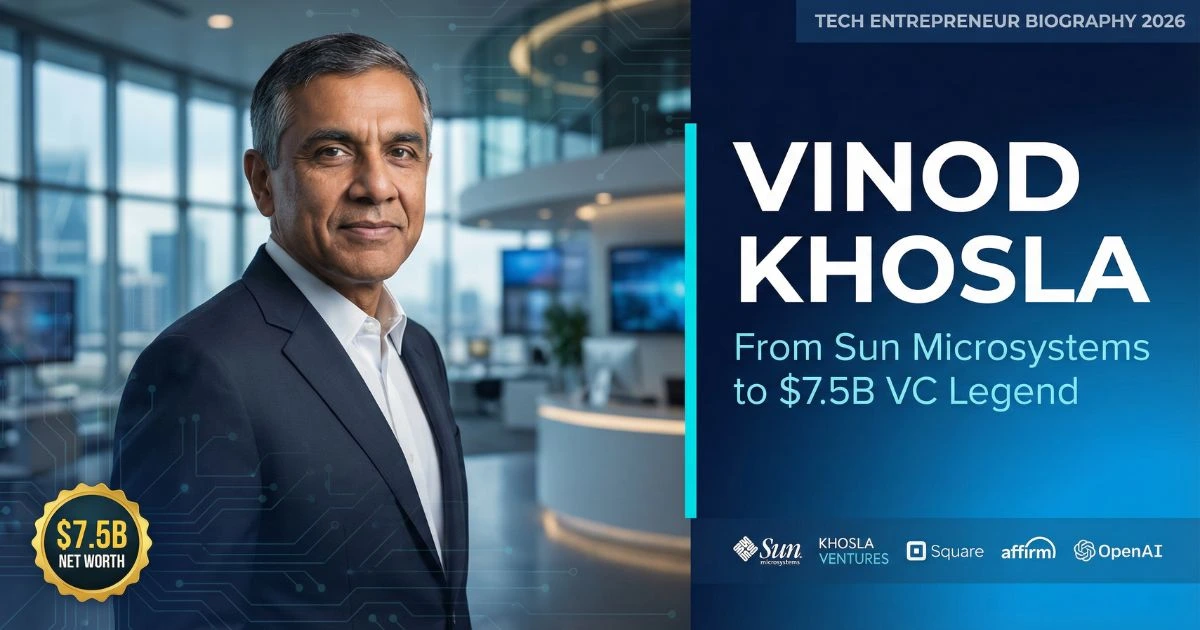
When a 20-year-old engineering student in India read about Intel’s founding in an electronics magazine, it sparked a dream that would reshape Silicon Valley. That student was Vinod Khosla, who went on to co-found Sun Microsystems, one of the most influential computer companies of the 1980s and 90s, and later became one of venture capital’s most successful and contrarian investors.
Vinod Khosla is a pioneering technology entrepreneur and venture capitalist whose bold bets on clean energy, artificial intelligence, and disruptive technologies have defined modern innovation. As the founder of Khosla Ventures, he has backed revolutionary companies like Square, Affirm, DoorDash, and Impossible Foods, earning a reputation for investing in “black swan” technologies that others dismiss as impossible.
Khosla is famous in the tech world for his fearless approach to investing, his focus on solving humanity’s biggest challenges through technology, and his willingness to fund moonshot ideas years before they become mainstream. From pioneering workstation computing at Sun Microsystems to championing renewable energy decades ahead of the market, Khosla has consistently been at the forefront of technological revolution.
In this comprehensive biography, readers will discover Khosla’s journey from a middle-class family in India to becoming a billionaire venture capitalist, his founding story at Sun Microsystems, his investment philosophy and major wins, his estimated $7.5 billion net worth breakdown, his controversial battles and bold predictions, and his lifestyle as one of Silicon Valley’s most influential power brokers.
2. Early Life & Background
Vinod Khosla was born on January 28, 1955, in Pune, Maharashtra, India, into a middle-class family with no business background. His father served as an officer in the Indian Army, which meant the family moved frequently across different military postings throughout India. His mother was a homemaker who managed the household while his father was away on duty.
Growing up in the 1960s and early 1970s in India, Khosla experienced a childhood far removed from the technology revolution that would later define his life. The family lived modestly, and young Vinod attended Mount St. Mary’s School in New Delhi, where he proved to be an exceptional student with a particular aptitude for mathematics and science.
Khosla’s pivotal moment came at age 16 when he read an article about the founding of Intel in an electronics magazine. The story of how Andy Grove, Gordon Moore, and Robert Noyce had started a company that would revolutionize computing captivated him completely. He became obsessed with the idea of entrepreneurship and technology, even though India in the early 1970s had virtually no startup ecosystem or exposure to such concepts.
His first exposure to technology came through his engineering education, but his interest in business and startups was self-taught through voracious reading of American business magazines and whatever technical publications he could find. This was challenging in pre-internet India, where access to information about Silicon Valley was extremely limited.
The young Khosla faced significant challenges, including the lack of a business environment in India, limited access to information about entrepreneurship, and the overwhelming pressure from his family and society to pursue a traditional engineering career in a large corporation or government job. However, his determination to follow the entrepreneurial path remained unshaken.
Khosla’s first business ideas emerged during his college years, though none materialized into actual ventures at that time. His motivation came from a deep desire to create something impactful and to escape what he saw as the limitations of a conventional career path. He drew inspiration from the Intel founders and other Silicon Valley pioneers, dreaming of one day making his mark in the technology world.
3. Family Details
| Relation | Name | Profession |
|---|---|---|
| Father | Not publicly disclosed | Indian Army Officer |
| Mother | Not publicly disclosed | Homemaker |
| Siblings | Three siblings (names not public) | Various professions |
| Spouse | Neeru Khosla | Philanthropist, Founder of CK12 Foundation |
| Children | Four children (names private) | Various fields including tech |
4. Education Background
Vinod Khosla’s educational journey reflects both exceptional academic achievement and strategic career planning. He attended Mount St. Mary’s School in New Delhi, one of India’s premier educational institutions, where he excelled in science and mathematics. His outstanding performance in secondary school earned him admission to the Indian Institute of Technology (IIT) Delhi, widely considered one of the world’s most selective and rigorous engineering programs.
At IIT Delhi, Khosla pursued a Bachelor of Technology degree in Electrical Engineering from 1972 to 1976. The IIT system is renowned for producing some of the world’s top engineers and entrepreneurs, and Khosla thrived in its demanding environment. His time at IIT Delhi not only provided him with a strong technical foundation but also connected him with a network of brilliant minds who would later populate Silicon Valley.
However, Khosla knew that to achieve his entrepreneurial dreams, he needed to get to America. After graduating from IIT Delhi in 1976, he applied to graduate programs in the United States and was accepted to Carnegie Mellon University, where he earned a Master of Science degree in Biomedical Engineering. This move to America was his first major step toward Silicon Valley.
Recognizing that technical skills alone wouldn’t be sufficient for his entrepreneurial ambitions, Khosla then applied to Stanford’s Graduate School of Business. He was admitted to Stanford GSB, where he earned his MBA in 1980. Stanford proved to be transformative, not just for the business education, but for the proximity to Silicon Valley’s emerging startup ecosystem and the network of future entrepreneurs and investors he met there.
Unlike many famous tech entrepreneurs, Khosla did not drop out of any of his programs. He strategically completed his education, understanding that the credentials and networks from IIT, Carnegie Mellon, and Stanford would open doors in the highly competitive world of technology entrepreneurship.
During his time at Stanford, Khosla was already deeply involved in startup ideas and spent considerable time networking with entrepreneurs and venture capitalists in the Bay Area. He balanced his coursework with active participation in the entrepreneurial community, attending startup events and seeking out mentors who could guide his transition from student to founder.
5. Entrepreneurial Career Journey
A. Early Career & First Startup
Immediately after graduating from Stanford Business School in 1980, Vinod Khosla didn’t waste time. His first venture was Daisy Systems, a computer-aided design software company that he co-founded. Daisy Systems focused on electronic design automation tools, a niche but growing market in the early 1980s as semiconductor and electronics companies needed sophisticated software to design increasingly complex chips and systems.
The initial funding for Daisy came from venture capital firms that were just beginning to see the potential of specialized software for the technology industry. However, Khosla’s time at Daisy was marked by struggles common to first-time entrepreneurs: internal conflicts among co-founders, challenges in product-market fit, and the intense pressure of managing a startup with limited resources. While Daisy would eventually go public, Khosla’s experience there taught him valuable lessons about team dynamics, the importance of clear vision, and the brutal realities of startup execution.
His first significant failure came through the challenges at Daisy, where personality conflicts and strategic disagreements among the founding team created dysfunction. Khosla learned that brilliant ideas and talented individuals weren’t enough—alignment on vision and execution was critical. This lesson would profoundly shape his later approach both as an entrepreneur and as an investor.
B. Breakthrough Phase
The real breakthrough in Khosla’s career came in 1982 when, at just 27 years old, he co-founded Sun Microsystems along with Andy Bechtolsheim, Bill Joy, and Scott McNealy. The company’s name stood for “Stanford University Network,” reflecting its origins in Stanford’s computer science program. Sun Microsystems was built on a revolutionary idea: creating powerful workstation computers that could network together, challenging the dominance of mainframe and minicomputers.
Khosla served as Sun’s first CEO and chairman, providing the strategic vision and business leadership while his co-founders brought deep technical expertise. The company’s founding product was based on Andy Bechtolsheim’s workstation design from Stanford, combined with Bill Joy’s Berkeley Unix operating system and networking software. Khosla’s role was to turn these technical innovations into a viable business.
The product launch was remarkably successful. Sun’s workstations offered performance that rivaled much more expensive minicomputers at a fraction of the cost, making them attractive to universities, research labs, and engineering companies. The company’s revenue grew explosively, reaching millions in its first year and accelerating from there. Sun’s early adoption of open standards and networking capabilities positioned it perfectly for the coming internet era.
Key investors quickly recognized Sun’s potential. The company received backing from prestigious venture capital firms including Kleiner Perkins, the legendary firm where Khosla would later become a partner. This relationship with John Doerr and Kleiner Perkins would prove instrumental in Khosla’s career trajectory. Strategic partnerships with software developers, semiconductor companies, and corporate customers helped Sun establish itself as a leader in technical computing.
C. Expansion & Global Impact
Under the leadership team that Khosla helped assemble, Sun Microsystems scaled rapidly throughout the 1980s. Khosla stepped down as CEO in 1984, making way for Scott McNealy to take the operational reins while Khosla remained deeply involved in strategy. The company expanded its product line from workstations to servers, developed the Java programming language, and became a foundational player in the internet infrastructure boom of the 1990s.
Sun went public in 1986 with a valuation that made Khosla, still in his early thirties, a wealthy man. The company’s international expansion was aggressive, with Sun establishing operations across Europe, Asia, and other global markets. Sun’s technology became the backbone of countless internet companies, scientific research institutions, and financial services firms.
Khosla’s leadership role and vision at Sun established him as one of Silicon Valley’s rising stars. However, in 1986, Khosla made a bold career transition. He left Sun Microsystems to join Kleiner Perkins Caufield & Byers as a general partner, shifting from entrepreneur to venture capitalist. This move was unusual at the time—most successful entrepreneurs either stayed with their companies or started new ones rather than moving into investing.
At Kleiner Perkins from 1986 to 2004, Khosla became one of venture capital’s most successful investors. He led investments in numerous successful technology companies including Juniper Networks, Cerent, and Siara Systems. His track record for identifying and backing winning companies was exceptional, and he developed a reputation for supporting visionary founders pursuing ambitious technical challenges.
In 2004, Khosla made another significant transition. He left Kleiner Perkins to found his own venture capital firm, Khosla Ventures. This move gave him complete independence to pursue his increasingly contrarian investment thesis focused on clean energy, artificial intelligence, and other transformative technologies that the mainstream venture capital community was largely avoiding.
Since founding Khosla Ventures, Khosla has backed over 300 companies across multiple sectors. His portfolio includes massive successes like Square (now Block), which revolutionized mobile payments; Affirm, the buy-now-pay-later leader founded by PayPal co-founder Max Levchin; DoorDash, the food delivery giant; Instacart, the grocery delivery platform; Impossible Foods, which pioneered plant-based meat alternatives; and early investments in OpenAI before its explosion in prominence with ChatGPT.
6. Career Timeline Chart
📅 CAREER TIMELINE

1976 ─── Graduated from IIT Delhi
   │
1980 ─── MBA from Stanford, Co-founded Daisy Systems
   │
1982 ─── Co-founded Sun Microsystems, became CEO (age 27)
   │
1986 ─── Sun Microsystems IPO, Joined Kleiner Perkins
   │
1995 ─── Major investments in internet infrastructure companies
   │
2004 ─── Founded Khosla Ventures
   │
2010 ─── Major push into clean energy and climate tech
   │
2015 ─── Portfolio companies Square and Affirm going public
   │
2023 ─── OpenAI investment proves prescient with ChatGPT boom
   │
2026 ─── Leading AI and climate tech investments globally
7. Business & Company Statistics
| Metric | Value |
|---|---|
| Companies Founded | 3+ (Sun Microsystems, Khosla Ventures, others) |
| Current Valuation | Khosla Ventures: $15+ billion in assets under management |
| Portfolio Revenue (Annual) | Portfolio companies: $50+ billion combined |
| Employees | Khosla Ventures: ~50 investment professionals |
| Countries Operated | Global portfolio spanning 20+ countries |
| Market Share | Leading clean tech VC, top 10 overall VC firm |
8. Entrepreneur Comparison Section
📊 Vinod Khosla vs Marc Andreessen
| Statistic | Vinod Khosla | Marc Andreessen |
|---|---|---|
| Net Worth | $7.5 Billion | $1.7 Billion |
| Companies Founded | Sun Microsystems, Khosla Ventures | Netscape, Andreessen Horowitz |
| Unicorns Built/Funded | 20+ unicorns | 15+ unicorns |
| Innovation Impact | Clean tech, AI, workstations | Web browsers, software eating world |
| Global Influence | Climate change pioneer | Tech policy influencer |
Winner: Khosla edges ahead in net worth and longer track record, having operated at the highest levels for over four decades. His willingness to invest in controversial and technically challenging areas like clean energy and synthetic biology before they were fashionable demonstrates a higher risk tolerance and longer-term vision. Andreessen has had enormous impact on software and internet infrastructure, but Khosla’s influence spans both the hardware revolution (Sun Microsystems) and the current climate and AI transitions. Both are legendary, but Khosla’s combination of operating experience and investing success across multiple technology eras gives him a slight overall edge.
9. Leadership & Work Style Analysis
Vinod Khosla’s leadership philosophy centers on what he calls “black swan” thinking—seeking out investments and opportunities that most people consider impossible or impractical. He believes that the biggest returns come from backing ideas that are widely dismissed by conventional wisdom. This contrarian approach has defined both his successes and his willingness to endure criticism when his bets don’t pay off.
His decision-making style is highly analytical yet willing to embrace uncertainty. Khosla is known for spending extensive time with founders, diving deep into technical details and challenging assumptions. He asks probing questions designed to expose weaknesses in thinking but also to understand whether founders have the intellectual honesty and adaptability to succeed. He values founders who can articulate not just why their idea will work, but what could go wrong and how they’ll respond.
Risk-taking ability is perhaps Khosla’s defining characteristic. While at Kleiner Perkins and especially after founding Khosla Ventures, he has consistently backed technologies and companies that were years or even decades ahead of market readiness. His investments in cellulosic ethanol, advanced batteries, and other clean energy technologies in the 2000s lost billions of dollars, yet he remained undeterred. He views these as necessary experiments in solving critical global problems, and his successes with Square, Affirm, and other companies have more than compensated financially.
Khosla’s innovation mindset is rooted in first-principles thinking and a focus on massive, important problems. He is less interested in incremental improvements or pure software plays than in technologies that can fundamentally transform major industries like energy, food, healthcare, and finance. He frequently says that failure is expected and acceptable—what’s unacceptable is thinking too small.
His strengths include exceptional pattern recognition honed over decades, deep technical knowledge that allows him to evaluate complex technologies, strong networks across multiple industries, and the courage to back unpopular ideas. His weaknesses include a tendency toward overconfidence in certain technologies, occasionally dismissive treatment of ideas he deems insufficiently ambitious, and a portfolio that has included numerous high-profile failures alongside the successes.
Industry experts consistently praise Khosla’s vision and willingness to fund moonshots. John Doerr, his former partner at Kleiner Perkins, has called him “one of the great venture capitalists of our time.” Founders who have worked with him describe both his intense intellectual demands and his unwavering support when things get difficult. As one portfolio CEO noted, “Vinod doesn’t just want you to succeed—he wants you to change the world.”
10. Achievements & Awards
Business & Tech Awards
- Lifetime Achievement Award from Venture Capital Journal (2009) – Recognizing exceptional career contributions to venture capital
- The Economist Innovation Award (2011) – For revolutionary investments in clean technology
- Distinguished Alumni Award from IIT Delhi (2007) – Honoring impact on global technology industry
Global Recognition
- Forbes Midas List – Consistently ranked among top venture capitalists globally (multiple years)
- Time 100 Most Influential People – Recognized for impact on clean energy and technology innovation
- Fortune’s “Most Powerful People in Business” – Recurring recognition for influence in technology and venture capital
Records Held
- Co-founded Sun Microsystems, which reached peak market capitalization of over $200 billion
- One of the earliest major investors in artificial intelligence (OpenAI investment)
- Largest single investor in clean energy technologies during 2000s-2010s
- Portfolio includes 5+ companies valued over $10 billion each
11. Net Worth & Earnings
💰 FINANCIAL OVERVIEW
| Year | Net Worth (Est.) |
|---|---|
| 2023 | $6.8 Billion |
| 2024 | $7.2 Billion |
| 2025 | $7.5 Billion |
Income Sources
Company Equity: Retains significant equity stakes in Sun Microsystems legacy holdings and Khosla Ventures portfolio companies worth approximately $5-6 billion
Salary & Bonuses: As managing partner of Khosla Ventures, earns management fees from the firm’s $15+ billion in assets under management
Investments: Carried interest (profit sharing) from successful exits generates $100-200 million annually in good years
Board Memberships: Serves on multiple boards, though compensation is typically minor compared to investment returns
Major Investments
- Square (Block) – Early investor, stake worth $500+ million at peak
- Affirm – Major early backer, post-IPO holdings substantial
- DoorDash – Early stage investor in food delivery leader
- Instacart – Significant investment in grocery delivery platform
- Impossible Foods – Major stake in plant-based meat leader
- OpenAI – Early investor before ChatGPT explosion
- Numerous Climate Tech Companies – Billions invested across clean energy portfolio
12. Lifestyle Section
🏠 ASSETS & LIFESTYLE
Properties
- Silicon Valley Estate: Multi-million dollar property in Portola Valley, California, one of the Bay Area’s most exclusive communities
- Martins Beach Property: Owns controversial beachfront property in Half Moon Bay, California (subject of major public access lawsuit)
- Additional Properties: Maintains residences near major tech hubs, though exact details kept private
Cars Collection
Khosla maintains a relatively modest car collection compared to many billionaires, focusing more on functionality than luxury. He has been photographed driving:
- Tesla Model S – Reflecting his clean energy investment philosophy
- Various practical vehicles – Not known for exotic car collecting
Hobbies
- Reading: Voracious reader of scientific papers, business strategy, and technology trends
- Travel: Frequently travels internationally for business and portfolio company visits
- Fitness: Maintains regular exercise routine despite demanding schedule
- Technology Exploration: Actively experiments with new technologies and products from portfolio companies
Daily Routine
Khosla is known for his intense work ethic, typically working 12-14 hour days. His routine involves:
- Early morning email and news review
- Multiple meetings with portfolio companies, prospective investments, and team members
- Deep technical reviews of investment opportunities
- Speaking engagements and conference participation
- Evening reading of research papers and industry analysis
His productivity habits include:
- Ruthless prioritization of time toward high-impact activities
- Direct, no-nonsense communication style
- Willingness to take calls from portfolio founders at nearly any hour
- Continuous learning about emerging technologies and scientific breakthroughs
13. Physical Appearance
| Attribute | Details |
|---|---|
| Height | Approximately 5’10” (178 cm) |
| Weight | Approximately 165 lbs (75 kg) |
| Eye Color | Dark Brown |
| Hair Color | Black/Gray (age-appropriate graying) |
| Body Type | Average build, maintains fitness |
14. Mentors & Influences
Early Mentors
- Andy Grove, Gordon Moore, Robert Noyce – Intel founders whose story inspired teenage Khosla to pursue entrepreneurship
- Stanford GSB Professors – Business school faculty who shaped his strategic thinking
- Early Sun Microsystems Advisors – Silicon Valley veterans who guided the young CEO
Business Idols
- Steve Jobs – Admired for product vision and willingness to think differently
- Andy Grove – Intel CEO whose strategic thinking and leadership style influenced Khosla
- Thomas Edison – Historical figure Khosla cites for relentless experimentation
Key Advisors
- John Doerr – Kleiner Perkins partner and long-time colleague who influenced his venture capital approach
- Bill Joy – Sun Microsystems co-founder and technology visionary
- Various Portfolio Founders – Khosla credits learning constantly from entrepreneurs he backs
Leadership Lessons Learned
From Sun Microsystems, Khosla learned that founding teams must have aligned vision and complementary skills. His experience navigating Sun through intense competition taught him the importance of bold technical bets and the dangers of incremental thinking. From his venture capital career, he learned that conviction in the face of skepticism is essential, that most breakthrough innovations are dismissed initially, and that patience with long development cycles separates great investors from good ones.
15. Company Ownership & Roles
| Company | Role | Years |
|---|---|---|
| Sun Microsystems | Co-founder, CEO, Chairman | 1982-1986 (active leadership) |
| Kleiner Perkins | General Partner | 1986-2004 |
| Khosla Ventures | Founder, Managing Partner | 2004-Present |
| Multiple Portfolio Boards | Board Member/Advisor | Ongoing |
16. Controversies & Challenges
Business Controversies
Clean Energy Investment Losses: Khosla’s aggressive investments in clean energy companies during the 2000s and early 2010s resulted in billions of dollars in losses. Companies like Range Fuels, KiOR, and others failed to commercialize their technologies. Critics labeled him overly optimistic about unproven technologies, though Khosla defended these as necessary bets on solving climate change.
Martins Beach Public Access Battle: Khosla purchased property including Martins Beach in Half Moon Bay, California, and closed public access to the beach. This sparked a decade-long legal battle with the California Coastal Commission and public access advocates. The case became a symbol of billionaire property rights versus public beach access, generating significant negative publicity. California courts ultimately ruled against Khosla, requiring him to restore public access.
Legal or Regulatory Issues
The Martins Beach controversy involved multiple lawsuits and appeals, with Khosla spending millions on legal fees to defend his property rights. The California Supreme Court’s refusal to hear his final appeal in 2018 represented a significant legal defeat. The case highlighted tensions between private property rights and California’s constitutional guarantee of coastal access.
Public Criticism
Khosla has faced criticism for his sometimes dismissive public statements about technologies or approaches he deems insufficient. His strong opinions on what will and won’t work in areas like renewable energy have occasionally alienated potential partners or allies in climate advocacy. Some perceive his communication style as arrogant, though supporters argue it reflects confidence born from decades of success.
How Challenges Were Handled
Regarding clean energy losses, Khosla has been remarkably transparent, openly discussing failures in interviews and presentations. He frames them as necessary experimentation costs in tackling major global problems, arguing that venture capital’s role includes funding high-risk, high-reward moonshots. He has not retreated from clean energy investing despite the losses, maintaining his conviction in the sector’s importance.
On the Martins Beach controversy, Khosla mounted an aggressive legal defense based on his interpretation of property rights, though ultimately accepting the court’s decision. He has not publicly apologized but complied with the requirement to restore public access.
Lessons Learned
From his clean energy investments, Khosla learned the importance of technology maturity and the challenges of commercializing innovations that require entirely new infrastructure. He has adjusted his approach to favor technologies with clearer paths to market adoption. From the public controversies, he has learned (though perhaps not fully embraced) the importance of public perception and stakeholder management beyond pure business considerations.
17. Charity & Philanthropy
Foundations Started
CK12 Foundation – Khosla’s wife Neeru founded this nonprofit organization providing free, open-source educational textbooks and materials. Khosla has been a major supporter and funder of the initiative, which aims to reduce education costs and improve access to quality learning materials.
Causes Supported
- Education Technology and Access – Major focus through support of CK12 and investments in education companies
- Climate Change Solutions – Both through for-profit investments and support for climate research
- Healthcare Innovation – Funding medical research and health technology development
- Scientific Research – Supporting university research programs in engineering and sciences
Education / Tech / Climate Initiatives
Khosla has donated tens of millions to his alma maters including IIT Delhi and Stanford, funding scholarships, research facilities, and entrepreneurship programs. His climate initiatives include not just for-profit investments but also support for policy advocacy and climate science research.
Donations & Impact
While Khosla has not signed the Giving Pledge or made as public a commitment to philanthropy as some billionaires, he has donated an estimated $100+ million to various causes throughout his career. His approach tends to favor supporting innovation and entrepreneurship in important sectors rather than traditional charity models.
18. Personal Interests
| Category | Favorites |
|---|---|
| Food | Indian cuisine, healthy vegetarian options |
| Movie | Not publicly disclosed, prefers documentaries |
| Book | Wide reader of scientific and business literature |
| Travel Destination | India (ancestral homeland), Silicon Valley |
| Technology | AI systems, clean energy innovations |
| Sport | Not particularly focused on sports |
19. Social Media Presence
| Platform | Handle | Followers |
|---|---|---|
| Not active | N/A | |
| Twitter/X | @vkhosla | 250,000+ |
| vinod-khosla | 100,000+ | |
| YouTube | Various conference talks | N/A (not personal channel) |
Khosla maintains an active Twitter/X presence where he shares thoughts on technology, climate change, artificial intelligence, and criticizes what he views as insufficient thinking in these areas. His posts often spark debate and generate significant engagement within the tech community.
20. Recent News & Updates (2025–2026)
Latest Funding and Acquisitions
Khosla Ventures has continued aggressive investment in AI companies following the OpenAI success, deploying hundreds of millions into next-generation AI models, AI infrastructure, and AI applications across multiple industries. The firm has also doubled down on climate technology with major new funds dedicated to carbon capture, sustainable materials, and clean energy.
Product Launches
Multiple portfolio companies have launched significant products, including new financial services from Affirm, expanded AI capabilities from OpenAI-related investments, and commercial launches from climate tech companies developing alternative proteins and sustainable materials.
Market Expansion
Khosla Ventures has expanded its geographic focus, opening stronger relationships with founders in India, Southeast Asia, and Europe while maintaining its Silicon Valley base. The firm has also expanded sector coverage into areas like space technology and advanced manufacturing.
Media Interviews
Khosla has been particularly active in discussing artificial intelligence, arguing that AI will transform most industries far more rapidly than people expect. He has given high-profile interviews warning about AI’s impact on employment while expressing optimism about its potential to solve major global challenges. He has also continued advocating for aggressive action on climate change.
Future Plans
Khosla has indicated he has no plans to slow down despite being in his early seventies. He is focused on AI investments, believing we are in the early innings of an AI-driven transformation, and continues to support climate technology companies despite past losses. He has expressed interest in technologies that can radically transform healthcare costs and access.
21. Lesser-Known Facts
- Teenage Dream: At age 20, Khosla applied to start a company in India but was rejected by the government bureaucracy, reinforcing his determination to reach Silicon Valley
- Initial Rejection: Khosla was initially rejected by Stanford Business School and only got in on his second application attempt
- Near-Bankruptcy: Sun Microsystems came close to running out of money in its first year, with the founding team taking no salary for months
- Programming Skills: Despite his engineering background, Khosla focused on business leadership rather than coding at Sun, recognizing his partners’ superior technical abilities
- Workaholic Reputation: During Sun’s early years, Khosla reportedly worked 100+ hour weeks and slept on a cot in his office
- Early AI Believer: Khosla invested in AI technologies decades before the recent boom, including expert systems in the 1980s and machine learning companies in the 2000s
- Clean Energy Conviction: Despite billions in losses, Khosla has publicly stated he has no regrets about clean energy investments and would do it again
- Stanford Lectures: He frequently returns to Stanford to lecture MBA students on entrepreneurship and venture capital
- Food Innovation: Beyond Impossible Foods, Khosla has backed numerous food technology companies working on sustainable proteins, lab-grown meat, and agricultural innovations
- Contrarian by Nature: Khosla has said he deliberately seeks out investments that most VCs have rejected or consider impossible
- Health Tech Focus: In recent years, he has increasingly focused on technologies that could radically reduce healthcare costs, including AI diagnostics and telemedicine
- Writing and Speaking: Khosla maintains a personal blog where he publishes long-form essays on technology, climate, and society
- Family Privacy: Despite his public profile, Khosla keeps his wife and children almost entirely out of the spotlight
- Mentorship: He spends significant time mentoring Indian entrepreneurs and has become a key figure in connecting Silicon Valley with India’s startup ecosystem
- Art Collection: Khosla and his wife maintain a private contemporary art collection, though details are not publicly disclosed
22. FAQs
Who is Vinod Khosla?
Vinod Khosla is a billionaire venture capitalist and technology entrepreneur who co-founded Sun Microsystems in 1982 and founded Khosla Ventures in 2004. He is known for pioneering investments in clean energy, artificial intelligence, and disruptive technologies, with a portfolio including Square, Affirm, DoorDash, and OpenAI.
What is Vinod Khosla’s net worth in 2026?
Vinod Khosla’s estimated net worth in 2026 is approximately $7.5 billion, derived primarily from his equity stakes in Khosla Ventures portfolio companies and carried interest from successful exits.
How did Vinod Khosla start Sun Microsystems?
After graduating from Stanford Business School in 1980, Khosla co-founded Sun Microsystems in 1982 with Andy Bechtolsheim, Bill Joy, and Scott McNealy. The company built networked workstation computers based on Bechtolsheim’s Stanford design. Khosla served as the founding CEO, providing business leadership while his technical co-founders developed the products. The company grew rapidly and went public in 1986.
Is Vinod Khosla married?
Yes, Vinod Khosla has been married to Neeru Khosla since 1980. Neeru is a philanthropist and founder of the CK12 Foundation, which provides free educational materials. The couple has four children together.
What companies does Vinod Khosla own?
Khosla is the founder and managing partner of Khosla Ventures, his venture capital firm. He holds equity stakes in 300+ portfolio companies including Square (Block), Affirm, DoorDash, Instacart, Impossible Foods, OpenAI, and numerous climate technology and AI companies. He retains legacy holdings from his Sun Microsystems days as well.
Why is Vinod Khosla famous?
Khosla is famous for co-founding Sun Microsystems, one of the most important computer companies of the 1980s-90s, and for his contrarian venture capital approach focused on moonshot technologies. His willingness to invest billions in clean energy and AI before they were popular, combined with massive successes like Square and Affirm, has made him one of the most influential investors in Silicon Valley.
What is Khosla Ventures?
Khosla Ventures is a venture capital firm founded by Vinod Khosla in 2004, managing over $15 billion in assets. The firm focuses on transformative technologies in areas like artificial intelligence, robotics, clean energy, healthcare, and financial services, with a willingness to back high-risk, high-reward innovations that other investors avoid.
Where did Vinod Khosla go to college?
Khosla earned a Bachelor of Technology in Electrical Engineering from IIT Delhi (1976), a Master of Science from Carnegie Mellon University, and an MBA from Stanford Graduate School of Business (1980).
23. Conclusion
Vinod Khosla’s journey from a middle-class family in India to the pinnacle of Silicon Valley represents one of technology’s most remarkable success stories. His career spans multiple eras of innovation: from pioneering networked workstations at Sun Microsystems in the 1980s, to backing internet infrastructure in the 1990s, to championing clean energy in the 2000s, to riding the AI wave in the 2020s. Few figures in technology can claim such sustained relevance and impact across four decades.
Khosla’s impact on the tech industry extends far beyond his personal wealth. Sun Microsystems’ technologies powered the internet revolution, its Java programming language remains foundational to modern computing, and its “the network is the computer” vision proved prophetic. As an investor, his willingness to fund moonshots—even controversial or unpopular ones—has pushed entire industries forward. His clean energy investments, while financially disappointing, helped prove and disprove numerous technologies, accelerating the sector’s learning curve. His early AI bets positioned both him and his portfolio companies to capitalize on one of technology’s most important transformations.
His leadership legacy is that of the contrarian who was right more often than wrong. Khosla demonstrated that conviction, patience, and a willingness to endure criticism are essential to funding transformative innovation. He showed that the biggest opportunities lie in problems others dismiss as unsolvable and that venture capital at its best means taking genuine risks on important challenges rather than following safe consensus bets.
Looking forward, Khosla shows no signs of slowing down. At 71, he remains deeply engaged in evaluating new technologies, mentoring founders, and deploying capital into AI, climate technology, and healthcare innovations. His prediction that AI will transform society even more dramatically than the internet seems increasingly prescient. Whether his current bets prove as successful as Square and Affirm or as challenging as his clean energy portfolio remains to be seen, but Khosla’s track record suggests betting against him is unwise.
👉 Found Vinod Khosla’s journey inspiring? Share this article with aspiring entrepreneurs and tech enthusiasts. Want to read about more legendary tech leaders? Explore our entrepreneur biography series for stories of innovation, risk-taking, and transformation.