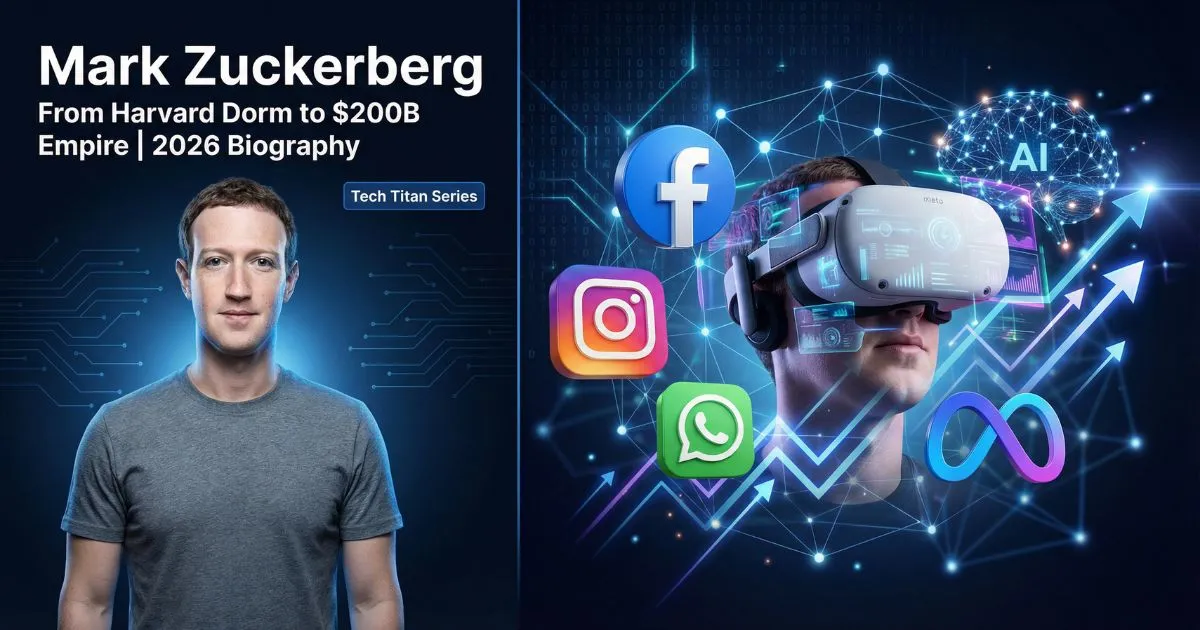
📊 QUICK INFO BOX
| Attribute | Details |
|---|---|
| Full Name | Mark Elliot Zuckerberg |
| Nick Name | Zuck |
| Profession | Tech Entrepreneur / CEO / Investor |
| Date of Birth | May 14, 1984 |
| Age | 41 years (as of 2026) |
| Birthplace | White Plains, New York, USA |
| Hometown | Dobbs Ferry, New York |
| Nationality | American |
| Religion | Raised Jewish, now Atheist |
| Zodiac Sign | Taurus |
| Ethnicity | Caucasian (Ashkenazi Jewish descent) |
| Father | Edward Zuckerberg (Dentist) |
| Mother | Karen Kempner (Psychiatrist) |
| Siblings | Randi, Donna, Arielle Zuckerberg |
| Wife/Partner | Priscilla Chan (m. 2012) |
| Children | 3 daughters: Maxima, August, Aurelia |
| School | Ardsley High School, Phillips Exeter Academy |
| College / University | Harvard University (dropped out) |
| Degree | Computer Science (incomplete) |
| First Startup | Facemash (2003) |
| Current Company | Meta Platforms, Inc. |
| Position | Chairman, CEO, and Controlling Shareholder |
| Industry | Tech / Social Media / AI / VR/AR |
| Known For | Founding Facebook (now Meta) |
| Years Active | 2004–present |
| Net Worth | $200+ billion (2026 est.) |
| Annual Income | $1 salary + billions in stock value |
| Major Investments | Meta AI, Reality Labs, Instagram, WhatsApp |
| @zuck | |
| Twitter/X | @finkd (inactive) |
| Mark Zuckerberg |
1. Introduction
From a Harvard dorm room to building one of the most influential technology companies in human history, Mark Zuckerberg has redefined how billions of people connect, communicate, and share information. As the co-founder and CEO of Meta Platforms (formerly Facebook), Zuckerberg transformed a college networking site into a global empire encompassing Facebook, Instagram, WhatsApp, and ambitious ventures into virtual reality and artificial intelligence.
With a net worth exceeding $200 billion in 2026, Zuckerberg ranks among the wealthiest individuals on the planet. But his influence extends far beyond financial metrics—he’s shaped the social media revolution, pioneered the metaverse concept, and continues to drive innovations in AI that could define the next era of computing.
In this comprehensive biography, you’ll discover Zuckerberg’s journey from coding prodigy to tech titan, his controversial decisions, philanthropic commitments, personal transformation, and his vision for connecting the world through immersive technologies. Whether you admire his achievements or question his impact, understanding Zuckerberg is essential to understanding the digital age itself.
2. Early Life & Background
Mark Elliot Zuckerberg was born on May 14, 1984, in White Plains, New York, and raised in the nearby suburb of Dobbs Ferry. He grew up in a comfortable, educated household—his father, Edward Zuckerberg, was a dentist who ran his practice from an office attached to the family home, while his mother, Karen, worked as a psychiatrist before dedicating herself to the family.
From an early age, Mark showed exceptional aptitude for computers and mathematics. His father taught him basic programming when he was around 12, and Mark quickly surpassed his father’s knowledge. By middle school, he was building software for his father’s dental office—a messaging system called “ZuckNet” that allowed office staff to communicate without shouting across the office.
Recognizing their son’s extraordinary talent, Mark’s parents hired a computer tutor, David Newman, who later described teaching Mark as challenging because the young prodigy would master concepts almost immediately. During high school at Ardsley High, and later at the prestigious Phillips Exeter Academy, Mark excelled in classics (he could read and write ancient Greek and Latin) while simultaneously developing increasingly sophisticated software projects.
One notable creation was Synapse Media Player, an AI-driven music recommendation system that learned users’ listening habits—a concept remarkably ahead of its time. Microsoft and AOL both expressed interest in acquiring the software and hiring the teenage Zuckerberg, but he declined, choosing instead to pursue his education at Harvard University.
These formative years reveal a consistent pattern: exceptional intellectual curiosity, rapid mastery of complex systems, and an early interest in connecting people through technology—themes that would define his career.
3. Family Details
| Relation | Name | Profession |
|---|---|---|
| Father | Edward Zuckerberg | Dentist |
| Mother | Karen Kempner Zuckerberg | Psychiatrist (former) |
| Sisters | Randi Zuckerberg | Former Facebook executive, entrepreneur |
| Donna Zuckerberg | Classics scholar, author | |
| Arielle Zuckerberg | Professional, private life | |
| Spouse | Priscilla Chan | Pediatrician, Philanthropist |
| Children | Maxima Chan Zuckerberg | Born 2015 |
| August Chan Zuckerberg | Born 2017 | |
| Aurelia Chan Zuckerberg | Born 2023 |
4. Education Background
Mark’s educational journey reflects both exceptional achievement and the controversial decision to prioritize entrepreneurship over formal credentials.
Ardsley High School (Dobbs Ferry, NY): Mark initially attended his local public high school, where he quickly exhausted available computer science courses. His talents became so apparent that the school arranged for him to take graduate-level computer science courses at nearby Mercy College while still in high school.
Phillips Exeter Academy (Exeter, NH): Recognizing that Mark needed more challenging academic opportunities, his parents transferred him to this elite preparatory school. At Exeter, he captained the fencing team and won prizes in mathematics, astronomy, physics, and classics. He continued programming, creating software that his classmates used.
Harvard University (2002-2004): Mark enrolled at Harvard intending to major in psychology and computer science. He quickly became known in his dorm for creating clever programming projects, including CourseMatch (which let students see what courses their friends were taking) and Facemash (a controversial “hot or not” style site comparing students’ photos).
The Dropout Decision: In his sophomore year, after Facebook’s initial success, Mark faced a pivotal choice. Despite pressure from family and advisors to complete his degree, he left Harvard in 2004 to pursue Facebook full-time in Palo Alto, California. Harvard eventually awarded him an honorary doctorate in 2017, when he returned to deliver the commencement address.
Mark’s educational path demonstrates how elite preparation and natural talent can create entrepreneurial opportunities—though his decision to leave Harvard remains controversial, particularly given how few startup founders achieve similar success.
5. Entrepreneurial Career Journey
A. Early Career & First Startup (2003-2004)
Mark’s entrepreneurial journey began with experiments rather than a master plan. In October 2003, after breaking up with a girlfriend, he created Facemash in a single night of coding—a website that displayed photos of two Harvard students side-by-side and asked viewers to choose who was more attractive. Mark hacked into Harvard’s residential network to obtain student ID photos, a violation that brought swift administrative consequences.
The site attracted 22,000 page views from 450 visitors in its first four hours before Harvard shut it down. Mark faced expulsion hearings for breaching security, violating copyrights, and violating individual privacy. He apologized and was ultimately placed on probation, but the incident revealed his willingness to push boundaries and his instinct for creating addictively engaging experiences.
The lesson wasn’t lost on Mark. Harvard students clearly craved digital platforms for social connection. This insight led directly to his next project: TheFacebook.com, launched from his dorm room on February 4, 2004, with co-founders Eduardo Saverin, Andrew McCollum, Dustin Moskovitz, and Chris Hughes.
Initially exclusive to Harvard students, the platform required a Harvard.edu email address to join. The concept was simple but powerful: authentic identity, a network of real friends, and user-generated profile pages. Within 24 hours, over 1,000 students had registered. Within a month, more than half of Harvard undergraduates had accounts.
B. Breakthrough Phase (2004-2007)
As TheFacebook’s popularity exploded, Mark faced his first major entrepreneurial decision: stay at Harvard or pursue the startup full-time. In summer 2004, he relocated to Palo Alto, California, establishing Facebook’s first real office. Peter Thiel provided the crucial first major investment—$500,000 for 10.2% of the company—giving Facebook the runway to expand.
The platform expanded systematically to other Ivy League schools, then to universities nationwide, then to high schools, and finally to the general public in September 2006. This deliberate, exclusive expansion strategy created intense demand and maintained quality control as Facebook scaled its infrastructure.
Key milestones in this phase:
- 2004: Dropped “The” from the name, becoming simply “Facebook”
- 2005: Accel Partners invested $12.7 million at a $98 million valuation
- 2006: Rejected a $1 billion acquisition offer from Yahoo!—a decision that shocked the business world but proved Zuckerberg’s conviction in Facebook’s potential
- 2007: Microsoft invested $240 million for 1.6% stake, valuing Facebook at $15 billion
- 2007: Launched Facebook Platform, allowing third-party developers to build applications
The Yahoo! rejection particularly revealed Zuckerberg’s mindset. While board members and investors pressured him to accept the offer, the 22-year-old CEO believed Facebook could become far more valuable. His youth and idealism were simultaneously his greatest vulnerability and his strategic advantage—unburdened by conventional wisdom, he could pursue an audacious vision.
C. Expansion & Global Impact (2008-Present)
The Mobile Revolution (2008-2012): As smartphones proliferated, Facebook initially struggled to adapt. The company’s mobile strategy lagged, and its first mobile app was poorly received. However, Zuckerberg recognized this existential threat and reorganized the entire company around mobile-first thinking. This strategic pivot proved crucial—today, the vast majority of Facebook users access the platform primarily via mobile devices.
IPO and Growing Pains (2012): Facebook’s initial public offering on May 18, 2012, was one of the most anticipated in history. The company raised $16 billion, valuing Facebook at $104 billion—the largest valuation for a newly public company ever. However, the IPO was marred by technical glitches, and the stock price initially dropped, raising questions about whether Facebook was overvalued.
Zuckerberg remained unfazed, continuing to focus on long-term growth over short-term stock performance. Within 18 months, Facebook’s stock had recovered and begun its ascent to becoming one of the most valuable companies in the world.
Strategic Acquisitions (2012-2014): Demonstrating increasingly sophisticated strategic thinking, Zuckerberg orchestrated major acquisitions:
- Instagram (2012): $1 billion for the photo-sharing app with just 13 employees—criticized as overpriced at the time, now recognized as one of the best tech acquisitions ever
- WhatsApp (2014): $19 billion for the messaging platform—the largest tech acquisition to that point, securing Facebook’s dominance in mobile messaging
- Oculus VR (2014): $2 billion for the virtual reality headset company, signaling Zuckerberg’s belief that VR/AR would be computing’s next frontier
Challenges and Controversies (2016-2020): Facebook faced intense scrutiny during this period:
- Accusations of enabling foreign election interference in 2016
- The Cambridge Analytica scandal exposing how third parties accessed user data
- Criticism over misinformation and polarizing content on the platform
- Antitrust investigations questioning whether Facebook had become an illegal monopoly
Zuckerberg testified before Congress multiple times, weathered calls to break up the company, and implemented significant changes to content moderation and privacy practices. These controversies tested his leadership and forced Facebook to mature from a “move fast and break things” startup to a more responsible platform.
The Meta Transformation (2021-Present): In October 2021, Zuckerberg made his boldest move yet: rebranding Facebook, Inc. as Meta Platforms, Inc. The name change reflected his conviction that the metaverse—persistent, immersive virtual worlds—would be the internet’s future. Meta would invest tens of billions annually in Reality Labs, developing VR headsets, AR glasses, and metaverse platforms like Horizon Worlds.
This bet has proven controversial, with Reality Labs losing billions and critics questioning whether the metaverse represents genuine innovation or expensive distraction. However, Zuckerberg’s decade-long horizon thinking has proven correct before, and he remains committed to this vision.
AI Renaissance (2023-2026): As artificial intelligence emerged as technology’s hottest sector, Meta pivoted rapidly, investing heavily in large language models and AI infrastructure. The release of Llama AI models as open-source alternatives to proprietary systems positioned Meta as an AI leader. By 2026, AI features permeate Meta’s products, from content recommendations to creative tools, and Zuckerberg speaks as frequently about AI as about the metaverse.
6. Career Timeline Chart
📅 CAREER TIMELINE
2003 ─── Created Facemash at Harvard
│
2004 ─── Launched TheFacebook from dorm room
│
2004 ─── Peter Thiel’s $500K investment; moved to Palo Alto
│
2006 ─── Rejected $1B Yahoo! offer; opened to public
│
2012 ─── Facebook IPO ($104B valuation); acquired Instagram
│
2014 ─── Acquired WhatsApp ($19B) and Oculus VR ($2B)
│
2018 ─── Cambridge Analytica scandal; testified before Congress
│
2021 ─── Rebranded company as Meta; committed to metaverse
│
2023 ─── Launched Llama AI models; pivoted toward AI leadership
│
2026 ─── Leading Meta with focus on AI, VR/AR, and global connectivity
7. Business & Company Statistics
| Metric | Value (2026 estimates) |
|---|---|
| Companies Founded | Meta (Facebook), Chan Zuckerberg Initiative |
| Current Valuation | $1.2+ trillion (Meta market cap) |
| Revenue (Annual) | $150+ billion |
| Employees | 70,000+ |
| Countries Operated | 190+ countries |
| Monthly Active Users | 3.9+ billion across Meta platforms |
| Market Share | #1 in social media (Facebook, Instagram, WhatsApp) |
8. Entrepreneur Comparison Section
📊 Mark Zuckerberg vs Elon Musk
| Statistic | Mark Zuckerberg | Elon Musk |
|---|---|---|
| Net Worth | $200+ billion | $220+ billion |
| Companies Founded | Meta (Facebook) | SpaceX, Tesla, Neuralink, X (Twitter), etc. |
| Unicorns Built | 1 mega-company | Multiple billion-dollar companies |
| Innovation Impact | Social connection, VR/AR, AI | Space, EVs, AI, infrastructure |
| Global Influence | 3.9B+ users across platforms | Industries transformed, cultural icon |
Analysis: While both are generational tech titans, their approaches differ fundamentally. Musk pursues diverse, high-risk ventures across industries, while Zuckerberg has maintained laser focus on a single company’s evolution from social network to metaverse platform. Zuckerberg built the larger single user base, but Musk’s portfolio spans more industries. Musk embraces public controversy; Zuckerberg has become more measured after early scandals. Both are betting tens of billions on futuristic visions—Musk on Mars and sustainable energy, Zuckerberg on immersive digital worlds and AI.
9. Leadership & Work Style Analysis
Leadership Philosophy: Zuckerberg’s management approach has evolved dramatically. Early Facebook embodied his famous motto: “Move fast and break things.” This aggressive, iterate-quickly philosophy enabled rapid growth but also led to privacy breaches and content moderation failures. By the late 2010s, facing regulatory scrutiny and public backlash, Zuckerberg shifted to “Move fast with stable infrastructure,” acknowledging that at Facebook’s scale, breaking things meant breaking society.
Decision-Making Style: Zuckerberg makes decisions with unusual conviction for someone who appears outwardly mild-mannered. He famously rejected acquisition offers that would have made him a billionaire in his early twenties, bet billions on technologies years before mainstream adoption, and reorganized massive organizations around new priorities. His decisions reflect long-term thinking—he frequently references 10-year horizons when others think in quarters.
Risk-Taking Ability: Zuckerberg’s risk tolerance is extraordinarily high when he believes in a technology’s potential. The Instagram acquisition seemed reckless at $1 billion for a 13-person company with no revenue. WhatsApp at $19 billion was considered lunacy. Spending $10+ billion annually on Reality Labs while it generates minimal revenue defies typical corporate logic. Yet his conviction in these bets stems from first-principles thinking about how technology evolves, not spreadsheet analysis.
Innovation Mindset: Zuckerberg combines product intuition with technical depth. He still codes and reviews architectural decisions, unusual for a CEO of a trillion-dollar company. He’s drawn to ambitious technical challenges—building AI systems, creating photorealistic avatars, achieving presence in virtual spaces. This engineering mindset means he understands feasibility constraints but also pushes teams toward seemingly impossible goals.
Strengths: Strategic vision, technical competence, long-term thinking, ability to attract top talent, willingness to make unpopular decisions, resilience under pressure.
Weaknesses: Communication skills (testified awkwardly before Congress), initially tone-deaf to privacy concerns, struggled with crisis management, sometimes appears to lack empathy in public settings, has difficulty articulating emotional or ethical dimensions of technology.
Expert Perspective: Former Facebook executive Antonio García Martínez described Zuckerberg as having “an almost autistic focus on the product” and noted that “he has a very clear vision, and he’ll do whatever it takes to get there, consequences be damned.” Harvard classmate and tech journalist Kara Swisher has said, “Mark is both more naive and more calculating than people realize.”
10. Achievements & Awards
Business & Tech Awards
- Time Person of the Year (2010) – Recognized for Facebook’s global impact
- Golden Plate Award, American Academy of Achievement (2011)
- Founders Award, Council on Foreign Relations (2011)
- Honorary Doctor of Laws, Harvard University (2017)
Global Recognition
- Forbes 400 – Consistently among the top 10 richest Americans
- Forbes Billionaires List – Typically #3-7 globally by net worth
- Time 100 Most Influential People – Featured multiple times
- Fortune Businessperson of the Year – Finalist multiple times
Records Held
- Youngest self-made billionaire at age 23 (since surpassed)
- Largest tech IPO valuation at the time ($104 billion in 2012)
- Biggest tech acquisition (WhatsApp at $19 billion in 2014, at the time)
- Most Facebook users – Grew platform to 3+ billion monthly active users
- Largest philanthropic commitment – Pledged to give away 99% of Meta shares ($45+ billion at the time)
11. Net Worth & Earnings
💰 FINANCIAL OVERVIEW
| Year | Net Worth (Est.) |
|---|---|
| 2012 | $17.5 billion (at IPO) |
| 2018 | $62 billion (pre-scandal peak) |
| 2020 | $86 billion |
| 2023 | $115 billion |
| 2024 | $175 billion |
| 2025 | $195 billion |
| 2026 | $200-220 billion |
Income Sources
Company Equity: Zuckerberg owns approximately 13-14% of Meta’s total shares and controls about 58% of voting power through dual-class stock structure. This equity stake represents the overwhelming majority of his net worth.
Salary & Bonuses: Famously takes a $1 annual salary (since 2013), though he receives substantial security expenses paid by Meta (reportedly $20+ million annually) due to threats and his public profile.
Investments: Through various vehicles, Zuckerberg has invested in startups and other companies, though these represent a tiny fraction of his wealth compared to Meta holdings.
Chan Zuckerberg Initiative: Through this LLC structure, Zuckerberg and his wife have committed to philanthropic and investment activities, though this reduces rather than increases personal wealth.
Major Investments & Acquisitions (Through Meta)
- Instagram (2012) – $1 billion → Now valued at $100+ billion
- Oculus VR (2014) – $2 billion → Core of Reality Labs division
- WhatsApp (2014) – $19 billion → Now valued at $50+ billion
- Various AI and infrastructure companies
12. Lifestyle Section
🏠 ASSETS & LIFESTYLE
Properties
Primary Residence: Palo Alto, California – A compound spanning multiple properties, estimated total value exceeding $150 million. The main house is a 5,600 sq ft home purchased in 2011 for $7 million, but Zuckerberg subsequently purchased surrounding properties to ensure privacy.
Other Holdings:
- Kauai, Hawaii: Purchased approximately 1,400 acres of land on Kauai’s North Shore for $100+ million, which generated controversy over legal disputes with local residents regarding traditional land rights
- Lake Tahoe compound: Two adjacent lakefront estates purchased for $59 million in 2018-2019
- San Francisco: Previously owned a home on Liberty Hill
Cars Collection
Unlike many billionaires, Zuckerberg is famously uninterested in flashy cars:
- Honda Fit – His most famous vehicle choice, a compact hatchback worth about $20,000
- Acura TSX – A modest luxury sedan, approximately $30,000
- Volkswagen Golf GTI – A sporty hatchback, roughly $30,000
- Pagani Huayra – His one supercar indulgence (custom made, ~$1.3 million), though rarely seen driving it
Hobbies
Martial Arts: Zuckerberg trains in mixed martial arts (MMA) and Brazilian jiu-jitsu, earning his blue belt in 2023. He’s competed in tournaments and has discussed how the discipline and competition improve his mental clarity.
Raising Livestock: He went through a phase where he would only eat meat from animals he personally killed, an experiment in understanding food origins and consumption ethics.
Reading: Known for annual reading challenges, typically focusing on different cultures, belief systems, and technologies.
Travel: Has visited nearly every U.S. state as part of a 2017 personal challenge to understand America better.
Learning Languages: Studied Mandarin Chinese extensively, delivering speeches in Mandarin at Tsinghua University, though he’s since acknowledged the effort required exceeded his available time.
Daily Routine
Work Hours: Reports suggest Zuckerberg works 50-60 hours per week, though this can spike during product launches or crisis periods.
Morning: Typically wakes up around 7-8 AM, checks Facebook, Messenger, and WhatsApp immediately. Often works out or trains in martial arts before starting the workday.
Productivity Habits:
- Famously wears the same outfit (gray t-shirt, jeans, sneakers) to eliminate decision fatigue
- Blocks extended focus time for deep thinking and coding
- Regularly holds walking meetings
- Reserves Fridays for longer-term strategic thinking
Evening: Prioritizes family dinner time with Priscilla and their daughters. Often returns to work after the children are in bed for product reviews and strategic planning.
13. Physical Appearance
| Attribute | Details |
|---|---|
| Height | 5’7″ (171 cm) |
| Weight | ~70 kg (155 lbs) – fluctuates based on MMA training |
| Eye Color | Blue-green |
| Hair Color | Brown (naturally curly, often kept short) |
| Body Type | Formerly slim/average; now more athletic/muscular after years of MMA training |
| Distinctive Features | Youthful appearance despite being in his 40s, often wears signature gray t-shirt |
14. Mentors & Influences
Steve Jobs (Apple co-founder): Zuckerberg sought Jobs’ advice multiple times before Jobs’ death in 2011. Jobs advised him on building a lasting company focused on changing the world, not just making money. The two took walks together, and Jobs’ influence is evident in Zuckerberg’s long-term thinking.
Bill Gates (Microsoft co-founder): Gates has served as an informal advisor on both technology strategy and philanthropy. Their conversations influenced the Chan Zuckerberg Initiative’s structure and mission.
Peter Thiel (PayPal co-founder, first major Facebook investor): Thiel provided not just funding but strategic guidance during Facebook’s early years. His contrarian thinking and emphasis on building monopolies influenced Zuckerberg’s approach to competition.
Sheryl Sandberg (former Meta COO): Served as Zuckerberg’s “adult supervision” for 14 years, teaching him about advertising markets, management structure, and corporate leadership. Their partnership transformed Facebook from a startup into a professional organization.
Marc Andreessen (Netscape founder, investor): As a Meta board member and advisor, Andreessen has counseled Zuckerberg on technology trends, long-term strategy, and dealing with public criticism.
Augustus Caesar: Zuckerberg has cited the Roman emperor as a leadership model, even naming his daughter August partly in tribute. He’s fascinated by how Augustus consolidated power and built lasting institutions.
15. Company Ownership & Roles
| Company | Role | Years |
|---|---|---|
| Meta Platforms, Inc. | Founder, Chairman, CEO | 2004–present |
| Chan Zuckerberg Initiative | Co-founder, Co-CEO (with Priscilla Chan) | 2015–present |
| Meta Reality Labs | Strategic overseer | 2014–present (from Oculus acquisition) |
| Breakthrough Energy (Bill Gates initiative) | Investor/Board Member | 2015–present |
Voting Control: Through Class B shares with 10 votes each, Zuckerberg controls approximately 58% of Meta’s voting power despite owning only 13-14% of total equity. This structure enables him to make long-term decisions without pressure from activist investors, but has drawn criticism for reducing accountability.
16. Controversies & Challenges
Cambridge Analytica Scandal (2018): The revelation that political consulting firm Cambridge Analytica had harvested data from 87 million Facebook users without consent represented Facebook’s worst crisis. Zuckerberg was slow to respond publicly, and when he did, his initial apologies seemed insufficient. His testimony before Congress was widely mocked for senators’ lack of technical understanding and his stiff, rehearsed answers. The scandal resulted in a $5 billion FTC fine and permanently damaged Facebook’s reputation regarding privacy.
Election Interference (2016, 2020): Facebook faced intense criticism for allowing Russian agents to spread disinformation during the 2016 U.S. presidential election. Later, both sides of the political spectrum accused the platform of bias—conservatives claimed censorship, progressives claimed insufficient action against misinformation. Zuckerberg struggled to articulate a coherent content moderation philosophy that satisfied anyone.
Antitrust Investigations: The FTC and state attorneys general sued to break up Facebook, arguing that acquiring Instagram and WhatsApp constituted illegal monopolization. Zuckerberg’s emails from acquisition periods, where he discussed “neutralizing” competitive threats, became evidence in these cases.
Metaverse Criticism: The Meta rebrand and massive investment in VR/AR drew ridicule, particularly when early metaverse demos featured cartoonish graphics. Critics questioned whether Zuckerberg was chasing a vision that consumers didn’t want, wasting tens of billions of dollars in the process.
Personal Security Controversies: The Hawaii land purchases sparked protests from Native Hawaiians who accused Zuckerberg of colonialism and attempting to privatize traditionally shared lands. He eventually dropped lawsuits against Hawaiian families but the damage to his reputation persisted.
Handling of Challenges: Zuckerberg’s response to controversies has evolved. Early in his career, he was defensive and dismissive. Over time, he’s become more willing to acknowledge mistakes, though critics argue he does so only after being caught. He’s hired former politicians and crisis managers, improved Meta’s communications capabilities, and personally become more polished in public appearances. However, the controversies have fundamentally shifted public perception—from boy genius to powerful executive with questionable ethics.
Lessons Learned: The repeated scandals forced Zuckerberg to recognize that engineering solutions don’t solve social problems. He’s spoken about the need to consider not just whether something can be built, but whether it should be built. Meta now employs thousands in trust and safety roles, a function that barely existed in Facebook’s early years.
17. Charity & Philanthropy
Chan Zuckerberg Initiative (CZI): In December 2015, when their first daughter Maxima was born, Mark and Priscilla announced they would give away 99% of their Meta shares over their lifetimes (then valued at $45 billion, now worth $150+ billion). Rather than a traditional foundation, they created an LLC structure allowing both charitable giving and for-profit investments aligned with their mission.
Focus Areas:
Education: Invested over $1 billion in personalized learning technologies, supporting schools that adapt to individual student needs. Also supports training for teachers and education research.
Science & Health:
- Goal to “cure, prevent, or manage all diseases by the end of this century”
- Built the $600 million Biohub research center in San Francisco
- Funds infectious disease research, neuroscience, and rare disease studies
- Supported COVID-19 response with grants for vaccines and treatment research
Criminal Justice Reform: Funds bail reform efforts, believing that cash bail discriminates against poor defendants. Has invested in organizations working to reduce incarceration rates.
Housing Affordability: In the Bay Area specifically, addressing the housing crisis CZI and tech companies have exacerbated through job growth.
Meta-Specific Initiatives:
- Free internet access through Internet.org/Free Basics in developing countries (though controversial for potential net neutrality violations)
- Donated $100 million to Newark public schools (2010), a gift later criticized as ineffective due to poor implementation
- $350+ million in grants to support election security and voting access (2020), though this drew partisan criticism
Criticism: Some philanthropy experts note that an LLC structure allows the Zuckerbergs to maintain control and potentially profit from investments, unlike a traditional foundation with independent oversight. Critics also question whether tech billionaires’ preferred solutions (technological fixes, data-driven approaches) address root causes of social problems.
18. Personal Interests
| Category | Favorites |
|---|---|
| Food | Simple meals; went through phase of only eating meat he killed himself |
| Movie | Has mentioned enjoying “The Social Network” despite its inaccuracies |
| Book | “The Aeneid” (Virgil), “The Better Angels of Our Nature” (Pinker), Chinese history |
| Travel Destination | Has traveled extensively; particularly interested in China and Ancient Roman sites |
| Technology | AI, VR/AR, brain-computer interfaces, connectivity infrastructure |
| Sport | Mixed Martial Arts, Brazilian jiu-jitsu, running |
19. Social Media Presence
| Platform | Handle | Followers (2026 est.) |
|---|---|---|
| facebook.com/zuck | 120+ million followers | |
| @zuck | 15+ million followers | |
| Twitter/X | @finkd | Largely inactive, <500K |
| Threads | @zuck | 5+ million (Meta’s Twitter alternative) |
| Mark Zuckerberg | 1+ million connections |
Posting Style: Zuckerberg uses his platforms primarily for company announcements, personal milestones (daughters’ births, MMA training), and occasionally to address controversies or explain strategic decisions. His posts are typically straightforward and lack the personality or humor common among other tech CEOs.
20. Recent News & Updates (2025–2026)
AI Developments: Meta released Llama 3 and Llama 4 models throughout 2025-2026, positioning them as open-source alternatives to OpenAI’s GPT models. Zuckerberg has argued that open-source AI is both safer and more innovative than closed proprietary models, putting him at odds with othertech leaders.
Quest Headset Evolution: Meta’s Quest headsets have achieved mainstream pricing and improving quality, with Quest 3 and Quest Pro gaining traction among consumers and enterprise users. Virtual reality adoption remains slower than Zuckerberg predicted, but steady progress continues.
Regulatory Battles: Ongoing antitrust litigation continues in multiple jurisdictions. The EU’s Digital Markets Act has forced Meta to make its services more interoperable, a change Zuckerberg has publicly criticized while complying.
Threads Growth: Meta’s Twitter/X alternative, Threads, has grown significantly after initial stumbles, reaching over 250 million monthly active users by 2026 and positioning itself as a true competitor in the text-based social media space.
Physical Transformation: Zuckerberg’s continued dedication to MMA training has been widely discussed, with some seeing it as a midlife crisis and others as admirable personal development. He’s competed in several jiu-jitsu tournaments, winning gold medals in white and blue belt divisions.
Future Plans: Zuckerberg has stated Meta’s 2026-2030 priorities are: (1) Building the world’s leading AI models and integrating them across products, (2) Achieving widespread AR glasses adoption, (3) Maintaining social platform leadership as younger users shift platforms, and (4) Balancing innovation with responsible development.
21. Lesser-Known Facts
- Color Blindness: Zuckerberg is red-green colorblind, which is why Facebook’s primary color is blue—it’s the richest color he can see.
- Learning Mandarin: He studied Mandarin Chinese for years, practicing daily with tutors. He delivered a 30-minute Q&A entirely in Mandarin at Tsinghua University, impressive even if imperfect.
- Ancient Languages: At Phillips Exeter Academy, he studied Latin, ancient Greek, and classical literature. He’s read “The Aeneid” in its original Latin.
- Honeymoon Timing: Mark and Priscilla married the day after Facebook’s IPO in 2012. They’d been planning the wedding for months but the IPO date kept shifting, so the timing appeared spontaneous but was actually carefully planned.
- First Office: Facebook’s first real office was a sublet apartment where team members slept, worked, and partied in the same space. Mark reportedly coded for days with minimal sleep during critical launches.
- Rejected Offers: Beyond Yahoo!’s $1 billion, Mark also rejected Microsoft’s acquisition attempts and multiple partnership offers that would have made him wealthy but cost control of Facebook.
- Meeting Priscilla: Mark met his wife Priscilla Chan at a Harvard party while waiting in line for the bathroom. They dated throughout Facebook’s early chaotic years before marrying in 2012.
- Coding Today: Unlike most tech CEOs, Zuckerberg still codes and reviews architectural decisions. He’s been spotted pushing code commits and participating in product reviews at the engineering level.
- Annual Challenges: For years, Zuckerberg set annual personal challenges: learning Mandarin, reading 25 books, running 365 miles, visiting every U.S. state, building his own AI assistant, and only eating meat he killed.
- Augustus Caesar Admiration: Named his second daughter August partly after Augustus Caesar, whom he admires for bringing peace after civil war and building lasting institutions.
- Senate Testimony Booster Seat: During his 2018 Congressional testimony, Zuckerberg sat on a booster cushion, which became a viral meme and symbol of his discomfort in the political spotlight.
- “Zuck Bucks”: Early Facebook employees called compensation “Zuck Bucks,” as in “How many Zuck Bucks did you get?” The term stuck internally.
- Real Estate Strategy: When buying his Palo Alto home, he subsequently purchased the four surrounding houses to create privacy—a pattern he’s repeated with other properties.
- Fencing Captain: At Phillips Exeter, he was captain of the fencing team, developing the competitive drive and strategic thinking that later defined his business approach.
- Dog Parent: The Zuckerbergs have a Puli dog named Beast who had his own Facebook page with millions of followers, more than many celebrities.
22. FAQs
Who is Mark Zuckerberg?
Mark Zuckerberg is an American technology entrepreneur and philanthropist who founded Facebook (now Meta Platforms) in 2004 from his Harvard dorm room. As Meta’s CEO, he oversees the world’s largest social media ecosystem including Facebook, Instagram, WhatsApp, and Threads, serving nearly 4 billion users globally. With a net worth exceeding $200 billion, he’s one of the world’s wealthiest individuals and a leading figure in AI and virtual reality development.
What is Mark Zuckerberg’s net worth in 2026?
Mark Zuckerberg’s net worth is estimated at approximately $200-220 billion as of 2026, making him one of the five wealthiest people globally. His wealth primarily derives from his 13-14% ownership stake in Meta Platforms, though he’s pledged to give away 99% of his shares during his lifetime through the Chan Zuckerberg Initiative.
How did Mark Zuckerberg start Facebook?
Mark Zuckerberg launched Facebook (originally “TheFacebook”) on February 4, 2004, from his Harvard University dorm room with co-founders Eduardo Saverin, Andrew McCollum, Dustin Moskovitz, and Chris Hughes. The site initially served only Harvard students with .edu email addresses, requiring authentic identity and creating profiles within a network of real friends. Its exclusivity and focus on real identities differentiated it from existing social networks like MySpace.
Is Mark Zuckerberg married?
Yes, Mark Zuckerberg married Priscilla Chan on May 19, 2012, one day after Facebook’s IPO. They met at a Harvard party in 2003 and dated for nine years before marrying. Priscilla is a pediatrician and philanthropist who co-leads the Chan Zuckerberg Initiative with Mark. They have three daughters: Maxima (born 2015), August (born 2017), and Aurelia (born 2023).
What companies does Mark Zuckerberg own?
Mark Zuckerberg owns and controls:
Meta Platforms, Inc. (the parent company encompassing Facebook, Instagram, WhatsApp, Threads, and Reality Labs)
Chan Zuckerberg Initiative (co-owned with his wife Priscilla Chan, focused on philanthropy and impact investing in education, science, and justice reform)
Through Meta, he oversees the world’s largest social media properties and significant investments in artificial intelligence and virtual/augmented reality technologies.
Why did Facebook change its name to Meta?
In October 2021, Facebook, Inc. rebranded as Meta Platforms, Inc. to reflect Mark Zuckerberg’s vision that the company’s future lies beyond traditional social media. The name change signaled a strategic pivot toward building the “metaverse”—persistent, immersive virtual worlds accessed through VR/AR technologies. Zuckerberg believes spatial computing will eventually replace smartphones as the primary way people interact digitally.
What is Mark Zuckerberg’s role at Meta?
Mark Zuckerberg serves as Chairman and Chief Executive Officer (CEO) of Meta Platforms. He maintains approximately 58% voting control through dual-class share structure, giving him final authority over company strategy despite owning only 13-14% of total equity. He remains deeply involved in product decisions, technology architecture, and long-term strategic planning.
How much does Mark Zuckerberg make per year?
Mark Zuckerberg’s official salary is $1 per year, a symbolic amount he’s maintained since 2013. However, his net worth increases or decreases by billions based on Meta’s stock performance. Meta also covers his security expenses, reportedly exceeding $20 million annually, due to threats and his public profile. His wealth generation comes almost entirely from appreciation of his Meta stock holdings.
What is the Chan Zuckerberg Initiative?
The Chan Zuckerberg Initiative (CZI) is a philanthropic and investment organization established in 2015 by Mark Zuckerberg and Priscilla Chan. Structured as an LLC rather than a traditional foundation, it pursues goals in education, science and health, and criminal justice reform through both charitable donations and for-profit investments. They’ve pledged to give away 99% of their Meta shares (worth $150+ billion) during their lifetimes through CZI.
Does Mark Zuckerberg still code?
Yes, Mark Zuckerberg still writes code and reviews engineering decisions, unusual for a CEO of a trillion-dollar company. He participates in product reviews at the technical level and has been documented pushing code commits. His continued technical involvement reflects his engineering background and hands-on approach to product development, though his coding time is naturally limited compared to his Harvard days.
23. Conclusion
From a Harvard dorm room to leading one of the most powerful technology companies in human history, Mark Zuckerberg’s journey embodies both the extraordinary promise and profound challenges of the digital age. He transformed how billions of people connect, communicate, and share information—an achievement that places him among the most influential figures of the 21st century.
Yet his legacy remains contested. Supporters see a visionary entrepreneur who connected the world, revolutionized digital communication, and now invests boldly in humanity’s technological future through AI and virtual reality. Critics view a powerful executive who prioritized growth over user welfare, enabled misinformation and division, and accumulated dangerous power with insufficient accountability.
What’s undeniable is Zuckerberg’s impact. Whether through Facebook’s role in political movements from the Arab Spring to election controversies, Instagram’s influence on visual culture and mental health, WhatsApp’s transformation of global communication, or Meta’s investments shaping AI and immersive technology development—Zuckerberg’s decisions affect billions.
As he enters his fifth decade, Zuckerberg faces perhaps his greatest test: proving that Meta’s enormous investments in the metaverse and AI represent genuine innovation rather than costly distractions. His track record of long-term thinking suggests betting against him is unwise, yet the technical and social challenges are immense.
One thing remains certain—Mark Zuckerberg will continue to shape how humanity communicates, connects, and experiences reality itself for decades to come.
What do you think about Mark Zuckerberg’s journey and Meta’s future? Share your thoughts in the comments below, and explore our other tech entrepreneur biographies to understand the minds building our digital future.