QUICK INFO BOX
| Attribute | Details |
|---|---|
| Full Name | Andrew R. Jassy |
| Nick Name | Andy |
| Profession | CEO, Tech Executive, Cloud Computing Pioneer |
| Date of Birth | January 13, 1968 |
| Age | 58 years (as of 2026) |
| Birthplace | Scarsdale, New York, USA |
| Hometown | Scarsdale, New York |
| Nationality | American |
| Religion | Jewish |
| Zodiac Sign | Capricorn |
| Ethnicity | Caucasian |
| Father | Everett Jassy (Corporate lawyer) |
| Mother | Margery Jassy |
| Siblings | Not publicly disclosed |
| Wife/Partner | Elana Rochelle Caplan (m. 1997) |
| Children | Two |
| School | Scarsdale High School |
| College / University | Harvard University (BA), Harvard Business School (MBA) |
| Degree | Bachelor of Arts in Government, MBA |
| First Startup | N/A (Career executive) |
| Current Company | Amazon |
| Position | Chief Executive Officer |
| Industry | Tech / Cloud Computing / E-commerce |
| Known For | Creating Amazon Web Services (AWS) |
| Years Active | 1997–present |
| Net Worth | $400–500 million (estimated 2026) |
| Annual Income | $212 million+ (2021 compensation) |
| Major Investments | Amazon stock, tech ventures |
| Not active publicly | |
| Twitter/X | @ajassy |
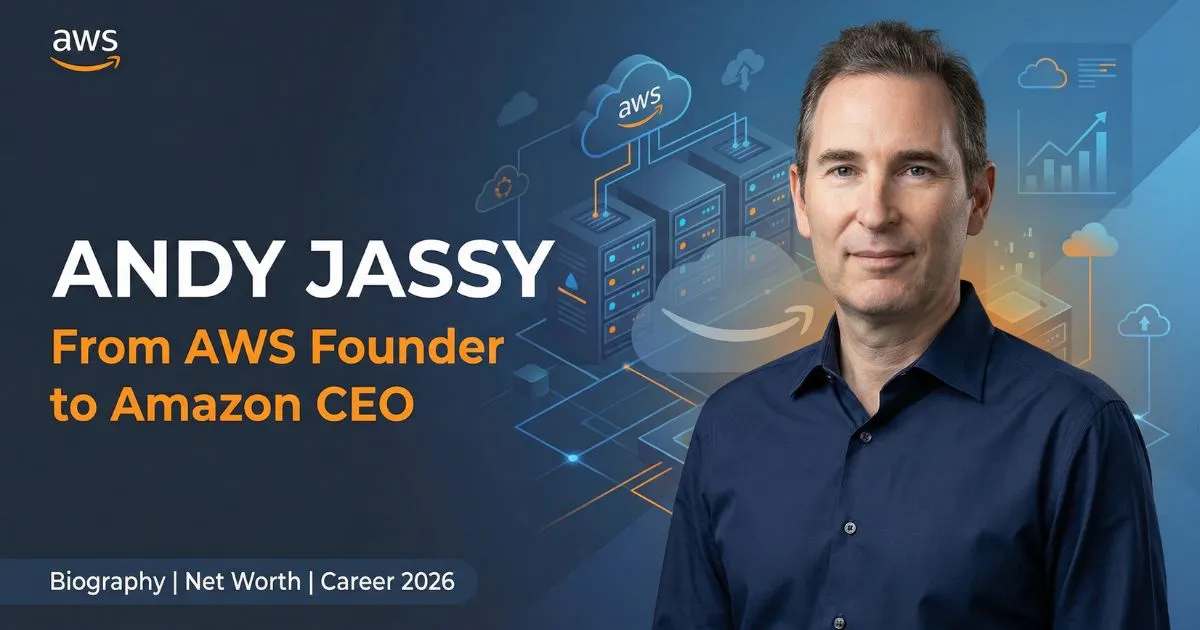
| Andy Jassy |
1. Introduction
When Andy Jassy became CEO of Amazon in July 2021, he inherited one of the world’s most valuable companies—but he had already built a significant part of its empire. As the visionary architect behind Amazon Web Services (AWS), Jassy transformed a risky internal infrastructure project into the world’s dominant cloud computing platform, generating over $90 billion in annual revenue and reshaping how businesses operate globally.
Who is Andy Jassy? He’s the tech executive who pioneered cloud computing as we know it, turning an experimental idea into an industry standard that powers Netflix, NASA, and millions of businesses worldwide. Before taking Amazon’s top job, Jassy spent 18 years leading AWS from concept to market dominance, establishing himself as one of the most successful enterprise technology leaders of the 21st century.
In this comprehensive biography, you’ll discover Jassy’s journey from Harvard MBA to cloud computing revolutionary, his leadership philosophy, net worth growth, strategic decisions as Amazon CEO, and how he’s navigating the company through AI transformation, regulatory challenges, and intense competition in 2026.
2. Early Life & Background
Andrew R. Jassy was born on January 13, 1968, in Scarsdale, New York, an affluent suburb north of New York City known for its excellent schools and achievement-oriented culture. Growing up in a well-educated family—his father Everett Jassy was a senior partner at the corporate law firm Dewey Ballantine—Andy was exposed to business, strategy, and intellectual rigor from an early age.
Scarsdale High School shaped Jassy’s competitive drive and leadership instincts. He was captain of the varsity baseball team and student council president, demonstrating early the combination of teamwork, strategic thinking, and leadership that would define his career. His athletic background instilled discipline and the ability to perform under pressure—qualities that proved invaluable during AWS’s make-or-break early years.
Unlike many tech CEOs, Jassy wasn’t coding in his bedroom as a teenager. His path to technology leadership came through business strategy rather than engineering. At Harvard University, he studied government, graduating in 1990, then worked briefly in marketing before returning to Harvard Business School for his MBA, which he completed in 1997.
During his MBA years, Jassy became fascinated by how technology could transform business operations. A case study on early e-commerce caught his attention—it was about a startup called Amazon.com. That academic curiosity would soon become his life’s work. Fresh out of Harvard Business School, Jassy joined Amazon in 1997 as a marketing manager when the company had just 600 employees and sold only books.
His early motivation wasn’t about wealth or fame—it was about being part of something transformative. Jassy recognized that Amazon, under Jeff Bezos’s leadership, was thinking bigger than anyone else in retail, and he wanted to help build that future.
3. Family Details
| Relation | Name | Profession |
|---|---|---|
| Father | Everett Jassy | Corporate Lawyer (Senior Partner, Dewey Ballantine) |
| Mother | Margery Jassy | Homemaker |
| Siblings | Not publicly disclosed | N/A |
| Spouse | Elana Rochelle Caplan | Fashion designer, philanthropist |
| Children | Two children | Not publicly disclosed (privacy maintained) |
Andy Jassy married Elana Rochelle Caplan in 1997, the same year he joined Amazon. Elana has her own successful career in fashion and is involved in various philanthropic initiatives. The couple maintains a notably private family life despite Jassy’s high-profile position, rarely sharing details about their two children publicly. This deliberate privacy reflects Jassy’s belief in separating professional responsibilities from personal life—a boundary he’s maintained even after becoming one of tech’s most powerful CEOs.
4. Education Background
Scarsdale High School (Scarsdale, New York)
- Graduated: 1986
- Captain of varsity baseball team
- Student council president
- Developed leadership and competitive mindset
Harvard University (Cambridge, Massachusetts)
- Degree: Bachelor of Arts in Government
- Graduated: 1990
- Focused on political science and organizational behavior
- Developed analytical thinking skills
Post-Graduation Work Experience
- Brief stint in marketing and project management at Citibank
- Gained business operations experience before business school
Harvard Business School (Cambridge, Massachusetts)
- Degree: Master of Business Administration (MBA)
- Graduated: 1997
- Studied e-commerce and technology business models
- Case study on Amazon.com sparked his interest in the company
- Networked with future tech leaders and investors
Unlike many tech founders who dropped out of college to chase their startup dreams, Jassy took the traditional path—completing both undergraduate and graduate degrees at one of the world’s most prestigious universities. His formal business education provided the strategic framework and analytical rigor he would later apply to building AWS. The Harvard network also connected him to influential investors and executives who would later support Amazon’s ambitious cloud computing bet.
Jassy’s education balanced theoretical knowledge with practical application. His government studies taught him how large organizations function and make decisions—invaluable when selling cloud services to enterprise clients and government agencies. His MBA equipped him with financial modeling, competitive strategy, and operations management skills that became essential when AWS required billions in infrastructure investment before generating profit.
5. Entrepreneurial Career Journey
A. Early Career at Amazon (1997–2003)
Andy Jassy joined Amazon in May 1997 as one of the company’s first marketing managers, employee number approximately 57. At the time, Amazon was still just an online bookstore operating out of a Seattle warehouse, with Jeff Bezos dreaming of becoming “Earth’s most customer-centric company.”
Jassy’s early years involved diverse roles across marketing and project management, giving him exposure to nearly every part of Amazon’s operations. He impressed Bezos with his strategic thinking and willingness to tackle unglamorous problems. By 2003, Jassy had become Bezos’s first “shadow advisor”—essentially the CEO’s chief of staff—spending two years attending every meeting with Bezos, learning his decision-making process, and understanding Amazon’s long-term vision.
This shadowing experience was transformational. Jassy absorbed Bezos’s customer-obsessed philosophy, long-term thinking, and willingness to make bold bets that wouldn’t pay off for years. He witnessed how Bezos made difficult decisions, balanced competing priorities, and thought about building infrastructure for future scale. These lessons became the foundation for AWS.
B. Breakthrough Phase: Creating AWS (2003–2006)
In 2003, a problem emerged within Amazon: different teams kept rebuilding the same infrastructure components, wasting time and resources. Jassy and a small team began exploring how Amazon could build standardized, reusable infrastructure services. The initial idea wasn’t to sell cloud services externally—it was to make Amazon itself more efficient.
But Jassy saw something bigger. What if Amazon offered its infrastructure as a service to other companies? Most businesses were terrible at managing servers, storage, and computing power. Amazon had become exceptionally good at it through necessity. There was an opportunity to transform Amazon’s operational expertise into a product.
Jassy led the team that pitched this radical idea to Bezos: Amazon should become an infrastructure company, not just a retailer. The pitch required convincing Amazon’s board to invest billions in data centers and technology for a business with no proven market, no customers, and uncertain returns. It was the ultimate “Day One” thinking—betting on a future that didn’t yet exist.
Bezos approved the concept, and Jassy became the founding CEO of Amazon Web Services. In March 2006, AWS officially launched with its first service: Simple Storage Service (S3). Two months later came Elastic Compute Cloud (EC2), allowing businesses to rent computing power by the hour. The cloud computing revolution had begun.
C. Building AWS into Global Dominance (2006–2021)
The early years were difficult. Most enterprise companies didn’t trust “the book company” with their critical infrastructure. Jassy and his team faced skepticism from CIOs, competition from established tech giants like Microsoft and IBM, and internal pressure to show results from massive capital investments.
Jassy’s strategy was brilliant in its simplicity: obsess over customers, move faster than competitors, and continuously lower prices as scale increased. AWS dropped prices 70+ times during his tenure, using Amazon’s retail playbook of sacrificing short-term margins for long-term market share. The approach worked.
By 2015, AWS was generating $7.8 billion in revenue. By 2020, that number reached $45 billion. When Jassy handed over AWS leadership to Adam Selipsky in 2021, the division was on track to exceed $60 billion in annual revenue with operating margins above 30%—making it one of the most profitable businesses in tech history.
AWS’s success transformed Amazon financially. While retail operated on razor-thin margins, AWS generated the cash flow that funded Amazon’s expansion into devices, video streaming, grocery, healthcare, and logistics. Jassy hadn’t just built a product—he’d built Amazon’s economic engine.
D. Amazon CEO Era (2021–Present)
On July 5, 2021, Andy Jassy officially became Amazon’s third CEO, succeeding Jeff Bezos who transitioned to Executive Chairman. The promotion was logical—Jassy had proven he could build and scale massive businesses, understood Amazon’s culture deeply, and had Bezos’s trust.
But Jassy inherited challenges Bezos never faced at this scale. The COVID-19 pandemic had accelerated Amazon’s growth but exposed operational strain. Labor unions were organizing warehouses. Regulators in the US and Europe were investigating Amazon’s market power. Competition intensified across every segment: Walmart and Target in retail, Microsoft and Google in cloud, Apple and Roku in streaming.
Jassy’s initial focus as CEO centered on operational efficiency. He cut costs aggressively, laying off over 27,000 employees across 2022-2023—the largest layoffs in Amazon’s history. He shut down experimental projects that weren’t working, including Amazon Care (healthcare) and Scout (delivery robots). He demanded profitability improvements across Prime Video and the devices division.
In 2024-2025, Jassy shifted toward strategic reinvention, particularly around artificial intelligence. He invested heavily in AI infrastructure, partnering with Anthropic and developing Amazon’s own large language models. He integrated AI throughout Amazon’s operations: improving product recommendations, warehouse robotics, Alexa capabilities, and AWS AI services.
By 2026, Jassy’s leadership is defined by balancing Amazon’s core businesses with positioning for the AI era, managing regulatory pressure while maintaining growth, and proving he can lead Amazon beyond the Bezos era. The company’s market capitalization has fluctuated but remains above $1.5 trillion, and AWS continues dominating cloud computing with approximately 32% market share.
6. Career Timeline Chart
📅 CAREER TIMELINE
1997 ─── Joined Amazon as Marketing Manager (#57 employee)
│
2003 ─── Became Jeff Bezos’s Shadow Advisor / Chief of Staff
│
2006 ─── Founded and launched Amazon Web Services (AWS)
│
2012 ─── AWS reached $1 billion revenue milestone
│
2015 ─── AWS revenue exceeded $7.8 billion; clear market leader
│
2018 ─── AWS revenue surpassed $25 billion; 47% segment operating income
│
2021 ─── Became Amazon CEO (July 5); AWS revenue ~$62 billion
│
2022-23 ─── Led major cost-cutting, 27,000+ layoffs, operational restructuring
│
2024-25 ─── Focused on AI transformation, generative AI investments
│
2026 ─── Leading Amazon through AI era, regulatory challenges, continued AWS growth
7. Business & Company Statistics
| Metric | Value |
|---|---|
| Companies Founded | Amazon Web Services (AWS) – 2006 |
| Current Company Valuation | Amazon: $1.5–1.8 trillion market cap (2026) |
| Revenue (Annual) | Amazon total: ~$620 billion (2025 est.) |
| AWS Revenue | ~$100 billion annually (2026 est.) |
| Employees | Amazon: ~1.5 million worldwide |
| Countries Operated | 100+ countries with AWS presence |
| AWS Market Share | ~32% of global cloud infrastructure market |
| AWS Customers | Millions of active customers across 245 countries/territories |
8. Entrepreneur Comparison Section
📊 Andy Jassy vs Satya Nadella (Cloud Computing Leadership)
| Statistic | Andy Jassy (Amazon) | Satya Nadella (Microsoft) |
|---|---|---|
| Net Worth | $400–500 million | $1+ billion |
| Company Valuation | $1.5–1.8 trillion | $3+ trillion |
| Cloud Revenue (Annual) | AWS: ~$100B | Azure: ~$110B+ |
| Market Share | AWS: 32% | Azure: 23% |
| Years as CEO | 5 years (2021–2026) | 12 years (2014–2026) |
| Innovation Impact | Invented cloud computing market | Transformed Microsoft to cloud-first |
| Leadership Style | Bezos protégé, customer-obsessed | Culture transformation, empathetic leadership |
Analysis: While Nadella has achieved higher personal wealth and company valuation, Jassy created the cloud computing industry itself. AWS launched three years before Azure and established the business model both companies now follow. Nadella’s achievement lies in cultural transformation—turning a declining Microsoft into a cloud powerhouse. Jassy’s challenge is different: maintaining Amazon’s dominance while expanding beyond Bezos’s shadow. Both are among the most consequential tech CEOs of the 2020s, with complementary strengths. Nadella excels at strategic partnerships and cultural change; Jassy excels at operational execution and long-term infrastructure building.
9. Leadership & Work Style Analysis
Leadership Philosophy: Jassy’s leadership is built on principles inherited from Jeff Bezos but adapted to his own style. He emphasizes customer obsession above all else, believing that if you solve customer problems correctly, financial success follows naturally. He’s famous for saying “there is no compression algorithm for experience”—you must do the work, learn from failures, and build expertise over time.
Decision-Making Style: Analytical and data-driven, Jassy makes decisions by examining metrics, customer feedback, and long-term implications rather than short-term optics. He’s comfortable with uncertainty and ambiguity, willing to make billion-dollar bets based on incomplete information when the strategic logic is sound. His AWS experience taught him that the best decisions often look risky in the moment but obvious in hindsight.
Risk-Taking Ability: Jassy is a calculated risk-taker. AWS itself was an enormous bet—investing billions in infrastructure for a market that didn’t exist. But the risk was mitigated through careful planning, incremental launches, and rapid customer feedback loops. He doesn’t gamble; he builds optionality and moves decisively when opportunities become clear.
Innovation Mindset: Jassy believes innovation requires two things: willingness to be misunderstood for long periods, and the patience to work on problems for 5-7 years before seeing results. He’s skeptical of innovation theater—projects that look cutting-edge but don’t solve real customer problems. His focus is pragmatic innovation that creates measurable value.
Communication Style: Direct, concise, and sports-metaphor-filled. Jassy communicates with precision, avoiding corporate jargon. He’s known for his detailed written memos (following Amazon’s “six-page narrative” culture) that clearly articulate problems, options, and recommendations. In meetings, he asks probing questions and expects specific, data-backed answers.
Strengths:
- Operational excellence and execution discipline
- Long-term strategic thinking (10+ year horizons)
- Customer-centric decision-making framework
- Building and scaling massive infrastructure businesses
- Calm under pressure during crisis situations
Weaknesses:
- Less publicly charismatic than predecessors like Bezos or competitors like Musk
- Sometimes slow to respond to PR crises (regulatory issues, labor concerns)
- Can be overly focused on efficiency metrics at the expense of employee morale
- Struggles with external communication compared to product execution
Expert Opinion: “Andy is one of the best operational executives in tech history. He built AWS with the precision of an engineer and the vision of an entrepreneur. His challenge as Amazon CEO is different—he needs to be more than an operator. He needs to be a public face, a culture leader, and a strategic visionary across diverse businesses. That’s a harder job than running AWS.” — Tech industry analyst, 2024
10. Achievements & Awards
Business & Tech Awards
Fortune Businessperson of the Year (2016)
- Recognized for building AWS into a $12+ billion business and redefining enterprise technology
CNBC Disruptor 50 – AWS Multiple Years
- AWS consistently ranked among the most disruptive companies transforming industries
GeekWire CEO of the Year (2017)
- Honored for leadership in cloud computing and Pacific Northwest tech ecosystem
Global Recognition
Forbes World’s Most Powerful People
- Ranked in the top 100 most powerful people globally since becoming Amazon CEO
TIME 100 Most Influential People (2022)
- Recognized for leading one of the world’s most valuable companies through transformation
Barron’s Best CEOs List
- Featured among top-performing CEOs for shareholder value creation
Industry-Specific Honors
Cloud Computing Pioneer Recognition
- Widely credited as the architect of modern cloud computing infrastructure
AWS Customer Satisfaction Leadership
- AWS maintained highest customer satisfaction ratings in enterprise cloud for 10+ consecutive years under his leadership
Records Held
Built Fastest-Growing Enterprise Tech Business
- AWS went from $0 to $10 billion revenue faster than any enterprise software company in history
Largest Cloud Infrastructure Market Share
- Maintained AWS market leadership position for 15+ consecutive years against Microsoft, Google, and IBM
Most Profitable Cloud Business
- AWS operating margins consistently exceeded 30%, highest in cloud infrastructure industry
11. Net Worth & Earnings
💰 FINANCIAL OVERVIEW
| Year | Net Worth (Estimated) |
|---|---|
| 2020 | $400 million |
| 2021 | $450 million |
| 2022 | $400 million |
| 2023 | $380 million |
| 2024 | $420 million |
| 2025 | $450 million |
| 2026 | $400–500 million |
Note: Jassy’s net worth fluctuates with Amazon’s stock price. Unlike founder-CEOs like Bezos or Zuckerberg, Jassy doesn’t own a massive equity stake in Amazon, making his wealth significantly lower than the company’s scale might suggest.
Income Sources
Amazon Equity & Stock Awards
- Largest component of wealth; owns substantial Amazon restricted stock units (RSUs)
- 2021 CEO compensation package worth $212+ million (primarily stock vesting over 10 years)
- Annual equity refreshes tied to performance metrics
Base Salary & Cash Compensation
- Base salary: $317,500 annually (standard for Amazon executives)
- Cash bonuses tied to company and AWS performance (historically modest compared to equity)
AWS Leadership Compensation (2006–2021)
- Accumulated significant equity during 15 years leading AWS
- Performance-based stock awards as AWS revenue grew from $0 to $60+ billion
Board Memberships & Advisory Roles
- Limited external board positions due to Amazon CEO time commitment
- Occasional speaking fees and advisory work (minimal compared to Amazon compensation)
Major Investments
Amazon Stock Holdings
- Primary investment; owns approximately $400–500 million in Amazon stock
- Subject to vesting schedules and trading windows
Technology Startups
- Some angel investing in early-stage tech companies (details not publicly disclosed)
- Focus on enterprise software and infrastructure businesses
Real Estate
- Properties in Seattle metro area
- Low-profile compared to other tech billionaires
Philanthropic Investments
- Growing focus on education and technology access initiatives
- Details kept private per Jassy’s preference for low-profile charitable giving
Key Context: Jassy’s relatively modest net worth (compared to founder-CEOs) reflects his status as a hired executive rather than a founder. He’s extraordinarily well-compensated but doesn’t have the billion-dollar equity stakes of Bezos, Gates, or Zuckerberg. His wealth-building strategy focuses on long-term Amazon stock appreciation and disciplined financial management rather than flashy investments or lavish spending.
12. Lifestyle Section
🏠 ASSETS & LIFESTYLE
Properties
Primary Residence: Seattle Metro Area
- Located in exclusive Seattle neighborhood (exact location not publicly disclosed)
- Estimated value: $5–8 million
- Modest compared to other tech CEOs (no mega-mansion)
- Prioritizes family privacy over ostentatious display
Secondary Properties
- Limited real estate portfolio
- Vacation home details kept private
- Focuses wealth on investments rather than luxury real estate
Cars Collection
Practical Over Flashy
- Not known for collecting luxury or exotic vehicles
- Prefers reliable, practical transportation
- Occasionally seen in standard luxury sedans (Audi, Mercedes)
- No public displays of car enthusiasm or collections
Philosophy: Jassy’s transportation choices reflect his pragmatic personality—functional, reliable, and low-key rather than attention-seeking.
Hobbies & Interests
Sports Enthusiast
- Lifelong baseball fan (played varsity in high school)
- Passionate Seattle sports supporter (Seahawks, Mariners, Sounders)
- Attends games regularly when schedule permits
- Involved in bringing NHL team to Seattle (Seattle Kraken)
Reading
- Voracious reader of business strategy, technology, and history books
- Recommends books to Amazon leadership team
- Values learning from diverse industries and time periods
Music & Entertainment
- Enjoys live music and Seattle’s arts scene
- Supports local cultural institutions
- Interested in how technology transforms entertainment
Family Time
- Prioritizes time with wife and two children despite demanding CEO schedule
- Maintains strong work-life boundaries (rare for tech CEO)
- Private family vacations away from public eye
Daily Routine
Work Hours
- Known for disciplined schedule but not extreme hours
- Typically in office/meetings 8-10 hours daily
- Values efficiency over face-time culture
Productivity Habits
- Starts day reviewing metrics and customer feedback
- Blocks time for deep thinking and strategic planning
- Follows Amazon’s meeting culture: “two-pizza teams,” written narratives, bias for action
- Reserves time for direct customer conversations and frontline employee check-ins
Health & Fitness
- Maintains regular exercise routine (details private)
- Not publicly focused on biohacking or extreme fitness trends
- Emphasizes sustainable health habits over optimization obsession
Philosophy on Balance
- Believes sustainable leadership requires personal renewal
- Advocates for reasonable work-life integration
- Sets example for Amazon leadership on avoiding burnout culture
13. Physical Appearance
| Attribute | Details |
|---|---|
| Height | ~5’10” (178 cm) |
| Weight | ~175 lbs (79 kg) |
| Eye Color | Brown |
| Hair Color | Dark Brown (graying) |
| Body Type | Average build, maintains fitness |
| Distinctive Features | Professional appearance, typically seen in business casual attire |
| Style | Conservative, functional; prefers business casual (Amazon’s standard) |
Jassy maintains a professional, understated appearance consistent with Amazon’s pragmatic culture. Unlike some tech CEOs who cultivate distinctive personal brands through fashion or appearance, Jassy’s look is intentionally unremarkable—allowing his work to speak for itself rather than his personal image.
14. Mentors & Influences
Jeff Bezos (Primary Mentor)
- Direct mentorship as shadow advisor (2003-2005)
- Learned customer obsession, long-term thinking, operational excellence
- Bezos gave Jassy autonomy to build AWS while providing strategic guidance
- Relationship evolved from mentor-mentee to peer colleagues
Early Harvard Professors
- Business strategy professors who shaped his analytical frameworks
- Case study methodology influenced his decision-making approach
- Academic rigor translated into business discipline
Amazon Leadership Principles
- While not a person, Amazon’s 16 Leadership Principles function as philosophical mentors
- “Customer Obsession,” “Invent and Simplify,” “Think Big” particularly influential
- Jassy helped develop and refine these principles during AWS creation
Tech Industry Pioneers
- Studied Bill Gates’s strategic thinking at Microsoft
- Learned from Oracle’s Larry Ellison about enterprise sales
- Observed IBM’s transformation challenges as cautionary tale
Sports Coaches & Team Leadership
- High school baseball coaches taught teamwork and performance under pressure
- Sports metaphors frequently appear in his leadership communication
- Team-building lessons applied to AWS and Amazon leadership
Key Lessons Learned:
- From Bezos: Never compromise long-term value for short-term results
- From AWS Experience: Patience compounds—revolutionary changes take 5-10 years
- From Failures: Every setback contains lessons if you’re willing to learn
- From Competition: Respect competitors but stay focused on customers, not rivals
15. Company Ownership & Roles
| Company | Role | Years | Details |
|---|---|---|---|
| Amazon | CEO | 2021–Present | Overall leadership of all Amazon businesses |
| Amazon | CEO, Amazon Web Services | 2006–2021 | Founded and built AWS from concept to $60B+ revenue |
| Amazon | Shadow Advisor to CEO | 2003–2005 | Worked directly with Jeff Bezos learning leadership |
| Amazon | Marketing Manager | 1997–2003 | Early employee, various roles across organization |
Equity Ownership:
- Jassy owns approximately 0.01–0.02% of Amazon (exact figures not publicly disclosed)
- Estimated $400–500 million in Amazon stock
- Significantly less than founder Jeff Bezos (~10%) but substantial for hired executive
- Subject to vesting schedules and trading restrictions
Board Positions:
- Amazon Board of Directors (ex-officio as CEO)
- Limited external board commitments to focus on Amazon leadership
- Previously more involved in Seattle business community before CEO role
Advisory Roles:
- Informal advisor to cloud computing startups
- Occasional consultant to government agencies on digital transformation
- Advocate for Seattle sports franchises (particularly involved in Seattle Kraken NHL team)
16. Controversies & Challenges
Labor Relations & Union Organizing
Challenge: Amazon’s warehouse working conditions and anti-union stance have faced intense scrutiny during Jassy’s CEO tenure. High-profile union campaigns at Staten Island (successful) and Alabama (failed) warehouses put Amazon’s labor practices in national spotlight.
Jassy’s Response: Publicly stated Amazon offers competitive wages ($18+ minimum) and benefits, but resisted unionization efforts. Faced criticism for perceived anti-worker stance despite company’s claims of good treatment.
Impact: Ongoing reputational challenge; Jassy must balance operational efficiency with improving labor perception while maintaining Amazon’s growth.
Antitrust & Regulatory Scrutiny
Challenge: FTC lawsuit filed in September 2023 alleging Amazon operates illegal monopoly, using anti-competitive tactics in online marketplace. European regulators also investigating Amazon’s dual role as marketplace and competitor.
Jassy’s Response: Defended Amazon’s business model as pro-consumer, arguing low prices and innovation benefit customers. Increased government relations efforts and prepared for extended legal battles.
Impact: Could result in business model changes, divestitures, or operational restrictions. Jassy must navigate regulation while maintaining growth trajectory.
Mass Layoffs & Cost-Cutting
Challenge: In 2022-2023, Jassy led Amazon’s largest-ever layoffs—over 27,000 employees across corporate and tech divisions. Decisions included shuttering projects like Amazon Care healthcare service.
Criticism: Accused of abandoning Amazon’s employee-centric culture; morale reportedly declined. Some questioned whether cost-cutting was necessary or overly aggressive.
Jassy’s Response: Explained decisions as necessary corrections after pandemic over-hiring; focused on long-term sustainability over short-term headcount growth.
Lesson Learned: Reinforced importance of disciplined hiring and realistic growth projections; improved operational efficiency but damaged employee trust temporarily.
Return-to-Office Mandate
Challenge: In 2023-2024, Jassy mandated corporate employees return to office five days per week, reversing remote work flexibility. Faced significant employee backlash and concerns about talent retention.
Response: Argued in-person collaboration drives innovation and culture; pointed to AWS success from co-located teams. Acknowledged some employees would choose to leave over policy.
Ongoing Debate: Whether decision improves productivity or simply reflects traditional management preferences. Competitors offering more flexibility may poach talent.
AWS Outages & Reliability Concerns
Challenge: While rare, AWS outages have impacted millions of users globally during Jassy’s leadership. Each incident raises questions about over-reliance on single cloud provider.
Response: Invested heavily in redundancy, multi-region architecture, and incident response. Transparent post-mortem reports and customer credits for downtime.
Lesson: Continuous improvement in infrastructure resilience; importance of communicating openly during crises rather than minimizing problems.
Alexa & Devices Division Struggles
Challenge: Amazon’s Alexa and devices division has reportedly lost billions annually with unclear path to profitability. Questions about strategic value versus financial drain.
Jassy’s Response: Continued investment in generative AI to improve Alexa; positioning for future smart home dominance rather than near-term profit. Signaled willingness to shut down unsuccessful experiments.
17. Charity & Philanthropy
Andy Jassy maintains a notably private approach to philanthropy compared to other tech CEOs, preferring low-profile giving over public announcements or foundations bearing his name. His charitable philosophy emphasizes direct impact over personal recognition.
Known Philanthropic Activities
Education Initiatives
- Supports STEM education programs in Seattle area schools
- Contributes to Harvard University (alma mater)
- Focus on increasing access to computer science education for underrepresented communities
Technology Access & Digital Divide
- Advocates for expanding internet access to rural and underserved communities
- Supports nonprofits providing technology training to low-income populations
- Aligned with AWS programs offering cloud credits to nonprofits and educational institutions
Seattle Community Support
- Active in Seattle business community charitable efforts
- Supports local arts and cultural institutions
- Contributed to Seattle sports infrastructure (Seattle Kraken NHL team brought youth hockey programs)
Jewish Community Involvement
- Supports Jewish educational and cultural organizations
- Contributes to initiatives addressing antisemitism
- Maintains connection to faith community while respecting diverse beliefs
AWS Social Impact Programs
- During his AWS leadership, established programs donating cloud services to nonprofits, disaster relief, and research institutions
- AWS Imagine Grant Program provides funding and technology to organizations addressing social challenges
- Estimated hundreds of millions in donated cloud services annually
Approach to Giving
Unlike Bill Gates or MacKenzie Scott, Jassy hasn’t announced massive philanthropic commitments or created a high-profile foundation. His giving appears focused on:
- Direct, practical impact over brand-building
- Supporting institutions and causes personally meaningful
- Leveraging Amazon/AWS resources alongside personal donations
- Privacy for family involvement in charitable activities
Future Outlook: As Jassy’s wealth grows and career potentially transitions beyond Amazon CEO role, expectations exist for expanded philanthropic activity. His operational mindset suggests future giving may focus on scalable, measurable impact rather than feel-good initiatives.
18. Personal Interests
| Category | Interest |
|---|---|
| Food | Seattle seafood |
| Movies | Business/tech documentaries |
| Books | Business and leadership |
| Travel | Pacific Northwest |
| Technology | Cloud computing, AI |
| Sports | Baseball, football, hockey |
| Music | Live music |
| Hobbies | Reading, family time |
19. Social Media Presence
| Platform | Handle | Followers | Activity Level |
|---|---|---|---|
| Twitter/X | @ajassy | 220,000+ | Moderate; professional updates, AWS/Amazon news |
| Andy Jassy | 500,000+ followers | Occasional posts; professional networking | |
| Not active publicly | N/A | Maintains privacy | |
| YouTube | N/A | N/A | Appears in Amazon/AWS official content |
| Not active publicly | N/A | Personal account likely private |
Social Media Strategy: Jassy uses social media primarily for professional communication rather than personal brand-building. His Twitter/X presence focuses on Amazon news, AWS innovations, customer stories, and occasionally sports enthusiasm. He avoids political commentary and personal life details, maintaining clear boundaries between professional responsibilities and private life.
This contrasts sharply with CEOs like Elon Musk (highly active, often controversial) or Tim Cook (carefully curated personal brand). Jassy’s approach reflects his personality: substance over style, results over rhetoric.
20. Recent News & Updates (2025–2026)
Major AI Investments & Strategic Shifts
Anthropic Partnership Expansion (2024-2025)
- Amazon invested $4 billion total in AI startup Anthropic (creators of Claude AI)
- Positioned Amazon as key player in generative AI race against Microsoft/OpenAI and Google/DeepMind
- AWS became primary cloud provider for Anthropic’s AI development
Amazon Q Launch (2023-2024)
- Released Amazon Q, an AI assistant for business customers competing with Microsoft Copilot
- Integration across AWS services and Amazon operations
- Early adoption by enterprise customers showing promising results
AI-Powered Alexa Development (2025)
- Announced major Alexa overhaul using generative AI for more natural conversations
- Subscription model consideration to monetize improved Alexa capabilities
- Release expected late 2025/early 2026
Operational & Business Developments
AWS Revenue Milestone (2025)
- AWS projected to cross $100 billion annual revenue run rate in 2025
- Maintained market leadership despite intense competition from Microsoft Azure and Google Cloud
- Expanding AI infrastructure for training large language models
Pharmacy & Healthcare Push (2024-2025)
- Amazon Pharmacy growth with RxPass subscription service expansion
- One Medical acquisition integration progressing
- Primary care network expansion across major US cities
Project Kuiper Satellite Launch (2024-2025)
- Amazon’s satellite internet constellation began deployment
- Competing with SpaceX Starlink for global broadband market
- First customer beta testing underway
Regulatory & Legal Developments
FTC Antitrust Trial Preparation (2025-2026)
- Amazon preparing defense for major antitrust lawsuit filed in 2023
- Jassy expected to testify about marketplace practices and competitive dynamics
- Outcome could reshape Amazon’s business model significantly
European Union Digital Markets Act Compliance (2024-2025)
- Amazon designated as “gatekeeper” under EU regulations
- Required to make operational changes in European marketplace
- Ongoing negotiations with regulators about compliance measures
Leadership & Culture Changes
Return-to-Office Policy Enforcement (2024)
- Five-day office mandate implementation completed
- Some attrition reported but less than feared
- Jassy defending policy as essential for innovation culture
Executive Team Restructuring (2025)
- Several senior leadership changes across retail and operations
- Continued integration of AI leaders into core business units
- Succession planning discussions (though Jassy expected to remain CEO through 2020s)
Recent Public Appearances & Statements
Re:Invent 2025 Keynote (December 2025)
- Jassy delivered AWS’s annual conference keynote
- Announced new AI chips, enhanced AI services, expanded global infrastructure
- Emphasized AWS’s role in democratizing AI technology
CNBC Interview on Amazon’s AI Strategy (Q1 2026)
- Discussed Amazon’s approach to generative AI across retail, AWS, and Alexa
- Defended Amazon’s competitive position against “AI-native” startups
- Emphasized customer-first philosophy in AI development
21. Lesser-Known Facts
- Employee #57 at Amazon – Jassy joined when Amazon had just 600 employees and was still only selling books, making him one of the longest-tenured executives in Big Tech.
- Shadow Advisor Program Creator – The “shadow advisor” role Jassy held under Bezos became a formal Amazon leadership development program, with executives rotating through similar positions.
- Baseball Team Captain – In high school, Jassy was captain of Scarsdale High’s varsity baseball team, developing leadership skills and competitive drive that shaped his business career.
- AWS Almost Had a Different Name – Early internal discussions considered names like “Amazon Infrastructure Services” before settling on “Amazon Web Services,” which Jassy believed better conveyed the product’s scope.
- Learned to Code at Amazon – Unlike many tech CEOs, Jassy wasn’t a programmer when he joined Amazon. He learned technical fundamentals on the job to better understand the infrastructure he’d eventually commercialize.
- First AWS Customer Pitch – Jassy personally pitched early AWS services to skeptical enterprise customers, facing rejection from CIOs who didn’t trust “the book company” with their infrastructure.
- Seattle Sports Advocate – Jassy was instrumental in bringing the NHL’s Seattle Kraken to the city, actively participating in ownership discussions and supporting Seattle’s sports renaissance.
- Government Degree, Not Computer Science – His Harvard undergraduate degree was in government, not engineering or business, giving him a unique perspective on organizational dynamics and policy.
- Writes Detailed Memos – Following Amazon tradition, Jassy writes extensive narrative memos for major decisions, sometimes 10+ pages, forcing clear thinking before action.
- Maintains Private Social Life – Despite being CEO of one of the world’s most valuable companies, Jassy rarely appears at tech industry parties or high-profile events, preferring family time.
- Never Worked at Another Tech Company – Amazon is the only tech company Jassy has ever worked for, making his career unusually focused compared to executives who job-hop across Silicon Valley.
- AWS Profitability Took Years – Jassy convinced Bezos and Amazon’s board to invest billions in AWS infrastructure for nearly five years before the business became profitable—a test of long-term conviction.
- Reads Customer Complaints Directly – Continuing Bezos’s tradition, Jassy personally reads customer complaint emails forwarded with “?” from the founder, maintaining customer obsession at scale.
- Jewish Heritage Influence – His Jewish background influenced his intellectual curiosity and emphasis on questioning assumptions—core to Amazon’s “Have Backbone; Disagree and Commit” principle.
- Hates Waste – Jassy is known for operational frugality, personally reviewing expense reports and questioning unnecessary spending, despite leading a trillion-dollar company.
22. FAQs
Who is Andy Jassy?
Andy Jassy is the CEO of Amazon and the founder of Amazon Web Services (AWS). He created the modern cloud computing industry and led AWS from concept to over $100 billion in annual revenue before becoming Amazon’s third CEO in July 2021, succeeding Jeff Bezos.
What is Andy Jassy’s net worth in 2026?
Andy Jassy’s net worth is estimated at $400–500 million as of 2026, primarily from Amazon stock holdings. Unlike founder-CEOs, Jassy accumulated wealth as a hired executive rather than through founding equity.
How did Andy Jassy start AWS?
In 2003, Jassy recognized Amazon’s infrastructure expertise could become a product. He pitched the idea of offering computing, storage, and infrastructure as a service to external customers. With Jeff Bezos’s approval, he launched AWS in 2006 with S3 and EC2, creating the cloud computing market.
Is Andy Jassy married?
Yes, Andy Jassy married Elana Rochelle Caplan in 1997, the same year he joined Amazon. They have two children together and maintain a notably private family life.
What companies does Andy Jassy own?
Jassy doesn’t own companies outright but holds significant Amazon stock (approximately 0.01-0.02% of the company, worth $400-500 million). He serves as Amazon’s CEO, overseeing all business units including retail, AWS, Prime Video, devices, and advertising.
What is AWS and why is it important?
Amazon Web Services (AWS) is a cloud computing platform offering on-demand infrastructure, storage, and computing power. Jassy created it in 2006, establishing the model for modern cloud computing that powers much of the internet, from Netflix to NASA.
How much does Andy Jassy make as Amazon CEO?
Jassy’s 2021 CEO compensation package was valued at $212+ million, primarily in stock vesting over 10 years. His base salary is $317,500, with most compensation coming from equity tied to long-term performance.
Did Andy Jassy work with Jeff Bezos?
Yes, Jassy joined Amazon in 1997 and served as Bezos’s first “shadow advisor” from 2003-2005, learning directly from the founder. He maintained a close working relationship with Bezos throughout his career before succeeding him as CEO in 2021.
What challenges does Andy Jassy face as Amazon CEO?
Jassy faces antitrust lawsuits, labor union organizing, intense competition in cloud computing and retail, regulatory scrutiny in multiple countries, and pressure to maintain growth while managing costs and transitioning Amazon toward AI leadership.
What is Andy Jassy’s leadership style?
Jassy leads with customer obsession, data-driven decision-making, long-term thinking, and operational discipline. He values written narratives over PowerPoints, emphasizes frugality, and focuses on building infrastructure for future scale rather than short-term wins.
23. Conclusion
Andy Jassy’s journey from Harvard MBA to creator of the cloud computing industry to CEO of one of the world’s most powerful companies represents a masterclass in strategic vision, operational excellence, and patient execution. While he may lack the celebrity status of founder-CEOs like Bezos, Musk, or Zuckerberg, Jassy’s impact on modern technology is arguably more fundamental—he built the infrastructure that powers the digital economy itself.
His leadership of AWS proved that transformative innovation often requires years of investment before yielding results, that customer obsession beats competitor obsession, and that the best business models solve problems customers didn’t know they had. These lessons now guide his stewardship of all of Amazon, as he navigates the company through regulatory challenges, labor tensions, and the AI revolution.
The question for Jassy’s legacy isn’t whether he’ll be remembered as a great technologist—AWS secured that. The question is whether he can lead Amazon beyond the Bezos era, transforming a founder-led company into a sustainably innovative institution that outlasts any individual leader. His pragmatic, customer-focused approach suggests he’s well-positioned to succeed, even if the journey lacks dramatic headlines.
As 2026 unfolds, Jassy faces his most significant tests: maintaining AWS’s dominance against strengthening competitors, integrating AI throughout Amazon’s businesses, defending the company’s practices against antitrust action, and proving that Amazon’s best years aren’t behind it. The builder of cloud computing’s foundation must now construct the next generation of Amazon’s future.
Want to learn more about tech leaders who built transformative companies? Explore our profiles of Satya Nadella, Sundar Pichai, and other executives reshaping the digital world. Share this article and follow us for more in-depth tech leader biographies.