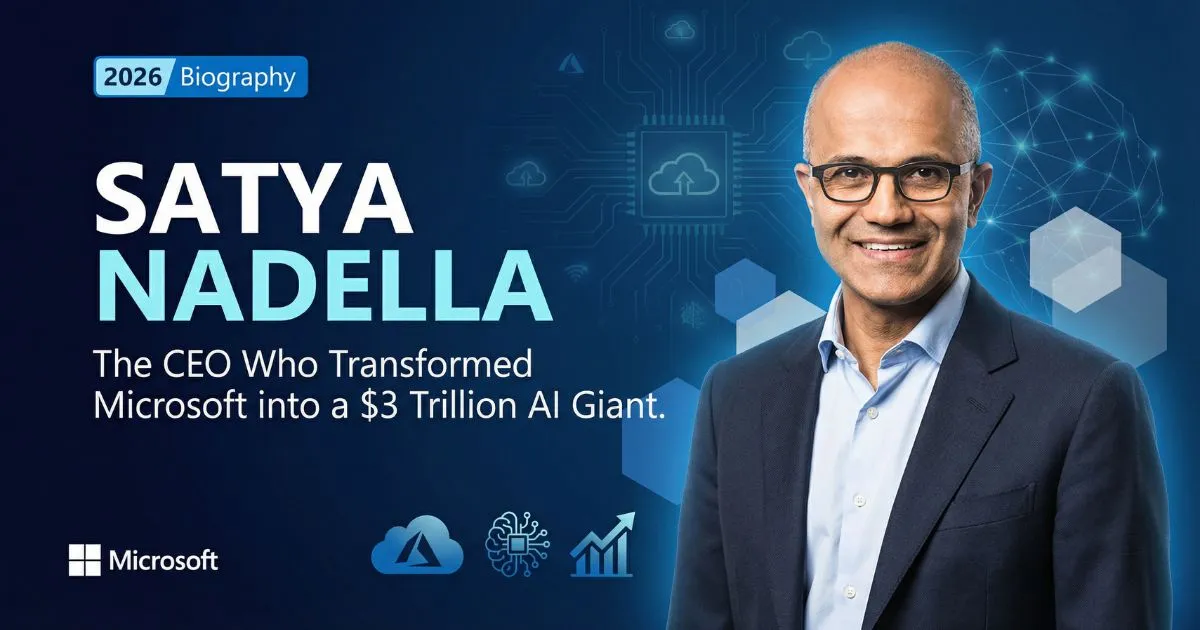
QUICK INFO BOX
| Attribute | Details |
|---|---|
| Full Name | Satya Narayana Nadella |
| Nick Name | Satya |
| Profession | Tech CEO / Cloud Computing Pioneer / AI Innovator |
| Date of Birth | August 19, 1967 |
| Age | 58 years (as of 2026) |
| Birthplace | Hyderabad, Andhra Pradesh, India |
| Hometown | Hyderabad, India |
| Nationality | American (Indian-born) |
| Religion | Hinduism |
| Zodiac Sign | Leo |
| Ethnicity | South Asian |
| Father | Bukkapuram Nadella Yugandhar (IAS Officer) |
| Mother | Prabhavati Nadella (Sanskrit Scholar) |
| Siblings | Two sisters |
| Wife/Partner | Anupama Nadella |
| Children | Three (Zain, Tara, Divya) |
| School | Hyderabad Public School |
| College / University | Manipal Institute of Technology, University of Wisconsin-Milwaukee, University of Chicago Booth School of Business |
| Degree | B.E. in Electrical Engineering, M.S. in Computer Science, MBA |
| First Company | Sun Microsystems (Early Career) |
| Current Company | Microsoft Corporation |
| Position | Chairman and CEO |
| Industry | Tech / Cloud Computing / AI / Software |
| Known For | Transforming Microsoft with Azure, AI integration, cultural change |
| Years Active | 1992–Present |
| Net Worth | $850 million – $1.2 billion (2026 est.) |
| Annual Income | $40-50 million (salary + stock) |
| Major Investments | Microsoft stock holdings, private tech investments |
| Not publicly active | |
| Twitter/X | @satyanadella |
| satya-nadella |
1. Introduction
When Satya Nadella took the helm of Microsoft in 2014, the tech giant was struggling to stay relevant in a mobile-first world. Twelve years later, he has transformed Microsoft into one of the world’s most valuable companies, surpassing $3 trillion in market capitalization and pioneering the AI revolution through partnerships with OpenAI and the development of Azure AI.
Satya Nadella is the Chairman and CEO of Microsoft Corporation, widely regarded as one of the most transformational leaders in modern technology. Under his leadership, Microsoft shifted from a Windows-centric company to a cloud-first, AI-first powerhouse that now dominates enterprise computing through Azure, leads in productivity software with Microsoft 365, and shapes the future of artificial intelligence through Copilot and OpenAI collaboration.
In this comprehensive biography, you’ll discover Nadella’s journey from a cricket-loving student in Hyderabad to becoming one of tech’s most respected CEOs, his leadership philosophy of empathy and growth mindset, the strategic decisions that revitalized Microsoft, his substantial net worth and lifestyle, and the personal challenges that shaped his compassionate approach to business and life.
2. Early Life & Background
Satya Narayana Nadella was born on August 19, 1967, in Hyderabad, India, into a family that valued both public service and education. His father, Bukkapuram Nadella Yugandhar, was a distinguished Indian Administrative Service (IAS) officer who dedicated his career to improving the lives of India’s rural poor. His mother, Prabhavati Nadella, was a Sanskrit scholar who instilled in him the importance of learning and culture.
Growing up in Hyderabad during the 1970s and 1980s, young Satya was passionate about cricket and dreamed of becoming a professional cricketer. He would spend hours playing the sport with friends, developing qualities of teamwork, strategy, and resilience that would later serve him in the business world. However, his interests gradually expanded to technology and computers as personal computing began emerging in India.
Satya’s first exposure to computers came during his school years when he became fascinated by the potential of technology to solve problems. Unlike many tech entrepreneurs who started coding in their early teens, Nadella’s interest in technology developed more gradually through his formal education. He was an excellent student, balancing his love for sports with academic achievement.
The family environment was intellectually stimulating. His father’s commitment to public service and his mother’s dedication to classical learning created a household where curiosity and compassion were equally valued. This upbringing would later influence Nadella’s leadership style, which emphasizes empathy alongside innovation.
During his teenage years, Satya attended Hyderabad Public School, one of India’s premier educational institutions. There, he developed a strong foundation in mathematics and science while maintaining his diverse interests. The competitive yet collaborative environment prepared him for the challenges ahead.
His early motivation came from witnessing India’s economic challenges and recognizing that technology could be a powerful equalizer. Unlike the entrepreneurial stories of garage startups, Nadella’s path was more traditional—excelling in education, pursuing advanced degrees, and climbing the corporate ladder. Yet this conventional beginning would lead to extraordinary transformation.
3. Family Details
| Relation | Name | Profession |
|---|---|---|
| Father | Bukkapuram Nadella Yugandhar | Indian Administrative Service (IAS) Officer |
| Mother | Prabhavati Nadella | Sanskrit Scholar, Teacher |
| Siblings | Two sisters | Various professions |
| Spouse | Anupama Nadella | Architect, Philanthropist |
| Children | Zain Nadella (deceased 2022), Tara Nadella, Divya Nadella | Students/Professionals |
4. Education Background
Manipal Institute of Technology (1984-1988) Satya Nadella completed his Bachelor of Engineering in Electrical Engineering from Manipal Institute of Technology in Karnataka, India. During these formative years, he developed a strong foundation in engineering principles and began exploring computer science alongside his core curriculum.
University of Wisconsin-Milwaukee (1988-1990) After graduating from Manipal, Nadella moved to the United States to pursue his Master of Science in Computer Science at the University of Wisconsin-Milwaukee. This transition marked a significant turning point in his life. He arrived in America with limited resources, living in student housing and working part-time while pursuing his degree. The experience taught him resilience and adaptability in unfamiliar environments.
University of Chicago Booth School of Business (1996-1997) While already working at Microsoft, Nadella pursued an MBA from the prestigious University of Chicago Booth School of Business as a part-time student. This decision demonstrated his commitment to understanding business strategy alongside technical excellence. The MBA equipped him with frameworks for thinking about markets, competition, and organizational leadership that would prove invaluable in his later career.
Balancing Education with Career Unlike many tech leaders who dropped out of college to pursue startups, Nadella took the traditional route, completing all his degrees while building his career. His evening MBA program required him to balance full-time work at Microsoft with rigorous academic coursework, often studying late into the night and traveling to Chicago for classes. This period taught him discipline and time management skills that would serve him throughout his leadership journey.
Early Work Experience During his time at the University of Wisconsin-Milwaukee, Nadella gained practical experience through internships and projects that exposed him to real-world computing challenges. After graduation, he briefly worked at Sun Microsystems in California before joining Microsoft in 1992, bringing with him both academic knowledge and industry experience.
5. Entrepreneurial Career Journey
A. Early Career & Microsoft Entry (1992-2000)
Satya Nadella joined Microsoft in 1992 as a young engineer, one of thousands of talented individuals attracted to the rapidly growing software giant. His first role was in the Windows NT development team, working on the operating system that would become the backbone of enterprise computing. Unlike flashy startup stories, Nadella’s early career was characterized by deep technical work, learning Microsoft’s culture, and proving his abilities through consistent execution.
During the 1990s, while Microsoft dominated the PC era under Bill Gates, Nadella was building expertise in operating systems and server technologies. He worked on critical projects but was far from the spotlight. His approach was methodical—understanding problems deeply, collaborating across teams, and delivering reliable solutions. Colleagues remember him as technically strong but also unusually empathetic for an engineer, taking time to understand different perspectives.
The first decade at Microsoft was about learning the business from the inside. Nadella witnessed firsthand how the company’s competitive intensity drove success but also created cultural challenges. He absorbed lessons about product development, enterprise sales, and Microsoft’s complex relationship with developers and partners.
B. Rising Through the Ranks (2000-2011)
Nadella’s breakthrough came when he transitioned from pure engineering to broader leadership roles. He was appointed to lead Microsoft’s bCentral, a small business portal, followed by roles in online services competing against Google. These positions, while not always successful in market terms, taught him valuable lessons about internet competition and customer needs.
His most significant pre-CEO achievement came when he took charge of Microsoft’s Server and Tools Business in 2011. This division, responsible for Windows Server, SQL Server, and emerging cloud services, generated over $20 billion in annual revenue. Under Nadella’s leadership, the division transformed its approach, recognizing that cloud computing represented an existential opportunity and threat.
As head of Server and Tools, Nadella championed the development of Azure, Microsoft’s cloud computing platform. When he took over, Azure was a nascent project struggling to compete with Amazon Web Services. Nadella bet heavily on cloud infrastructure, arguing internally that Microsoft needed to embrace a subscription-based, platform-agnostic approach even if it cannibalized traditional software licenses.
This period revealed Nadella’s strategic thinking. While Microsoft’s culture under Steve Ballmer emphasized Windows everywhere, Nadella recognized that the future required supporting multiple platforms. He pushed for SQL Server on Linux, Office on mobile devices, and Azure supporting open-source technologies—controversial positions at the time but prescient in hindsight.
C. Becoming CEO and Transformation (2014-Present)
On February 4, 2014, Satya Nadella was named the third CEO of Microsoft, succeeding Steve Ballmer. The appointment surprised many observers who expected an external candidate or a more prominent executive. At the time, Microsoft was valued at roughly $300 billion, down from its peak, and widely seen as a fading giant unable to compete in mobile or cloud computing.
Nadella’s first priority was cultural transformation. He introduced the concept of “growth mindset,” drawn from psychologist Carol Dweck’s research, as Microsoft’s new cultural foundation. The growth mindset philosophy—believing that abilities can be developed through dedication and hard work—became more than a corporate slogan. It fundamentally changed how Microsoft operated, encouraging experimentation, learning from failure, and collaboration over internal competition.
The strategic transformation was equally dramatic. Nadella articulated a vision of Microsoft as a “mobile-first, cloud-first” company, later evolving to “intelligent cloud and intelligent edge.” Key strategic decisions included:
Azure First: Nadella bet Microsoft’s future on cloud computing, investing billions in data center infrastructure and making Azure the company’s top priority. By 2026, Azure has become the second-largest cloud platform globally, challenging AWS and generating over $100 billion in annual revenue.
Embracing Open Source: In a stunning reversal from Microsoft’s traditional stance, Nadella made peace with the open-source community. Microsoft acquired GitHub for $7.5 billion, open-sourced .NET framework, and became a leading contributor to Linux. The famous statement “Microsoft loves Linux” signaled a new era.
Productivity Reimagined: Under Nadella, Microsoft transformed Office from desktop software to Microsoft 365, a cloud-based subscription service combining productivity apps with AI capabilities. Teams, launched in 2017, became a collaboration platform competing directly with Slack and Zoom, especially thriving during the 2020 pandemic.
Gaming Strategy: Nadella approved major gaming acquisitions including Minecraft (2014, $2.5 billion), ZeniMax Media (2021, $7.5 billion), and the landmark Activision Blizzard deal (2023, $69 billion)—the largest tech acquisition in history. These moves positioned Microsoft as a gaming industry leader through Xbox, Game Pass, and cloud gaming.
AI Revolution: Perhaps Nadella’s most consequential decision came in 2019 when he invested $1 billion in OpenAI, followed by additional investments totaling $13 billion through 2023. This partnership gave Microsoft early access to GPT models, enabling the integration of AI across all products. The launch of Microsoft Copilot in 2023 brought generative AI to Office, Windows, and Azure, opening new revenue streams and competitive advantages.
Strategic Acquisitions: Beyond gaming, Nadella approved LinkedIn ($26.2 billion, 2016), which has grown substantially under Microsoft’s ownership, and numerous smaller acquisitions strengthening Microsoft’s cloud, AI, and security capabilities.
By 2026, Microsoft’s market capitalization has grown to over $3 trillion, making it one of the world’s most valuable companies. Azure competes closely with AWS, Microsoft 365 dominates enterprise productivity, and the company leads in AI integration across consumer and enterprise products. The transformation from a Windows-centric dinosaur to an innovative cloud and AI leader stands as one of the most remarkable corporate turnarounds in tech history.
6. Career Timeline Chart
📅 CAREER TIMELINE

1992 ─── Joined Microsoft as Engineer (Windows NT team)
   │
2000 ─── VP of Microsoft bCentral
   │
2007 ─── Senior VP of R&D for Online Services
   │
2011 ─── President of Server and Tools Business (Azure development)
   │
2014 ─── Named CEO of Microsoft (February 4)
   │
2016 ─── LinkedIn acquisition ($26.2 billion)
   │
2019 ─── Initial OpenAI investment ($1 billion)
   │
2021 ─── Named Chairman of the Board
   │
2023 ─── Activision Blizzard acquisition completed ($69 billion)
   │
2023 ─── Microsoft Copilot launched
   │
2025 ─── Microsoft reaches $3 trillion market cap
   │
2026 ─── Leading AI transformation across tech industry
7. Business & Company Statistics
| Metric | Value |
|---|---|
| Companies Founded | 0 (Career executive) |
| Current Company Valuation | $3+ trillion (Microsoft) |
| Annual Revenue | $245+ billion (Microsoft FY2025) |
| Employees | 238,000+ globally |
| Countries Operated | 190+ countries |
| Market Share | #2 in cloud (Azure ~25%), #1 in enterprise productivity |
8. CEO Comparison Section
📊 Satya Nadella vs Sundar Pichai
| Statistic | Satya Nadella | Sundar Pichai |
|---|---|---|
| Net Worth | $850M – $1.2B | $600M – $1B |
| Tenure as CEO | 12 years (2014-present) | 9 years (2015-present as Alphabet CEO) |
| Company Market Cap Growth | ~$2.7 trillion increase | ~$1.5 trillion increase |
| Major Strategic Pivots | Cloud-first, AI integration, open source | AI-first, hardware expansion |
| Signature Achievement | Azure + OpenAI partnership | Google AI/Search dominance |
| Global Influence | Enterprise AI transformation | Consumer AI and search |
Winner: Both leaders have achieved remarkable success in their tenures. Nadella’s transformation of Microsoft from a declining software giant to a cloud and AI leader represents one of tech’s greatest turnarounds. His market cap growth under his leadership ($300B to $3T+) edges out Pichai’s impressive but more evolutionary stewardship of Google/Alphabet. However, Pichai maintains stronger consumer brand dominance while Nadella leads in enterprise transformation.
9. Leadership & Work Style Analysis
Leadership Philosophy: Empathy Meets Innovation
Satya Nadella’s leadership style is distinctive in the tech industry for prioritizing empathy alongside execution. His philosophy, detailed in his book “Hit Refresh,” centers on the belief that technology should amplify human ingenuity and serve humanity’s needs. Unlike the aggressive, competition-focused approach of predecessors, Nadella emphasizes collaboration, learning, and long-term value creation.
Growth Mindset Culture
The introduction of Carol Dweck’s growth mindset concept wasn’t just corporate jargon—Nadella fundamentally rewired Microsoft’s incentive structures, performance reviews, and team dynamics around learning rather than just achieving. He famously asks in meetings: “What did we learn?” rather than only “What did we achieve?” This shift reduced internal politics and increased cross-team collaboration.
Decision-Making Style
Nadella is known for deep listening and consensus-building, but he makes bold decisions once conviction forms. The OpenAI investment, LinkedIn acquisition, and commitment to Azure infrastructure were all significant bets made despite internal skepticism. He balances data-driven analysis with intuition about technology trends, often citing customer feedback and competitive dynamics in strategic discussions.
Risk-Taking Ability
While not as flamboyant as Elon Musk or as aggressive as Larry Ellison, Nadella takes calculated risks backed by strategic logic. The $69 billion Activision Blizzard acquisition—Microsoft’s largest ever—faced regulatory challenges globally but demonstrated his willingness to pursue transformative opportunities. His multi-billion dollar OpenAI investment before generative AI became mainstream showed remarkable foresight.
Innovation Mindset
Nadella believes innovation comes from diverse perspectives and relentless customer focus. He encourages experimentation and has publicly shared Microsoft’s failures (like Windows Phone) as learning opportunities. His approach to AI has been pragmatic rather than purely research-driven—focusing on how AI enhances existing products rather than just pursuing breakthrough research.
Strengths
- Strategic vision for technology trends (cloud, AI)
- Cultural transformation ability
- Strong execution on large-scale integration (acquisitions)
- Building partnerships across the tech industry
- Communicating complex technology clearly
Weaknesses
- Sometimes criticized for being too consensus-oriented, slowing decisions
- Microsoft’s consumer products (outside gaming) remain weak
- The company still struggles with innovation speed compared to smaller competitors
- Heavy reliance on enterprise customers may limit consumer breakthroughs
Expert Perspectives
Wall Street analyst Brad Reback stated: “Nadella has proven to be one of the most effective tech CEOs in history, successfully repositioning Microsoft for the cloud era while maintaining massive profitability.”
Former Microsoft executive Steven Sinofsky noted: “Satya’s superpower is making people feel heard while driving toward clear strategic goals. He changed Microsoft’s culture without destroying what made it great.”
10. Achievements & Awards
Business & Tech Awards
- Fortune Businessperson of the Year (2019)
- Financial Times Person of the Year (2019)
- Time Magazine 100 Most Influential People (2018, 2020)
- CNN’s “Tech CEO of the Year” (2019)
- GeekWire’s CEO of the Year (2015)
- Global Indian of the Year by Indian community organizations (2020)
Global Recognition
- Forbes World’s Most Powerful People (Consistently ranked in top 50 since 2014)
- Fortune’s World’s Greatest Leaders (Multiple years)
- Barron’s Best CEOs (Multiple years)
- Harvard Business Review’s Best-Performing CEOs (Ranked #3 globally in 2019)
Industry Recognition
- Inducted into the American Academy of Arts and Sciences (2023)
- Honorary Doctorates from multiple institutions including Manipal Academy
- Padma Bhushan (India’s third-highest civilian award, 2022)
Records Held
- Largest tech industry acquisition – Activision Blizzard for $69 billion
- Fastest growth in market capitalization – Microsoft gained over $2 trillion in value under his tenure
- Most successful CEO transition in mega-cap tech company history based on shareholder value creation
11. Net Worth & Earnings
💰 FINANCIAL OVERVIEW
| Year | Net Worth (Est.) |
|---|---|
| 2014 | $150-200 million |
| 2020 | $400-500 million |
| 2023 | $650-800 million |
| 2025 | $850 million – $1 billion |
| 2026 | $850 million – $1.2 billion |
Income Sources
Company Equity (Primary Source) Nadella’s wealth primarily comes from Microsoft stock holdings accumulated through equity compensation packages. As CEO, he receives substantial stock awards tied to performance metrics. His holdings represent roughly 1.6 million Microsoft shares (precise numbers vary with vesting schedules and sales).
Salary & Bonuses
- Base salary: $2.5 million annually
- Annual cash bonus: $10-15 million (performance-based)
- Stock awards: $30-40 million annually in equity compensation
- Total annual compensation: $40-55 million
Board Memberships
- Starbucks Corporation Board (resigned in 2022 due to schedule)
- Fred Hutchinson Cancer Research Center Board
Speaking & Book Royalties While not a major income source, Nadella’s book “Hit Refresh” (2017) generated royalties, and he occasionally participates in speaking engagements, though far less than many tech CEOs.
Major Investments
Microsoft Stock (Primary Holding) Nadella’s wealth is overwhelmingly concentrated in Microsoft stock, demonstrating confidence in the company’s future. He periodically sells shares for diversification and tax planning but maintains substantial holdings.
Private Investments Unlike many tech CEOs, Nadella is notably private about personal investments. He’s known to have invested in:
- Education technology startups (specific companies undisclosed)
- Healthcare technology ventures
- Sustainable energy projects
Real Estate Holdings Primary residence in Bellevue, Washington, and investment properties in the Seattle area (details kept private for security).
12. Lifestyle Section
🏠 ASSETS & LIFESTYLE
Properties
Primary Residence – Clyde Hill, Washington Nadella and his family live in the exclusive Clyde Hill area near Bellevue, Washington, close to Microsoft headquarters. The property is estimated at $4-6 million and reflects understated luxury rather than Silicon Valley ostentation. The home features privacy-oriented landscaping and accessibility modifications for his family’s needs.
Investment Properties Nadella owns several investment properties in the Seattle metropolitan area, though exact details are kept private. Unlike many tech billionaires, he doesn’t own multiple mansions across global destinations.
Cars Collection
Nadella is not known for an extravagant car collection. He maintains:
- Tesla Model S (Daily driver, reflecting interest in sustainable technology)
- Mercedes S-Class (Occasional use for formal events)
- Toyota Sienna (Family vehicle with accessibility features)
His automotive choices reflect practicality and environmental consciousness rather than status display.
Hobbies & Interests
Reading An voracious reader, Nadella regularly shares book recommendations with Microsoft employees. His reading spans technology, philosophy, poetry, and business strategy. He’s particularly drawn to works exploring human consciousness, empathy, and innovation.
Cricket Despite decades in America, Nadella remains a passionate cricket fan. He follows Indian Premier League matches and occasionally plays social cricket with friends. He credits the sport with teaching him teamwork and strategic thinking.
Poetry Nadella has a deep appreciation for poetry, particularly Urdu and Sanskrit verse. He often quotes poets in speeches and internal communications, reflecting his belief that humanities complement technology.
Fitness Maintains a regular fitness routine including walking, light exercise, and stress management practices. His approach is consistent rather than extreme.
Daily Routine
Work Hours Nadella typically works 12-14 hour days but emphasizes work-life harmony rather than pure hustle culture. He arrives at Microsoft headquarters around 8 AM and often works until 7-8 PM, with time carved out for family.
Productivity Habits
- Starts mornings reading news and industry updates
- Dedicates time to deep work without meetings
- Practices active listening in meetings, taking notes by hand
- Reserves Friday afternoons for strategic thinking and reading
- Limits social media use, focusing on LinkedIn and Twitter for professional purposes
- Emphasizes face-to-face conversations over email when possible
Family Time Despite demanding schedule, Nadella prioritizes family dinners when possible and weekends with his wife and children. His family life, particularly caring for his late son Zain who had cerebral palsy, profoundly influenced his leadership philosophy around empathy and accessibility.
13. Physical Appearance
| Attribute | Details |
|---|---|
| Height | 5’9″ (175 cm) |
| Weight | ~165 lbs (75 kg) |
| Eye Color | Dark Brown |
| Hair Color | Black (graying) |
| Body Type | Average build, fit for age |
| Distinctive Features | Warm smile, approachable demeanor, typically wears business casual attire |
14. Mentors & Influences
Early Mentors
His Father, B.N. Yugandhar Nadella frequently cites his father, an IAS officer dedicated to rural development, as his primary influence on empathetic leadership. His father’s commitment to public service and focus on improving others’ lives shaped Nadella’s belief that technology should serve humanity.
His Mother, Prabhavati Nadella His mother’s passion for Sanskrit and classical learning instilled in him the importance of humanities alongside sciences, an unusual combination that defines his leadership approach.
Business Idols & Mentors
Bill Gates Despite their different styles, Nadella learned immensely from Gates during his early Microsoft years. He absorbed Gates’ technical rigor, strategic thinking, and later, Gates’ evolution toward philanthropy influenced Nadella’s perspective on technology’s societal role.
Steve Ballmer While ultimately taking Microsoft in a different direction, Nadella learned valuable lessons from Ballmer about enterprise sales, competitive intensity, and large-scale organizational management.
Peter Drucker (Indirect Influence) Nadella frequently references management philosopher Peter Drucker’s ideas about innovation, customer focus, and organizational effectiveness.
Carol Dweck Stanford psychologist Carol Dweck’s research on growth mindset became foundational to Nadella’s cultural transformation at Microsoft. Her work provided the framework for changing Microsoft’s internal dynamics.
Key Leadership Lessons Learned
- Empathy as a Core Leadership Trait: From his personal experiences, particularly raising a child with special needs, Nadella learned that understanding others’ perspectives drives innovation and effective leadership.
- Culture Eats Strategy: Nadella realized that Microsoft’s cultural issues—internal competition, arrogance, resistance to change—were bigger obstacles than any strategic challenge.
- Long-term Thinking: Unlike the quarterly results obsession common in tech, Nadella focused on multi-year strategic positioning, particularly with Azure and AI investments.
- Partnership Over Competition: Reversing Microsoft’s historically combative approach to competitors, Nadella embraced partnerships with Apple, Linux community, and others, recognizing that collaboration expands opportunities.
- Technology Should Empower: His core belief that technology exists to amplify human capability rather than replace it guides Microsoft’s AI strategy and product development.
15. Company Ownership & Roles
| Company | Role | Years | Details |
|---|---|---|---|
| Microsoft Corporation | CEO & Chairman | 2014–Present (CEO), 2021–Present (Chairman) | Primary role, responsible for all strategic direction |
| Microsoft Corporation | President, Server and Tools | 2011–2014 | Led Azure development and cloud transformation |
| Microsoft Corporation | Various VP/Engineering Roles | 1992–2011 | Windows NT, bCentral, Online Services, Search |
| Starbucks Corporation | Board Member | 2017–2022 | Resigned due to schedule demands |
| Fred Hutchinson Cancer Research Center | Board Member | 2019–Present | Philanthropic board service |
Stock Ownership Nadella owns approximately 1.6 million Microsoft shares (subject to vesting schedules and periodic sales), representing roughly 0.02% of Microsoft’s total shares outstanding. This stake is valued at approximately $600-700 million based on Microsoft’s 2026 stock price.
16. Controversies & Challenges
Women in Tech Comments (2014) Shortly after becoming CEO, Nadella faced significant criticism for comments made at a Grace Hopper Celebration of Women in Computing event. When asked about women asking for raises, he suggested they should trust the system and have faith that they’ll be rewarded, rather than asking directly. The backlash was swift and intense. Nadella quickly apologized, calling his comments “completely wrong,” and the incident became a catalyst for his personal growth and Microsoft’s renewed focus on diversity and inclusion. He has since championed women in tech initiatives and admitted the gaffe taught him important lessons about privilege and systemic barriers.
Antitrust Scrutiny Under Nadella, Microsoft has faced renewed antitrust attention, particularly regarding:
- Cloud computing dominance: EU regulators have investigated Microsoft’s bundling practices with Azure and Office 365
- Activision Blizzard acquisition: The $69 billion deal faced intense regulatory scrutiny in the US, UK, and EU, delaying completion until late 2023
- Teams bundling: Complaints from competitors like Slack about Microsoft bundling Teams with Office 365
Nadella’s approach has been more conciliatory than Microsoft’s historically combative stance, working with regulators rather than fighting them. The Activision deal ultimately succeeded through negotiated remedies and concessions.
LinkedIn Privacy Concerns Following Microsoft’s acquisition of LinkedIn, the platform faced various privacy and data usage controversies. While not directly blamed on Nadella, the incidents raised questions about Microsoft’s data stewardship under his leadership.
GitHub Copilot Copyright Issues Microsoft’s AI coding assistant, GitHub Copilot, has faced lawsuits claiming it reproduces copyrighted code without proper attribution. These ongoing legal challenges reflect broader tensions around AI training data and intellectual property—issues Nadella and Microsoft continue navigating.
Work Culture During Transformation While Nadella’s cultural transformation is largely praised, some former employees have reported that the transition period involved significant stress, layoffs in certain divisions, and pressure to adapt to new ways of working. Critics argue the “growth mindset” messaging sometimes masked difficult organizational changes.
Handling Challenges Nadella’s approach to controversies typically involves:
- Quick acknowledgment when Microsoft makes mistakes
- Transparency about challenges and learning processes
- Proactive engagement with regulators and critics
- Implementation of policy changes addressing concerns
- Balancing business objectives with stakeholder concerns
Lessons Learned The controversies have reinforced Nadella’s public commitment to responsible technology development, diversity and inclusion, and collaborative approaches with regulators and civil society. He frequently references mistakes as learning opportunities, embodying the growth mindset philosophy he promotes.
17. Charity & Philanthropy
Personal Philanthropy
Education Initiatives Following his father’s legacy of public service, Nadella supports education initiatives particularly focused on:
- Computer science education for underserved communities
- STEM programs for girls and minorities
- Scholarships for Indian students pursuing technology degrees in the US
Disability Rights & Accessibility The experience of raising his late son Zain, who had cerebral palsy, profoundly shaped Nadella’s commitment to accessibility. He has:
- Championed Microsoft’s accessibility initiatives, making it a core company value
- Supported Children’s Hospital Seattle and disability rights organizations
- Advocated for inclusive design in technology products
Microsoft Philanthropic Initiatives (Under Nadella’s Leadership)
Microsoft Philanthropies Under Nadella, Microsoft has significantly expanded corporate giving, focusing on:
- AI for Good: Providing AI tools and resources to nonprofits addressing humanitarian challenges
- Affordable Access: Initiatives to bring technology and internet access to underserved communities globally
- Cybersecurity for Nonprofits: Free or subsidized security tools for civil society organizations
- Climate Initiatives: Commitment to carbon negativity by 2030, with substantial investment in carbon removal technologies
Employee Giving Program Microsoft’s employee giving program, expanded under Nadella, matches employee donations and volunteer time, generating hundreds of millions in charitable contributions annually.
COVID-19 Response During the pandemic, Nadella led Microsoft’s response including:
- Financial support for small businesses affected by lockdowns
- Free Teams access for healthcare and education institutions
- Funding for vaccine research and distribution
Estimated Charitable Contributions While Nadella keeps personal giving private, estimates suggest he and his wife Anupama have donated $15-25 million personally to various causes. Microsoft’s corporate philanthropy under his leadership exceeds $3 billion in combined software donations, cash grants, and pro bono services since 2014.
Future Commitments Nadella has indicated intention to increase personal philanthropy as his career progresses, following the model of Bill and Melinda Gates, though he has not publicly signed the Giving Pledge.
18. Personal Interests
| Category | Favorites |
|---|---|
| Food | Indian cuisine (especially Hyderabadi biryani), prefers home-cooked meals |
| Movie | “The Shawshank Redemption,” Enjoys thoughtful dramas and Indian cinema |
| Book | “Mindset” by Carol Dweck, “The Boys in the Boat,” Poetry collections |
| Travel Destination | India (family visits), enjoys cultural/historical destinations |
| Technology | Cloud computing, AI/machine learning, quantum computing |
| Sport | Cricket (lifelong passion), follows Test cricket and IPL |
19. Social Media Presence
| Platform | Handle | Followers | Activity Level |
|---|---|---|---|
| Not publicly active | N/A | Does not maintain personal account | |
| Twitter/X | @satyanadella | 11.8 million+ | Active, posts 2-3 times weekly |
| satya-nadella | 11.5 million+ followers | Very active, shares company updates and industry insights | |
| YouTube | Via Microsoft channels | N/A | Appears in keynotes, interviews |
| Limited presence | N/A | Minimal personal activity |
Social Media Strategy
Nadella’s social media presence is professional and measured, contrasting sharply with more provocative tech CEOs. His approach includes:
- LinkedIn Focus: His most active platform, where he shares Microsoft announcements, industry trends, book recommendations, and reflections on technology’s societal impact
- Twitter/X Usage: Primarily for company communications, responding to customer feedback, and occasional personal insights about cricket or reading
- No Instagram: Unlike younger tech leaders, Nadella doesn’t maintain a visual social media presence, preferring text-based professional platforms
- Controlled Messaging: His posts are thoughtful and edited, rarely spontaneous or controversial
- Engagement Style: Responds selectively to replies, maintains professional tone, avoids political controversies
Notable Social Media Moments
- Regular sharing of employee achievements and Microsoft innovations
- Book recommendations that influence tech industry reading lists
- Tributes to technology pioneers and thought leaders
- Updates during major Microsoft events and product launches
- Occasional cricket-related posts during major tournaments
20. Recent News & Updates (2025–2026)
Major Developments
Microsoft Copilot Expansion (Late 2025) Microsoft announced Copilot integration across all consumer Windows devices, making AI assistance available to over 1 billion users. Nadella positioned this as “the most significant Windows update since Windows 95,” emphasizing how AI would transform personal computing. The feature received mixed reviews, with praise for productivity gains but concerns about privacy and accuracy.
AI Datacenter Investment ($80 Billion, 2025-2026) Under Nadella’s direction, Microsoft committed to spending approximately $80 billion on AI infrastructure over 2025-2026, building datacenters globally to support Azure AI services and OpenAI partnership demands. This represents the largest infrastructure investment in tech history.
OpenAI Governance Changes (2024-2026) Following the November 2023 OpenAI board drama where Sam Altman was briefly fired then reinstated, Microsoft’s relationship with OpenAI evolved. Nadella navigated complex negotiations, securing Microsoft’s position while respecting OpenAI’s independence. By 2026, Microsoft holds observer status on OpenAI’s board, and the partnership has deepened despite periodic tensions.
Quantum Computing Breakthrough (January 2026) Microsoft announced significant progress in quantum computing, with Azure Quantum services achieving error-correction milestones. Nadella highlighted this as a 10-15 year investment paying off, positioning Microsoft alongside Google and IBM in the quantum race.
Regulatory Developments
EU Digital Markets Act Compliance (2025) Microsoft made significant changes to Azure and Teams bundling in Europe to comply with DMA regulations. Nadella took a cooperative stance, working with EU regulators rather than fighting compliance.
AI Safety Commitments (2025) Nadella participated in global AI safety summits, committing Microsoft to voluntary safety standards before formal regulations. He positioned Microsoft as a responsible AI leader, contrasting with more libertarian approaches from some competitors.
Market Performance
$3 Trillion Milestone (2025) Microsoft briefly crossed $3 trillion market capitalization in 2025, competing with Apple and Nvidia for most valuable company status. Under Nadella’s 12-year tenure, the company added approximately $2.7 trillion in value.
Product Launches
Windows 12 (Expected 2026) Reports suggest Microsoft is preparing Windows 12 with AI deeply integrated at the operating system level. Nadella has previewed this as a reimagining of Windows for the AI era.
Microsoft 365 Copilot Adoption By early 2026, over 10 million enterprise users are paying for Microsoft 365 Copilot, generating billions in new annual revenue and validating Nadella’s AI strategy.
Media Interviews & Appearances
- Bloomberg Interview (January 2026): Discussed AI regulation, Microsoft’s competitive position, and thoughts on maintaining innovation leadership
- World Economic Forum Davos (January 2026): Participated in panels on AI governance and technology’s role in addressing climate change
- Internal Microsoft Events: Continues hosting regular employee Q&A sessions and all-hands meetings, maintaining connection with Microsoft’s 238,000+ employees
Future Plans
Nadella has indicated priorities for 2026-2027 include:
- Expanding AI capabilities across all Microsoft products
- Investing in emerging markets for cloud services
- Continuing quantum computing development
- Strengthening Microsoft’s cybersecurity portfolio
- Exploring new applications of AI in healthcare and education
21. Lesser-Known Facts
Interesting Insights About Satya Nadella
- Cricket Nearly Changed Everything: Nadella was seriously considering a professional cricket career in his youth. He played competitive cricket in Hyderabad and only shifted focus to engineering after realizing the limited opportunities in Indian cricket at the time. He still plays social cricket occasionally with friends in Seattle.
- His Son Changed His Leadership Philosophy: Nadella’s eldest son Zain was born with cerebral palsy and required intensive care throughout his life. Zain passed away in 2022 at age 26. This experience profoundly shaped Nadella’s empathy-centered leadership approach and his commitment to accessibility in technology. He has said Zain taught him more about life and leadership than any business school could.
- Poetry Influences His Business Communication: Nadella frequently quotes Urdu and Sanskrit poetry in speeches and internal Microsoft communications. He believes poetry helps express complex emotions and ideas that pure business language cannot capture. His book “Hit Refresh” includes poetry references throughout.
- He Almost Didn’t Get the CEO Job: When Microsoft’s board was searching for Steve Ballmer’s successor, Nadella was not initially a frontrunner. Many expected an external candidate like Ford CEO Alan Mulally. Bill Gates reportedly championed Nadella internally, recognizing qualities others initially overlooked.
- First Major Decision Was Culturally Risky: One of Nadella’s first acts as CEO was declaring “Microsoft loves Linux” at a company event—a statement that would have been heretical under previous leadership. The decision shocked many longtime Microsoft employees but signaled the cultural transformation to come.
- He Commuted to Chicago for MBA Classes: While working full-time at Microsoft in the 1990s, Nadella flew to Chicago on weekends to attend MBA classes at University of Chicago Booth School of Business. He balanced demanding work responsibilities with rigorous academic coursework for over a year.
- Does Not Own a Yacht or Private Jet: Unlike many tech billionaires, Nadella doesn’t own luxury assets like yachts, private jets, or multiple mansions. He flies commercially for personal travel and maintains a relatively modest lifestyle focused on family and work.
- His Father Never Saw His CEO Success: Nadella’s father, B.N. Yugandhar, passed away in 2013, just months before Satya became Microsoft’s CEO. Nadella has expressed regret that his father couldn’t witness his achievement, though his mother remains a important presence in his life.
- Turned Down Other CEO Opportunities: Before becoming Microsoft CEO, Nadella was reportedly approached for CEO positions at other tech companies but declined, believing he could make the most impact at Microsoft despite its challenges at the time.
- Implemented “No Jerks” Policy: One of Nadella’s unwritten rules is that brilliant people who harm team culture don’t last at Microsoft. He prioritizes collaboration over individual genius, a significant departure from Microsoft’s historically cutthroat internal culture.
- Reads 4-5 Books Monthly: Nadella is an voracious reader who typically finishes 4-5 books per month across diverse topics—technology, philosophy, history, poetry, and business. He maintains detailed notes and regularly shares recommendations with Microsoft employees.
- Started a Book Club at Microsoft: Nadella initiated an internal book club where executives and employees discuss books related to growth mindset, innovation, and leadership. The discussions influence company strategy and culture.
- His Compensation is Heavily Performance-Based: While Nadella’s total compensation can reach $40-50 million annually, over 90% comes from stock awards tied to Microsoft’s performance metrics. His base salary of $2.5 million is modest compared to total compensation.
- Played Key Role in Saving Nokia Partnership: During Microsoft’s troubled Nokia phone acquisition (2014), Nadella inherited the failing business. He made the difficult decision to write off $7.6 billion and exit the smartphone hardware business, one of his first major strategic choices showing willingness to cut losses rather than pursue sunk costs.
- Champions Accessibility Beyond Compliance: Microsoft’s accessibility features (like AI-powered visual assistance, real-time captions, adaptive controllers) go far beyond legal requirements, reflecting Nadella’s personal commitment. He views accessibility as innovation driver, not just compliance burden.
22. FAQs
Who is Satya Nadella?
Satya Nadella is the Chairman and CEO of Microsoft Corporation, appointed in February 2014. He transformed Microsoft from a struggling software giant into a $3 trillion cloud computing and AI leader. Under his leadership, Microsoft pioneered enterprise AI through partnerships with OpenAI, grew Azure into the world’s second-largest cloud platform, and became one of the most valuable companies globally.
What is Satya Nadella’s net worth in 2026?
Satya Nadella’s net worth is estimated at $850 million to $1.2 billion in 2026. His wealth primarily comes from Microsoft stock holdings accumulated through equity compensation packages. His annual compensation ranges from $40-50 million, consisting of base salary, bonuses, and primarily stock awards tied to company performance.
How did Satya Nadella become Microsoft CEO?
Nadella joined Microsoft in 1992 as an engineer and spent 22 years rising through the ranks. He led crucial divisions including Server and Tools Business where he championed Azure development. When Steve Ballmer announced retirement in 2013, Microsoft’s board selected Nadella over external candidates and internal competitors, recognizing his technical expertise, strategic vision, and cultural fit for transforming Microsoft.
Is Satya Nadella married?
Yes, Satya Nadella is married to Anupama Nadella, an architect and philanthropist. They met at Manipal Institute of Technology in India where both were students. The couple has three children: their eldest son Zain passed away in 2022 at age 26 after living with cerebral palsy, and they have two daughters, Tara and Divya.
What companies does Satya Nadella own?
Satya Nadella does not own companies; he is a career executive. He is the CEO and Chairman of Microsoft Corporation, where he owns approximately 1.6 million shares worth $600-700 million. He previously served on Starbucks’ board of directors (2017-2022) and currently serves on the board of Fred Hutchinson Cancer Research Center.
What is Satya Nadella’s educational background?
Nadella holds a Bachelor of Engineering in Electrical Engineering from Manipal Institute of Technology (India), a Master of Science in Computer Science from University of Wisconsin-Milwaukee, and an MBA from University of Chicago Booth School of Business. He completed his MBA while working full-time at Microsoft.
What is Satya Nadella’s leadership philosophy?
Nadella’s leadership philosophy centers on “growth mindset”—the belief that abilities can be developed through dedication and hard work. He emphasizes empathy, continuous learning, collaboration over competition, and long-term strategic thinking. His approach transformed Microsoft’s previously cutthroat culture into one focused on innovation, customer obsession, and partnerships.
What are Satya Nadella’s biggest achievements as Microsoft CEO?
Nadella’s major achievements include: growing Microsoft’s market value from $300 billion to over $3 trillion; making Azure the second-largest cloud platform globally; securing strategic partnership with OpenAI for AI leadership; successfully integrating major acquisitions like LinkedIn ($26B) and Activision Blizzard ($69B); transforming company culture around growth mindset; and positioning Microsoft as enterprise AI leader through Copilot integration across products.
Where does Satya Nadella live?
Nadella lives in Clyde Hill, an exclusive area near Bellevue, Washington, close to Microsoft’s Redmond headquarters. His primary residence is estimated at $4-6 million. Unlike many tech billionaires, he maintains a relatively modest lifestyle and does not own multiple luxury properties worldwide.
What is Satya Nadella’s salary?
Nadella’s base salary is approximately $2.5 million annually. However, his total compensation ranges from $40-50 million per year, with the majority coming from performance-based stock awards ($30-40 million) and annual cash bonuses ($10-15 million). Over 90% of his compensation is tied to Microsoft’s performance metrics.
23. Conclusion
Satya Nadella’s journey from a cricket-loving student in Hyderabad to leading one of the world’s most valuable technology companies represents a remarkable story of vision, perseverance, and transformational leadership. Over twelve years as CEO, he has fundamentally reshaped Microsoft’s trajectory, proving that even massive, mature tech companies can reinvent themselves with the right leadership.
When Nadella took over in 2014, Microsoft was widely viewed as a fading giant, having missed mobile computing and struggling to remain relevant in a cloud-first world. Through strategic clarity, cultural transformation, and bold bets on cloud computing and artificial intelligence, he transformed Microsoft into a $3 trillion powerhouse that leads in enterprise cloud services, productivity software, and AI integration. The addition of approximately $2.7 trillion in shareholder value under his tenure ranks among the greatest value creation stories in corporate history.
Beyond financial metrics, Nadella’s impact on Microsoft’s culture may be his most enduring legacy. By introducing growth mindset principles, emphasizing empathy and collaboration, and shifting from a “know-it-all” to a “learn-it-all” culture, he made Microsoft an attractive place for top talent and a respected partner in the technology ecosystem. His willingness to embrace open source, partner with former competitors, and acknowledge Microsoft’s mistakes marked a dramatic departure from the company’s historically combative approach.
His personal story—shaped by his father’s commitment to public service, his experience raising a child with special needs, and his belief that technology should amplify human potential—has influenced how Microsoft thinks about accessibility, responsible AI development, and technology’s role in society. In an industry often criticized for prioritizing disruption over responsibility, Nadella has demonstrated that empathetic leadership and business success can coexist.
Looking ahead, Microsoft under Nadella faces significant opportunities and challenges. The company’s early investments in OpenAI and aggressive AI integration across products position it to lead the next computing era, but competition from Google, Amazon, and emerging players remains fierce. Regulatory scrutiny around market dominance, particularly in cloud services and AI, will test Nadella’s diplomatic approach. The success of major bets like the $69 billion Activision Blizzard acquisition and the $80+ billion AI infrastructure investment will shape Microsoft’s trajectory for years to come.
As Nadella continues leading Microsoft through the AI revolution, his legacy is already secure as one of technology’s most effective transformation leaders. He proved that established companies can innovate, that culture truly does eat strategy for breakfast, and that empathetic leadership can drive both financial performance and positive societal impact.
For aspiring entrepreneurs, executives, and anyone interested in technology leadership, Satya Nadella’s story offers valuable lessons: the power of long-term strategic thinking over short-term wins, the importance of continuous learning and adaptation, the competitive advantage of strong organizational culture, and the reality that the most meaningful innovations often come from understanding human needs deeply rather than just pursuing technological possibility.
👉 Share Your Thoughts: What aspect of Satya Nadella’s leadership inspires you most? Share this article with aspiring tech leaders and entrepreneurs who can learn from his transformational journey. Follow us for more in-depth profiles of technology’s most influential leaders.