QUICK INFO BOX
| Attribute | Details |
|---|---|
| Full Name | Demis Hassabis |
| Profession | AI Researcher, Entrepreneur, Neuroscientist, Game Designer |
| Date of Birth | July 27, 1976 |
| Age | 49 (as of 2026) |
| Birthplace | London, England |
| Hometown | London, England |
| Nationality | British |
| Ethnicity | Greek Cypriot and Singaporean Chinese descent |
| Education | University of Cambridge (Computer Science), University College London (PhD Cognitive Neuroscience) |
| AI Specialization | Deep Reinforcement Learning, Artificial General Intelligence (AGI), Neuroscience-inspired AI |
| First AI Startup | DeepMind Technologies (2010) |
| Current Company | Google DeepMind |
| Position | CEO & Co-Founder |
| Industry | Artificial Intelligence, Deep Tech, Scientific Research |
| Known For | AlphaGo, AlphaFold, Nobel Prize in Chemistry (2024) |
| Years Active | 1994–Present |
| Net Worth | $285 million (estimated, 2026) |
| Major Achievement | Nobel Prize in Chemistry 2024 for AlphaFold protein structure prediction |
1. Introduction
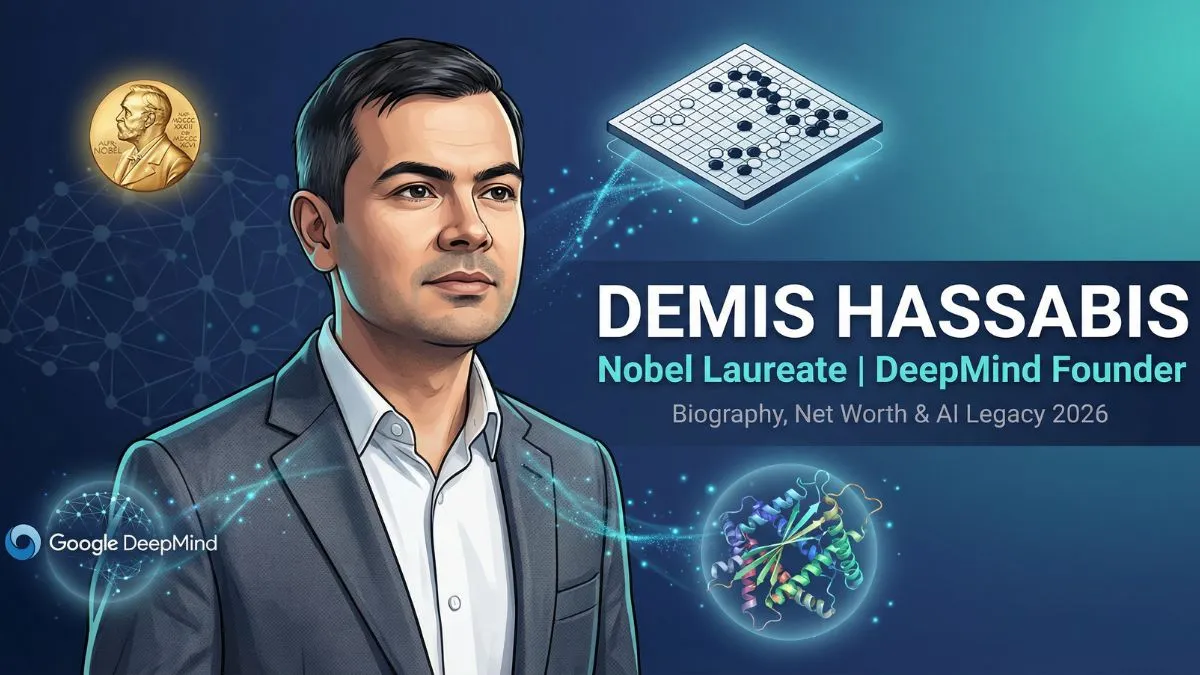
Demis Hassabis stands as one of the most visionary minds in artificial intelligence, bridging neuroscience, game design, and cutting-edge AI research. As the co-founder and CEO of DeepMind (acquired by Google in 2014 for approximately $500 million), Hassabis has pioneered breakthroughs that redefined what machines can achieve—from defeating world champions at Go to solving one of biology’s grand challenges with AlphaFold.
In 2024, Hassabis achieved a historic milestone: winning the Nobel Prize in Chemistry alongside John Jumper for their revolutionary work on protein structure prediction. This recognition cemented his status not just as a tech entrepreneur, but as a scientist whose work impacts humanity at the deepest level.
This comprehensive biography explores Hassabis’s journey from chess prodigy to AI luminary, his leadership philosophy, the creation of DeepMind, his net worth, lifestyle, and his vision for artificial general intelligence (AGI) that could transform civilization.
2. Early Life & Background
Demis Hassabis was born in London to a Greek Cypriot father and a Singaporean Chinese mother. Growing up in a multicultural household in North London, Hassabis displayed extraordinary intellectual gifts from an early age. By age four, he was already playing chess, and by eight, he had become one of the highest-ranked junior chess players in the world, achieving a master rating at 13.
His childhood was marked by an insatiable curiosity about how minds work—both human and artificial. Hassabis spent countless hours not just mastering chess, but understanding the patterns, strategies, and cognitive processes behind decision-making. This early fascination with intelligence would become the foundation of his life’s work.
At age eight, Hassabis bought his first computer—a ZX Spectrum—and taught himself programming. He was immediately captivated by the potential of computers to simulate intelligent behavior. His first programs were simple games, but they sparked a deeper question that would drive his career: Could machines truly think?
During his teenage years, Hassabis balanced competitive chess with coding, often staying up late to program games while contemplating the nature of intelligence, consciousness, and learning. His role models included Alan Turing, whose work on computation and AI philosophy deeply influenced him, and chess grandmaster Garry Kasparov, whose battles with IBM’s Deep Blue fascinated the young prodigy.
3. Family Details
| Relation | Name | Profession |
|---|---|---|
| Father | Not publicly disclosed | Greek Cypriot heritage |
| Mother | Not publicly disclosed | Singaporean Chinese heritage |
| Siblings | Brothers and sisters (details private) | Not publicly disclosed |
| Spouse | Teresa Hassabis (married 2010s) | Italian molecular biologist |
| Children | Two children | Private |
Hassabis maintains strict privacy about his family life, rarely discussing personal details in interviews. His wife Teresa shares his passion for science, and they’ve built a life that balances groundbreaking research with family time.
4. Education Background
Early Education: Hassabis attended a state comprehensive school in North London, where he excelled in mathematics, science, and computer studies despite the school’s limited resources.
University of Cambridge (1994-1997): At 16, Hassabis gained admission to Queens’ College, Cambridge, to study Computer Science—remarkably young for university entry. He graduated with a double first-class honors degree, completing his undergraduate studies with distinction. At Cambridge, he was exposed to cutting-edge AI research and began formulating ideas about combining neuroscience with artificial intelligence.
Gap Period – Game Industry (1998-2005): Before pursuing his PhD, Hassabis took an unconventional detour into the video game industry. At 17, he joined Bullfrog Productions, working on the legendary game Theme Park. By 21, he co-founded Elixir Studios, where he served as designer and lead programmer for games like Republic: The Revolution and Evil Genius. This experience taught him about complex systems, simulation, and emergent behavior—concepts that would later inform his AI research.
University College London – PhD in Cognitive Neuroscience (2005-2009): Hassabis returned to academia to pursue a PhD at UCL’s Gatsby Computational Neuroscience Unit under the supervision of Professor Eleanor Maguire. His groundbreaking research focused on memory, imagination, and episodic memory in the hippocampus. He published influential papers demonstrating that patients with hippocampal damage couldn’t imagine future scenarios, revealing deep connections between memory and imagination. This neuroscience foundation would become crucial to his AI philosophy: building intelligent systems by understanding biological intelligence first.
5. Entrepreneurial Career Journey
A. Early Career & First AI Startup
The Game Industry Years (1998-2005): After Cambridge, Hassabis joined Bullfrog Productions, working on Theme Park, and quickly rose to lead AI programmer. At 21, he founded Elixir Studios, raising millions in venture capital to create sophisticated strategy games. While Elixir achieved critical acclaim, it faced commercial challenges and ultimately closed in 2005. This experience taught Hassabis invaluable lessons about startup management, team building, and the importance of focusing on a singular mission.
The PhD Pivot (2005-2009): Rather than immediately founding another company, Hassabis made a strategic decision: return to academia to deeply understand intelligence at the neural level. His PhD research at UCL investigating memory systems gave him scientific credibility and a unique perspective that would differentiate DeepMind from other AI ventures.
B. Breakthrough Phase – Founding DeepMind (2010)
In 2010, Hassabis co-founded DeepMind Technologies in London alongside Shane Legg (a machine learning researcher he met at UCL) and Mustafa Suleyman (a childhood friend and social entrepreneur). Their audacious mission: “Solve intelligence, then use it to solve everything else.”
The Vision: DeepMind aimed to build artificial general intelligence (AGI) by combining the best techniques from machine learning with insights from neuroscience. Unlike narrow AI systems designed for specific tasks, Hassabis envisioned systems that could learn and adapt like humans.
Early Development: The team started small, operating stealth-mode for the first few years while developing foundational technologies. They focused on deep reinforcement learning—teaching AI systems to learn through trial and error, similar to how humans learn. Their early work involved training neural networks to play classic Atari games, achieving superhuman performance without any hand-coded rules.
The DQN Breakthrough (2013): DeepMind’s Deep Q-Network (DQN) algorithm made headlines when it learned to play 49 different Atari games at superhuman levels using only raw pixels as input—the same information a human player would see. This Nature paper demonstrated that a single algorithm could master diverse tasks through learning alone, a crucial step toward general intelligence.
Google Acquisition (2014): In January 2014, Google acquired DeepMind for approximately $500 million (some reports suggest up to $650 million), making it one of the largest European tech acquisitions at the time. The deal came with unusual provisions: DeepMind would remain relatively independent, operate from London, and maintain an ethics board to ensure AI safety. Hassabis negotiated these terms to preserve DeepMind’s research culture and long-term mission.
C. Expansion & Global Impact
AlphaGo (2016): DeepMind achieved global recognition when AlphaGo defeated Lee Sedol, one of the world’s greatest Go players, 4-1 in a historic match in Seoul. Go, an ancient Chinese board game, has more possible positions than atoms in the universe, and experts had predicted AI wouldn’t master it for another decade. AlphaGo’s victory demonstrated the power of deep learning and reinforcement learning combined with Monte Carlo tree search. The match was watched by over 200 million people worldwide.
AlphaGo Zero & AlphaZero (2017-2018): DeepMind then created AlphaGo Zero, which learned to play Go at superhuman levels purely through self-play, starting from random moves—no human knowledge required. AlphaZero generalized this approach to chess and shogi, mastering all three games and defeating previous champion programs. These systems discovered novel strategies that surprised even grandmasters, demonstrating creativity beyond imitation of human play.
AlphaFold (2018-2020): Perhaps DeepMind’s most impactful achievement came in biology. AlphaFold tackled the “protein folding problem”—predicting 3D protein structures from amino acid sequences—a challenge that had stumped scientists for 50 years. In 2020, AlphaFold 2 achieved unprecedented accuracy at the CASP14 competition, essentially solving the problem. DeepMind made AlphaFold open-source, providing structure predictions for over 200 million proteins, accelerating drug discovery, disease research, and biological understanding worldwide.
AlphaFold Nobel Prize (2024): In October 2024, Demis Hassabis and John Jumper (DeepMind’s AlphaFold project lead) were awarded the Nobel Prize in Chemistry for their work on protein structure prediction—a historic recognition of AI’s contribution to fundamental science. Hassabis became one of the youngest Nobel laureates in Chemistry and the first AI entrepreneur to receive the prize.
Google DeepMind Merger (2023): In April 2023, Google merged DeepMind with Google Brain (its in-house AI research division) to form Google DeepMind, with Hassabis as CEO. This consolidation aimed to accelerate AI development and coordinate Google’s AGI efforts. The combined entity now employs thousands of researchers and engineers across London, Mountain View, and other global offices.
Gemini AI Models (2023-2024): Under Hassabis’s leadership, Google DeepMind launched Gemini, a family of large language models designed to compete with OpenAI’s GPT series. Gemini represents the integration of DeepMind’s research expertise with Google’s infrastructure, offering multimodal AI capabilities across text, images, audio, and video.
6. Career Timeline Chart
📅 CAREER TIMELINE

1976 ─── Born in London
   │
1984 ─── Chess prodigy (age 8)
   │
1994 ─── Cambridge University (Computer Science)
   │
1998 ─── Bullfrog Productions (Theme Park)
   │
1998 ─── Founded Elixir Studios (age 21)
   │
2005 ─── UCL PhD (Cognitive Neuroscience)
   │
2010 ─── Founded DeepMind Technologies
   │
2014 ─── Google acquires DeepMind ($500M+)
   │
2016 ─── AlphaGo defeats Lee Sedol
   │
2020 ─── AlphaFold solves protein folding
   │
2023 ─── CEO of Google DeepMind (merger)
   │
2024 ─── Nobel Prize in Chemistry
   │
2026 ─── Leading AGI research
7. Business & Company Statistics
| Metric | Value |
|---|---|
| AI Companies Founded | 2 (Elixir Studios, DeepMind) |
| DeepMind Acquisition Value | $500-650 million (2014) |
| Google DeepMind Valuation | Part of $2+ trillion Google (Alphabet) |
| Employees (Google DeepMind) | ~2,500-3,000+ |
| Countries Operated | UK, USA, Canada, France |
| Major AI Systems | AlphaGo, AlphaFold, Gemini, AlphaZero |
| Research Papers Published | 1,000+ (DeepMind total) |
| AlphaFold Impact | 200M+ protein structures predicted |
8. AI Founder Comparison Section
📊 Demis Hassabis vs Sam Altman
| Statistic | Demis Hassabis | Sam Altman |
|---|---|---|
| Net Worth | ~$285 million | ~$2 billion+ |
| AI Companies Built | DeepMind (acquired) | OpenAI (nonprofit → capped-profit) |
| Nobel Prize | Yes (Chemistry, 2024) | No |
| Academic Background | PhD Neuroscience, Cambridge CS | Stanford CS (dropout) |
| AI Philosophy | AGI through neuroscience + RL | AGI through scaling LLMs |
| Company Status | Part of Google/Alphabet | Independent (Microsoft partnership) |
| Major Breakthrough | AlphaGo, AlphaFold | ChatGPT, GPT-4 |
Winner: Different approaches to the same goal. Hassabis brings deep scientific rigor and neuroscience-inspired methods, achieving breakthroughs in games and biology. Altman has popularized AI through accessible products like ChatGPT, achieving massive commercial scale. Hassabis has scientific prestige (Nobel Prize); Altman has greater cultural influence and valuation. Both are indispensable to the AI revolution.
9. Leadership & Work Style Analysis
Neuroscience-Inspired Leadership: Hassabis applies principles from cognitive neuroscience to organizational design. He believes in creating environments where researchers can engage in deep, focused work—similar to how the brain consolidates memories during rest. DeepMind’s office design includes quiet spaces, game rooms, and areas for spontaneous collaboration.
Long-Term Thinking: Unlike many tech CEOs focused on quarterly results, Hassabis thinks in decades. His willingness to work on problems like protein folding—which took years with uncertain outcomes—reflects patience rare in Silicon Valley. He often quotes the Go proverb: “Lose your first 50 games as quickly as possible,” emphasizing learning over immediate success.
Scientific Rigor: Hassabis insists on publishing research in peer-reviewed journals like Nature and Science, not just corporate blogs. This academic approach has earned DeepMind credibility in scientific communities and attracts top research talent.
Risk & Innovation: Hassabis embraces calculated risks. Challenging Lee Sedol at Go when defeat seemed possible required courage—a loss would have damaged DeepMind’s reputation. His background in chess taught him to think many moves ahead while accepting uncertainty.
Interdisciplinary Integration: Hassabis actively recruits from diverse fields: neuroscience, physics, mathematics, philosophy. He believes breakthrough AI requires perspectives beyond computer science. This philosophy led to AlphaFold’s success, combining AI expertise with structural biology knowledge.
Ethical Considerations: From DeepMind’s founding, Hassabis has emphasized AI safety and ethics. He established an ethics board and regularly discusses risks of advanced AI, including potential misuse and societal disruption. He advocates for proactive governance rather than reactive regulation.
Quote: “I think the most important thing is to solve intelligence and then use that to solve everything else. If we can crack that, it’s the final invention we’ll ever have to make.”
10. Achievements & Awards
AI & Tech Awards
- Nobel Prize in Chemistry (2024) – For AlphaFold protein structure prediction
- CBE (Commander of the British Empire) (2018) – Honors from Queen Elizabeth II for services to science and technology
- Fellow of the Royal Society (2017) – One of the UK’s highest scientific honors
- Nature’s 10 (2016, 2020) – Selected as one of ten people who mattered in science
- Financial Times Person of the Year (Runner-up, 2016)
- MIT Technology Review TR35 – Top innovator under 35
- Royal Academy of Engineering Silver Medal (2024)
Global Recognition
- Time 100 Most Influential People (2017)
- Fortune 40 Under 40 (Multiple years)
- Wired 25 Icons – Shaping the future
Gaming Industry Recognition
- Golden Joystick Award – For contributions to game AI (Early career)
Records
- Youngest master-level chess player in UK history (at age 13)
- Led team to solve 50-year protein folding challenge
- Co-created AI system that defeated world champions in multiple complex games
11. Net Worth & Earnings
💰 FINANCIAL OVERVIEW
| Year | Net Worth (Est.) |
|---|---|
| 2014 | $50-100 million (post-Google acquisition) |
| 2020 | $200 million |
| 2024 | $270 million |
| 2026 | $285 million |
Income Sources
Founder Equity: Hassabis’s wealth primarily comes from his stake in DeepMind when Google acquired it. While exact figures remain private, as co-founder and CEO, his share likely represented significant value. Google’s acquisition structure included performance bonuses tied to research milestones, potentially adding tens of millions more over subsequent years.
Google Compensation: As CEO of Google DeepMind (a critical Alphabet subsidiary), Hassabis receives substantial compensation including salary, bonuses, and stock grants. Senior Google executives typically earn $10-50 million annually in total compensation.
Nobel Prize: The 2024 Nobel Prize in Chemistry came with approximately 11 million Swedish kronor (~$1 million USD), shared with co-laureate John Jumper.
Speaking & Advisory: Hassabis commands six-figure speaking fees at major tech conferences and serves as an advisor to UK government AI initiatives and scientific institutions.
Major Investments
Hassabis keeps a relatively low investment profile compared to other tech billionaires, but known interests include:
- AI Safety Organizations – Supporting research into beneficial AGI development
- Neuroscience Research – Funding cognitive science initiatives
- UK Tech Ecosystem – Occasional angel investments in British AI startups
- Scientific Causes – Donations to research institutions
Note: Unlike founders who pursue aggressive wealth accumulation, Hassabis appears more focused on scientific impact than personal fortune. His net worth is modest compared to other tech CEOs leading companies of Google DeepMind’s caliber.
12. Lifestyle Section
🏠 ASSETS & LIFESTYLE
Properties:
- Primary Residence: North London home (estimated value £5-10 million) – Hassabis maintains privacy about exact location
- Work-Life Balance: Known to live relatively modestly compared to Silicon Valley billionaires
Cars Collection: Hassabis is not known for flashy car collections or luxury vehicles. His transportation choices remain private, reflecting his preference for substance over status symbols.
Hobbies:
- Chess: Still plays regularly and follows competitive chess
- Reading: Voracious reader of science fiction, neuroscience, philosophy, and history
- Video Games: Maintains connection to gaming roots, occasionally plays strategy games
- Go: Learned the game seriously before AlphaGo project
- Travel: Visits scientific conferences and research institutions globally
- Science Fiction: Fan of authors exploring AI and consciousness (Iain M. Banks, Isaac Asimov)
Daily Routine:
- Early Start: Typically begins work between 7-8 AM
- Deep Work: Blocks time for focused thinking on strategic problems
- Research Review: Regularly reviews DeepMind research papers and results
- Team Collaboration: Balances executive duties with staying connected to research
- Exercise: Maintains fitness routine, though specifics are private
- Family Time: Prioritizes evenings with wife and children
- Reading: Reads extensively before bed
Philosophy: Hassabis lives according to principles of “compound interest thinking”—making small, consistent investments in knowledge and relationships that compound over decades. He’s known for being approachable despite his achievements, maintaining friendships from childhood, and staying grounded.
13. Physical Appearance
| Attribute | Details |
|---|---|
| Height | ~5’9″ (175 cm) |
| Weight | ~70-75 kg (154-165 lbs) |
| Eye Color | Dark Brown |
| Hair Color | Dark Brown/Black |
| Body Type | Average/Lean |
| Distinctive Features | Warm, thoughtful demeanor; often wears casual tech attire |
Hassabis typically dresses in smart-casual style—blazers with open-collar shirts for public appearances, casual wear in the office. He lacks the cultivated image of some tech CEOs, preferring substance over style.
14. Mentors & Influences
Academic Mentors:
- Eleanor Maguire (UCL) – PhD supervisor who guided his neuroscience research
- Peter Dayan (Gatsby Unit, UCL) – Computational neuroscience pioneer
- David Silver – Later became DeepMind’s principal research scientist
Intellectual Influences:
- Alan Turing – The father of computer science and AI; Hassabis cites Turing’s vision constantly
- Richard Feynman – Physicist whose approach to problem-solving inspired Hassabis
- Douglas Hofstadter – Author of Gödel, Escher, Bach, exploring consciousness and intelligence
- Marvin Minsky – AI pioneer whose ideas about intelligence shaped Hassabis’s thinking
Game Design Influences:
- Peter Molyneux – Legendary game designer at Bullfrog, Hassabis’s early career mentor
- Sid Meier – Civilization creator whose complex strategy games influenced Hassabis’s design philosophy
Chess Masters:
- Garry Kasparov – The world champion whose matches against Deep Blue fascinated young Hassabis
- Bobby Fischer – Whose creative, unconventional approaches to chess inspired innovation
Leadership Lessons:
- Patience in pursuing long-term goals (from Go philosophy)
- Importance of interdisciplinary thinking (from neuroscience)
- Balancing creativity with rigor (from game design)
- Ethical responsibility of powerful technology (from science fiction)
15. Company Ownership & Roles
| Company | Role | Years |
|---|---|---|
| Elixir Studios | Co-Founder, CEO | 1998-2005 |
| DeepMind Technologies | Co-Founder, CEO | 2010-2023 |
| Google DeepMind | CEO | 2023-Present |
| UK Government AI Council | Advisor | 2018-Present |
| Various AI Safety Orgs | Board Member/Advisor | Ongoing |
Current Focus: As CEO of Google DeepMind, Hassabis leads one of the world’s premier AI research organizations. His responsibilities include:
- Setting research strategy toward AGI
- Managing integration of DeepMind and Google Brain cultures
- Representing AI safety and ethics in public discourse
- Collaborating with Google on product applications (Gemini, Search, etc.)
- Publishing groundbreaking research
- Recruiting and retaining top AI talent globally
16. Controversies & Challenges
Google Acquisition Concerns (2014): When Google acquired DeepMind, some in the AI research community worried about corporate influence on AGI research. Critics questioned whether a profit-driven company could responsibly develop superintelligent systems. Hassabis addressed this by maintaining DeepMind’s independence and establishing an ethics board, though the board’s effectiveness has been debated.
Military Applications: DeepMind faced criticism in 2018 when Google employees protested Project Maven, a Pentagon contract using AI to analyze drone footage. While DeepMind wasn’t directly involved, the controversy highlighted tensions about AI military applications. Hassabis has consistently stated DeepMind won’t work on autonomous weapons, but Google’s broader military contracts remain contentious.
AlphaFold Open Access Debate: While praised for open-sourcing AlphaFold, some questioned whether DeepMind should profit from scientific tools funded partly by public research. Others worried about misuse in bioweapon development. Hassabis balanced these concerns by making the database free for academic use while working with biosecurity experts.
AGI Timeline Predictions: Hassabis has made varying predictions about AGI timelines, sometimes suggesting decades, other times hinting at sooner arrival. Critics argue such uncertainty creates hype and misdirects AI policy. Hassabis defends his caution, noting the inherent unpredictability of breakthrough research.
DeepMind Losses: Financial reports showed DeepMind operating at significant losses (hundreds of millions annually) before the Google Brain merger. Some questioned the sustainability of pure research without commercial products. Hassabis argued that fundamental research requires long-term investment, and Google’s support was essential.
Compute Resource Inequality: DeepMind’s access to Google’s massive compute resources creates advantages independent researchers lack. Critics argue this concentrates AI power in big tech. Hassabis acknowledges the challenge and supports initiatives to democratize AI research access.
Lessons Learned: Hassabis has navigated controversies by maintaining transparency, engaging with critics respectfully, and staying true to DeepMind’s founding principles of beneficial AI. His scientific credibility and Nobel Prize have insulated him from harsher criticism faced by other AI leaders.
17. Charity & Philanthropy
AI Education Initiatives: Hassabis supports programs introducing AI and coding to disadvantaged students in UK schools. He’s spoken at numerous educational events, inspiring young people to pursue STEM careers.
Open-Source Contributions: DeepMind’s decision to open-source AlphaFold represents one of AI’s greatest philanthropic contributions—accelerating disease research and drug discovery globally. The AlphaFold Protein Structure Database is freely accessible to scientists worldwide.
Scientific Research Funding: Hassabis has supported cognitive neuroscience research at UCL and other institutions, funding fellowships and laboratory equipment.
UK Tech Ecosystem: Through mentorship and occasional angel investments, Hassabis supports British AI startups, helping build London as an AI research hub competitive with Silicon Valley.
AI Safety Research: Hassabis funds and advises organizations working on AI alignment and safety, ensuring advanced systems remain beneficial and controllable.
Climate & Sustainability: DeepMind has applied AI to optimize Google’s data center cooling (reducing energy use by 40%) and is exploring AI applications in climate science, weather prediction, and sustainable energy.
Personal Philosophy: Rather than establishing a personal foundation, Hassabis’s philanthropy focuses on leveraging DeepMind’s research for public good—treating scientific breakthroughs as his primary contribution to humanity.
18. Personal Interests
| Category | Favorites |
|---|---|
| Food | Italian cuisine, Japanese food |
| Movies | Science fiction classics (2001: A Space Odyssey, Blade Runner), Christopher Nolan films |
| Books | Gödel, Escher, Bach (Hofstadter), Iain M. Banks novels, Richard Feynman biographies |
| Travel Destination | Japan (culture and technology), Greece (family heritage) |
| Technology | AI research tools, computational neuroscience platforms |
| Sport | Chess (watches major tournaments), occasional football fan |
| Music | Classical music, electronic/ambient (for concentration) |
| Podcasts/Media | Lex Fridman, Scientific American, Nature podcast |
19. Social Media Presence
| Platform | Handle | Followers (Est. 2026) |
|---|---|---|
| Twitter/X | @demishassabis | ~400,000 |
| Demis Hassabis | ~1 million+ | |
| Not active/private | N/A | |
| YouTube | Appears in interviews | N/A (not personal channel) |
Social Media Style: Hassabis maintains a professional, research-focused social media presence. He shares DeepMind publications, comments on AI developments, and occasionally posts about scientific achievements. Unlike some tech CEOs, he avoids controversy and maintains a measured, thoughtful tone. His posts often include links to research papers and thoughtful threads about AI’s societal implications.
20. Recent News & Updates (2025–2026)
Nobel Prize Impact (Late 2024-2025): Following his Chemistry Nobel Prize, Hassabis has been invited to speak at major scientific and policy forums worldwide. He’s used this platform to advocate for responsible AI development and increased investment in scientific AI applications.
Gemini Development (2025): Under Hassabis’s leadership, Google DeepMind continues advancing the Gemini model family, competing with OpenAI’s GPT-5 and Anthropic’s Claude. Recent versions show improved reasoning and multimodal capabilities.
AlphaFold 3 (2025): DeepMind announced AlphaFold 3 with expanded capabilities for predicting protein interactions with DNA, RNA, and small molecules—accelerating drug discovery further.
UK AI Safety Summit Participation (2025): Hassabis played a key role in the UK’s AI Safety Summit, advising Prime Minister’s office on AI governance frameworks and international cooperation.
Research Breakthroughs (2026): Google DeepMind published groundbreaking work on AI-assisted mathematical theorem proving and materials science discovery, continuing the legacy of applying AI to fundamental science.
Interviews & Media: Hassabis appeared on major podcasts and documentaries discussing AGI timelines, AI safety, and the future of human-machine collaboration. His post-Nobel visibility has made him AI’s most prominent scientific voice.
Future Roadmap: Hassabis has hinted at DeepMind’s work on more general reasoning systems that combine language understanding, visual processing, and real-world interaction—steps toward AGI. He emphasizes the need for AI systems that can explain their reasoning and remain aligned with human values.
21. Lesser-Known Facts
- Chess Prodigy at 4: Hassabis learned chess at age four and was competing nationally by age eight—one of England’s top junior players.
- Video Game Legend: His work on Theme Park at age 17 contributed to one of gaming’s most successful simulation franchises.
- Cambridge at 16: Gained university admission at 16, completing his degree by 19—exceptionally young for Cambridge Computer Science.
- Neuroscience Research Impact: His PhD research on memory and imagination was cited over 1,000 times and influenced understanding of hippocampal function.
- Go Player: Learned to play Go seriously in preparation for the AlphaGo project, reaching amateur dan level.
- Science Fiction Influence: Names Iain M. Banks’s Culture novels as inspiring his vision of beneficial AI—AGI that enhances rather than replaces humanity.
- Multicultural Background: His Greek Cypriot and Singaporean Chinese heritage gave him a global perspective from childhood.
- Elixir Studios Lessons: His first startup’s closure taught him the importance of focus—a lesson he applied when founding DeepMind with a singular mission.
- Ethics Board Pioneer: DeepMind was one of the first major AI companies to establish an independent ethics board (though its role has evolved).
- Deep Work Advocate: Schedules blocks of uninterrupted thinking time, believing creativity requires sustained focus.
- Compound Interest Thinker: Often quotes Warren Buffett and Charlie Munger on long-term thinking and learning.
- Avoids Hype: Despite leading AI breakthroughs, Hassabis consistently downplays AGI timelines and warns against overconfidence.
- Friendship-Based Team: Co-founded DeepMind with childhood friend Mustafa Suleyman, valuing trust and shared values.
- Royal Society Fellowship: Elected Fellow of Royal Society in 2017—one of science’s highest honors, typically reserved for senior scientists.
- Turing Test Advocate: Believes true AGI must pass extended versions of the Turing Test, including demonstrating creativity and emotional understanding.
22. FAQ Section
Q1: Who is Demis Hassabis?
Demis Hassabis is a British AI researcher, neuroscientist, and entrepreneur who co-founded DeepMind (acquired by Google) and currently serves as CEO of Google DeepMind. He won the 2024 Nobel Prize in Chemistry for AlphaFold’s breakthrough in protein structure prediction.
Q2: What is Demis Hassabis’s net worth in 2026?
Approximately $285 million, primarily from Google’s acquisition of DeepMind and his compensation as CEO of Google DeepMind.
Q3: How did Demis Hassabis start DeepMind?
After earning a PhD in cognitive neuroscience at UCL, Hassabis co-founded DeepMind in 2010 with Shane Legg and Mustafa Suleyman. They combined neuroscience insights with machine learning to build systems capable of learning like humans, starting with mastering Atari games through deep reinforcement learning.
Q4: Is Demis Hassabis married?
Yes, Hassabis is married to Teresa Hassabis, an Italian molecular biologist. They have two children and maintain a private family life.
Q5: What AI companies does Demis Hassabis own?
Hassabis co-founded DeepMind (now Google DeepMind, part of Alphabet). He previously founded Elixir Studios, a video game company that closed in 2005. He holds equity in Google/Alphabet through DeepMind’s acquisition.
Q6: What is AlphaFold?
AlphaFold is DeepMind’s AI system that predicts 3D protein structures from amino acid sequences, solving a 50-year scientific challenge. It has provided structure predictions for over 200 million proteins, revolutionizing biology and drug discovery.
Q7: Did Demis Hassabis win a Nobel Prize?
Yes, Hassabis won the 2024 Nobel Prize in Chemistry alongside John Jumper for their development of AlphaFold and its contribution to understanding protein structures.
Q8: What is Demis Hassabis’s educational background?
Hassabis earned a double first-class degree in Computer Science from Cambridge University (1997) and a PhD in Cognitive Neuroscience from University College London (2009).
Q9: What is Demis Hassabis’s vision for AI?
Hassabis aims to build artificial general intelligence (AGI) that can solve complex problems across domains, then use it to address humanity’s greatest challenges—disease, climate change, energy, and scientific discovery—while ensuring AI remains safe and beneficial.
Q10: What was the AlphaGo achievement?
In 2016, DeepMind’s AlphaGo defeated Lee Sedol, one of the world’s top Go players, 4-1 in a historic match. Go was considered too complex for AI due to its vast strategic depth, making this victory a landmark in AI history.
23. Conclusion
Demis Hassabis represents a rare convergence of brilliance: child chess prodigy, pioneering game designer, neuroscience researcher, and AI visionary. His journey from North London council estate to Nobel laureate exemplifies how intellectual curiosity, interdisciplinary thinking, and patient long-term focus can reshape entire fields.
Through DeepMind, Hassabis has delivered breakthroughs that seemed impossible—defeating world champions at Go, solving protein folding, and demonstrating AI’s potential to accelerate scientific discovery. Unlike entrepreneurs focused solely on commercial success, Hassabis has pursued knowledge for humanity’s benefit, open-sourcing AlphaFold and prioritizing fundamental research over quick profits.
As CEO of Google DeepMind, Hassabis now leads the charge toward artificial general intelligence. His approach—grounded in neuroscience, cautious about risks, and committed to beneficial outcomes—offers a model for responsible AI development. Whether AGI arrives in five years or fifty, Hassabis’s legacy is secure: he proved AI could master humanity’s most complex games, solve our hardest scientific puzzles, and perhaps, one day, augment human intelligence itself.
In 2026, Demis Hassabis stands at the frontier of human achievement, asking the ultimate question that has driven him since childhood: Can we build minds that think? And if we can, how do we ensure they help us flourish?