QUICK INFO BOX
| Attribute | Details |
|---|---|
| Full Name | Alexandr Wang |
| Nick Name | Alex Wang |
| Profession | AI Startup Founder / CEO / Entrepreneur |
| Date of Birth | January 1997 |
| Age | 29 years (as of 2026) |
| Birthplace | Los Alamos, New Mexico, USA |
| Hometown | Los Alamos, New Mexico |
| Nationality | American |
| Religion | Not publicly disclosed |
| Zodiac Sign | Capricorn |
| Ethnicity | Asian-American (Chinese descent) |
| Father | Physicist (weapons physicist at Los Alamos National Laboratory) |
| Mother | Physicist (weapons physicist at Los Alamos National Laboratory) |
| Siblings | Not publicly disclosed |
| Wife / Partner | Not publicly disclosed |
| Children | None (publicly known) |
| School | Los Alamos High School |
| College / University | MIT (dropped out) |
| Degree | Computer Science (incomplete) |
| AI Specialization | Machine Learning / Data Infrastructure / Computer Vision |
| First AI Startup | Scale AI |
| Current Company | Scale AI |
| Position | Founder & CEO |
| Industry | Artificial Intelligence / Data Labeling / Enterprise AI |
| Known For | Youngest self-made billionaire / Scale AI founder |
| Years Active | 2016–present |
| Net Worth | $1+ billion (2026 est.) |
| Annual Income | Not publicly disclosed |
| Major Investments | AI infrastructure companies |
| Private | |
| Twitter/X | @alexandr_wang |
| linkedin.com/in/alexandrwang |
1. Introduction
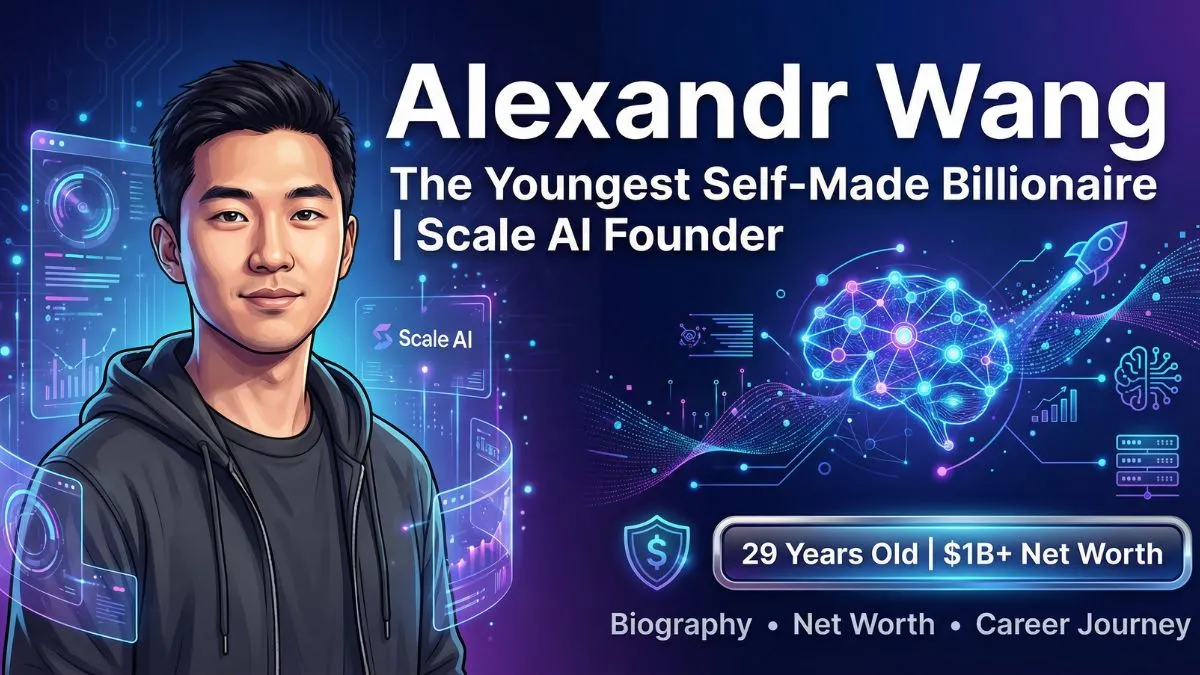
At just 19 years old, Alexandr Wang co-founded Scale AI and became the world’s youngest self-made billionaire by age 25. His company revolutionized how artificial intelligence systems are trained by providing high-quality labeled data to tech giants like OpenAI, Tesla, and the U.S. Department of Defense. Scale AI’s valuation soared past $7 billion, making Wang one of the most influential figures in the AI infrastructure space.
Wang represents a new generation of AI entrepreneurs who recognized early that the bottleneck in AI development wasn’t just algorithms, but the massive amounts of accurately labeled training data needed to power machine learning models. His vision transformed data labeling from a tedious manual process into a sophisticated, AI-assisted platform serving the world’s leading AI companies.
In this comprehensive biography, you’ll discover Wang’s journey from a teenage coding prodigy to a billionaire AI entrepreneur, his leadership philosophy, Scale AI’s meteoric rise, his net worth trajectory, and the lifestyle of one of tech’s youngest titans. This is the story of how brilliant timing, technical expertise, and relentless execution created one of AI’s most essential companies.
2. Early Life & Background
Alexandr Wang was born in January 1997 in Los Alamos, New Mexico, a town with deep scientific roots as the birthplace of the atomic bomb during the Manhattan Project. Growing up in this intellectually charged environment profoundly shaped his worldview. Both of Wang’s parents were weapons physicists at Los Alamos National Laboratory, giving him early exposure to cutting-edge scientific research and rigorous analytical thinking.
From an early age, Wang showed exceptional aptitude for mathematics and computer science. His parents, both immigrants from China who had built successful careers in physics, instilled in him a strong work ethic and appreciation for scientific inquiry. The dinner table conversations in the Wang household often revolved around complex physics problems and mathematical concepts, creating an environment where intellectual curiosity was not just encouraged but expected.
Wang’s first exposure to programming came in elementary school, where he quickly became fascinated by the logic and creativity required to write code. By middle school, he was already participating in competitive programming contests and building small software projects. Unlike many of his peers who saw coding as a hobby, Wang recognized early that software would be the defining technology of his generation.
During high school at Los Alamos High School, Wang distinguished himself as one of the top students in mathematics and computer science. He participated in the USA Computing Olympiad and various mathematics competitions, consistently placing among the top performers nationally. His teachers recall a student who was not just technically brilliant but also possessed an unusual maturity and strategic thinking ability for his age.
A pivotal moment came when Wang began exploring machine learning and AI during his teenage years. He became fascinated by the idea that computers could learn from data rather than being explicitly programmed for every task. This curiosity led him to read research papers, experiment with open-source machine learning frameworks, and build his own AI projects. Even then, Wang was thinking about the infrastructure and tooling that would be needed to scale AI systems, a prescience that would later define his career.
3. Family Details
| Relation | Name | Profession |
|---|---|---|
| Father | Not publicly disclosed | Weapons Physicist (Los Alamos National Laboratory) |
| Mother | Not publicly disclosed | Weapons Physicist (Los Alamos National Laboratory) |
| Siblings | Not publicly disclosed | Not publicly disclosed |
| Spouse | Not publicly disclosed | N/A |
| Children | None | N/A |
Wang has maintained significant privacy regarding his family life, rarely discussing personal relationships in public interviews. His parents’ background as physicists at one of America’s premier research institutions clearly influenced his analytical mindset and comfort with complex technical challenges.
4. Education Background
Los Alamos High School (Los Alamos, New Mexico)
Wang excelled academically, particularly in advanced mathematics and computer science courses. He was known for solving problems that stumped even his teachers and frequently worked on projects far beyond the standard curriculum.
Massachusetts Institute of Technology (MIT) (2015–2016)
Wang was accepted to MIT, one of the world’s most prestigious technical universities, to study computer science. At MIT, he immersed himself in artificial intelligence and machine learning coursework, working on research projects and connecting with some of the brightest minds in the field.
However, Wang’s time at MIT was short-lived. After just one year, he made the bold decision to drop out to pursue entrepreneurial opportunities. This decision was influenced by his internship experiences in Silicon Valley, where he saw firsthand the explosive growth of AI and the infrastructure challenges companies faced.
The Decision to Drop Out
Wang’s dropout story mirrors other legendary tech founders like Bill Gates, Mark Zuckerberg, and Steve Jobs. However, unlike some who left because they were struggling academically, Wang left MIT because he had identified a massive market opportunity that couldn’t wait. He had already begun working on early versions of what would become Scale AI and realized that the window to build the definitive data infrastructure company for AI was closing.
Internships & Early Experience
Before founding Scale AI, Wang completed internships at Quora (as a software engineering intern) and later worked briefly at Addepar, a wealth management technology platform. These experiences exposed him to real-world engineering challenges and gave him insights into how technology companies operated at scale. At Quora, he worked on machine learning systems and saw firsthand the difficulties of managing training data quality.
5. Entrepreneurial Career Journey
A. Early Career & First AI Startup
In 2016, at just 19 years old, Alexandr Wang co-founded Scale AI with Lucy Guo, whom he had met through the startup accelerator Y Combinator. The initial idea was deceptively simple but profoundly important: build infrastructure to help companies label and manage the massive datasets required to train machine learning models.
Wang had observed that every company building AI faced the same bottleneck. Creating accurate training data required enormous amounts of human labor to label images, transcribe text, annotate videos, and categorize data. This process was expensive, slow, and error-prone. Existing solutions were fragmented, with companies either building internal tools or outsourcing to traditional Business Process Outsourcing (BPO) firms that weren’t optimized for AI workloads.
Scale AI’s founding insight was that data labeling could be dramatically improved through a combination of human intelligence and machine learning. By building software that intelligently routed labeling tasks, quality-checked results, and continuously improved through AI assistance, Scale could deliver faster, more accurate, and more cost-effective data labeling than any alternative.
The MVP & Early Development
Wang and Guo built the initial version of Scale API in a matter of weeks. The product was simple: developers could send API requests with raw data (images, text, etc.) and receive back accurately labeled results. Behind the scenes, Scale managed a distributed workforce of human labelers, quality control systems, and machine learning models that improved accuracy over time.
Y Combinator Acceleration
Scale AI was accepted into Y Combinator’s Summer 2016 batch, one of the most competitive startup accelerators in the world. The YC experience provided crucial early validation, mentorship from successful founders, and access to a network of potential investors and customers. Wang impressed YC partners with his technical depth, clear thinking about market opportunity, and mature approach to building the business despite his youth.
Bootstrapping vs VC Funding
Unlike many startups that bootstrap for years, Scale AI raised venture capital early. The team recognized that to win the data infrastructure market, they needed to move fast, hire aggressively, and establish market leadership before competitors emerged. Their Y Combinator demo day presentation attracted significant investor interest.
Early Customers & Traction
Scale AI’s first customers included autonomous vehicle companies, e-commerce platforms, and robotics firms. The company’s ability to rapidly label vast amounts of sensor data, product images, and other AI training datasets made it invaluable to these early AI pioneers. Word spread quickly in Silicon Valley’s AI community about the “data labeling startup from YC” that actually worked.
B. Breakthrough Phase
Founding & Scaling Scale AI
The breakthrough for Scale AI came when it began working with OpenAI, Cruise (GM’s autonomous vehicle division), and other high-profile AI companies. These partnerships validated Scale’s technology and business model, proving that even the most sophisticated AI labs were willing to outsource their data infrastructure.
In 2017, Scale AI raised a $4.5 million Series A led by Accel, followed by an $18 million Series B in 2018 led by Index Ventures. These rounds allowed Wang to expand the team, improve the platform, and pursue larger enterprise customers.
The Product Evolution
Scale AI evolved from a simple labeling API into a comprehensive data platform. The company added:
- Computer vision labeling for autonomous vehicles and robotics
- Natural language processing data for chatbots and language models
- Document understanding for extracting information from complex documents
- Content moderation for social platforms
- Government and defense applications for national security
Explosive Growth & User Adoption
By 2019-2020, Scale AI was processing hundreds of millions of data labeling tasks and had become the default choice for AI companies. The rise of large language models and generative AI created even more demand for high-quality training data, and Scale was perfectly positioned to capitalize on this trend.
Key Investors & Major Funding Rounds
Scale AI’s investor base reads like a who’s who of venture capital: Accel, Index Ventures, Founders Fund (Peter Thiel’s firm), Tiger Global, Dragoneer, Coatue, and many others. In 2021, Scale raised a massive $325 million Series E at a $7.3 billion valuation, making Wang a billionaire at age 24—the youngest self-made billionaire in the world at the time.
Unicorn Status & Beyond
Scale AI achieved unicorn status (valuation over $1 billion) remarkably quickly, becoming one of the fastest-growing enterprise software companies in history. The company’s revenue grew exponentially year-over-year, with estimates suggesting hundreds of millions in annual recurring revenue by the mid-2020s.
C. Expansion & Global Impact
Scaling AI Infrastructure
As Scale AI matured, Wang focused on building the infrastructure to handle increasingly complex AI workloads. The company invested heavily in:
- Workforce management systems to coordinate hundreds of thousands of human labelers worldwide
- Quality assurance algorithms using AI to verify labeling accuracy
- Security and compliance infrastructure for government and enterprise clients
- Specialized tools for different industries and use cases
Enterprise & Global Clients
Scale AI’s client list expanded to include virtually every major AI company: OpenAI, Meta, Microsoft, Cruise, Tesla (rumored), Nuro, Pinterest, Samsung, and many others. The company also won significant contracts with the U.S. Department of Defense and intelligence agencies, becoming a critical part of national AI infrastructure.
Government Partnerships
Wang positioned Scale AI as essential infrastructure for U.S. technological competitiveness against China. The company’s work with the Department of Defense on Project Maven and other initiatives made it a key player in the intersection of AI and national security. This strategic positioning differentiated Scale from pure commercial data labeling companies.
Acquisitions & Strategic Partnerships
Scale AI acquired several smaller companies to expand its capabilities, including Ouster (in discussions) and various specialized data labeling firms. The company also formed partnerships with cloud providers and AI chip companies to create integrated solutions.
Vision for AI Future
Wang has articulated a vision where Scale AI becomes the foundational data layer for all AI systems. He believes that as AI becomes more sophisticated, the quality and provenance of training data will become even more critical. Scale’s mission extends beyond just labeling data to ensuring AI systems are built on accurate, unbiased, and well-understood datasets.
The company has also invested in AI evaluation and testing tools, recognizing that as AI systems become more powerful, understanding their capabilities and limitations through rigorous testing will be essential for safe deployment.
6. Career Timeline Chart
📅 CAREER TIMELINE

2012–2015 ─── Competitive programming, early coding projects
   │
2015 ─── Enrolled at MIT for Computer Science
   │
2016 ─── Dropped out of MIT, co-founded Scale AI
   │
2016 ─── Accepted into Y Combinator Summer batch
   │
2017 ─── Raised $4.5M Series A (Accel)
   │
2018 ─── Raised $18M Series B (Index Ventures)
   │
2019 ─── Major enterprise clients acquired
   │
2021 ─── Raised $325M Series E at $7.3B valuation
   │          Became world's youngest self-made billionaire
   │
2022–2024 ─── Expanded government/defense contracts
   │             Scaled platform for generative AI boom
   │
2025–2026 ─── Current focus: AI evaluation, safety & global expansion
7. Business & Company Statistics
| Metric | Value |
|---|---|
| AI Companies Founded | 1 (Scale AI) |
| Current Valuation | $7.3 billion (last funding round, 2021) |
| Annual Revenue | $500M+ (estimated, 2025) |
| Employees | 1,000+ (2026 estimate) |
| Countries Operated | Global operations, primary markets: US, Europe, Asia |
| Active Users | Enterprise clients (100+), millions of end tasks processed |
| AI Models Deployed | Proprietary quality control and routing algorithms |
8. AI Founder Comparison Section
📊 Alexandr Wang vs Sam Altman
| Statistic | Alexandr Wang | Sam Altman |
|---|---|---|
| Net Worth | $1+ billion | $2+ billion (estimated) |
| AI Startups Built | 1 (Scale AI) | Multiple (Loopt, OpenAI) |
| Unicorns | 1 | Multiple |
| AI Innovation Impact | AI infrastructure/data | Generative AI/AGI development |
| Global Influence | Enterprise + Government | Consumer + Research |
Analysis: While Sam Altman leads OpenAI in developing cutting-edge AI models like ChatGPT, Alexandr Wang built the infrastructure that powers these models. Both represent different but complementary approaches to advancing AI—Altman focuses on pushing the boundaries of what AI can do, while Wang ensures the data foundation that makes those advances possible is robust and scalable. Wang achieved billionaire status younger than Altman, demonstrating exceptional execution speed. However, Altman’s work on AGI and consumer AI products gives him broader public visibility. Both are essential figures in the modern AI ecosystem, with Scale AI literally providing training data for OpenAI’s models.
9. Leadership & Work Style Analysis
AI-First Leadership Philosophy
Alexandr Wang embodies a data-driven, AI-first leadership approach. He believes decisions should be made based on rigorous analysis rather than intuition alone. At Scale AI, this manifests in extensive use of metrics, A/B testing, and quantitative analysis for everything from product development to hiring decisions.
Decision-Making with Data
Wang has said that one of Scale AI’s competitive advantages is that they “eat their own dog food”—using AI and data analysis internally to optimize their own operations. The company uses machine learning to predict labeling task difficulty, optimize workforce allocation, and identify quality issues before they reach customers.
Risk Tolerance in Emerging Tech
Despite his youth, Wang shows remarkable maturity in risk management. He took significant risks (dropping out of MIT, raising large venture rounds, pursuing government contracts) but always with careful calculation of potential outcomes. His approach combines aggressive growth ambitions with thoughtful risk mitigation strategies.
Innovation & Experimentation Mindset
Wang encourages experimentation at Scale AI, allocating resources for teams to explore new labeling techniques, AI-assisted quality control, and novel data types. The company maintains a research culture despite being a commercial enterprise, publishing papers and contributing to open-source projects.
Strengths & Blind Spots
Strengths:
- Exceptional technical depth in machine learning and software architecture
- Strategic thinking about market positioning and competitive dynamics
- Ability to attract and retain world-class talent despite his youth
- Strong relationships with both commercial and government stakeholders
- Clear communication of complex technical concepts
Potential Blind Spots:
- Limited operational experience before founding Scale (learning on the job)
- Some critics argue Scale’s business model relies heavily on human labor that may eventually be automated away
- Questions about work-life balance and sustainability of intense startup pace
Notable Quotes
“The models are only as good as the data they’re trained on. That’s why data infrastructure is the most important problem in AI.”
“I don’t think about being the youngest billionaire. I think about building the company that will power every AI system in the world.”
“Speed matters in technology. We dropped out of MIT not because school wasn’t valuable, but because the opportunity window wouldn’t wait.”
10. Achievements & Awards
AI & Tech Awards
- Forbes 30 Under 30 (2018) – Enterprise Technology category
- Fortune 40 Under 40 (2022) – Recognized as one of the most influential young leaders in business
- MIT Technology Review 35 Innovators Under 35 (2019)
- Y Combinator Notable Alumni – Featured case study for successful exits
Global Recognition
- Forbes AI 50 (multiple years) – Scale AI recognized as one of the most promising AI companies
- Time 100 Next (2022) – Emerging leaders shaping the future
- Forbes Billionaires List (2021-present) – Youngest self-made billionaire globally at time of first listing
- Fast Company Most Innovative Companies – Scale AI recognized multiple years
Records & Distinctions
- Youngest Self-Made Billionaire (2021) – At age 24, became the youngest person to achieve billionaire status through their own company rather than inheritance
- Fastest-Scaling Enterprise AI Company – Scale AI reached unicorn status faster than most enterprise software companies
- Largest AI Infrastructure Valuation – One of the highest-valued private companies focused specifically on AI data infrastructure
11. Net Worth & Earnings
💰 FINANCIAL OVERVIEW
| Year | Net Worth (Est.) |
|---|---|
| 2016 | ~$0 (founding year) |
| 2018 | $50M+ (Series B valuation) |
| 2020 | $500M+ (Series D) |
| 2021 | $1B+ (Series E, billionaire status achieved) |
| 2024 | $1.5B+ (estimated) |
| 2025-2026 | $1+ billion (current estimate) |
Income Sources
- Founder Equity – Wang owns a significant percentage of Scale AI (estimated 10-20% post-dilution), which represents the vast majority of his net worth
- Salary & Compensation – As CEO, receives competitive salary and equity compensation, though modest compared to his ownership stake
- Angel Investments – Wang has made personal investments in other AI and technology startups, though not as actively as some founder-investors
- Advisory Roles – Occasionally advises other startups and investment firms on AI strategy
Wealth Context
It’s important to note that Wang’s wealth is largely “paper wealth”—tied up in illiquid Scale AI equity. While the company raised at a $7.3 billion valuation in 2021, the actual value of Wang’s stake depends on future liquidity events (IPO, acquisition, or secondary sales). The private company valuation has likely fluctuated with broader tech market conditions.
Major Investments
Wang has been relatively quiet about personal investments compared to other billionaire founders. Known areas of interest include:
- AI Infrastructure Startups – Investments in companies building tools for AI developers
- Developer Tools – Software that improves programmer productivity
- Defense Technology – Companies working at the intersection of AI and national security
Philanthropy & Financial Philosophy
Wang has stated he views wealth primarily as a tool for building ambitious companies and advancing AI technology. He has signed commitment letters for future philanthropic giving, particularly focused on AI safety research and computer science education for underrepresented groups.
12. Lifestyle Section
🏠 ASSETS & LIFESTYLE
Properties
- San Francisco Bay Area Residence – Wang lives in the San Francisco Bay Area, close to Scale AI’s headquarters. While specific property details aren’t publicly disclosed, real estate records suggest a modest home by billionaire standards, valued in the low millions.
- Investment Properties – Unlike some tech billionaires, Wang hasn’t publicized a significant real estate portfolio
Cars Collection
Wang maintains a relatively low profile regarding material possessions. He’s been photographed driving:
- Tesla Model S – Practical choice aligned with Scale AI’s autonomous vehicle clients
- Reports suggest he doesn’t maintain an extensive luxury car collection, preferring practicality over ostentation
Hobbies & Interests
- Reading AI Research Papers – Wang regularly reads cutting-edge machine learning research and stays current with academic developments
- Technology Tinkering – Still writes code personally and experiments with new AI models
- Strategic Board Games – Chess and Go player, drawn to games involving pattern recognition and strategic thinking
- Hiking – Occasional outdoor activities in the Bay Area
- Fitness – Maintains regular exercise routine, though not publicly discussed in detail
Daily Routine
Wang is known for intense work habits:
- Work Hours – Typically works 12-14 hour days, common among young startup CEOs
- Deep Work Blocks – Reserves morning hours for strategic thinking and complex problem-solving
- Customer Meetings – Personally engages with major clients and maintains close relationships with enterprise accounts
- Team Check-ins – Regular meetings with engineering, sales, and operations leaders
- Learning Routine – Dedicates time weekly to reading research papers and experimenting with new AI techniques
Lifestyle Philosophy
Wang’s lifestyle reflects his priorities: building Scale AI takes precedence over personal luxuries. He maintains a relatively modest public profile, avoiding the flashy displays of wealth common among some tech billionaires. Friends and colleagues describe him as intensely focused, intellectually curious, and more interested in solving technical problems than enjoying the trappings of wealth.
13. Physical Appearance
| Attribute | Details |
|---|---|
| Height | ~5’9″ (175 cm, estimated) |
| Weight | ~160 lbs (72 kg, estimated) |
| Eye Color | Dark Brown |
| Hair Color | Black |
| Body Type | Slim/Average build |
Wang typically dresses in the standard Silicon Valley uniform of casual clothes—hoodies, jeans, and sneakers for day-to-day work, with business casual attire for important client meetings and public appearances. His appearance reflects a focus on function over fashion, consistent with tech industry norms.
14. Mentors & Influences
AI Researchers
- Fei-Fei Li (Stanford AI Lab director) – Pioneer in computer vision and ImageNet, influenced Wang’s thinking about the importance of quality training data
- Andrew Ng (Google Brain, Baidu) – Popularized deep learning, influenced Wang’s understanding of ML infrastructure needs
Startup Founders
- Paul Graham (Y Combinator co-founder) – Mentored Wang through YC accelerator, influenced startup strategy
- Brian Chesky (Airbnb) – Example of building marketplace businesses with network effects
- Palmer Luckey (Oculus, Anduril) – Demonstrated how technical founders can build both commercial and defense technology companies
Investors & Advisors
- Accel Partners – Early investors who provided strategic guidance on enterprise SaaS
- Index Ventures – Helped Scale think about international expansion
- Founders Fund – Peter Thiel’s firm, influenced thinking about defensible moats and long-term vision
Leadership Lessons
Wang has cited several principles learned from mentors:
- “Hire people smarter than you and get out of their way”
- “Focus on product quality above all else—it’s the only defensible moat”
- “Enterprise sales requires trust and reliability, not just fancy technology”
- “The best time to raise capital is when you don’t need it”
15. Company Ownership & Roles
| Company | Role | Years | Status |
|---|---|---|---|
| Scale AI | Founder & CEO | 2016–present | Active (Private Company) |
| [Various AI Startups] | Angel Investor/Advisor | 2019–present | Advisory roles (specific companies not disclosed) |
Wang’s primary focus remains Scale AI, where he maintains significant equity ownership despite multiple funding rounds. Unlike some serial entrepreneurs, he has concentrated on building one company to market dominance rather than starting multiple ventures.
16. Controversies & Challenges
Labor Practices Scrutiny
Scale AI has faced questions about the working conditions and compensation of its global workforce of data labelers. Some critics argue the company benefits from low-cost labor in developing countries, though Scale maintains that its workers are paid above local market rates and receive training opportunities.
AI Ethics Debates
Wang and Scale AI have been involved in debates about AI ethics, particularly regarding work with the Department of Defense. Critics from the tech community have questioned whether AI companies should develop technology for military applications. Wang has defended this work as essential for maintaining U.S. technological leadership and ensuring responsible AI development for national security.
Data Privacy Concerns
As a company handling vast amounts of potentially sensitive data for clients, Scale AI has faced scrutiny about data security and privacy practices. The company has invested heavily in security infrastructure and compliance certifications, but questions persist about how data is protected throughout the labeling process.
Competition from Internal Teams
Some of Scale AI’s largest clients have built internal data labeling teams, creating questions about Scale’s long-term competitive position. Wang argues that Scale’s specialized infrastructure and quality control remain superior to internal solutions, especially as AI systems become more complex.
Automation Threat
A fundamental question about Scale’s business model is whether advances in AI will eventually automate data labeling, reducing demand for the company’s services. Wang has addressed this by pivoting the company toward AI evaluation, testing, and more complex data workflows that are harder to automate.
Market Valuation Volatility
Like many high-growth tech companies, Scale AI’s valuation has been subject to broader market conditions. The company’s $7.3 billion valuation from 2021 came during a peak in tech valuations, and questions exist about whether that valuation would hold in current market conditions.
Lessons Learned
Wang has demonstrated maturity in responding to controversies:
- Engaging transparently with critics about labor practices and publishing workforce data
- Articulating a clear ethical framework for government work
- Investing proactively in security and compliance rather than reactively after incidents
- Evolving the business model to address automation concerns
17. Charity & Philanthropy
AI Education Initiatives
Wang has supported programs to increase diversity in AI and computer science education. While specific donation amounts aren’t widely publicized, he has:
- Funded scholarships for underrepresented minorities in computer science programs
- Supported coding bootcamps and AI education programs
- Provided mentorship to students interested in AI careers
Open-Source Contributions
Scale AI has contributed to open-source projects and published research papers that advance the broader AI community. This includes tools for data quality assessment and labeling workflow management.
AI Safety & Alignment Research
Wang has expressed interest in supporting AI safety research, recognizing that as AI systems become more powerful, ensuring they’re aligned with human values becomes critical. This includes potential future commitments to fund academic research in AI alignment.
Future Philanthropic Commitments
While Wang hasn’t signed the Giving Pledge (a commitment by wealthy individuals to give away the majority of their wealth), he has indicated interest in significant future philanthropy focused on:
- Computer science education access
- AI safety and governance research
- Supporting scientific research infrastructure
- Bridging technology and policy communities
Philosophy on Giving
Wang appears to take a long-term view on philanthropy, focusing first on building Scale AI to maximum impact and planning more substantial philanthropic initiatives as his wealth and influence grow. This approach mirrors other tech founders who scaled their giving over time.
18. Personal Interests
| Category | Favorites |
|---|---|
| Food | Asian cuisine, San Francisco restaurants |
| Movie | Not publicly disclosed; interests in sci-fi |
| Book | AI research papers, biographies of scientists and founders |
| Travel Destination | Asia (family connections), tech hubs globally |
| Technology | Latest AI models, developer tools, autonomous systems |
| Sport | Not publicly athletic, casual hiking |
| Music | Not publicly disclosed |
| Game | Chess, strategic board games |
Wang’s interests reflect his technical background and intense focus on AI. He’s known more for intellectual pursuits than traditional hobbies, though friends note he’s working on achieving better work-life balance as Scale AI matures.
19. Social Media Presence
| Platform | Handle | Followers | Activity Level |
|---|---|---|---|
| Private/Not Active | N/A | Minimal public presence | |
| Twitter/X | @alexandr_wang | ~50,000+ | Moderate (AI industry insights) |
| linkedin.com/in/alexandrwang | 100,000+ | Occasional updates | |
| YouTube | N/A | N/A | Appears on podcasts/interviews |
Social Media Strategy
Wang maintains a professional, low-key social media presence focused on AI industry insights rather than personal content. His Twitter/X account shares Scale AI company updates, thoughts on AI development, and occasional commentary on technology policy. Unlike some tech founders who are prolific on social media, Wang prioritizes building the company over cultivating a personal brand.
Notable Online Presence
- Guest appearances on technology podcasts discussing AI infrastructure
- Conference talks at major AI and technology events
- Occasional media interviews with tech publications like TechCrunch, Forbes, and The Information
20. Recent News & Updates (2025–2026)
Latest Funding & Valuation
While no new major funding rounds have been publicly announced in 2025-2026, Scale AI continues to be valued as one of the leading AI infrastructure companies. The company is rumored to be considering IPO timing, though no official announcement has been made.
Generative AI Expansion
Scale AI has significantly expanded its services for generative AI companies, providing:
- RLHF (Reinforcement Learning from Human Feedback) data for fine-tuning large language models
- Red-teaming and safety testing services for AI model developers
- Evaluation frameworks for assessing AI model capabilities
Government Contract Growth
Scale AI has won additional contracts with U.S. government agencies, expanding its national security technology portfolio. The company has positioned itself as critical infrastructure for maintaining U.S. AI competitiveness against China.
Product Launches
- Scale Donovan – AI-powered platform for defense and government applications
- Scale Rapid – Accelerated data labeling for time-sensitive AI projects
- Scale Nucleus – Data management and quality control platform
Media Appearances
Wang has been featured in several high-profile interviews and podcasts in 2025-2026:
- Discussions about the future of AI regulation
- Comments on AI safety and responsible development
- Insights on building AI companies in the current market environment
Strategic Initiatives
- Expansion into European markets with local data residency
- Partnerships with major cloud providers for integrated AI workflows
- Investment in AI evaluation and red-teaming capabilities
Future Roadmap
Wang has indicated Scale AI’s focus areas for the coming years:
- Building the definitive platform for AI model evaluation and testing
- Expanding beyond data labeling to comprehensive AI lifecycle management
- Potential IPO when market conditions are favorable
- Continued investment in government and defense AI applications
21. Lesser-Known Facts
- Physics Family Legacy – Both parents were weapons physicists at Los Alamos National Laboratory, the same institution where the atomic bomb was developed during World War II.
- Competition Programming Champion – Wang was a top performer in programming competitions during high school, including the USA Computing Olympiad.
- Met Co-Founder at Y Combinator – Lucy Guo, Scale AI’s co-founder, met Wang through the Y Combinator network. She left the company in 2018 to pursue other ventures.
- First Customer Was OpenAI – One of Scale AI’s earliest customers was OpenAI, creating an enduring partnership between the data infrastructure provider and the generative AI leader.
- Coded the First Product – Wang personally wrote much of Scale AI’s initial codebase, demonstrating hands-on technical leadership.
- Youngest Billionaire Record – At 24, Wang became the youngest self-made billionaire globally, surpassing even Mark Zuckerberg’s age when Facebook made him a billionaire.
- Defense Contracts Were Strategic – Wang deliberately pursued government contracts to create a defensible moat and position Scale as essential national infrastructure.
- Still Reads Research Papers – Despite CEO responsibilities, Wang maintains the habit of reading cutting-edge AI research papers weekly.
- Considered Multiple Startups – Before settling on data infrastructure, Wang explored several other AI-related startup ideas during his brief time at MIT.
- Low Public Profile – Unlike many young billionaires, Wang deliberately avoids excessive media attention and maintains relatively private personal life.
- Scale’s Name Origin – The company name “Scale” reflects the core challenge it solves: scaling AI data infrastructure to handle massive datasets.
- Early Remote Work Pioneer – Scale AI built a distributed workforce model early, before remote work became mainstream, to access global talent for data labeling.
- Never Sold Shares – Reports suggest Wang has not sold significant personal shares in secondary markets, indicating long-term commitment to the company.
- Influenced by ImageNet – Fei-Fei Li’s ImageNet project, which provided labeled data that revolutionized computer vision, directly inspired Scale AI’s mission.
- Chess Player – Wang plays chess and sees parallels between strategic game-playing and business strategy, particularly pattern recognition and long-term planning.
22. FAQ Section (Featured Snippet Optimized)
Q1: Who is Alexandr Wang?
A: Alexandr Wang is the founder and CEO of Scale AI, a data infrastructure company for artificial intelligence. Born in 1997, he became the world’s youngest self-made billionaire at age 24 when Scale AI reached a $7.3 billion valuation in 2021. He dropped out of MIT to start the company in 2016.
Q2: What is Alexandr Wang’s net worth in 2026?
A: Alexandr Wang’s net worth is estimated at $1+ billion as of 2026, based on his ownership stake in Scale AI, which was valued at $7.3 billion in its 2021 Series E funding round.
Q3: How did Alexandr Wang start Scale AI?
A: Wang co-founded Scale AI in 2016 after dropping out of MIT. He identified that AI companies struggled with labeling training data and built an API-based platform combining human labelers with machine learning for efficient, accurate data annotation. The company was accepted into Y Combinator and quickly gained traction with clients like OpenAI.
Q4: Is Alexandr Wang married?
A: No, Alexandr Wang’s marital status is not publicly disclosed, and he maintains significant privacy about his personal relationships. There is no public information about a spouse or partner.
Q5: What companies does Alexandr Wang own?
A: Alexandr Wang is the founder and CEO of Scale AI, his primary company. He owns a significant equity stake (estimated 10-20% post-dilution) in Scale AI and has made angel investments in other AI and technology startups, though specific portfolio companies are not publicly disclosed.
Q6: How old was Alexandr Wang when he became a billionaire?
A: Alexandr Wang became a billionaire at age 24 in 2021 when Scale AI raised funding at a $7.3 billion valuation, making him the youngest self-made billionaire in the world at that time.
Q7: Did Alexandr Wang graduate from MIT?
A: No, Alexandr Wang dropped out of MIT after one year (2015-2016) to focus full-time on building Scale AI. He was studying computer science before leaving to pursue his entrepreneurial venture.
Q8: What does Scale AI do?
A: Scale AI provides data infrastructure for artificial intelligence, specializing in data labeling, annotation, and quality control for training machine learning models. The company serves autonomous vehicle companies, tech giants, government agencies, and AI developers, processing millions of labeling tasks for computer vision, natural language processing, and other AI applications.
23. Conclusion
Alexandr Wang’s journey from a teenage programming prodigy in Los Alamos to the world’s youngest self-made billionaire represents one of the most remarkable entrepreneurial stories in modern technology. By recognizing that artificial intelligence’s progress depended not just on better algorithms but on higher-quality training data, Wang identified and solved one of the AI industry’s most fundamental challenges.
Scale AI’s success demonstrates that infrastructure—the often unglamorous plumbing that makes cutting-edge technology possible—can be just as valuable and impactful as the headline-grabbing AI models themselves. Wang built a company that powers OpenAI’s ChatGPT, autonomous vehicles, government intelligence systems, and countless other AI applications, making Scale AI essential infrastructure for the AI revolution.
At just 29 years old in 2026, Wang’s impact on the AI industry is already profound, yet his story is far from complete. As artificial intelligence continues to transform every aspect of human society, the data infrastructure Wang built will only become more critical. His focus on AI evaluation and safety positions Scale AI to address the next frontier: ensuring these increasingly powerful AI systems are reliable, trustworthy, and aligned with human values.
Wang’s leadership style—technically deep, strategically thoughtful, and execution-focused—offers lessons for aspiring entrepreneurs. His willingness to drop out of MIT, raise capital aggressively, pursue controversial government contracts, and build for the long term rather than quick exits demonstrates conviction and maturity beyond his years.
As Scale AI approaches potential IPO or other liquidity events, Wang stands at the threshold of even greater influence and wealth. Whether he chooses to remain focused solely on Scale AI or eventually applies his talents to other challenges, his legacy as a builder of essential AI infrastructure is already secure. The data that powers the AI revolution—and the systems that ensure its quality—will remain Scale AI’s contribution to technological progress for decades to come.
👉 Explore More: Discover other AI founder biographies, share this article with aspiring entrepreneurs, and comment below with your thoughts on Alexandr Wang’s remarkable journey!