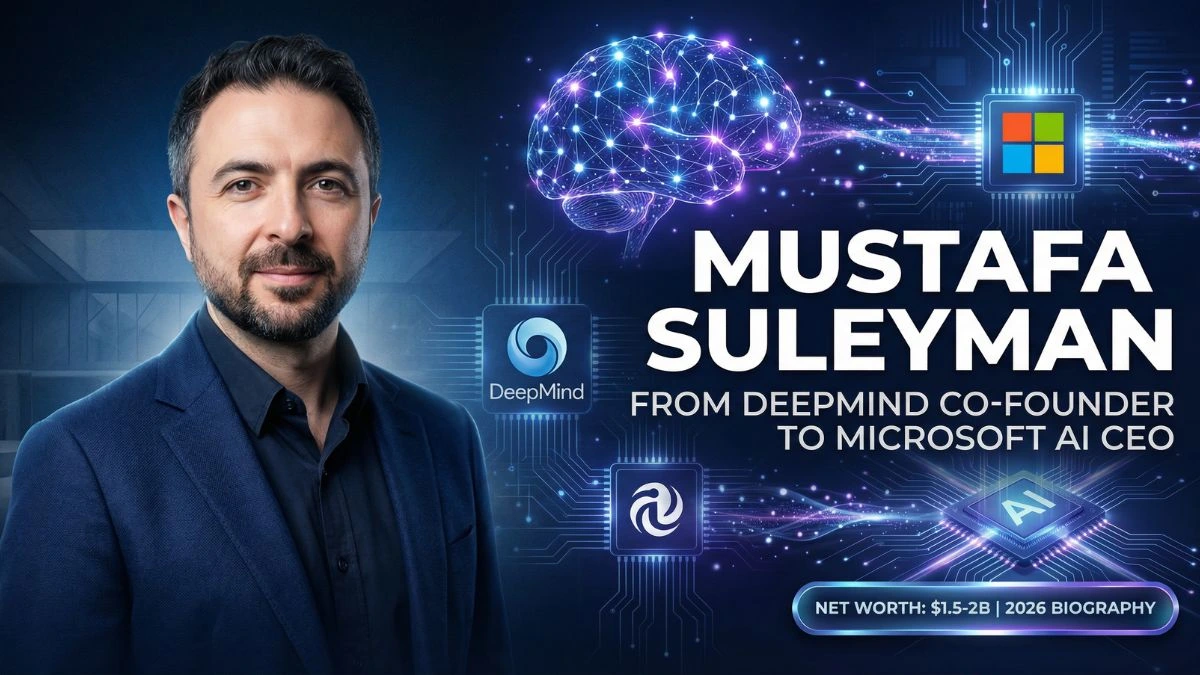
QUICK INFO BOX
| Attribute | Details |
|---|---|
| Full Name | Mustafa Suleyman |
| Nick Name | Moose |
| Profession | AI Startup Founder / CEO / AI Researcher / Tech Entrepreneur |
| Date of Birth | August 1984 |
| Age | 41 years (as of 2026) |
| Birthplace | London, England |
| Hometown | London, England |
| Nationality | British |
| Religion | Muslim background |
| Zodiac Sign | Leo/Virgo |
| Ethnicity | Mixed (Syrian father, English mother) |
| Father | Syrian immigrant |
| Mother | English nurse |
| Siblings | Not publicly disclosed |
| Wife / Partner | Private |
| Children | Private |
| School | Queen Elizabeth’s School, Barnet |
| College / University | University of Oxford (dropped out) |
| Degree | Philosophy and Theology (incomplete) |
| AI Specialization | Applied AI / Machine Learning / AI Ethics / Conversational AI |
| First AI Startup | DeepMind (Co-founder, 2010) |
| Current Company | Microsoft AI |
| Position | CEO, Microsoft AI |
| Industry | Artificial Intelligence / Deep Tech / Enterprise AI |
| Known For | Co-founding DeepMind, Inflection AI, AI Ethics advocacy |
| Years Active | 2010–present |
| Net Worth | Est. $1.5–2 billion (2026) |
| Annual Income | Estimated $100–200 million+ |
| Major Investments | Various AI startups, climate tech |
| Limited presence | |
| Twitter/X | @mustafasuleyman |
| Mustafa Suleyman |
1. Introduction
Mustafa Suleyman stands as one of the most influential figures in the artificial intelligence revolution. From co-founding DeepMind—the groundbreaking AI lab acquired by Google for over $500 million—to launching Inflection AI and now leading Microsoft’s AI division, Suleyman has been at the forefront of developing AI systems that are reshaping how humanity interacts with technology.
Known for his deep commitment to AI safety and ethics, Suleyman has championed the responsible development of artificial intelligence while building products used by millions globally. His journey from a college dropout and community organizer to a billionaire AI pioneer exemplifies the transformative power of vision, persistence, and technical innovation.
In this comprehensive biography, you’ll discover Mustafa Suleyman’s complete story: his multicultural upbringing in London, the founding of DeepMind and its historic achievements, his controversial departure and triumphant return with Inflection AI, his move to Microsoft, and the leadership philosophy that drives one of tech’s most thoughtful entrepreneurs.
2. Early Life & Background
Mustafa Suleyman was born in August 1984 in London, England, to parents from vastly different worlds. His father was a Syrian immigrant taxi driver, while his mother worked as an English nurse for the National Health Service. This multicultural household exposed young Mustafa to diverse perspectives and instilled in him a deep sense of social responsibility from an early age.
Growing up in North London, Suleyman attended Queen Elizabeth’s School in Barnet, a prestigious grammar school where he excelled academically. Even as a teenager, he demonstrated an unusual combination of intellectual curiosity and social consciousness. Rather than focusing solely on academics, he became involved in community organizing and social justice initiatives.
His early interests weren’t initially focused on computers or mathematics in the traditional sense. Instead, Suleyman was drawn to philosophy, ethics, and understanding how systems—whether social or technological—could be designed to benefit humanity. This philosophical bent would later become a defining characteristic of his approach to AI development.
At 19, Suleyman secured a place at Oxford University to study Philosophy and Theology, a path that seemed destined for academia or policy work. However, his entrepreneurial spirit and desire for direct impact led him to drop out after just 18 months. This decision shocked many, but Suleyman had already identified a problem he wanted to solve: he wanted to work on issues that could create immediate positive change in people’s lives.
His first venture into the real world involved co-founding a telephone counseling service for young Muslims struggling with mental health and family issues. This experience taught him invaluable lessons about human psychology, the power of conversation, and the importance of accessible support systems—insights that would later influence his vision for conversational AI.
3. Family Details
| Relation | Name | Profession |
|---|---|---|
| Father | Not publicly disclosed | Syrian immigrant, Taxi driver |
| Mother | Not publicly disclosed | NHS Nurse |
| Siblings | Private | Not publicly disclosed |
| Spouse | Private | Not publicly disclosed |
| Children | Private | Not publicly disclosed |
Suleyman maintains a notably private personal life, rarely discussing his family in public forums. His parents’ immigrant and working-class background significantly influenced his worldview and commitment to creating technology that serves everyone, not just the privileged.
4. Education Background
School: Queen Elizabeth’s School, Barnet (London)
- A prestigious grammar school known for academic excellence
- Developed strong analytical and critical thinking skills
University: University of Oxford (1 year attended, dropped out)
- Course: Philosophy and Theology at Mansfield College
- Duration: 18 months (left in 2003)
- Reason for leaving: Desire for direct impact and entrepreneurial pursuits
Alternative Education:
- Self-taught in machine learning and AI concepts
- Learned through mentorship, reading research papers, and hands-on experience
- Attended conferences and built relationships with leading AI researchers
Early Projects:
- Co-founded Muslim Youth Helpline (2001) at age 17
- Worked as a conflict resolution negotiator
- Policy work for local government on youth services
Key Learning Experience: Unlike traditional tech founders who followed the Stanford-to-Silicon Valley pipeline, Suleyman’s path was unconventional. His humanities background gave him a unique perspective on AI’s societal implications, while his community organizing taught him about human needs and ethical considerations—skills that would prove crucial in the AI ethics debates that followed.
5. Entrepreneurial Career Journey
A. Early Career & Path to AI (2001–2010)
After dropping out of Oxford in 2003, Mustafa Suleyman spent his early twenties in social entrepreneurship rather than technology. He worked as a policy officer for the Mayor of London, focusing on human rights and conflict resolution. This experience exposed him to complex systems thinking and the potential for interventions to create cascading positive effects.
During this period, Suleyman became fascinated by a question: Could technology amplify human potential in the same way social programs aimed to? He began exploring the emerging field of machine learning, teaching himself the fundamentals while working in policy. His unique combination of ethical training, social awareness, and growing technical knowledge made him an unusual prospect in the tech world.
In 2010, everything changed when Suleyman met Demis Hassabis and Shane Legg. Hassabis, a chess prodigy and neuroscience PhD, and Legg, a machine learning researcher, were planning to start an AI company with an audacious goal: to solve intelligence and use it to solve everything else. They needed someone who could handle the applied side—someone who understood how to bring AI research into the real world and navigate its ethical implications.
Suleyman was the perfect fit. At just 26 years old, he became the third co-founder of what would become DeepMind.
B. DeepMind Era: Building AI’s Most Influential Lab (2010–2019)
The Founding Vision (2010–2011)
DeepMind Technologies was founded in London in September 2010 with a bold mission: create artificial general intelligence (AGI) and ensure it benefits humanity. While Hassabis focused on the research and Legg on the theoretical foundations, Suleyman took on the role of applying AI to real-world problems.
The early days were challenging. The trio bootstrapped initially, then raised a seed round from investors who believed in their long-term vision despite having no product. Suleyman’s ability to articulate the social benefits of AI—not just its technical achievements—helped secure crucial early funding.
The Google Acquisition (2014)
By 2014, DeepMind had made significant breakthroughs in reinforcement learning and was attracting attention from tech giants. Google acquired the company for approximately $500–650 million, one of the largest AI acquisitions in history at that time. The deal came with unusual conditions that Suleyman helped negotiate: DeepMind would remain in London, maintain independent branding, and establish an AI ethics board.
As Vice President of Applied AI, Suleyman led DeepMind’s efforts to use AI for social good. His division focused on healthcare, energy efficiency, and other practical applications.
AlphaGo and Global Recognition (2016)
The defining moment came in March 2016 when DeepMind’s AlphaGo defeated Lee Sedol, the world champion Go player, in a historic 4-1 match. While Suleyman wasn’t directly involved in the AlphaGo research, he played a crucial role in managing the event’s global impact and articulating its significance beyond the game itself.
This achievement put AI on the global stage and established DeepMind as the world’s leading AI research lab.
DeepMind Health and Ethical Challenges (2016–2018)
Suleyman spearheaded DeepMind Health, an initiative to apply AI to healthcare. The division partnered with the UK’s National Health Service (NHS) to develop systems for detecting eye diseases, predicting patient deterioration, and improving clinical workflows.
However, this work generated significant controversy. A 2017 project with the Royal Free Hospital faced criticism over patient data handling, leading to investigations by the UK’s Information Commissioner’s Office. The incident highlighted the tension between AI’s potential and privacy concerns—issues Suleyman had long warned about but now faced directly.
Departure from DeepMind (2019)
In 2019, after nearly a decade at DeepMind, Suleyman’s role underwent significant changes. Reports suggested tensions over management style and the applied AI division’s direction. He was placed on administrative leave before officially departing. While the circumstances were contentious, both parties emphasized mutual respect and Suleyman’s foundational contributions to DeepMind’s success.
C. Inflection AI: A Bold New Chapter (2022–2024)
The Founding (2022)
After leaving DeepMind and a period of reflection, Suleyman returned to the AI arena in 2022 with Inflection AI. Partnering with LinkedIn co-founder Reid Hoffman and former DeepMind researcher Karén Simonyan, Suleyman set out to build a new kind of AI company focused on personal AI assistants.
Inflection’s mission was distinct from DeepMind’s pursuit of AGI: create AI that truly understands and serves individual users through natural conversation. The company’s philosophy centered on AI as a tool for amplifying human potential rather than replacing human intelligence.
Record Fundraising
Inflection raised one of the largest seed rounds in tech history: $225 million in 2022 from investors including Reid Hoffman, Bill Gates, Eric Schmidt, and major venture capital firms. In 2023, the company secured an additional $1.3 billion in funding at a $4 billion valuation, making it one of the fastest-growing AI startups ever.
Pi: Personal Intelligence (2023)
In May 2023, Inflection launched Pi (Personal Intelligence), a conversational AI assistant designed to be supportive, empathetic, and genuinely helpful. Unlike ChatGPT’s focus on productivity or Google’s emphasis on search, Pi was positioned as a friendly AI companion—someone to talk to, brainstorm with, or seek advice from.
Pi quickly gained traction, with millions of users engaging in lengthy conversations. The product reflected Suleyman’s long-standing belief that AI should enhance human wellbeing and be accessible to everyone.
Technical Innovation
Inflection developed its own large language models, including Inflection-2, which the company claimed matched or exceeded GPT-4’s capabilities in certain benchmarks. Suleyman invested heavily in compute infrastructure, reportedly securing access to thousands of NVIDIA GPUs to train cutting-edge models.
D. Microsoft AI: Leading Tech’s AI Future (2024–Present)
The Microsoft Move (March 2024)
In a stunning move that reshaped the AI industry, Microsoft announced in March 2024 that Mustafa Suleyman would join as CEO of Microsoft AI—a newly created division encompassing Copilot, Bing, and Edge. The deal also saw Microsoft hire most of Inflection’s team and license its technology in a transaction worth approximately $650 million.
This marked one of the most significant leadership appointments in Microsoft’s history, signaling the company’s commitment to competing with OpenAI (in which Microsoft is a major investor) and Google in the AI race.
Current Role and Vision
As CEO of Microsoft AI, Suleyman oversees consumer AI products reaching billions of users. His mandate includes:
- Scaling Microsoft Copilot across consumer and enterprise applications
- Advancing Bing’s AI capabilities to compete with Google
- Integrating AI throughout Microsoft’s product ecosystem
- Maintaining ethical AI development standards
Suleyman has articulated a vision of “AI companions” that work alongside humans in every aspect of life—from productivity to creativity to personal wellbeing. Under his leadership, Microsoft has accelerated AI feature releases and emphasized responsible deployment.
2025–2026 Developments
Recent reports suggest Microsoft AI has achieved significant milestones under Suleyman’s leadership:
- Copilot user base exceeding 100 million active users
- New multimodal AI capabilities in Microsoft products
- Strategic partnerships with enterprises for AI integration
- Continued investment in AI safety research
6. Career Timeline Chart
📅 CAREER TIMELINE

2001 ─── Co-founded Muslim Youth Helpline at age 17
   │
2003 ─── Left Oxford University; policy work begins
   │
2010 ─── Co-founded DeepMind Technologies
   │
2014 ─── DeepMind acquired by Google ($500M+)
   │
2016 ─── AlphaGo defeats world champion
   │
2016-18 ─── Led DeepMind Health initiative
   │
2019 ─── Departed DeepMind
   │
2022 ─── Founded Inflection AI ($225M seed round)
   │
2023 ─── Launched Pi; raised $1.3B Series A
   │
2024 ─── Joined Microsoft as CEO of Microsoft AI
   │
2026 ─── Leading Microsoft's consumer AI strategy
7. Business & Company Statistics
| Metric | Value |
|---|---|
| AI Companies Founded | 2 (DeepMind, Inflection AI) |
| Current Company Valuation | Microsoft (parent): $3+ trillion |
| Inflection AI Peak Valuation | $4 billion (2023) |
| DeepMind Acquisition Value | $500–650 million (2014) |
| Total Capital Raised (Inflection) | $1.5+ billion |
| Microsoft AI Division Size | Thousands of employees |
| Products Led | Copilot, Bing AI, Pi |
| Global Users Reached | 100+ million (Copilot) |
| Countries Operated | Global presence |
| Major Achievements | AlphaGo, Pi, Copilot scaling |
8. AI Founder Comparison Section
📊 Mustafa Suleyman vs Sam Altman
| Statistic | Mustafa Suleyman | Sam Altman |
|---|---|---|
| Net Worth | ~$1.5–2 billion | ~$1–2 billion |
| AI Companies Founded | 2 (DeepMind, Inflection) | 1 (OpenAI, plus Loopt earlier) |
| Unicorns Created | 2 | 1 |
| Current Company | Microsoft AI | OpenAI |
| Focus Area | Applied AI, Ethics, Personal AI | AGI, Enterprise AI |
| Background | Philosophy, Social Entrepreneurship | Computer Science, Startups |
| Leadership Style | Ethical, collaborative, human-centered | Visionary, ambitious, scale-focused |
| Global Influence | High (AI ethics advocate) | Very High (AI commercialization) |
Analysis: Both founders have profoundly shaped modern AI, but their approaches differ significantly. Altman has focused on rapid scaling and AGI development through OpenAI’s ChatGPT, while Suleyman emphasizes ethical AI deployment and personal AI assistants. Suleyman’s humanities background makes him particularly vocal about AI safety and regulation, whereas Altman champions accelerated development balanced with safety research. Both are now positioned at tech giants (Microsoft and OpenAI respectively), driving the industry’s future direction.
9. Leadership & Work Style Analysis
Mustafa Suleyman’s leadership philosophy is distinctive in Silicon Valley for its emphasis on ethics, long-term thinking, and social impact alongside commercial success.
Ethical-First Approach
Unlike many tech leaders who treat ethics as an afterthought, Suleyman integrates ethical considerations into product development from day one. His background in philosophy and human rights work shapes his belief that AI developers have a profound responsibility to society. He has consistently advocated for AI regulation, transparency, and accountability—positions that sometimes put him at odds with the “move fast and break things” culture.
Human-Centered Product Design
Suleyman believes AI should augment human capabilities rather than replace human judgment. This philosophy is evident in Pi’s design as a supportive companion and in Microsoft Copilot’s positioning as an assistant rather than an autonomous agent. He prioritizes AI that empowers users and respects their autonomy.
Collaborative Decision-Making
Those who have worked with Suleyman describe him as collaborative and consultative, seeking input from diverse stakeholders. However, some reports from his DeepMind days suggested his management style could be intense and demanding, leading to the tensions that preceded his departure.
Long-Term Vision Over Short-Term Gains
Suleyman thinks in decades, not quarters. He has repeatedly emphasized that AI development is a marathon requiring patience, sustained investment, and careful consideration of societal impacts. This perspective sometimes conflicts with investor pressure for rapid returns.
Strengths:
- Deep ethical framework guiding decision-making
- Ability to articulate AI’s social implications to diverse audiences
- Strong relationship-building skills with policymakers and researchers
- Visionary thinking about AI’s long-term trajectory
Potential Blind Spots:
- Management style that some found challenging
- Balancing idealism with commercial realities
- Navigating big tech politics and bureaucracy
Notable Quotes:
“The question is not whether AI will change the world—it will. The question is whether we’ll shape that change responsibly.”
“I want to build AI that makes people feel more capable, more creative, more connected—not diminished or replaced.”
“We’re not just building technology. We’re shaping the future of human potential.”
10. Achievements & Awards
AI & Tech Recognition
- Time 100 Most Influential People (2023) – Recognized for contributions to AI development and ethics
- Technology Pioneer – World Economic Forum (2017)
- TED Speaker – Multiple appearances discussing AI ethics and future
- Forbes 30 Under 30 (Europe, Technology) – Early recognition at DeepMind
Industry Impact
- Co-founder of DeepMind – One of the most influential AI research labs in history
- AlphaGo Achievement – Part of the team that created AI surpassing human world champions
- AI Safety Advocacy – Leading voice in responsible AI development
- Inflection AI Founder – Built unicorn startup in record time
Academic & Policy Contributions
- AI Ethics Research – Published papers and frameworks on responsible AI
- Government Advisory Roles – Consulted with UK and EU regulators on AI policy
- Public Intellectual – Frequent contributor to discussions on technology’s societal impact
Books
- “The Coming Wave: Technology, Power, and the 21st Century’s Greatest Dilemma” (2023) – Bestselling book examining AI, synthetic biology, and how humanity can manage powerful new technologies
Records & Milestones
- One of the largest seed rounds in tech history ($225M for Inflection)
- Among the youngest founders to build multiple billion-dollar AI companies
- Key architect of several landmark AI achievements (AlphaGo, Pi, Copilot evolution)
11. Net Worth & Earnings
💰 FINANCIAL OVERVIEW
| Year | Net Worth (Est.) |
|---|---|
| 2014 | $50–100 million (DeepMind acquisition) |
| 2020 | $400–600 million |
| 2023 | $1–1.5 billion (Inflection funding) |
| 2024 | $1.5–2 billion (Microsoft deal) |
| 2026 | $1.5–2.5 billion (current estimate) |
Income Sources
1. Founder Equity
- DeepMind ownership stake (liquidated via Google acquisition)
- Inflection AI founder shares
- Microsoft compensation package (reportedly very substantial)
2. Microsoft Compensation
- Base salary as CEO of Microsoft AI (estimated $1–5 million annually)
- Stock options and performance bonuses
- Equity grants tied to Microsoft AI performance
3. Investment Portfolio
- Angel investments in AI and climate tech startups
- Public market investments
- Real estate holdings
4. Book Royalties
- “The Coming Wave” – bestseller with significant sales
5. Advisory Roles & Speaking
- Board positions
- Speaking engagements (though less frequent)
- Consulting with governments and organizations
Major Investments
While Suleyman keeps his investment portfolio relatively private, known investments include:
- Climate Tech Startups – Companies working on carbon capture and renewable energy
- AI Safety Research – Organizations focused on AI alignment
- Healthcare AI – Startups applying machine learning to medical challenges
- Education Technology – Platforms democratizing learning
Wealth Growth Trajectory
Suleyman’s wealth accumulation reflects the explosive growth of AI over the past decade. His net worth increased dramatically through three key events:
- DeepMind’s Google acquisition (2014)
- Inflection’s funding rounds (2022–2023)
- Microsoft AI appointment and compensation package (2024)
Unlike some tech billionaires focused on wealth accumulation, Suleyman has expressed commitment to deploying capital toward social good and responsible technology development.
12. Lifestyle Section
🏠 ASSETS & LIFESTYLE
Properties
Mustafa Suleyman maintains a relatively low-profile lifestyle compared to many tech billionaires:
- London Residence – Primary home in upscale London neighborhood (estimated value: $5–10 million)
- Bay Area Property – Residence near Microsoft offices (details private)
- Prefers privacy; no public information about lavish estates or property portfolios
Cars Collection
Suleyman is not known for flashy car collections. Reports suggest:
- Practical, environmentally conscious vehicle choices
- Likely drives electric vehicles (Tesla, others)
- Values functionality and sustainability over status symbols
Travel
- Frequent travel between London, Seattle, and San Francisco for Microsoft
- Attends major AI conferences globally (NeurIPS, ICML, etc.)
- Known to enjoy cultural experiences and historical sites
Hobbies & Personal Interests
Reading & Learning
- Voracious reader of philosophy, history, and science
- Stays current with AI research papers
- Particularly interested in civilizational history and technology’s role in societal change
Writing
- Author of “The Coming Wave”
- Regular contributor to policy discussions
- Active on social media sharing insights
Physical Fitness
- Maintains regular exercise routine
- Meditation and mindfulness practices
- Values work-life balance (at least philosophically)
Cultural Engagement
- Interests in art and architecture
- Music appreciation
- Theater and cultural events
Daily Routine
While Suleyman hasn’t publicly detailed his daily schedule, industry sources suggest:
Morning (6:00–9:00 AM)
- Early riser
- Exercise or meditation
- Reading news and research updates
- Strategic thinking time
Work Day (9:00 AM–7:00 PM)
- Leadership meetings with Microsoft AI team
- Product strategy sessions
- Stakeholder communications
- Cross-functional collaboration
Evening (7:00 PM–11:00 PM)
- Family time (highly private)
- Reading and learning
- Occasional industry events or dinners
- Writing and thought leadership
Deep Work Habits
- Blocks time for uninterrupted strategic thinking
- Prioritizes meaningful meetings over constant availability
- Values face-to-face collaboration when important
Philosophy on Work Suleyman has spoken about avoiding burnout culture and building sustainable organizations. He believes in intense focus during work hours but protecting personal time for reflection and relationships.
13. Physical Appearance
| Attribute | Details |
|---|---|
| Height | ~5’10” (178 cm) |
| Weight | ~165 lbs (75 kg) |
| Eye Color | Brown |
| Hair Color | Dark Brown/Black |
| Hair Style | Short, professional |
| Body Type | Average build, fit |
| Facial Features | Distinctive beard, glasses (occasionally) |
| Style | Business casual, professional but approachable |
| Distinctive Traits | Warm demeanor, thoughtful expression |
Suleyman typically presents a professional yet approachable appearance. His style reflects his personality: thoughtful, serious about his work, but not interested in flashy displays of wealth or status.
14. Mentors & Influences
Key Mentors & Collaborators
Demis Hassabis
- DeepMind co-founder and primary collaborator
- Taught Suleyman about AI research and technical excellence
- Shared vision for beneficial AI
Reid Hoffman
- LinkedIn founder and Inflection AI co-founder
- Mentored Suleyman on entrepreneurship and scaling
- Introduced to Silicon Valley networks
Eric Schmidt
- Former Google CEO and investor
- Advised on navigating big tech and policy
- Supported both DeepMind and Inflection
Shane Legg
- DeepMind co-founder
- Provided theoretical AI foundations
- Collaborative partner in early AI research
Intellectual Influences
Philosophers & Thinkers
- Nick Bostrom – AI safety and existential risk
- Yuval Noah Harari – Technology and civilization
- Daniel Kahneman – Human decision-making and psychology
Tech Visionaries
- Alan Turing – Computing and intelligence
- John von Neumann – Systems thinking
- Douglas Engelbart – Human-computer augmentation
Social Impact Leaders
- Various human rights activists and community organizers from his early career
- NHS healthcare professionals who shaped his applied AI thinking
Key Lessons Learned
- Ethics must be foundational – Can’t be added as an afterthought
- Long-term thinking wins – AI development requires patience
- Collaboration beats competition – Best outcomes come from working together
- Technology serves humanity – Not the other way around
- Stay humble – AI’s implications are profound and not fully understood
15. Company Ownership & Roles
| Company | Role | Years | Status |
|---|---|---|---|
| Muslim Youth Helpline | Co-founder | 2001–2010 | Ongoing (departed) |
| DeepMind Technologies | Co-founder, VP Applied AI | 2010–2019 | Acquired by Google (departed) |
| Inflection AI | Co-founder, CEO | 2022–2024 | Transitioned to Microsoft |
| Microsoft AI | CEO | 2024–present | Active |
Current Holdings & Positions
Microsoft AI (2024–present)
- Role: Chief Executive Officer
- Responsibilities: Leading consumer AI products including Copilot, Bing, and Edge
- Scope: Oversees thousands of employees and billion-dollar product lines
Inflection AI (Current Status)
- Role: Founder (transitioned team to Microsoft)
- Equity: Likely retained significant founder equity
- Status: Company continues operating with remaining team focused on enterprise AI
Advisory Positions
- Various AI ethics organizations
- Academic institutions researching AI safety
- Government advisory panels (UK, EU)
Investments
- Portfolio of AI, climate, and healthcare startups (mostly private)
- Focus on impact-driven companies aligned with values
16. Controversies & Challenges
DeepMind Health Data Controversy (2017)
The Issue: DeepMind Health’s partnership with London’s Royal Free Hospital came under scrutiny when the UK’s Information Commissioner’s Office (ICO) found that patient data sharing did not comply with data protection law. The project involved accessing 1.6 million patient records to develop a kidney injury detection app called Streams.
Suleyman’s Role: As head of DeepMind Applied, Suleyman was responsible for the healthcare initiatives. He defended the work’s medical benefits while acknowledging the need for better transparency and consent mechanisms.
Resolution: The ICO ruled the data sharing was inappropriate, though the app itself was valuable. DeepMind significantly improved its patient data protocols. The incident became a watershed moment for healthcare AI ethics.
Lessons Learned: This controversy hardened Suleyman’s commitment to transparency and privacy protections, influencing his later approach at Inflection and Microsoft.
DeepMind Departure (2019)
The Situation: In August 2019, reports emerged that Suleyman had been placed on administrative leave from DeepMind amid complaints about his management style. He officially left the company later that year.
Reported Issues:
- Management style described as “bullying” by some employees
- Tensions over the direction of applied AI work
- Conflicts about integration with Google
- Workplace culture concerns
Suleyman’s Response: Both Suleyman and DeepMind leadership emphasized his foundational contributions and maintained mutual respect. Suleyman has acknowledged that scaling a company brings inevitable challenges and that he learned important lessons about leadership.
Industry Perspective: Many in the AI community viewed this as a natural evolution for a company transitioning from startup to Google division. Suleyman’s subsequent success at Inflection and Microsoft demonstrated his continued capability as a leader.
AI Ethics Debates
Regulation Advocacy: Suleyman’s strong advocacy for AI regulation has drawn criticism from some in Silicon Valley who believe it could stifle innovation. He’s been accused of advocating rules that favor established players over newcomers.
Response: Suleyman argues that reasonable guardrails are essential for public trust and long-term success of AI. He points to historical examples where lack of regulation caused significant harm.
Microsoft-Inflection Transition Questions
The Deal Structure: The 2024 transition that saw most of Inflection’s team join Microsoft while the company continued operating raised questions:
- Was this effectively an acquisition disguised as a hiring?
- What happened to minority investors in Inflection?
- Did Microsoft gain unfair advantage through the arrangement?
Suleyman’s Position: The deal was structured to benefit all parties: Inflection continues with its enterprise focus, Microsoft gained exceptional talent and technology, and investors received compensation. He maintains it was a creative solution that served everyone’s interests.
Ongoing Scrutiny
As a prominent AI leader, Suleyman faces constant scrutiny regarding:
- Microsoft’s AI practices and competitive behavior
- Balance between AI capability development and safety
- Corporate responsibility in AI deployment
- His personal wealth and lifestyle versus stated values
Overall Assessment: While Suleyman has faced real controversies, he’s also demonstrated willingness to learn, adapt, and maintain ethical commitments. His challenges reflect the complex realities of building powerful AI systems responsibly within competitive corporate environments.
17. Charity & Philanthropy
AI Education & Access
Democratizing AI Knowledge
- Advocates for open research publication (within safety bounds)
- Supports educational programs teaching AI to underserved communities
- Mentors young entrepreneurs and researchers from diverse backgrounds
STEM Education Initiatives
- Supports programs encouraging youth from disadvantaged backgrounds to pursue technology careers
- Particularly focused on communities similar to his London upbringing
Open Source Contributions
Research Transparency
- Advocated for DeepMind’s policy of publishing research papers
- Supports responsible open-source AI development
- Contributes to AI safety research communities
Climate & Environmental Impact
Climate Tech Investment
- Invests in startups working on carbon capture, renewable energy, and sustainable technology
- Advocates for using AI to address climate change
- Supports research into AI’s environmental footprint reduction
Healthcare & Social Services
Healthcare AI Applications
- Continued commitment to applying AI for medical diagnostics and care improvement
- Focus on making healthcare AI accessible to underserved populations
- Support for global health initiatives
Mental Health Advocacy
- Roots in his early Muslim Youth Helpline work
- Believes AI can play a role in expanding mental health support access
- Supports organizations working on mental wellness
Refugee & Immigrant Support
Personal Connection Given his Syrian father’s immigrant background, Suleyman reportedly supports:
- Organizations assisting refugees and immigrants
- Integration programs helping newcomers build lives in new countries
- Advocacy for humane immigration policies
Foundations & Structured Giving
While Suleyman hasn’t established a high-profile foundation like some tech billionaires, his philanthropic approach includes:
- Direct investments in impact-driven companies
- Strategic donations to research institutions
- Support for policy organizations working on technology governance
- Quiet, personal support for causes aligned with his values
Philosophy on Giving
Suleyman appears to follow an “effective altruism” adjacent approach: focusing donations where they can create maximum positive impact, particularly in areas where technology can amplify effect. He emphasizes:
- Long-term systemic change over short-term relief
- Empowerment over dependency
- Evidence-based interventions
- Combining profit motive with social benefit
18. Personal Interests
| Category | Favorites |
|---|---|
| Food | Mediterranean cuisine, traditional Syrian dishes, healthy plant-forward meals |
| Movies | Science fiction exploring AI themes (Blade Runner, Her), documentary films, historical dramas |
| Books | “Sapiens” by Yuval Harari, “Superintelligence” by Nick Bostrom, philosophy texts, history of science |
| Travel Destinations | Middle East (family heritage), Mediterranean, historical cities (Athens, Rome), Silicon Valley |
| Technology | Cutting-edge AI models, personal productivity tools, sustainable tech, health monitoring devices |
| Sports | Football (soccer), cycling, hiking, mindfulness practices |
| Music | Diverse tastes, likely including classical, world music, and contemporary artists |
| Podcasts | Tech and AI discussions, philosophy, history, long-form interviews |
Intellectual Pursuits
- Philosophy: Maintains deep interest in ethics, consciousness, and philosophy of mind
- History: Particularly interested in how technology shapes civilizations
- Science Fiction: Views it as a tool for thinking about AI’s future implications
- Current Affairs: Stays deeply engaged with global politics and policy
Personal Philosophy
Suleyman has articulated several core beliefs that guide his personal and professional life:
- Technology should augment, not replace, human capabilities
- Long-term thinking beats short-term optimization
- Ethical considerations must be foundational, not peripheral
- Success means positive impact, not just wealth accumulation
- Diversity of thought and background strengthens organizations
19. Social Media Presence
| Platform | Handle | Followers (Est. 2026) | Activity Level |
|---|---|---|---|
| Twitter/X | @mustafasuleyman | ~500K–750K | Very Active |
| Mustafa Suleyman | ~1M+ | Moderate | |
| Private/Limited | N/A | Minimal | |
| YouTube | Various appearances | N/A | Guest appearances |
Social Media Strategy
Twitter/X
- Primary platform for thought leadership
- Shares AI research, policy perspectives, and technology insights
- Engages in debates about AI ethics and regulation
- Promotes “The Coming Wave” and related ideas
- Professional but approachable tone
- Career milestones and professional announcements
- Thought leadership articles
- Team building and recruitment
- Industry networking
Public Appearances
- TED Talks and conference keynotes
- Podcast interviews (Lex Fridman, others)
- Media interviews with major outlets
- University speaking engagements
Content Themes
- AI Ethics & Safety: Regular commentary on responsible AI development
- Technology Policy: Advocacy for sensible regulation
- Innovation: Insights into latest AI breakthroughs
- Leadership: Thoughts on building ethical technology companies
- Book Promotion: “The Coming Wave” and its themes
Notable Absence
Unlike some tech leaders, Suleyman maintains boundaries:
- Minimal personal life sharing
- No family photos or intimate details
- Focuses on ideas rather than personality
- Protective of privacy while maintaining public intellectual presence
20. Recent News & Updates (2025–2026)
Microsoft AI Achievements (2025–2026)
Copilot Expansion (Early 2025) Microsoft announced Copilot active users surpassed 100 million under Suleyman’s leadership, with integration across Windows, Office, and web services showing strong adoption.
Multimodal Capabilities (Mid-2025) Microsoft AI released enhanced multimodal features allowing Copilot to process images, video, and audio inputs simultaneously, competing directly with Google’s Gemini and OpenAI’s GPT-4V.
Enterprise AI Growth (Late 2025) Reports indicate Microsoft AI secured major enterprise contracts for Copilot deployment, generating billions in new recurring revenue.
“The Coming Wave” Impact (2024–2026)
Suleyman’s book became a bestseller and influenced policy discussions globally:
- Cited in regulatory hearings in the US, UK, and EU
- Required reading in technology ethics courses
- Sparked conversations about technology governance
- Multiple translations and international editions
AI Regulation & Policy (2025–2026)
UK AI Safety Summit Follow-ups Suleyman participated in continued international discussions about AI governance frameworks.
US Senate Testimony Testified before Congress on AI regulation and Microsoft’s responsible AI practices.
EU AI Act Implementation Consulted with European regulators on practical implementation of AI governance rules.
Industry Developments
AI Competition Intensifies (2025–2026)
- Microsoft AI under Suleyman increasingly competitive with OpenAI and Google
- Anthropic, Meta, and others joining the race
- Focus shifting to practical applications over pure research
New Product Launches
- Enhanced Bing AI capabilities
- Edge browser AI features
- Consumer AI products in development
Personal Milestones
Speaking Tour (2025) Global speaking tour promoting “The Coming Wave” and discussing AI’s future.
Academic Engagement Visiting positions or lectures at major universities discussing AI ethics and governance.
Awards & Recognition (2026) Continued recognition as one of the most influential figures in AI.
Market Context
AI Investment Boom The AI sector has seen unprecedented investment, with Microsoft’s position strengthened by Suleyman’s leadership.
Talent Wars Microsoft AI continues recruiting top talent, leveraging Suleyman’s reputation and network.
Technology Evolution AI capabilities advancing rapidly, requiring constant strategic adaptation from leaders like Suleyman.
21. Lesser-Known Facts
- Teen Helpline Founder: Co-founded the Muslim Youth Helpline at just 17 years old, demonstrating early leadership and social commitment.
- Oxford Dropout: Left one of the world’s most prestigious universities after 18 months because he wanted direct real-world impact over academic pursuit.
- Not a Traditional Coder: Unlike most AI founders, Suleyman’s background is in humanities (philosophy and theology) rather than computer science—he learned AI concepts later.
- Nickname “Moose”: Known as “Moose” to close friends and colleagues, though he typically goes by Mustafa professionally.
- Policy Background: Worked for the Mayor of London on human rights and conflict resolution before entering tech.
- AlphaGo Behind-the-Scenes: While Demis Hassabis was the public face of AlphaGo, Suleyman played a crucial role managing the event’s global implications and media strategy.
- Privacy Advocate: Despite leading data-intensive AI companies, he’s been a consistent advocate for strong privacy protections and user rights.
- Conflict Resolution Training: Formal training in mediation and conflict resolution, skills he applies to complex negotiations and partnerships.
- Healthcare Passion: His mother’s work as an NHS nurse deeply influenced his commitment to applying AI to healthcare challenges.
- Multicultural Identity: Syrian father and English mother gave him unique perspective on identity, immigration, and belonging—themes that influence his worldview.
- First Business: Before DeepMind, his business experience was entirely in social enterprises, not traditional tech startups.
- Billionaire Status Uncertain: Despite media reports, his exact net worth is unclear as most wealth is tied up in private equity and Microsoft compensation packages.
- Youngest DeepMind Co-founder: At 26, he was the youngest of the three DeepMind founders when the company launched.
- Chess Player: Enjoys chess, fitting given DeepMind’s association with games and strategy.
- Avid Reader: Reportedly reads extensively across disciplines—not just AI but history, philosophy, biology, and social sciences.
22. FAQs
Q1: Who is Mustafa Suleyman?
A: Mustafa Suleyman is a British-Syrian AI entrepreneur and the CEO of Microsoft AI. He co-founded DeepMind (acquired by Google for $500M+) and Inflection AI, making him one of the most influential figures in artificial intelligence. He’s known for his work on applied AI and strong advocacy for ethical AI development.
Q2: What is Mustafa Suleyman’s net worth in 2026?
A: Mustafa Suleyman’s estimated net worth is between $1.5–2.5 billion as of 2026, derived from the DeepMind acquisition, Inflection AI equity, and his substantial Microsoft compensation package.
Q3: How did Mustafa Suleyman start in AI?
A: Unlike typical tech founders, Suleyman came to AI from social entrepreneurship and philosophy. He met DeepMind co-founders Demis Hassabis and Shane Legg in 2010, and they recruited him to handle applied AI and real-world applications while they focused on research. He taught himself machine learning concepts while bringing unique ethical and social perspectives.
Q4: Is Mustafa Suleyman married?
A: Mustafa Suleyman keeps his personal life extremely private. While there are no public details about his marital status or family, he has indicated he maintains a private personal life separate from his public role.
Q5: What AI companies does Mustafa Suleyman own or lead?
A: Suleyman co-founded DeepMind (2010, now part of Google) and Inflection AI (2022). He currently serves as CEO of Microsoft AI, leading products like Copilot and Bing AI. He retains equity stakes in Inflection and likely received significant Microsoft stock as part of his employment agreement.
Q6: Why did Mustafa Suleyman leave DeepMind?
A: Suleyman departed DeepMind in 2019 after being placed on administrative leave amid reports of management style concerns. Both parties emphasized his foundational contributions and maintained mutual respect. He later founded Inflection AI and is now thriving at Microsoft, suggesting the departure was ultimately constructive.
Q7: What is “The Coming Wave” about?
A: “The Coming Wave” (2023) is Suleyman’s bestselling book examining how AI, synthetic biology, and other emerging technologies will reshape civilization. It explores both opportunities and risks, arguing for proactive governance to ensure these technologies benefit humanity rather than causing harm.
Q8: What’s the difference between DeepMind and Inflection AI?
A: DeepMind focused on artificial general intelligence (AGI) research and created breakthrough systems like AlphaGo. Inflection AI focused on personal AI assistants, launching Pi as an empathetic conversational AI companion. DeepMind emphasized research excellence; Inflection emphasized human-centered product design.
Q9: How does Mustafa Suleyman view AI ethics?
A: Suleyman is one of tech’s strongest voices for responsible AI development. He advocates for transparency, accountability, privacy protection, and government regulation. He believes ethical considerations must be foundational to AI design, not added afterward, and has consistently warned about potential harms if AI is developed without appropriate guardrails.
Q10: What is Mustafa Suleyman’s role at Microsoft?
A: As CEO of Microsoft AI (appointed March 2024), Suleyman leads Microsoft’s consumer-facing AI products including Copilot, Bing, and Edge browser. He oversees strategy for integrating AI across Microsoft’s ecosystem and competes directly with Google and OpenAI in the AI assistant market.
23. Conclusion
Mustafa Suleyman’s journey from a London teenager running a mental health helpline to leading Microsoft’s AI division represents one of the most remarkable careers in technology. His path demonstrates that the most impactful tech leaders don’t always follow conventional routes—his humanities background and social entrepreneurship experience gave him unique insights into AI’s societal implications that pure technologists might miss.
Through DeepMind, Suleyman helped create AI systems that surpassed human world champions and advanced the state of the art in machine learning. Through Inflection AI, he pioneered a more personal, empathetic approach to AI assistants with Pi. Now, at Microsoft, he’s bringing these experiences to bear on products reaching hundreds of millions of users globally.
What sets Suleyman apart is his unwavering commitment to ethical AI development. In an industry often criticized for prioritizing capability over safety, he’s consistently advocated for transparency, regulation, and accountability—even when it costs him commercially. His book “The Coming Wave” crystallizes this philosophy, warning that powerful technologies like AI and synthetic biology require unprecedented governance to prevent catastrophic outcomes.
Suleyman’s leadership philosophy centers on a fundamental belief: technology should augment human potential, not diminish it. Whether through healthcare AI that assists doctors, conversational assistants that empower users, or enterprise tools that enhance productivity, he envisions AI as a force for human flourishing rather than replacement.
As artificial intelligence increasingly shapes every aspect of modern life, leaders like Mustafa Suleyman—who combine technical understanding with ethical commitment and real-world pragmatism—will be crucial in determining whether this technology benefits all of humanity or only a fortunate few.
His story is far from finished. At 41, with a proven track record of building influential AI companies and a platform at one of tech’s giants, Suleyman is positioned to shape the AI revolution for decades to come.
👉 Want to learn more about AI pioneers shaping our future? Explore our profiles of Sam Altman, Demis Hassabis, and other leaders building tomorrow’s technology. Share this article and join the conversation about responsible AI development.