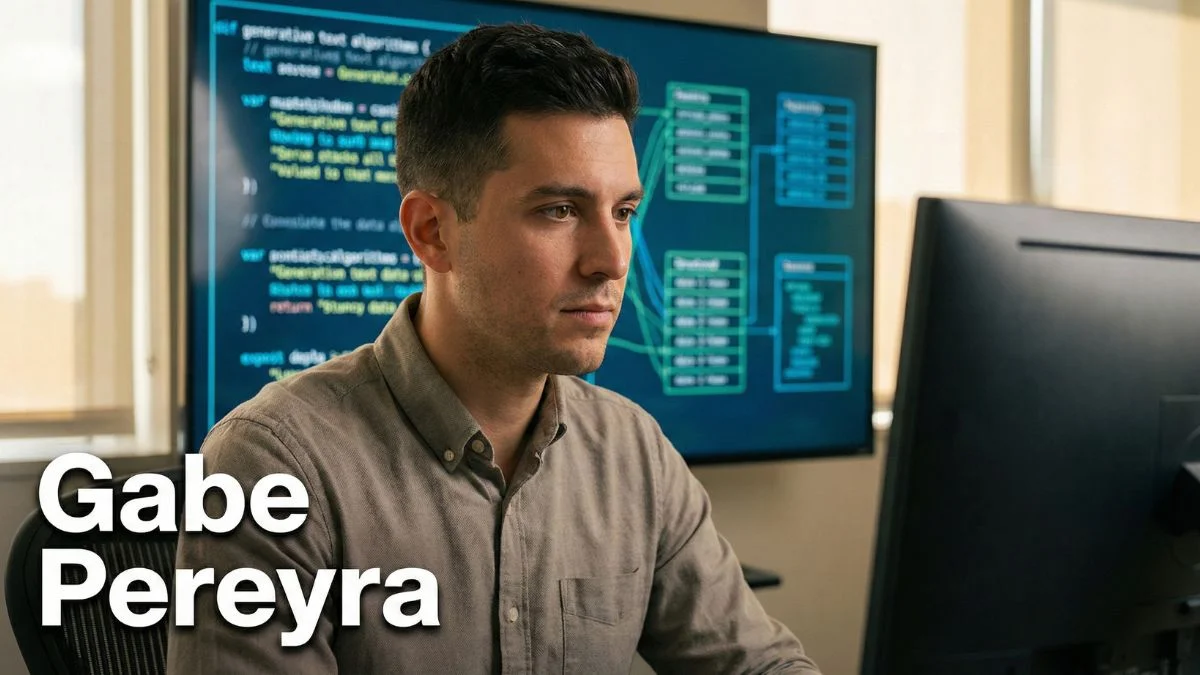
QUICK INFO BOX
| Attribute | Details |
|---|---|
| Full Name | Gabriel Pereyra |
| Nick Name | Gabe |
| Profession | AI Startup Founder / President / AI Researcher |
| Date of Birth | Circa 1994 (estimated) |
| Age | ~31 years old |
| Birthplace | United States |
| Hometown | Los Angeles, California |
| Nationality | American |
| Religion | Not publicly disclosed |
| Zodiac Sign | Not publicly disclosed |
| Ethnicity | Not publicly disclosed |
| Father | PhD in Computer Science |
| Mother | PhD in Computer Science |
| Siblings | Not publicly disclosed |
| Wife / Partner | Not publicly disclosed |
| Children | None (publicly known) |
| School | Not publicly disclosed |
| College / University | University of Southern California (USC), University of Oxford |
| Degree | B.S. Computer Science (USC), PhD Neuroscience (Oxford, incomplete) |
| AI Specialization | Machine Learning / Large Language Models / NLP |
| First AI Startup | Harvey (2022) |
| Current Company | Harvey |
| Position | President & Co-Founder |
| Industry | Artificial Intelligence / Legal Tech / SaaS |
| Known For | Co-founding Harvey AI – Legal AI Unicorn |
| Years Active | 2014 – Present (AI Research & Entrepreneurship) |
| Net Worth | Estimated $500M – $1B+ (2026) |
| Annual Income | Not publicly disclosed |
| Major Investments | Harvey AI equity stake |
| Not publicly active | |
| Twitter/X | @gabepereyra |
| Gabe Pereyra |
1. Introduction
In the rapidly evolving landscape of artificial intelligence, few names have risen as meteorically as Gabe Pereyra. At just 31 years old, this former Google Brain and DeepMind research scientist has co-founded Harvey, a legal AI platform that achieved an unprecedented $8 billion valuation in less than three years. Pereyra represents a new generation of AI entrepreneurs who are not just building technology—they’re fundamentally transforming centuries-old industries with machine learning and large language models.
What makes Gabe Pereyra’s story remarkable is the convergence of elite AI research experience, strategic timing, and an unconventional partnership with first-year attorney Winston Weinberg. Together, they’ve built Harvey into one of the most successful vertical AI applications in history, serving over 1,000+ customers across 59+ countries and generating $190M+ in annual recurring revenue by early 2026.
In this comprehensive biography, you’ll discover Gabe Pereyra’s journey from a computer science student at USC to the President of an $8 billion AI unicorn, his technical innovations in neural networks, his leadership philosophy, net worth trajectory, and what drives one of Silicon Valley’s most promising young founders.
2. Early Life & Background
Gabe Pereyra grew up in an intellectually stimulating environment that would profoundly shape his career trajectory. Both of his parents held PhDs in Computer Science and worked in adjacent fields throughout their careers. This academic household exposed young Gabe to computational thinking and scientific rigor from an early age, creating a foundation that would later enable him to navigate the complex world of artificial intelligence research.
Unlike many tech founders who discovered programming as teenagers, Pereyra was surrounded by computer science concepts throughout his childhood. His parents’ work provided dinner table conversations about algorithms, computational problems, and the emerging potential of machine learning—topics that most children never encounter. This unique upbringing gave him an intuitive understanding of how computers process information and solve problems.
From his earliest days, Pereyra demonstrated a curiosity about how things work beneath the surface. He was drawn not just to using technology but to understanding its fundamental mechanisms. This intellectual curiosity extended beyond computers to mathematics and neuroscience—interests that would later converge in his AI research career. He showed particular aptitude for abstract thinking and pattern recognition, skills that proved essential in machine learning research.
As Pereyra approached his college years, he recognized that artificial intelligence represented a convergence of his interests: computer science, mathematics, cognitive science, and the potential to tackle large societal problems. While many of his peers were drawn to AI for its technical challenges alone, Pereyra was always motivated by application—how could this technology make a meaningful difference in people’s lives?
The timing of Pereyra’s intellectual development proved fortuitous. He came of age just as deep learning was beginning its historic breakthrough. By 2014, when Pereyra began his AI research in earnest, the field was experiencing a renaissance driven by increased computational power, larger datasets, and algorithmic innovations like convolutional neural networks. He positioned himself at the epicenter of this transformation.
3. Family Details
| Relation | Name | Profession |
|---|---|---|
| Father | Not publicly disclosed | PhD in Computer Science |
| Mother | Not publicly disclosed | PhD in Computer Science |
| Siblings | Not publicly disclosed | Not publicly disclosed |
| Spouse | Not publicly disclosed | Not publicly disclosed |
| Children | None | – |
Gabe Pereyra maintains significant privacy regarding his personal life, a stance that’s relatively common among technical founders focused on building products rather than personal brands. What is publicly known is that both of his parents held doctoral degrees in computer science and worked in technology-adjacent fields, creating an environment where computational thinking was second nature.
This family background provided Pereyra with more than just exposure to technology—it gave him role models who demonstrated how to pursue intellectually challenging work with discipline and rigor. Growing up with parents who understood research, publication, peer review, and the scientific method likely influenced his own approach to AI development, which emphasizes empirical validation and systematic experimentation.
4. Education Background
University of Southern California (2012-2016)
Gabe Pereyra enrolled at the University of Southern California (USC) in 2012 to pursue a Bachelor’s degree in Computer Science. USC’s computer science program, part of the Viterbi School of Engineering, provided him with foundational knowledge in algorithms, data structures, and software engineering. However, what truly defined Pereyra’s undergraduate experience was his early involvement in AI research beginning in 2014.
By his junior year, Pereyra had already begun exploring deep learning at a time when the field was experiencing explosive growth. The publication of AlexNet in 2012 had demonstrated that deep convolutional neural networks could dramatically outperform traditional computer vision approaches, sparking renewed interest in neural network research. Pereyra immersed himself in this emerging field, studying the foundational papers and beginning to conduct his own experiments.
During his time at USC, Pereyra connected with some of the pioneers who would later be known as the “godfathers of AI,” including Yoshua Bengio and Geoffrey Hinton. These connections, established while he was still an undergraduate, demonstrated both his intellectual precociousness and his ability to network with leading researchers. He reached out to top research labs, expressing interest in contributing to advancing artificial intelligence.
University of Oxford (2017-2018)
After graduating from USC in 2016, Pereyra made an unconventional decision that reflected his interdisciplinary interests. He enrolled in a fully-funded PhD program in Neuroscience at the University of Oxford, one of the world’s most prestigious research universities. This program was sponsored by DeepMind, the London-based AI research lab, reflecting the company’s belief that insights from neuroscience could advance artificial intelligence.
The Oxford neuroscience program represented DeepMind’s interdisciplinary philosophy. The company recruited researchers from neuroscience, physics, mathematics, and other fields, believing that diverse perspectives would accelerate progress toward artificial general intelligence. Pereyra’s enrollment in this program demonstrated his intellectual breadth—he wasn’t just interested in building AI systems but in understanding the biological intelligence they aimed to emulate.
However, Pereyra ultimately made the decision not to complete his PhD, instead choosing to focus on hands-on AI research and industry applications. This decision mirrored the paths of many prominent AI researchers who found that direct work on large-scale machine learning systems provided more immediate learning opportunities than traditional academic research. The incomplete PhD was not a failure but a strategic pivot toward practical AI development.
5. Entrepreneurial Career Journey
A. Early Career & First Steps (2014-2016)
Gabe Pereyra’s entrepreneurial journey began not with a startup but with rigorous research training at the world’s leading AI labs. In 2016, immediately after completing his undergraduate degree at USC, he joined Google Brain as a Brain Resident. This highly selective program placed promising researchers directly into Google’s premier AI research division, giving them access to massive computational resources and collaboration with some of the field’s top scientists.
As a Brain Resident, Pereyra worked on fundamental problems in deep learning, focusing particularly on techniques that would make neural networks more robust and reliable. This work contributed to several research papers and gave him hands-on experience with the infrastructure required to train large-scale machine learning models. The Brain Residency program served as both advanced education and professional launching pad, exposing him to the cutting edge of AI capabilities.
B. DeepMind Research Scientist (2017-2019)
In 2017, Pereyra advanced to become a Research Scientist at DeepMind, Google’s London-based AI research subsidiary renowned for breakthrough achievements like AlphaGo. At DeepMind, he focused on regularization techniques—methods that prevent neural networks from overfitting to training data and help them generalize to new situations. This work was critical for applications where errors carry real consequences.
During his time at DeepMind, Pereyra co-authored significant research papers including work on label smoothing and confidence penalties. These techniques improved model performance across multiple domains including image classification and language modeling. His research demonstrated both technical depth and practical applicability—qualities that would later prove essential in building Harvey.
The DeepMind experience provided Pereyra with two critical assets for his future entrepreneurial career. First, he gained deep technical expertise in how large language models work, including their strengths, limitations, and potential applications. Second, he built relationships with other researchers who would later become key players in the AI industry, creating a network he could leverage when building Harvey.
C. Meta AI / FAIR (2019-2022)
After DeepMind, Pereyra joined Meta’s AI Research lab (FAIR) as a machine learning engineer, where he focused specifically on large language models. This position placed him at the forefront of the generative AI revolution that would soon transform the technology landscape. At Meta, he worked on fundamental research related to how language models learn, represent knowledge, and generate text.
The timing of Pereyra’s tenure at Meta proved significant. He was working on large language models just as GPT-3 demonstrated the surprising capabilities that emerged when these models reached sufficient scale. He witnessed firsthand how increasing model size and training data led to qualitative improvements in language understanding and generation. This experience would prove invaluable when evaluating the potential of GPT-4 for legal applications.
Throughout his time at Google Brain, DeepMind, and Meta, Pereyra maintained his original motivation: finding ways to apply AI technology to large societal problems. He initially believed education would be his target domain, but his perspective would shift dramatically when he reconnected with an old roommate named Winston Weinberg.
D. The Genesis of Harvey (2022)
In early 2022, Pereyra was living with Winston Weinberg, a first-year securities litigation associate at the prestigious Los Angeles law firm O’Melveny & Myers. Weinberg was experiencing the grinding reality of junior associate life—long hours reviewing documents, conducting research, and drafting memoranda. He recognized that large language models might transform these workflows but lacked the technical expertise to evaluate their potential.
The breakthrough came when Pereyra gained early access to GPT-4 approximately six months before ChatGPT’s public launch. While most of the world hadn’t yet seen ChatGPT, Pereyra had access to a significantly more capable model. Recognizing the potential, he and Weinberg began experimenting with legal applications, starting with simple question-answering tasks.
Their first major experiment became legendary in venture capital circles. They scraped 100 questions about California landlord-tenant law from Reddit’s r/legaladvice forum. Using chain-of-thought prompting—a technique Pereyra had developed before it became widely known—they generated answers using GPT-4. They then presented these question-answer pairs to three experienced landlord-tenant attorneys without mentioning AI, asking simply whether they would send the responses as-is or make edits.
The results shocked everyone involved. On 86 out of 100 samples, at least two of the three attorneys said they would send the responses with zero edits. This meant that GPT-4, properly prompted, could match attorney-quality output on real legal questions. For Pereyra and Weinberg, this was the “holy shit” moment—the realization that an entire industry could be transformed by this technology.
Rather than pursuing traditional startup development, they took a direct approach. On July 4, 2022, they cold-emailed Sam Altman (CEO of OpenAI) and Jason Kwon (OpenAI’s General Counsel). They figured that including the General Counsel was essential—lawyers would recognize quality legal output in ways that technical people might miss. They shared their chatbot experiment and explained their vision for applying large language models to legal work.
The timing proved perfect. That same morning at 10 a.m. on Independence Day, they found themselves on a video call with Altman and much of OpenAI’s C-suite. The OpenAI leadership immediately recognized the potential. Legal work—complex, language-intensive, and commercially valuable—represented an ideal application for their most advanced models. Within weeks, the OpenAI Startup Fund made its first-ever institutional investment in Harvey.
E. Building Harvey – The Breakthrough Phase (2022-2024)
With OpenAI backing secured, Pereyra and Weinberg officially founded Harvey in August 2022. The company’s vision was ambitious: build a comprehensive AI associate capable of handling everything from contract drafting to regulatory analysis across multiple jurisdictions. Unlike narrow point solutions, Harvey would be a general-purpose legal AI that could tackle diverse tasks.
Pereyra’s technical decision-making proved crucial during this formative period. Rather than simply fine-tuning existing models, Harvey partnered with OpenAI to build custom-trained legal foundation models. They incorporated approximately 10 billion tokens worth of legal data, starting with Delaware case law (the most important jurisdiction for corporate law) and expanding to all U.S. case law.
The custom model demonstrated dramatic superiority over general-purpose alternatives. In tests with 10 large law firms, attorneys preferred Harvey’s custom case law model 97% of the time compared to standard GPT-4. The custom model provided longer, more complete answers that addressed legal nuances and covered more relevant case law. It also reduced hallucination rates—false citations that could be devastating in legal work.
Early customer acquisition followed an ingenious strategy. The Harvey team would pull public litigation briefs from PACER (the federal court filing system), identify the partner who wrote each brief, and then demonstrate how Harvey could argue against their own work. This approach got immediate attention because it was directly relevant to what attorneys had just done. It also showcased Harvey’s capabilities in a way that felt personally relevant rather than abstract.
By April 2023, Harvey had raised a $21 million Series A led by Sequoia Capital, one of Silicon Valley’s most prestigious venture capital firms. Pat Grady, Sequoia partner, described the legal market as feeling “like a bulls-eye” for generative AI—a massive industry ($400 billion in the U.S. alone) with language-intensive work and high willingness to pay for productivity improvements.
F. Explosive Growth & Scaling (2024-2026)
The period from 2024 to 2026 saw Harvey experience growth that surprised even optimistic observers. In early 2024, the company served approximately 40 customers. By the end of 2024, this had expanded to 235 customers across 42 countries. By early 2026, Harvey reported serving over 1,000 customers in 59+ countries, including 42% of AmLaw 100 firms—the most prestigious and profitable legal practices in the United States.
Revenue growth matched customer expansion. In February 2025, CEO Winston Weinberg announced Harvey had surpassed $50 million in annual recurring revenue (ARR) and projected hitting $100 million within eight months. By August 2025, they achieved this milestone. By January 2026, Harvey announced crossing $190 million in ARR—a trajectory that placed it among the fastest-growing B2B SaaS companies in history.
The valuation trajectory was equally dramatic:
- July 2024: $1.5 billion (OpenAI Startup Fund initial investment)
- February 2025: $3 billion (Series D, $300M, led by Sequoia)
- June 2025: $5 billion (Series E, $300M, co-led by Kleiner Perkins & Coatue)
- October 2025: $8 billion (Series F, $160M, led by Andreessen Horowitz)
In total, Harvey raised approximately $806 million in funding in 2025 alone, with backing from a who’s who of Silicon Valley: OpenAI Startup Fund, Sequoia Capital, Andreessen Horowitz, Kleiner Perkins, Coatue, Google Ventures, Elad Gil, and others.
G. Product Evolution & Technical Innovation
Under Pereyra’s technical leadership, Harvey evolved from a simple question-answering tool into a comprehensive legal AI platform. The core product offerings expanded to include:
Harvey Assistant: A domain-specific AI that handles complex legal tasks including contract drafting, legal research, due diligence, and regulatory analysis.
Harvey Vault: A secure document management system that allows firms to store, organize, and bulk-analyze legal documents using AI.
Harvey Knowledge: A research tool that answers complex legal, regulatory, and tax questions across multiple jurisdictions.
Harvey Workflows: Customizable, pre-built workflows that chain multiple AI models and tools together to complete specific legal tasks.
Pereyra’s core technical thesis—”the models are the product”—proved prophetic. Rather than building narrow tools for specific tasks, Harvey created a broad AI assistant. Since lawyers work primarily in text and email, conversational AI became the natural interface, functioning as an “AI associate” that supports partners and teams across diverse tasks.
The platform integrated directly into attorneys’ existing workflows through plugins for Microsoft Outlook, Word, and SharePoint. This integration strategy reduced friction and increased adoption—lawyers didn’t need to learn new systems but could access AI capabilities within familiar tools.
H. Strategic Partnerships
Recognizing that legal work requires access to authoritative data sources, Pereyra orchestrated strategic partnerships with industry incumbents:
LexisNexis Partnership (June 2025): Integration allowing Harvey users to access U.S. case law, statutes, and agency materials directly within the Harvey interface. This partnership was particularly significant because LexisNexis, one of the century-old duopoly in legal research, effectively acknowledged it couldn’t build comparable technology independently.
Wolters Kluwer Partnership: Similar integration for additional legal research content.
iManage & NetDocuments: Integrations with document management systems used by law firms.
Microsoft Azure Marketplace: Launch on Azure Marketplace in May 2024, expanding distribution channels.
These partnerships reflected Pereyra’s pragmatic recognition that Harvey shouldn’t try to build everything. Research databases, document management, and other infrastructure represented established markets with entrenched players. Harvey’s competitive advantage lay in the AI layer—the models, workflows, and user experience built on top of these foundational data sources.
I. Expansion Beyond Law Firms
While Harvey initially focused exclusively on elite law firms, Pereyra and Weinberg recognized early that the technology had broader applications. By early 2025, approximately 4% of Harvey’s revenue came from corporate legal departments. By late 2025, this had grown to 33%, with projections suggesting 40% by year-end.
Major corporate clients included PwC, KKR, Bridgewater Associates, Comcast, and Carvana. These enterprise deployments demonstrated that Harvey’s technology applied to in-house legal work, compliance monitoring, contract management, and other adjacent functions. The corporate expansion also opened pathways into adjacent verticals like tax and accounting.
6. Career Timeline Chart
📅 CAREER TIMELINE

2012 ─── Enrolled at USC, Computer Science
   │
2014 ─── Began AI research, deep learning exploration
   │
2016 ─── Google Brain Resident
   │
2017 ─── DeepMind Research Scientist / Oxford PhD program
   │
2019 ─── Joined Meta AI (FAIR), LLM research
   │
2022 ─── Co-founded Harvey with Winston Weinberg
   │
2023 ─── Series A ($21M, Sequoia Capital)
   │
2024 ─── Custom legal foundation model with OpenAI
   │
2025 ─── Three major funding rounds ($806M total)
       ─── Harvey reaches $100M ARR milestone
       ─── Company valuation hits $8 billion
   │
2026 ─── $190M+ ARR, 1,000+ customers, 59+ countries
       ─── President of $8B AI unicorn
7. Business & Company Statistics
| Metric | Value (2026) |
|---|---|
| AI Companies Founded | 1 (Harvey) |
| Current Valuation | $8 Billion |
| Annual Recurring Revenue | $190M+ |
| Total Funding Raised | $806M+ |
| Employees | 500+ |
| Countries Operated | 59+ |
| Active Customers | 1,000+ |
| AmLaw 100 Penetration | 42% |
| AI Models Deployed | Multiple custom LLMs |
| Weekly Active Users Growth | 4x year-over-year |
| Monthly Query Volume Growth | 5.5x year-over-year |
| Corporate Revenue Mix | 33% (growing from 4% in early 2025) |
8. AI Founder Comparison Section
📊 Gabe Pereyra vs Sam Altman (OpenAI)
| Statistic | Gabe Pereyra | Sam Altman |
|---|---|---|
| Net Worth | $500M – $1B+ | $2B+ |
| Company Valuation | $8B (Harvey) | $157B (OpenAI, 2024) |
| AI Specialization | Legal AI / Vertical Applications | General AI / Foundation Models |
| Years in AI | ~12 years | ~15+ years |
| Funding Raised | $806M | $13B+ |
| Customer Focus | Enterprise Legal (B2B) | Consumer + Enterprise (B2B2C) |
| Global Influence | Legal Industry Leader | Global AI Policy Leader |
Analysis: While Sam Altman operates at a larger scale with OpenAI’s foundation models, Gabe Pereyra has achieved remarkable success in vertical AI application. Harvey represents one of the most successful examples of taking general-purpose AI and adapting it for a specific professional services industry. Pereyra’s close partnership with OpenAI gives Harvey early access to cutting-edge models, creating a competitive moat. The comparison highlights two complementary strategies: Altman builds the infrastructure layer while Pereyra builds the application layer.
📊 Gabe Pereyra vs Ilya Sutskever (Safe Superintelligence)
| Statistic | Gabe Pereyra | Ilya Sutskever |
|---|---|---|
| Company Founded | Harvey (2022) | Safe Superintelligence (2024) |
| Previous Role | Meta AI Research | OpenAI Chief Scientist |
| Research Focus | Applied LLMs | AGI Safety |
| Valuation Achieved | $8B (Harvey) | $5B (SSI) |
| Commercial Traction | $190M ARR | Pre-revenue (research phase) |
| Approach | Product-first | Research-first |
Analysis: Pereyra and Sutskever represent divergent paths from elite AI research labs. Sutskever, one of the most influential AI researchers of the decade, chose to focus on fundamental AI safety research. Pereyra, with equally strong research credentials, opted for commercial application. Harvey’s rapid revenue growth demonstrates the viability of vertical AI businesses, while SSI’s massive valuation reflects investor belief in breakthrough research. Both approaches are valuable to the AI ecosystem.
9. Leadership & Work Style Analysis
The Technical Founder as Leader
Gabe Pereyra embodies a distinctive leadership archetype: the technical founder who can translate research breakthroughs into commercial products. Unlike CEO Winston Weinberg, who handles go-to-market strategy and customer relationships, Pereyra as President focuses on product, engineering, and technical partnerships. This division of labor has proven highly effective, with Sequoia partner Pat Grady noting both founders’ complementary evolution.
“The Models Are the Product” Philosophy
Pereyra’s core thesis—that the AI models themselves are the product—has guided Harvey’s entire strategy. This contrasts with competitors who treated models as infrastructure supporting narrow workflow tools. Pereyra recognized that as models became more capable, the value would concentrate in model quality, training data, and customization rather than in surface-level UX or workflow orchestration.
This philosophy led to several key decisions:
- Partnering with OpenAI for custom model training rather than relying solely on APIs
- Investing heavily in legal-specific training data
- Building broad capabilities rather than narrow point solutions
- Focusing on model performance metrics (accuracy, hallucination rates) as core KPIs
Decision-Making with Data
Coming from rigorous research environments at Google, DeepMind, and Meta, Pereyra brings an empirical approach to product development. Before launching features, Harvey conducts extensive testing with real attorneys, measuring preferences, accuracy, and adoption. The company’s 97% preference rate for its custom legal model over GPT-4 reflects this commitment to rigorous validation.
Risk Tolerance and Experimentation
Pereyra demonstrates high tolerance for technical risk but carefully manages commercial risk. Harvey has made significant bets on custom model training, agentic workflows, and multiplayer features—all technically complex initiatives. However, the company validates each capability with customers before broad rollout, ensuring product-market fit at each stage.
Innovation and Collaboration Mindset
Rather than attempting to build every component in-house, Pereyra has orchestrated partnerships with established players like LexisNexis, Wolters Kluwer, and Microsoft. This “coopetition” strategy recognizes that Harvey’s competitive advantage lies in AI capabilities, not in recreating legal research databases or document management systems that already exist.
Pereyra has also maintained close relationships with his former colleagues at major AI labs. This network gives Harvey insights into upcoming model capabilities, allowing the company to build for where the technology is heading rather than just current capabilities. He frequently advises other founders: “Don’t build for the current capabilities of models today—build for where the models are going to be.”
Strengths & Potential Blind Spots
Strengths:
- Deep technical expertise in large language models
- Ability to evaluate AI capabilities and limitations realistically
- Strong research network across major AI labs
- Interdisciplinary thinking (CS, neuroscience, legal)
- Pragmatic approach to partnerships vs. building in-house
Potential Blind Spots:
- Heavy reliance on OpenAI partnership (strategic dependency)
- Background entirely in research rather than enterprise software
- Limited experience with legal industry before Harvey
- Company growth speed may create organizational challenges
10. Achievements & Awards
AI & Tech Awards
Time 100 Most Influential Companies (2024) – Harvey recognized as one of the world’s most influential companies, reflecting its impact on legal technology.
Forbes AI 50 (2024, 2025) – Listed among the top AI companies transforming industries.
TechCrunch Top Startups (2025) – Featured as one of the year’s breakthrough startups.
Industry Recognition
Legal Tech Breakthrough Award – For revolutionizing legal services through AI.
Enterprise AI Innovation – Recognition from enterprise software industry analysts.
Notable Milestones
Youngest President of an $8B Company – At approximately 31 years old, among the youngest executives leading a company at this valuation.
Fastest Legal Tech Company to $100M ARR – Achieved in approximately 3 years from founding.
Highest Valuation Legal Tech Startup – Harvey’s $8B valuation exceeds any previous legal technology company.
Largest Legal Tech Funding Round – Multiple rounds exceeding $300M each.
Research Contributions
Published Papers on Neural Network Regularization – Co-authored influential research on label smoothing and confidence penalties at DeepMind.
Contributions to Large Language Model Development – Research at Google Brain and Meta AI that advanced LLM capabilities.
11. Net Worth & Earnings
💰 FINANCIAL OVERVIEW
| Year | Estimated Net Worth | Key Events |
|---|---|---|
| 2022 | $1M – $5M | Founded Harvey, initial OpenAI backing |
| 2023 | $50M – $100M | Series A funding, company valuation reaches $250M+ |
| 2024 | $200M – $400M | Company reaches unicorn status ($1.5B+) |
| 2025 | $500M – $800M | Three major rounds, $8B valuation achieved |
| 2026 | $500M – $1B+ | As President with significant equity stake |
Income Sources
Founder Equity Stake – As co-founder and President of Harvey, Pereyra holds significant equity. While exact ownership percentage isn’t public, co-founders typically retain 10-20% post-dilution at this stage. At Harvey’s $8B valuation, even 7-10% ownership would represent $560M-$800M in paper wealth.
Salary & Compensation – As President of a well-funded startup, Pereyra likely earns $300K-$500K+ annual base salary plus bonuses, though equity represents the vast majority of his compensation.
Stock Options & RSUs – Ongoing equity compensation as the company grows and raises additional rounds.
Advisory Roles – Given his expertise, Pereyra likely provides occasional technical advisory services, though this represents minimal income compared to his Harvey stake.
Wealth Trajectory Analysis
Pereyra’s net worth trajectory reflects the explosive growth of Harvey rather than traditional income accumulation. His wealth is primarily illiquid—tied to his ownership stake in a private company. True realization of this wealth would come through:
- Secondary Share Sales – Harvey announced its first tender offer in late 2025, allowing employees and founders to sell shares. This likely provided some liquidity.
- Future Fundraising Rounds – Additional rounds at higher valuations increase the paper value of existing shares.
- IPO or Acquisition – The ultimate liquidity event where Pereyra’s ownership converts to cash or public company stock.
Given Harvey’s rapid growth and $190M+ ARR, the company appears on a path toward IPO within 2-3 years. CEO Winston Weinberg has explicitly expressed interest in public markets, though without providing a specific timeline. An IPO at $10B+ valuation would likely make Pereyra a billionaire.
Comparative Context
To contextualize Pereyra’s wealth trajectory, consider comparable founders:
- Brian Chesky (Airbnb) was worth ~$10B+ after Airbnb’s IPO
- Dylan Field (Figma) was estimated at $2B before Adobe acquisition attempt
- Patrick Collison (Stripe) worth $11B+
Pereyra’s trajectory is ahead of most founders at the same stage. Reaching a net worth of $500M-$1B before age 32, with a company generating $190M ARR, places him among the most successful technical founders of his generation.
12. Lifestyle Section
🏠 ASSETS & LIFESTYLE
Properties
Primary Residence: San Francisco, California – Given Harvey’s headquarters in San Francisco and Pereyra’s role as President, he likely maintains a primary residence in the city. San Francisco real estate for successful tech executives typically ranges from $2M-$5M for upscale apartments or $5M-$15M for homes in prestigious neighborhoods like Pacific Heights or Russian Hill.
Cars & Transportation
Like many technical founders, Pereyra maintains a relatively low-key public profile regarding material possessions. No information is publicly available about his car collection or transportation preferences, suggesting he prioritizes privacy and doesn’t showcase luxury assets on social media.
Hobbies & Personal Interests
AI Research & Reading – Pereyra continues following cutting-edge AI research, maintaining connections with academic labs and staying current on new papers and breakthroughs.
Interdisciplinary Learning – His background in neuroscience and ongoing interest in how biological and artificial intelligence intersect suggests continued intellectual curiosity beyond immediate business needs.
Professional Networks – Active participation in AI research communities and legal tech industry events.
Daily Routine & Work Habits
While specific details of Pereyra’s daily routine aren’t publicly documented, his role as President of a rapidly scaling startup likely involves:
Early Mornings – Tech executives typically start early, often 6-7 AM, to handle global operations and communications.
Deep Work Sessions – As a technical leader, Pereyra likely blocks time for focused product review, model evaluation, and strategic technical planning.
Cross-Functional Collaboration – Regular sync meetings with co-founder Winston Weinberg, engineering teams, and product managers.
Customer Engagement – Participation in key customer meetings, particularly with major law firms adopting Harvey’s platform.
Research Monitoring – Time allocated to staying current with AI research developments, particularly from OpenAI and other frontier labs.
Work-Life Balance – Like many startup founders in hypergrowth phase, Pereyra likely works 60-80+ hour weeks, though he maintains this is sustainable given his passion for the work.
13. Physical Appearance
| Attribute | Details |
|---|---|
| Height | Approximately 5’10” – 6’0″ (estimated) |
| Weight | Not publicly disclosed |
| Eye Color | Brown |
| Hair Color | Dark Brown |
| Body Type | Average build |
| Style | Casual tech founder aesthetic – typically seen in t-shirts, hoodies, or business casual attire |
Gabe Pereyra maintains a relatively low public profile and doesn’t emphasize personal appearance or fashion. His presentation style aligns with Silicon Valley’s technical founder culture—professional but unpretentious, focused on substance over style.
14. Mentors & Influences
AI Research Pioneers
Yoshua Bengio – One of the “godfathers of AI” and Turing Award winner. Pereyra connected with Bengio during his undergraduate years at USC, demonstrating early networking abilities and recognition of who represented excellence in the field.
Geoffrey Hinton – Another AI pioneer whose work on neural networks fundamentally shaped modern deep learning. Pereyra studied Hinton’s research and connected with his broader research network.
Researchers at Google Brain, DeepMind, and Meta AI – During his time at these elite labs, Pereyra worked alongside and learned from some of the world’s leading AI researchers, absorbing their methodologies and approaches.
Entrepreneurial Influences
Sam Altman – OpenAI CEO who became both investor and strategic partner. Altman’s willingness to take Pereyra’s cold email seriously on July 4, 2022, changed Harvey’s trajectory. The partnership between Harvey and OpenAI reflects mutual respect and aligned vision.
Pat Grady (Sequoia Capital) – Led Harvey’s Series A and provided strategic guidance on scaling enterprise SaaS businesses. Grady’s experience with companies like Snowflake and ServiceNow helped Harvey navigate hypergrowth.
Elad Gil – Serial entrepreneur and investor who backed Harvey early and provided operational advice based on his experience scaling multiple unicorns.
Co-Founder Partnership
Winston Weinberg – Pereyra’s co-founder and CEO represents his most significant professional partnership. Weinberg’s legal expertise complements Pereyra’s technical capabilities, creating a founding team that bridges two essential domains. Their mutual respect and clear role division has been crucial to Harvey’s success.
Leadership Lessons Learned
From his mentors and experiences, Pereyra has internalized several key principles:
- Build for the future, not the present – Don’t optimize for current model capabilities; anticipate where AI is heading
- Partner strategically – Don’t try to build everything; focus on core competencies
- Validate rigorously – Use empirical testing to prove capabilities before broad rollout
- Stay close to the technology – Maintain technical depth even as the company scales
- Choose co-founders carefully – Complementary skills and mutual respect enable better decision-making
15. Company Ownership & Roles
| Company | Role | Years | Ownership/Details |
|---|---|---|---|
| Harvey | President & Co-Founder | 2022 – Present | Estimated 7-15% equity stake (post-dilution) |
| Harvey AI, Inc. | Board Member | 2022 – Present | Active board participation |
| Google Brain | Brain Resident | 2016 – 2017 | No equity (employment) |
| DeepMind | Research Scientist | 2017 – 2019 | No equity (Google subsidiary) |
| Meta AI (FAIR) | ML Engineer | 2019 – 2022 | Stock options (departed before value realization) |
Harvey Investor Relationships
While not an investor himself, Pereyra maintains close relationships with Harvey’s major backers:
- OpenAI Startup Fund – Strategic investor and technology partner
- Sequoia Capital – Lead Series A and D investor
- Andreessen Horowitz (a16z) – Lead Series F investor
- Kleiner Perkins – Series E co-lead
- Coatue Management – Series E co-lead
- Google Ventures (GV) – Strategic investor
- Elad Gil – Angel investor and advisor
16. Controversies & Challenges
AI Ethics and Job Displacement Concerns
Like all AI companies targeting professional services, Harvey faces criticism that it could displace legal professionals. Critics argue that legal AI might eliminate junior associate positions, reducing opportunities for new lawyers to develop skills. Pereyra and Weinberg have consistently argued that Harvey augments rather than replaces attorneys, handling routine tasks and allowing lawyers to focus on higher-value work.
Response: Harvey’s leadership emphasizes that legal work is expanding faster than the legal workforce can grow, creating opportunity for both AI and human lawyers. They cite that their largest customers are actually hiring more attorneys, not fewer, because increased productivity allows firms to take on more work.
Data Privacy and Confidentiality
Legal work involves highly sensitive information—trade secrets, M&A details, litigation strategy, personal data. Any AI system processing this information raises confidentiality concerns. Questions have been raised about how Harvey stores data, whether it uses customer data to train models, and how it prevents information leakage between clients.
Response: Harvey has implemented strict data isolation, enterprise-grade security, and contractual commitments not to use customer data for model training without explicit permission. The company has obtained SOC 2 Type II certification and maintains security protocols that meet law firm requirements.
OpenAI Dependency Risk
Harvey’s close partnership with OpenAI creates strategic dependency. If OpenAI’s models become less competitive, if the partnership terms change unfavorably, or if OpenAI launches competing legal products, Harvey’s position could be threatened. Some investors and analysts have questioned whether Harvey is building defensible technology or simply wrapping OpenAI’s models.
Response: Pereyra argues that Harvey’s defensibility comes from its custom legal training data, workflows, integrations, and customer relationships rather than from proprietary model architecture. The company is also diversifying to support multiple model providers while maintaining OpenAI as its primary partner.
Hallucination and Accuracy Concerns
Legal work demands extreme accuracy—a single incorrect case citation could have serious professional consequences. AI language models are prone to “hallucinations”—generating plausible-sounding but factually incorrect information. Despite Harvey’s custom training, the risk of errors remains.
Response: Harvey has implemented multiple safeguards including confidence scoring, citation verification, human-in-the-loop workflows, and explicit warnings that attorneys must verify AI output. The company frames its product as a tool that assists attorneys rather than replacing their judgment.
Regulatory Uncertainty
The legal industry is heavily regulated, with rules about unauthorized practice of law, attorney-client privilege, and professional responsibility. As AI becomes more capable, questions arise about whether AI-generated legal work constitutes practice of law and what responsibilities attorneys have when using AI tools.
Response: Harvey positions its product as a tool used by licensed attorneys rather than as an autonomous legal service. The company works with bar associations and ethics committees to ensure compliance with evolving regulations.
Lessons Learned from Challenges
These controversies have shaped Harvey’s approach:
- Transparency about limitations – Clearly communicating what AI can and cannot do
- Security-first design – Building enterprise security from day one rather than retrofitting
- Human-in-the-loop philosophy – Maintaining attorneys as final decision-makers
- Proactive regulatory engagement – Working with regulators rather than waiting for enforcement
- Continuous accuracy improvement – Investing heavily in reducing hallucination rates
17. Charity & Philanthropy
While Gabe Pereyra’s philanthropic activities aren’t extensively documented publicly—common for young founders focused on building their companies—several areas suggest future philanthropic focus:
AI Education and Research
Given his academic background and research experience, Pereyra likely supports initiatives that advance AI education and make research more accessible. This could include:
- Open-source contributions – Sharing research and tools that advance the broader AI community
- Educational content – Speaking at universities and conferences to inspire the next generation
- Research funding – Potential future support for AI safety and alignment research
Access to Legal Services
Harvey’s technology has potential to democratize legal access. While the company currently focuses on elite law firms and corporations, the underlying technology could eventually help:
- Pro bono legal work – Making AI tools available to public interest organizations
- Legal aid societies – Helping under-resourced organizations serve more clients
- Self-represented litigants – Potentially offering simplified tools for individuals navigating legal systems
STEM Education
With both parents holding PhDs in computer science, Pereyra likely values educational opportunity. Future philanthropy might include:
- Scholarship programs for computer science students
- STEM education initiatives in underserved communities
- Support for interdisciplinary programs combining AI and other fields
Future Philanthropic Potential
As Harvey continues growing and Pereyra’s wealth increases, he’ll likely develop a more structured philanthropic approach. Many successful tech founders establish foundations or join initiatives like the Giving Pledge after achieving liquidity events. Given his trajectory, Pereyra could become a significant philanthropic force in AI education and legal access within the next 5-10 years.
18. Personal Interests
| Category | Favorites |
|---|---|
| Food | Not publicly disclosed |
| Movie | Not publicly disclosed |
| Book | Likely AI research papers, neuroscience texts, business strategy |
| Travel Destination | San Francisco (work), likely international travel for business |
| Technology | Large Language Models, AI research tools, latest model releases |
| Sport | Not publicly disclosed |
| Podcasts | Likely AI-focused podcasts, technical interviews |
| Music | Not publicly disclosed |
Intellectual Interests
Artificial Intelligence – Pereyra remains deeply engaged with AI research, following new papers from labs like OpenAI, Anthropic, Google DeepMind, and academic institutions.
Neuroscience – His Oxford PhD program (though incomplete) reflects ongoing interest in how biological intelligence works and what it can teach us about building better AI.
Philosophy of Mind – The intersection of consciousness, intelligence, and computation—questions that become more relevant as AI systems grow more capable.
Business Strategy – Particularly interested in how technology disrupts established industries and the dynamics of vertical SaaS businesses.
19. Social Media Presence
| Platform | Handle | Followers | Activity Level |
|---|---|---|---|
| Twitter/X | @gabepereyra | 2,500+ | Moderate – Industry insights, company updates |
| Gabe Pereyra | 10,000+ | Active – Professional updates, hiring announcements | |
| Not publicly active | N/A | Private or inactive | |
| YouTube | Not publicly active | N/A | Appears in conference talks, interviews |
| GitHub | Not publicly active | N/A | Research code likely under institutional accounts |
Social Media Strategy
Unlike consumer-facing founders who build large social followings, Pereyra maintains a professional, low-key online presence. His social media activity focuses on:
- Industry thought leadership – Sharing insights about AI capabilities and limitations
- Company updates – Announcing funding rounds, product launches, customer wins
- Hiring – Recruiting top talent for Harvey’s growing teams
- Technical discussions – Engaging with AI research community on model capabilities
This approach aligns with Harvey’s B2B enterprise focus—the target customers are law firm partners and general counsels, not general consumers. Pereyra’s credibility comes from technical depth and business results rather than social media influence.
20. Recent News & Updates (2025–2026)
October 2025 – Series F Funding ($160M at $8B Valuation)
Harvey raised $160 million in Series F funding led by Andreessen Horowitz, with participation from existing investors. This round valued the company at $8 billion, making it one of the most valuable private legal technology companies in history. The funding will support continued product development, international expansion, and sales team growth.
January 2026 – $190M ARR Milestone
CEO Winston Weinberg announced Harvey crossed $190 million in annual recurring revenue, demonstrating continued hypergrowth. The company also reported serving over 1,000 customers across 59+ countries, with 42% penetration of AmLaw 100 firms.
November 2025 – LexisNexis Partnership Expansion
Harvey expanded its partnership with LexisNexis, adding UK case law and additional jurisdictions to the integrated research capabilities. This international expansion reflects Harvey’s growing global customer base.
September 2025 – Corporate Legal Department Focus
Harvey announced that 33% of revenue now comes from corporate legal departments (up from 4% at the start of 2025), with projections to hit 40% by year-end. Major corporate wins included expanded deployments at PwC, KKR, and Bridgewater Associates.
August 2025 – $100M ARR Achievement
Harvey reached $100 million in annual recurring revenue, approximately three years after founding. This milestone placed the company among the fastest-growing B2B SaaS businesses ever, comparable to the trajectories of Snowflake, Databricks, and other category leaders.
June 2025 – Series E Funding ($300M at $5B Valuation)
Kleiner Perkins and Coatue Management co-led a $300 million Series E round, valuing Harvey at $5 billion. The round included participation from Google Ventures and other strategic investors.
May 2025 – Multiplayer Features Launch
Harvey launched collaborative features allowing multiple attorneys to work together using AI assistance, similar to Google Docs’ collaborative editing. This capability addressed a key enterprise requirement—legal work is often team-based rather than individual.
February 2025 – Series D Funding ($300M at $3B Valuation)
Sequoia Capital led a $300 million Series D round at a $3 billion valuation. This represented Sequoia’s continued conviction in Harvey’s trajectory after leading the Series A.
Future Roadmap (2026 and Beyond)
IPO Preparation – CEO Winston Weinberg has expressed interest in public markets, though without committing to a specific timeline. At $190M+ ARR and growing, Harvey could be IPO-ready within 1-2 years.
International Expansion – Continued expansion into new jurisdictions, particularly in Asia-Pacific and additional European markets.
Adjacent Verticals – Expansion from legal into tax, accounting, and compliance—adjacent professional services that share similar knowledge-intensive workflows.
Agentic AI – Development of more autonomous AI agents that can handle multi-step legal tasks with minimal human intervention.
Enterprise AI Platform – Evolution from legal-specific tool toward a broader platform for professional services AI applications.
21. Lesser-Known Facts About Gabe Pereyra
- Both parents hold PhDs in Computer Science – Pereyra grew up in an exceptionally technical household where computational thinking was the norm, not the exception.
- Started AI research as an undergraduate – While most students focus purely on coursework, Pereyra began conducting original AI research in 2014 as a junior at USC.
- Dropped out of Oxford PhD program – Despite being accepted into a prestigious, fully-funded DeepMind-sponsored neuroscience PhD at Oxford, Pereyra chose to leave and focus on industry AI research.
- Cold-emailed Sam Altman on July 4th – The founding story of Harvey involved sending a cold email to OpenAI’s CEO on Independence Day 2022—and getting a response that same morning.
- Had early access to GPT-4 – Pereyra experimented with GPT-4 approximately six months before ChatGPT’s public launch, giving him unique insight into the technology’s potential.
- Developed chain-of-thought prompting independently – Before it became widely known, Pereyra was already using chain-of-thought techniques to improve legal AI responses.
- Worked at three of the world’s top AI labs – Google Brain, DeepMind, and Meta AI (FAIR) represent arguably the three most influential AI research organizations, and Pereyra trained at all three.
- Lives with his co-founder (initially) – The Harvey founding story began when Pereyra was roommates with Winston Weinberg, leading to late-night experiments with legal AI.
- $8 billion valuation in under 3 years – Harvey’s trajectory from founding in August 2022 to $8B valuation by October 2025 represents one of the fastest enterprise software scaling stories in history.
- 97% attorney preference rate for custom models – In head-to-head testing, attorneys preferred Harvey’s custom-trained legal models over standard GPT-4 in 97% of cases.
- First investment from OpenAI Startup Fund – Harvey represented the first institutional investment from OpenAI’s dedicated startup fund, reflecting unique strategic importance.
- Contributed to neural network regularization research – Pereyra’s academic research on label smoothing and confidence penalties has been cited hundreds of times and influenced how modern neural networks are trained.
- Non-technical co-founder – Unlike most AI startups founded by technical teams, Harvey pairs Pereyra’s deep AI expertise with Weinberg’s legal domain knowledge.
- Youngest president of an $8B company – At approximately 31 years old, Pereyra is among the youngest executives leading a company at this valuation tier.
- Focused on vertical AI before it was trendy – While most AI founders in 2022 were building horizontal tools, Pereyra recognized that deep vertical integration would create defensible businesses.
22. FAQs
Q1: Who is Gabe Pereyra?
A: Gabe Pereyra is the co-founder and President of Harvey, an AI legal platform valued at $8 billion. He previously worked as a research scientist at Google Brain, DeepMind, and Meta AI, specializing in large language models. At 31, he’s built one of the fastest-growing B2B AI companies in history.
Q2: What is Gabe Pereyra’s net worth in 2026?
A: Gabe Pereyra’s estimated net worth in 2026 is between $500 million and $1 billion, primarily from his equity stake in Harvey, which is valued at $8 billion. His exact ownership percentage isn’t public, but co-founders typically retain 7-15% after multiple funding rounds.
Q3: How did Gabe Pereyra start Harvey AI?
A: Pereyra co-founded Harvey in August 2022 after gaining early access to GPT-4. He and his roommate Winston Weinberg (a junior attorney) tested the model on 100 legal questions from Reddit and achieved 86% attorney-approval rates. They cold-emailed Sam Altman on July 4, 2022, and received OpenAI Startup Fund backing within weeks.
Q4: Is Gabe Pereyra married?
A: Gabe Pereyra keeps his personal life private. There is no public information about his marital status, relationship, or children. He focuses his public presence on professional accomplishments and company building.
Q5: What companies did Gabe Pereyra work at before Harvey?
A: Before founding Harvey, Pereyra worked at three of the world’s premier AI research labs: Google Brain (2016-2017 as Brain Resident), DeepMind (2017-2019 as Research Scientist), and Meta AI/FAIR (2019-2022 as ML Engineer). This experience gave him deep expertise in large language models.
Q6: What is Harvey AI and what does it do?
A: Harvey is an AI legal assistant that helps lawyers with research, contract drafting, due diligence, and regulatory analysis. Built on custom-trained legal models developed with OpenAI, Harvey serves over 1,000 customers including 42% of AmLaw 100 firms and generates $190M+ in annual recurring revenue.
Q7: How much funding has Harvey raised?
A: Harvey has raised over $806 million in total funding across multiple rounds. Major investments include a $300M Series D led by Sequoia Capital, a $300M Series E co-led by Kleiner Perkins and Coatue, and a $160M Series F led by Andreessen Horowitz at an $8 billion valuation.
Q8: What is Gabe Pereyra’s educational background?
A: Pereyra earned a Bachelor of Science in Computer Science from the University of Southern California (USC) in 2016. He then enrolled in a PhD program in Neuroscience at the University of Oxford (2017-2018), sponsored by DeepMind, but left to focus on industry AI research.
Q9: What makes Harvey different from other legal AI tools?
A: Harvey uses custom-trained legal foundation models built specifically for legal work, rather than general-purpose AI. The company partnered with OpenAI to train models on 10 billion+ tokens of legal data. In testing, attorneys preferred Harvey’s custom models 97% of the time over standard GPT-4.
Q10: Who is Gabe Pereyra’s co-founder at Harvey?
A: Winston Weinberg is Pereyra’s co-founder and serves as CEO of Harvey. Weinberg was a first-year securities litigation associate at O’Melveny & Myers when he and Pereyra (his roommate at the time) began experimenting with legal AI. Their complementary skills—Pereyra’s AI expertise and Weinberg’s legal knowledge—have been crucial to Harvey’s success.
23. Conclusion
Gabe Pereyra’s journey from AI researcher to President of an $8 billion company represents one of the most remarkable entrepreneurial trajectories in recent tech history. In less than four years, he transformed from a Meta AI research engineer into a founder leading one of the most successful vertical AI applications ever built. His story demonstrates how deep technical expertise, strategic timing, and finding the right co-founder can create extraordinary outcomes.
What sets Pereyra apart is not just his technical brilliance—many AI researchers possess comparable skills—but his ability to identify the convergent moment when technology capabilities, market need, and strategic partnerships aligned. His early access to GPT-4, combined with Weinberg’s legal insights, created a unique founding advantage. His decision to partner with OpenAI rather than compete with them demonstrated strategic sophistication unusual in first-time founders.
Harvey’s impact extends far beyond its valuation. The company is fundamentally transforming how legal services work, increasing productivity for attorneys, and potentially expanding access to legal help through improved efficiency. With 42% penetration of elite law firms and expansion into corporate legal departments, Harvey is proving that AI can augment professional services at scale.
For Pereyra personally, the journey is likely just beginning. At 31, with a company generating $190M+ in annual recurring revenue and growing rapidly, he’s positioned to become one of the defining tech leaders of his generation. Whether through an IPO, continued private growth, or expansion into adjacent verticals, Harvey’s trajectory suggests Pereyra will remain influential in enterprise AI for decades to come.
His leadership philosophy—”the models are the product”—has proven prescient. As AI capabilities continue improving, Harvey’s focus on custom-trained models, deep vertical integration, and strategic partnerships positions it to benefit from each new generation of foundation models. Pereyra’s background at Google Brain, DeepMind, and Meta gives him unique insight into where AI is heading, allowing Harvey to build for tomorrow’s capabilities rather than just today’s.
As you follow Gabe Pereyra’s continued journey, you’re witnessing the emergence of a new archetype: the research scientist turned vertical AI founder. His success suggests that the next wave of valuable AI companies won’t be building foundation models but rather applying those models to specific industries with deep domain expertise.
Related Articles & Resources
- Sam Altman – OpenAI CEO Biography & Net Worth
- Ilya Sutskever – Safe Superintelligence Founder Profile
- Satya Nadella – Microsoft CEO & AI Strategy
- Sundar Pichai – Google CEO Biography
- Marc Benioff – Salesforce Founder & AI Pioneer
- Nikesh Arora – Palo Alto Networks CEO
- Ali Ghodsi – Databricks CEO Profile
- Vinod Khosla – Venture Capitalist & Tech Investor