QUICK INFO BOX
| Attribute | Details |
|---|---|
| Full Name | Fei-Fei Li (李飞飞) |
| Nick Name | Godmother of AI, ImageNet Creator |
| Profession | AI Researcher / Professor / Entrepreneur / AI Ethics Advocate |
| Date of Birth | July 3, 1976 |
| Age | 49 years (as of 2026) |
| Birthplace | Chengdu, Sichuan, China |
| Hometown | Parsippany, New Jersey, USA |
| Nationality | American (Chinese-born) |
| Religion | Not publicly disclosed |
| Zodiac Sign | Cancer |
| Ethnicity | Chinese |
| Father | Factory worker, camera repairman |
| Mother | Factory worker |
| Siblings | One younger sister |
| Spouse | Silvio Savarese (AI researcher, married 2000s) |
| Children | Two children |
| School | Parsippany High School, New Jersey |
| College / University | Princeton University (undergrad), California Institute of Technology (PhD) |
| Degree | BA in Physics (Princeton), PhD in Electrical Engineering (Caltech) |
| AI Specialization | Computer Vision / Machine Learning / Deep Learning / AI Ethics |
| First AI Startup | World Labs (2024) |
| Current Company | World Labs |
| Position | Co-founder & CEO |
| Industry | Artificial Intelligence / Computer Vision / Spatial Intelligence |
| Known For | ImageNet dataset, Stanford AI Lab Director, Google Cloud AI Chief Scientist |
| Years Active | 2000–Present |
| Net Worth | Estimated $100–150 million (2026) |
| Annual Income | Estimated $10–20 million |
| Major Investments | AI startups, ethics initiatives |
| Limited presence | |
| Twitter/X | @drfeifei |
| Fei-Fei Li |
1. Introduction
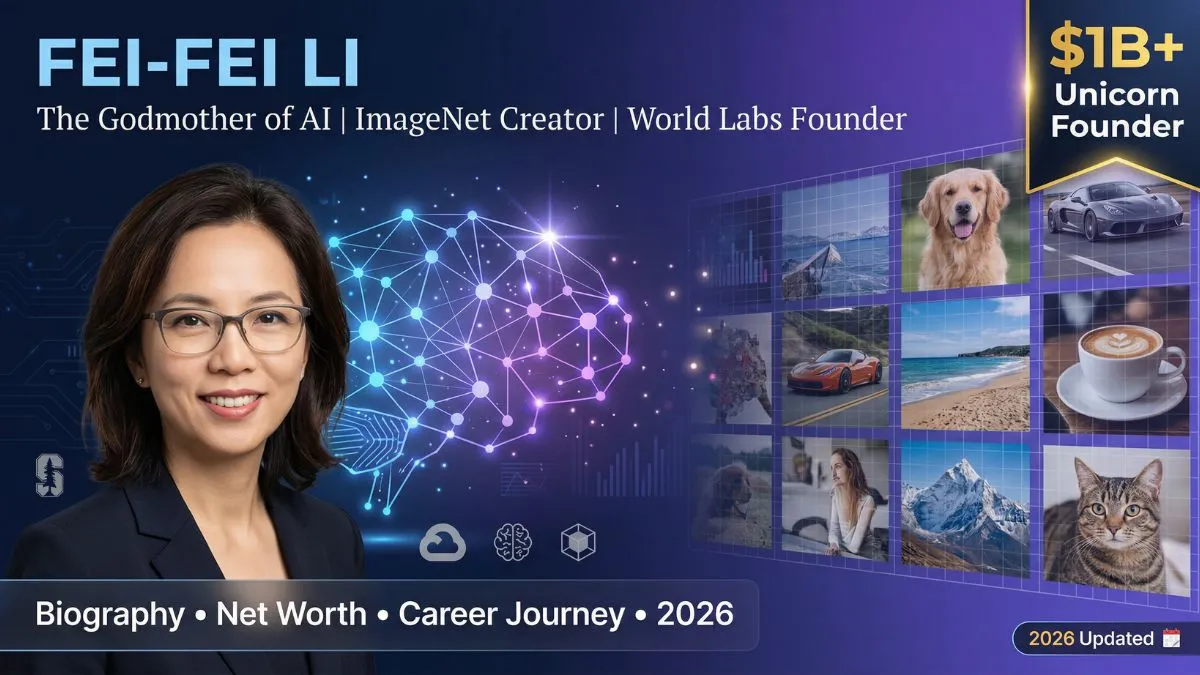
In 2024, Fei-Fei Li made headlines when her startup World Labs achieved a $1 billion valuation just months after launch, solidifying her status as one of AI’s most influential figures. But Li’s impact on artificial intelligence began decades earlier with ImageNet—the massive visual database that revolutionized computer vision and enabled the deep learning revolution.
Who is Fei-Fei Li?
She’s a Stanford professor, former Google Cloud AI Chief Scientist, and the visionary who proved that teaching machines to see could transform the entire AI landscape. From immigrating to America as a teenager to becoming TIME’s “Godmother of AI,” Li has shaped how machines understand the visual world.
Why is Fei-Fei Li famous in the AI ecosystem?
Li created ImageNet in 2009, a dataset containing millions of labeled images that became the training ground for breakthrough AI models. Her work catalyzed the deep learning boom and helped companies like Google, Facebook, and Amazon build powerful computer vision systems. Beyond research, she’s a leading voice on AI ethics and human-centered AI development.
In this comprehensive biography, you’ll discover Li’s journey from working in her parents’ dry-cleaning shop to founding a unicorn AI startup, her groundbreaking research that changed computer vision forever, her net worth and business ventures, her leadership philosophy, and her vision for making AI benefit all of humanity.
2. Early Life & Background
Fei-Fei Li was born on July 3, 1976, in Chengdu, Sichuan Province, China, during a transformative period in the country’s history. Her parents were factory workers with limited formal education but strong values around learning and perseverance. Growing up in post-Cultural Revolution China, Li showed early curiosity about science and mathematics, encouraged by teachers who recognized her exceptional analytical abilities.
At age 12, Li’s father moved to the United States seeking better opportunities, leaving the family behind for three years while he worked odd jobs. In 1993, when Fei-Fei was 16, she and her mother finally reunited with her father in Parsippany, New Jersey. The transition was jarring—Li spoke minimal English and struggled to adapt to American culture while her parents worked grueling hours at a dry-cleaning business they had opened.
Despite the cultural and language barriers, Li threw herself into her studies. She took ESL classes, devoured science books, and quickly caught up academically. On weekends and after school, she worked the cash register at her parents’ dry-cleaning shop, watching her parents’ work ethic and determination to provide educational opportunities for their children. This experience of immigrant struggle would profoundly shape her perspective on accessibility and the democratization of technology.
Li’s fascination with mathematics and physics intensified during high school. She was drawn to the elegance of scientific reasoning and the possibility of understanding the natural world through computational models. A physics teacher recognized her potential and encouraged her to apply to top universities. When she received admission to Princeton University with financial aid, it felt like a validation of her family’s sacrifices and her own hard work.
Her early exposure to both hardship and opportunity created a dual awareness: she understood the transformative power of education while recognizing how systemic barriers could prevent talented individuals from accessing it. This insight would later inform her commitment to AI ethics, diversity in tech, and ensuring AI benefits everyone, not just the privileged few.
3. Family Details
| Relation | Name | Profession |
|---|---|---|
| Father | Not publicly disclosed | Camera repairman, dry-cleaning business owner |
| Mother | Not publicly disclosed | Factory worker, dry-cleaning business owner |
| Siblings | One younger sister | Professional details not public |
| Spouse | Silvio Savarese | AI researcher, Professor (University of Illinois), Former VP at Salesforce AI |
| Children | Two (names not public) | Students |
Fei-Fei Li’s family has remained relatively private despite her public prominence. Her husband, Silvio Savarese, is also a distinguished AI researcher specializing in computer vision, and the two have collaborated professionally while maintaining separate career trajectories. They share a commitment to advancing AI research and have raised their children with an appreciation for both scientific inquiry and ethical responsibility.
4. Education Background
High School: Parsippany High School, New Jersey
- Accelerated ESL and honors courses
- Graduated with distinction despite starting with limited English proficiency
Undergraduate: Princeton University (1995–1999)
- Degree: BA in Physics with High Honors
- Worked multiple jobs to support herself financially
- Conducted undergraduate research in computational neuroscience
- Developed interest in how the brain processes visual information
Graduate Studies: California Institute of Technology (Caltech) (1999–2005)
- Degree: PhD in Electrical Engineering
- Advisor: Pietro Perona (renowned computer vision researcher)
- Dissertation Focus: Bayesian models for visual object recognition
- Published groundbreaking papers on computational models of vision
- Collaborated with cognitive scientists to understand human visual perception
Postdoctoral Research:
- Worked at multiple institutions exploring the intersection of neuroscience and AI
- Studied how children learn to recognize objects, which inspired her ImageNet approach
Li’s academic journey was marked by interdisciplinary thinking. She didn’t just study computer science in isolation—she integrated insights from neuroscience, cognitive science, physics, and psychology. This holistic approach would become her signature style, enabling her to ask fundamentally different questions than her peers in computer vision research.
Throughout her education, Li worked tirelessly to support herself financially, continuing to help her family while pursuing her studies. This experience of balancing academic excellence with economic necessity gave her a grounded perspective that would later influence her advocacy for accessible AI education and her commitment to mentoring students from underrepresented backgrounds.
5. Entrepreneurial Career Journey
A. Early Career & Academic Foundation (2005–2009)
After completing her PhD at Caltech in 2005, Fei-Fei Li took a faculty position at the University of Illinois at Urbana-Champaign, one of the top computer science programs in the world. She then moved to Princeton University before joining Stanford University in 2009 as an Assistant Professor of Computer Science.
During this period, Li was grappling with a fundamental problem in AI: computer vision systems were trained on tiny datasets with only a few hundred or thousand images. She realized that if AI was going to truly understand the visual world, it needed exposure to the breadth and complexity of visual experience that humans have. This insight led to her most transformative project.
The ImageNet Vision: In 2007, Li embarked on an audacious project—building a massive visual database that would mirror the way children learn to see. She recruited a team, including graduate student Jia Deng, to systematically organize millions of images according to WordNet’s hierarchical structure. Using Amazon Mechanical Turk, they crowdsourced the labeling of over 14 million images across 20,000+ categories.
The initial idea was met with skepticism. Many researchers thought the dataset was unnecessary or that the computational resources required to train models on such data didn’t exist yet. Li persisted, believing the data infrastructure had to come first.
B. Breakthrough Phase: ImageNet & The Deep Learning Revolution (2009–2012)
In 2009, Li and her team launched ImageNet and created the ImageNet Large Scale Visual Recognition Challenge (ILSVRC), an annual competition where researchers worldwide could test their algorithms against the dataset.
The 2012 Turning Point: In 2012, a team led by Geoffrey Hinton, Alex Krizhevsky, and Ilya Sutskever used a deep convolutional neural network called AlexNet to win the ImageNet challenge with unprecedented accuracy—crushing previous benchmarks by over 10 percentage points. This moment is widely considered the spark that ignited the modern deep learning revolution.
ImageNet became the standard benchmark for computer vision. Every major tech company—Google, Facebook, Microsoft, Amazon—used it to train their visual recognition systems. Li’s dataset enabled breakthroughs in facial recognition, autonomous vehicles, medical image analysis, and countless other applications.
Academic Leadership: Li became Director of the Stanford Artificial Intelligence Lab (SAIL) and the Stanford Vision and Learning Lab. She supervised dozens of PhD students who would go on to become leaders in AI research and industry. Her lab produced influential research on visual question answering, image captioning, video understanding, and AI safety.
C. Industry Impact & Google Cloud AI (2017–2018)
In January 2017, Li took a leave from Stanford to become Vice President and Chief Scientist of AI/ML at Google Cloud. During her tenure, she:
- Helped democratize AI tools for developers through Google Cloud AI services
- Advanced AutoML technology to make machine learning accessible to non-experts
- Advocated for responsible AI development and diversity in tech
- Launched initiatives to make AI education available globally
She returned to Stanford in 2018, resuming her faculty position and research leadership while also co-directing the Stanford Human-Centered AI Institute (HAI), which she co-founded to ensure AI technology benefits humanity.
D. World Labs: The Spatial Intelligence Vision (2024–Present)
In 2024, Li made her formal entry into the startup world by co-founding World Labs with three distinguished AI researchers: Christoph Lassner, Justin Johnson, and Ben Mildenhall. The company’s mission is to develop spatial intelligence—AI systems that can perceive, understand, and interact with the 3D physical world the way humans do.
The Core Idea: While large language models had conquered text and image generators had mastered 2D visuals, Li believed the next frontier was teaching AI to understand space, physics, depth, and 3D reasoning. World Labs aims to build foundational models that can reason about the physical world, enabling applications in robotics, augmented reality, autonomous systems, and beyond.
Explosive Launch: Within months of founding, World Labs raised over $230 million in funding from top-tier investors including Andreessen Horowitz, Radical Ventures, and prominent Silicon Valley angels. The company’s valuation quickly surpassed $1 billion, making it one of the fastest AI startups to achieve unicorn status.
Product Vision: World Labs is developing AI systems that can:
- Generate accurate 3D scenes from 2D images or text descriptions
- Understand spatial relationships and physical properties
- Enable robots to navigate and manipulate real-world environments
- Power immersive AR/VR experiences with realistic physics
Li’s transition from pure academic research to entrepreneurship reflects her belief that transformative AI capabilities need to move from research labs into real-world applications. World Labs represents the culmination of her decades-long work in computer vision, now applied to one of AI’s most challenging frontiers.
6. Career Timeline Chart
📅 CAREER TIMELINE

1993 ─── Immigrated to the United States
   │
1995 ─── Enrolled at Princeton University
   │
1999 ─── Started PhD at Caltech
   │
2005 ─── Joined faculty at University of Illinois
   │
2007 ─── Began ImageNet project
   │
2009 ─── Launched ImageNet Challenge; Joined Stanford
   │
2012 ─── AlexNet breakthrough using ImageNet
   │
2013 ─── Became Director of Stanford AI Lab
   │
2017 ─── Joined Google Cloud AI as VP & Chief Scientist
   │
2018 ─── Returned to Stanford; Co-founded Stanford HAI
   │
2024 ─── Founded World Labs (Unicorn status)
   │
2026 ─── Leading spatial intelligence revolution
7. Business & Company Statistics
| Metric | Value |
|---|---|
| AI Companies Founded | 1 (World Labs) |
| Current Valuation | $1+ billion (World Labs) |
| Annual Revenue | Not publicly disclosed (early stage) |
| Employees | 50–100+ (estimated, 2026) |
| Countries Operated | USA (headquarters in San Francisco Bay Area) |
| Active Users | Enterprise/research focus (not consumer-facing yet) |
| AI Models Deployed | Spatial intelligence models in development |
8. AI Founder Comparison Section
📊 Fei-Fei Li vs. Andrew Ng
| Statistic | Fei-Fei Li | Andrew Ng |
|---|---|---|
| Net Worth | ~$100–150M | ~$100–200M |
| AI Startups Built | 1 (World Labs) | Multiple (Coursera, DeepLearning.AI, Landing AI) |
| Unicorns | 1 | 1 (Coursera) |
| AI Innovation Impact | ImageNet, Computer Vision revolution | Online AI education, ML deployment |
| Global Influence | Research & ethics leadership | Education & democratization |
Winner: Both Li and Ng have profoundly shaped AI’s trajectory, but in complementary ways. Li’s ImageNet dataset provided the foundation for the deep learning boom in computer vision, while Ng democratized AI education and made machine learning accessible to millions through online courses. Li’s strength lies in foundational research and ethical AI advocacy, while Ng excels in scaling AI education and practical deployment. In terms of pure research impact on computer vision and the deep learning revolution, Li’s influence is unparalleled. For educational reach and practical ML implementation, Ng leads. Both are titans whose contributions are irreplaceable in AI’s evolution.
9. Leadership & Work Style Analysis
Fei-Fei Li’s leadership philosophy centers on human-centered AI—the conviction that artificial intelligence should amplify human potential rather than replace human agency. Her approach combines rigorous scientific thinking with deep ethical consideration and inclusive collaboration.
Data-Driven Vision with Long-Term Thinking: Li’s ImageNet project exemplifies her style—she identified a fundamental bottleneck (lack of training data), designed a systematic solution, and persisted despite skepticism. She thinks in decades, not quarters, willing to invest years in foundational work that others might dismiss as impractical.
Interdisciplinary Integration: Li consistently draws insights from neuroscience, cognitive science, psychology, and philosophy. She doesn’t view AI purely through an engineering lens but asks deeper questions about intelligence, perception, learning, and consciousness. This interdisciplinary approach has given her unique perspectives that others in purely technical roles might miss.
Emphasis on Diversity and Inclusion: Having experienced barriers as an immigrant woman in STEM, Li is a vocal advocate for diversity in AI. She has actively mentored women and underrepresented minorities, created programs to increase access to AI education, and consistently speaks about the need for diverse perspectives in building AI systems that serve everyone.
Ethical AI Leadership: Li co-founded Stanford HAI explicitly to ensure AI development considers societal impact. She advocates for transparency, fairness, accountability, and safety in AI systems. Her leadership extends beyond technical excellence to encompass moral responsibility—she regularly engages with policymakers, ethicists, and the public on AI governance.
Collaborative and Mentorship-Oriented: Former students and colleagues describe Li as a generous mentor who invests deeply in developing the next generation of AI researchers. She creates collaborative environments where interdisciplinary teams can thrive, and she’s known for asking provocative questions that push researchers to think more deeply.
Risk Tolerance in Emerging Tech: Li’s founding of World Labs at age 48, after an established academic career, demonstrates her willingness to take entrepreneurial risks when she believes the mission is important. She’s betting on spatial intelligence as the next major AI frontier—a bold vision that requires years of R&D before commercial payoff.
Notable Quotes:
- “If we want machines to think, we need to teach them to see.”
- “AI is not just a technology; it’s a humanity amplifier. It can amplify the best of us, but it can also amplify the worst.”
- “Diversity is not just good ethics; it’s good science.”
10. Achievements & Awards
AI & Tech Awards
- Elected to National Academy of Engineering (2023) – For contributions to computer vision and AI
- ACM Prize in Computing – For pioneering work in large-scale visual recognition
- IJCAI Award for Research Excellence – For ImageNet and deep learning contributions
- National Academy of Medicine Member – Recognizing AI’s impact on healthcare
- IEEE Fellow – For contributions to computer vision
Global Recognition
- TIME 100 Most Influential People (2024, potentially earlier years)
- Forbes AI 50 – Consistently ranked among top AI leaders
- Fortune’s Most Powerful Women in Tech
- Foreign Policy’s Leading Global Thinkers
- Carnegie Corporation’s Great Immigrants Award
Academic Honors
- MacArthur Fellowship consideration (though not publicly confirmed)
- Multiple best paper awards at top AI conferences (CVPR, ICCV, NeurIPS)
- Athena Award for Excellence in Education (Stanford)
Records & Milestones
- Created the largest publicly available image dataset (ImageNet) with 14M+ images
- Enabled the 2012 deep learning breakthrough that transformed AI
- One of the few academics to successfully transition to unicorn startup founder
- Co-founded Stanford HAI, one of the world’s leading AI ethics and policy institutes
11. Net Worth & Earnings
💰 FINANCIAL OVERVIEW
| Year | Net Worth (Est.) |
|---|---|
| 2015 | ~$5–10 million |
| 2020 | ~$20–40 million |
| 2024 | ~$80–120 million |
| 2026 | ~$100–150 million |
Income Sources
1. Founder Equity (World Labs)
- Substantial ownership stake in unicorn-valued company
- Equity worth estimated $50–100+ million depending on ownership percentage
2. Stanford Faculty Salary
- Tenured full professor salary: ~$250,000–400,000 annually
- Research grants and lab funding
3. Consulting & Advisory Roles
- Board positions and advisory roles with tech companies
- Speaking engagements and conference appearances
- Estimated $500,000–1 million annually
4. Previous Google Compensation
- VP-level compensation during 2017–2018 tenure
- Significant stock grants
5. Investments & Intellectual Property
- Angel investments in AI startups
- Patent licensing
- Book royalties (The Worlds I See memoir)
Major Investments
- AI Safety Startups – Supporting ethical AI development
- Education Technology – Companies democratizing STEM education
- Healthcare AI – Medical imaging and diagnostics startups
- World Labs – Primary equity position
Note: Li’s wealth is primarily tied to World Labs equity, which could increase dramatically with future funding rounds or an eventual IPO/acquisition.
12. Lifestyle Section
🏠 ASSETS & LIFESTYLE
Properties
Primary Residence: Palo Alto/Stanford area, California
- Estimated value: $3–5 million
- Modest by Silicon Valley standards, reflective of academic lifestyle
- Close proximity to Stanford campus
Other Properties: Not publicly disclosed; Li maintains a relatively private personal life
Cars Collection
Li is not known for ostentatious displays of wealth. She maintains a practical approach to transportation consistent with her academic background.
- Tesla Model S or Model X (estimated, given Bay Area tech culture)
- Focus on functionality and sustainability over luxury
Hobbies
Reading & Learning
- Voracious reader of scientific literature, philosophy, and humanities
- Interests span cognitive science, ethics, art history, and literature
Photography
- Inspired by her father’s camera repair work
- Appreciates visual arts and image composition
Travel
- Regular international travel for conferences and research collaborations
- Visits China frequently to maintain cultural connections
Fitness & Well-being
- Walks and hiking in Bay Area nature
- Mindfulness practices
- Work-life integration rather than strict balance
Daily Routine
Morning (6:00–9:00 AM)
- Early wake-up for focused thinking and writing
- Reads latest research papers and news
- Family breakfast when possible
Work Hours (9:00 AM–6:00 PM)
- Stanford teaching and lab supervision
- World Labs strategy and meetings
- Research and grant writing
- Student mentorship
Evening (6:00–10:00 PM)
- Family time with husband and children
- Dinner discussions about science, ethics, technology
- Continued reading and correspondence
- Sometimes returns to work on pressing projects
Deep Work Habits
- Blocks focused time for difficult problems
- Limits distractions during research thinking
- Collaborative work interspersed with solo reflection
Learning Routines
- Constant consumption of interdisciplinary knowledge
- Attends seminars outside her immediate field
- Engages with philosophers, ethicists, and policymakers
- Writes regularly to clarify thinking (essays, op-eds, book)
13. Physical Appearance
| Attribute | Details |
|---|---|
| Height | ~5’4″ (163 cm) |
| Weight | ~120 lbs (55 kg) |
| Eye Color | Dark Brown |
| Hair Color | Black |
| Body Type | Slender, athletic |
Li typically dresses professionally but not ostentatiously, favoring practical business casual attire appropriate for academic and tech settings. She often wears glasses and maintains a warm, approachable demeanor despite her formidable intellectual presence.
14. Mentors & Influences
AI Researchers
- Pietro Perona (PhD advisor at Caltech) – Taught her rigorous approach to computer vision research
- Geoffrey Hinton – Pioneer of deep learning whose work validated her ImageNet vision
- Terry Winograd – Stanford AI legend who influenced her thinking on human-centered AI
Startup Founders & Leaders
- Marc Andreessen – Investor and advisor for World Labs
- Reid Hoffman – Silicon Valley thought leader on scaling technology for humanity
Philosophers & Ethicists
- John Rawls – Political philosophy informing her views on AI fairness and justice
- Various colleagues in Stanford philosophy department shaping AI ethics thinking
Investors & Advisors
- Andreessen Horowitz team – Supporting World Labs growth
- Stanford leadership – Mentored by university presidents and provosts on institutional leadership
Leadership Lessons
Li learned from her parents the value of perseverance and sacrifice. From her academic mentors, she absorbed rigorous scientific thinking. From tech leaders, she learned how to scale impact beyond academia. From ethicists, she developed frameworks for responsible AI development. This combination makes her uniquely positioned to bridge research, entrepreneurship, and social responsibility.
15. Company Ownership & Roles
| Company | Role | Years |
|---|---|---|
| World Labs | Co-founder & CEO | 2024–Present |
| Stanford AI Lab (SAIL) | Director (former) | 2013–2017 |
| Stanford HAI | Co-Director | 2019–Present |
| Google Cloud AI | VP & Chief Scientist | 2017–2018 |
| Stanford Vision & Learning Lab | Faculty Director | 2009–Present |
| Various AI Startups | Advisor/Investor | Ongoing |
16. Controversies & Challenges
While Fei-Fei Li is widely respected, her career hasn’t been without controversy and criticism:
AI Ethics Debates
Facial Recognition Concerns: Li’s work on computer vision helped enable facial recognition technology, which has raised significant privacy and civil liberties concerns. Critics argue that ImageNet inadvertently enabled surveillance systems that disproportionately harm marginalized communities. Li has since become a vocal advocate for ethical AI development and has called for regulation of facial recognition.
Dual-Use Technology: The challenge of AI research being used for both beneficial and harmful purposes has been a recurring theme. Li acknowledges this tension and advocates for responsible development frameworks.
Google Cloud AI Controversy
During her time at Google Cloud, Li faced scrutiny when internal emails revealed concerns about the optics of Google’s work with the Department of Defense on Project Maven (drone imagery analysis). While Li wasn’t directly involved in Maven, the controversy highlighted tensions between AI researchers’ ethical concerns and corporate partnerships with military applications.
Data Privacy Issues
ImageNet faced criticism when researchers discovered that the dataset contained images of people’s faces scraped from the internet without explicit consent. In 2019, artists and activists highlighted privacy issues, leading ImageNet to blur faces in the dataset. Li and her team responded by addressing these concerns and updating the dataset to better protect privacy.
Representation in AI
Despite Li’s efforts to promote diversity, critics point out that the tech industry and AI research remain predominantly white and male. Some argue that efforts like Stanford HAI, while valuable, haven’t moved the needle enough on systemic representation issues.
Regulatory Challenges
As AI policy debates intensify, Li’s positions—advocating for thoughtful regulation while supporting innovation—sometimes satisfy neither critics who want stricter controls nor industry leaders who resist any constraints.
Lessons Learned
Li has publicly reflected on these challenges, emphasizing the importance of:
- Anticipating unintended consequences of research
- Building diverse teams from the start
- Creating accountability mechanisms in AI development
- Engaging with critics and affected communities
- Balancing innovation with precaution
Her willingness to acknowledge mistakes and evolve her thinking has generally strengthened her credibility as an ethical AI leader.
17. Charity & Philanthropy
AI Education Initiatives
Stanford HAI (Human-Centered AI Institute)
- Co-founded to advance AI research with human values at center
- Provides interdisciplinary education programs
- Funds research on AI safety, fairness, and societal impact
AI4ALL
- Co-founded in 2015 (originally SAILORS – Stanford AI Lab Outreach Summer program)
- National nonprofit increasing diversity and inclusion in AI
- Provides AI education to underrepresented high school students
- Has reached thousands of students across dozens of universities
K-12 AI Literacy
- Advocates for AI education in secondary schools
- Develops curriculum materials for teachers
- Promotes computational thinking for all students
Open-Source Contributions
- ImageNet remains freely available for research
- Publishes research openly for academic community
- Shares educational materials and tutorials
Climate & Social Impact
- Supports AI research for climate science and sustainability
- Healthcare AI initiatives for underserved populations
- Advocates for AI applications addressing UN Sustainable Development Goals
Foundations & Donations
- Personal donations to educational nonprofits (amounts not public)
- Scholarship funds for immigrant and first-generation college students
- Support for scientific research foundations
Li views her philanthropic work as integral to her mission of ensuring AI benefits humanity broadly, not just privileged groups.
18. Personal Interests
| Category | Favorites |
|---|---|
| Food | Chinese cuisine, Sichuan spicy dishes, family cooking |
| Movie | Science fiction exploring AI and consciousness; documentaries |
| Book | Interdisciplinary works bridging science and humanities; her memoir The Worlds I See |
| Travel Destination | China (cultural roots), European research institutions, national parks |
| Technology | Computer vision systems, spatial computing, AR/VR |
| Sport | Hiking, walking, recreational activities with family |
Li is known for her intellectual curiosity that extends far beyond AI—she engages deeply with literature, philosophy, art, and history, viewing these domains as essential to understanding human intelligence and creating AI that truly serves humanity.
19. Social Media Presence
| Platform | Handle | Followers |
|---|---|---|
| Twitter/X | @drfeifei | ~500,000+ (estimated 2026) |
| Fei-Fei Li | ~300,000+ connections | |
| Limited public presence | N/A | |
| YouTube | Various talks and interviews | Videos have millions of views collectively |
Li uses social media primarily for professional purposes—sharing research, commenting on AI policy, promoting education initiatives, and engaging with the AI community. She’s thoughtful and measured in her online presence, focusing on substance over self-promotion.
20. Recent News & Updates (2025–2026)
Latest Developments
World Labs Funding (2025)
- Secured additional $150+ million in Series A extension
- Valuation reportedly exceeding $1.5 billion
- Expanded team with top researchers from Google, Meta, NVIDIA
New AI Model Launches (2025–2026)
- World Labs released preview of spatial intelligence models
- Demonstrations of 3D scene generation from text descriptions
- Partnerships with robotics companies for real-world applications
Market Expansion
- World Labs collaborating with AR/VR companies (Meta, Apple rumored)
- Enterprise partnerships in architecture, gaming, simulation
- Autonomous vehicle applications under development
Media Interviews
- Featured in major tech publications discussing spatial AI
- TED Talk on the future of AI and physical world understanding
- Keynote speeches at top AI conferences worldwide
Policy Engagement
- Testified before Congress on AI regulation
- Advised international AI governance initiatives
- Published op-eds on responsible AI development
Future Roadmap
- World Labs aiming to democratize 3D AI capabilities
- Building foundation models for spatial reasoning
- Long-term vision: AI systems that understand physics and can interact intelligently with the physical world
21. Lesser-Known Facts
- Dry-Cleaning Business: Li worked in her parents’ dry-cleaning shop throughout high school and college, managing the cash register and helping customers while studying for exams.
- Princeton Sachs Scholarship: She received the prestigious Sachs Global Scholarship at Princeton, which supports exceptional international students with financial need.
- Tibetan Monks Study: Early in her career, Li conducted research in Tibetan monasteries studying how monks’ visual perception and cognition might differ due to their meditation practices.
- Published Memoir: In 2023, Li published The Worlds I See: Curiosity, Exploration, and Discovery at the Dawn of AI, a memoir exploring her journey and AI’s implications for humanity.
- Neuroscience Background: Her PhD work combined electrical engineering with neuroscience, studying how the human brain processes visual information—insights that directly informed ImageNet’s design.
- Mechanical Turk Crowdsourcing Pioneer: ImageNet was one of the first major academic projects to use Amazon Mechanical Turk at scale, pioneering crowdsourced data labeling that became standard in AI.
- Parent of Two: Despite her demanding career, Li has raised two children while building ImageNet, directing Stanford’s AI lab, and founding a company—she speaks openly about work-family integration challenges.
- Artist Collaboration: Li has collaborated with artists exploring AI and creativity, viewing art as essential to understanding and shaping AI’s role in society.
- Name Meaning: “Fei-Fei” (飞飞) means “flying” or “soaring” in Chinese—fitting for someone whose work helped AI vision take flight.
- Late English Learning: Li didn’t learn English until age 15, yet went on to become one of the most influential voices in global AI discourse.
- Google Controversy Sensitivity: During her Google tenure, Li was careful about corporate AI ethics, once writing in emails about avoiding “weaponized AI” discussions—showing her awareness of AI’s potential harms even in corporate settings.
- Stanford Tenure Achievement: Li achieved tenure at Stanford at a relatively young age, a rare accomplishment in computer science, especially for women and minorities.
- Photography Passion: Inspired by her father’s camera repair work, Li developed a deep appreciation for photography and visual composition, which influenced her approach to computer vision.
- Philosophy Reading: Li regularly engages with philosophical texts on consciousness, perception, and ethics—unusual for an AI researcher but crucial to her human-centered approach.
- Global AI Governance: Li serves on international committees advising on AI policy, bridging technical expertise with governance needs.
22. FAQ Section
Q1: Who is Fei-Fei Li?
A: Fei-Fei Li is a pioneering AI researcher, Stanford professor, and entrepreneur who created ImageNet, the dataset that catalyzed the deep learning revolution. She founded World Labs, a unicorn AI startup, and co-directs Stanford’s Human-Centered AI Institute, advocating for ethical AI development.
Q2: What is Fei-Fei Li’s net worth in 2026?
A: Fei-Fei Li’s estimated net worth in 2026 is approximately $100–150 million, primarily from her founder equity in World Labs (valued over $1 billion), academic career, consulting, and investments.
Q3: How did Fei-Fei Li start her AI career?
A: Li earned a PhD in Electrical Engineering from Caltech studying computer vision and neuroscience. She joined Stanford in 2009 and created ImageNet, a massive visual database that became the foundation for modern computer vision AI. In 2024, she founded World Labs to develop spatial intelligence AI.
Q4: Is Fei-Fei Li married?
A: Yes, Fei-Fei Li is married to Silvio Savarese, a fellow AI researcher and professor specializing in computer vision. They have two children together.
Q5: What AI companies does Fei-Fei Li own?
A: Li is co-founder and CEO of World Labs (founded 2024), a spatial intelligence AI startup valued over $1 billion. She also co-directs Stanford’s Human-Centered AI Institute and has advisory/investment roles in various AI startups.
Q6: What is ImageNet?
A: ImageNet is a massive visual database containing over 14 million labeled images across thousands of categories. Created by Li in 2009, it became the standard training dataset for computer vision AI and enabled the 2012 deep learning breakthrough that transformed modern AI.
Q7: What is World Labs building?
A: World Labs is developing spatial intelligence AI—systems that understand the 3D physical world, spatial relationships, and physics. These capabilities could revolutionize robotics, augmented reality, autonomous systems, and any application requiring AI to interact with real-world environments.
Q8: Why is Fei-Fei Li called the “Godmother of AI”?
A: Li earned this title for creating ImageNet, which provided the data foundation that enabled the deep learning revolution in computer vision. Her work fundamentally changed how AI systems learn to see and understand visual information.
Q9: Where did Fei-Fei Li work before World Labs?
A: Before founding World Labs, Li was a Stanford professor and directed the Stanford AI Lab. She also served as VP and Chief Scientist at Google Cloud AI (2017–2018) and co-founded Stanford’s Human-Centered AI Institute.
Q10: What is Fei-Fei Li’s background?
A: Li was born in China, immigrated to the U.S. at age 16, and worked in her parents’ dry-cleaning shop while excelling academically. She earned degrees from Princeton (BA Physics) and Caltech (PhD Electrical Engineering) before becoming a pioneering AI researcher.
23. Conclusion
Fei-Fei Li’s journey from a teenager working in a New Jersey dry-cleaning shop to the “Godmother of AI” exemplifies how vision, perseverance, and interdisciplinary thinking can reshape entire fields. Her creation of ImageNet didn’t just advance computer vision—it catalyzed the deep learning revolution that powers today’s AI systems in everything from smartphones to autonomous vehicles.
Career Summary: Li’s career spans three decades of groundbreaking contributions: pioneering academic research that transformed computer vision, leadership roles at Stanford and Google Cloud that shaped AI’s institutional development, advocacy for ethical AI that ensures technology serves humanity, and now entrepreneurial innovation with World Labs pushing AI into spatial intelligence.
Impact on the AI Industry: ImageNet remains one of the most cited datasets in AI history. Li’s work enabled billions of dollars in AI applications and influenced how entire generations of researchers approach machine learning. Her advocacy for human-centered AI has made ethics and inclusivity central conversations in technology development.
Leadership & Innovation Legacy: Li demonstrated that rigorous science, ethical responsibility, and practical impact aren’t competing values—they’re complementary. She showed that academic researchers can successfully transition to entrepreneurship without compromising intellectual integrity. Her mentorship has shaped hundreds of students who are now leaders in AI research and industry.
Future Vision: With World Labs, Li is betting that spatial intelligence represents AI’s next major frontier. Just as ImageNet taught machines to see in 2D, World Labs aims to teach them to understand the 3D physical world. If successful, this could unlock applications from home robots to immersive virtual experiences to autonomous systems that safely navigate complex real-world environments.
Li’s story reminds us that transformative technology emerges not just from coding prowess but from asking fundamental questions, persisting through skepticism, and never losing sight of human values. Her immigrant experience, interdisciplinary thinking, and ethical commitment make her a uniquely influential voice as humanity navigates AI’s promises and perils.
Want to learn more about AI pioneers shaping our future? Explore biographies of Sam Altman, Demis Hassabis, Ilya Sutskever, and other leaders transforming artificial intelligence. Share this article with anyone interested in computer vision, ethical AI, or the human stories behind technological breakthroughs. Comment below with your thoughts on spatial intelligence and the future of AI!