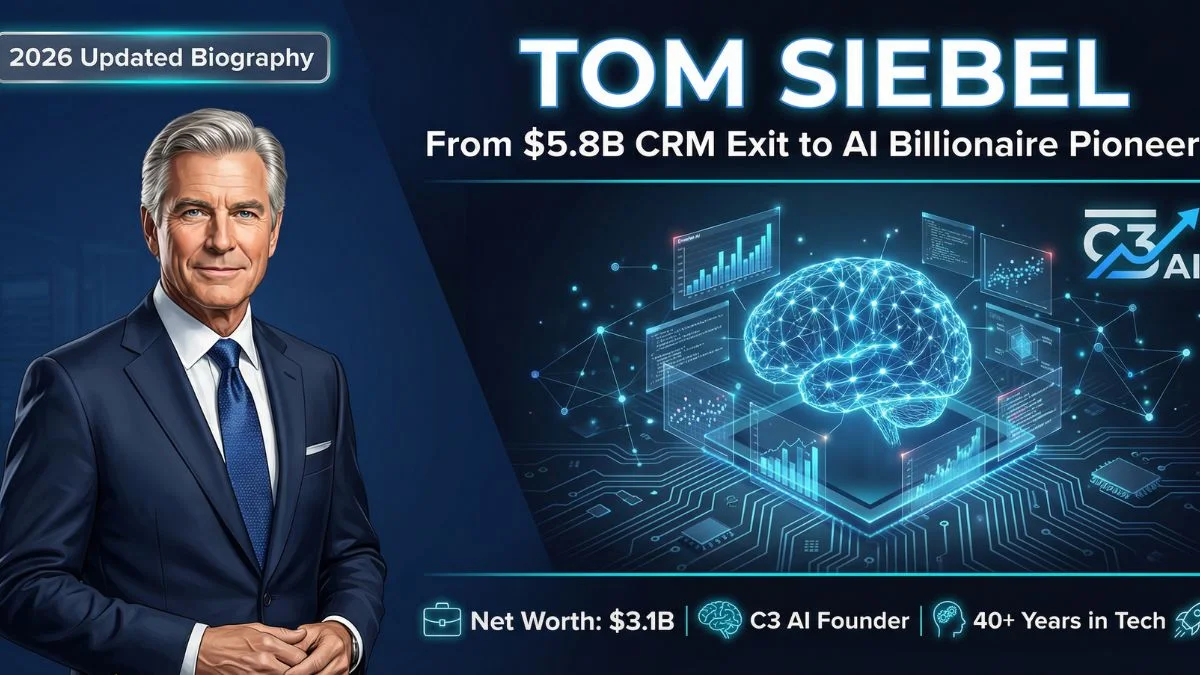
QUICK INFO BOX
| Attribute | Details |
|---|---|
| Full Name | Thomas M. Siebel |
| Nick Name | Tom Siebel |
| Profession | AI Startup Founder / CEO / Technology Entrepreneur / Investor |
| Date of Birth | November 20, 1952 |
| Age | 73 years (as of 2026) |
| Birthplace | Chicago, Illinois, USA |
| Hometown | Chicago, Illinois |
| Nationality | American |
| Religion | Christianity |
| Zodiac Sign | Scorpio |
| Ethnicity | Caucasian |
| Father | Arthur Francis Siebel |
| Mother | Ruth A. Siebel |
| Siblings | Information not publicly available |
| Wife / Partner | Stacey Siebel |
| Children | 2 children |
| School | St. Ignatius College Prep, Chicago |
| College / University | University of Illinois at Urbana-Champaign |
| Degree | BS in History, MBA, MS in Computer Science |
| AI Specialization | Enterprise AI / Predictive Analytics / IoT / Machine Learning |
| First AI Startup | Siebel Systems (CRM pioneer, foundation for AI) |
| Current Company | C3 AI |
| Position | Chairman & CEO |
| Industry | Artificial Intelligence / Enterprise SaaS / Deep Tech |
| Known For | C3 AI Platform / Enterprise AI Solutions / CRM Innovation |
| Years Active | 1984–Present (42+ years) |
| Net Worth | $3.1 billion (2026 est.) |
| Annual Income | $200+ million |
| Major Investments | C3 AI, First Virtual Group, Real Estate Portfolio |
| Not publicly active | |
| Twitter/X | @ThomasMSiebel |
| Tom Siebel LinkedIn |
1. Introduction
Tom Siebel stands as one of the most influential figures in enterprise technology and artificial intelligence. From revolutionizing customer relationship management (CRM) in the 1990s to pioneering enterprise AI applications in the 2020s, Tom Siebel has consistently been at the forefront of technological innovation. As the founder and CEO of C3 AI, Siebel has transformed how global enterprises leverage artificial intelligence for predictive analytics, energy management, fraud detection, and supply chain optimization.
With a career spanning over four decades, Tom Siebel built Siebel Systems into a multi-billion dollar CRM giant before Oracle’s $5.8 billion acquisition in 2006. Not content to retire, he founded C3 AI in 2009, foreseeing the massive potential of enterprise artificial intelligence years before it became mainstream. Today, C3 AI serves Fortune 500 companies across energy, financial services, manufacturing, defense, and healthcare sectors.
In this comprehensive biography, you’ll discover Tom Siebel’s journey from a sales executive at Oracle to becoming a billionaire AI entrepreneur, his leadership philosophy, net worth evolution, the companies he’s built, his philanthropic endeavors, and his vision for the future of artificial intelligence in enterprise applications.
2. Early Life & Background
Thomas M. Siebel was born on November 20, 1952, in Chicago, Illinois, into a middle-class American family. Growing up in Chicago during the 1950s and 1960s, Tom Siebel developed an early appreciation for hard work and discipline. His father, Arthur Francis Siebel, worked in the business sector, instilling in young Tom the importance of professional excellence and integrity.
Siebel attended St. Ignatius College Prep in Chicago, a rigorous Jesuit high school known for its academic excellence and emphasis on critical thinking. The disciplined educational environment shaped his analytical mindset and work ethic. Unlike many tech entrepreneurs who showed early coding prowess, Tom Siebel initially gravitated toward history and liberal arts, demonstrating that diverse educational backgrounds can lead to technological innovation.
During his formative years, Siebel witnessed the post-war American economic boom and the emergence of computer technology in business settings. This exposure to both traditional business practices and emerging technology would later inform his approach to enterprise software. He was particularly influenced by the systematic, methodical approach to problem-solving emphasized in his Jesuit education—a philosophy that would become central to his business methodology.
The challenges of growing up in a competitive urban environment taught Tom Siebel resilience and determination. He learned that success required not just intelligence but persistence, strategic thinking, and the ability to identify market opportunities before they became obvious to others. These early lessons would prove invaluable as he navigated the cutthroat world of enterprise software and, later, artificial intelligence.
3. Family Details
| Relation | Name | Profession |
|---|---|---|
| Father | Arthur Francis Siebel | Business Professional |
| Mother | Ruth A. Siebel | Homemaker |
| Siblings | Not publicly disclosed | N/A |
| Spouse | Stacey Siebel | Philanthropist |
| Children | 2 children | Private individuals |
Tom Siebel maintains a relatively private personal life, especially regarding his family. He is married to Stacey Siebel, and together they have two children. The Siebel family is known for their philanthropic activities, particularly in education and conservation. Unlike many tech billionaires who court media attention, Tom Siebel keeps his family life largely out of the public spotlight, focusing instead on his business ventures and charitable work.
4. Education Background
Tom Siebel’s educational journey demonstrates the value of interdisciplinary learning in technology entrepreneurship:
University of Illinois at Urbana-Champaign was where Siebel pursued his higher education, earning multiple degrees that would shape his career:
- Bachelor of Arts in History (1975) – His undergraduate focus on history provided him with analytical frameworks for understanding patterns, trends, and human behavior—skills that would prove invaluable in anticipating market shifts.
- Master of Business Administration (MBA) (1983) – The MBA equipped him with essential business acumen, financial understanding, and strategic planning capabilities necessary for building and scaling enterprises.
- Master of Science in Computer Science (1985) – Recognizing the growing importance of technology, Siebel pursued computer science, giving him the technical foundation to understand software architecture and database systems.
This unique combination of history, business, and computer science created a rare skill set that allowed Tom Siebel to bridge the gap between technology and business needs. Unlike pure technologists who sometimes struggle with commercial applications, or pure business people who don’t understand technical constraints, Siebel could communicate effectively with both engineers and executives.
During his time at the University of Illinois, Siebel was exposed to emerging database technologies and information systems. He participated in research projects and gained hands-on experience with early computing systems. His education coincided with the personal computer revolution of the late 1970s and early 1980s, giving him a front-row seat to the transformation of computing from mainframes to accessible business tools.
The rigorous academic environment at the University of Illinois—one of America’s premier engineering schools—taught Tom Siebel the importance of systematic problem-solving and data-driven decision-making, principles that would become hallmarks of his business philosophy.
5. Entrepreneurial Career Journey
A. Early Career & Foundation at Oracle
Tom Siebel’s entrepreneurial journey began not with founding a company, but with mastering the art of enterprise software sales at Oracle Corporation. Joining Oracle in 1984 as one of its earliest employees, Siebel quickly distinguished himself as an exceptional salesperson and strategist. Within a few years, he rose to become Oracle’s top salesperson and was promoted to Vice President, overseeing Oracle’s database product marketing and sales.
At Oracle, Tom Siebel learned directly from Larry Ellison, absorbing lessons about aggressive sales tactics, market positioning, and the enterprise software business model. However, Siebel also observed gaps in how companies managed customer relationships. While Oracle focused on database technology, Siebel recognized that businesses needed better tools to track, manage, and analyze customer interactions.
By 1990, tensions emerged between Siebel and Oracle’s leadership over strategic direction. Rather than remain constrained, Tom Siebel made the bold decision to leave Oracle and pursue his vision for customer relationship management software. This decision—walking away from a lucrative position at a rapidly growing company—demonstrated the risk tolerance and conviction that characterizes successful entrepreneurs.
B. Breakthrough Phase: Siebel Systems Revolution
In 1993, Tom Siebel founded Siebel Systems with Patricia House and four other co-founders. The company’s mission was revolutionary for its time: to create enterprise software that would help companies manage their relationships with customers systematically and strategically. This was the birth of modern Customer Relationship Management (CRM).
The timing was perfect. Businesses were drowning in customer data but lacked tools to organize, analyze, and act on that information. Siebel Systems offered a solution that integrated sales force automation, marketing automation, and customer service into a unified platform. The software helped companies track every customer interaction, predict buying behavior, and optimize sales processes.
Tom Siebel’s sales expertise proved invaluable. He understood how to sell complex enterprise software to Fortune 500 companies, focusing on demonstrating clear ROI and addressing specific business pain points. Siebel Systems didn’t just sell software; it sold business transformation.
The company’s growth was meteoric. By 1996, just three years after founding, Siebel Systems went public on NASDAQ (ticker: SEBL) with an initial valuation that stunned Wall Street. The IPO raised substantial capital, enabling aggressive expansion into new markets and industries. Revenue grew exponentially:
- 1996: $39 million
- 1998: $391 million
- 2000: $1.8 billion
- 2002: $2.1 billion
At its peak in 2000, Siebel Systems had a market capitalization exceeding $30 billion, making it one of the most valuable software companies in the world. Tom Siebel became a billionaire and was recognized as one of the most successful entrepreneurs of the dot-com era. Importantly, unlike many dot-com companies, Siebel Systems was profitable, with strong fundamentals and genuine customer value.
The company dominated the CRM market with over 4,500 corporate customers, including 90% of the Forbes Global 100. Clients included IBM, Cisco, AT&T, and numerous government agencies. Siebel Systems employed over 8,000 people worldwide and maintained offices across North America, Europe, and Asia.
However, the early 2000s brought challenges. The dot-com crash reduced technology spending, and competition intensified with the emergence of Salesforce.com’s cloud-based CRM model. Tom Siebel initially resisted the cloud transition, believing enterprise customers preferred on-premise software for security and control reasons. This strategic miscalculation allowed Salesforce to capture market share.
By 2005, facing increased competition and market pressure, Tom Siebel negotiated the sale of Siebel Systems to Oracle Corporation for $5.8 billion—a fitting full-circle moment given his roots at the company. The acquisition made Oracle a dominant force in CRM and application software.
C. Expansion & Global Impact: The C3 AI Revolution
Most entrepreneurs would have retired after selling a company for nearly $6 billion. Tom Siebel had other plans. Between 2006 and 2009, he studied emerging technologies, particularly the convergence of big data, cloud computing, machine learning, and the Internet of Things (IoT). He recognized that these technologies, combined with artificial intelligence, would create opportunities far larger than CRM.
In 2009, Tom Siebel founded C3 (originally C3 Energy, later renamed C3 AI) with the vision of creating enterprise-scale AI applications. The timing seemed questionable—the global economy was in recession, and “AI” was still largely academic. But Siebel saw what others missed: enterprises would soon be drowning in IoT sensor data, operational data, and customer data that traditional analytics couldn’t process effectively.
C3 AI’s approach was fundamentally different from Siebel Systems. Rather than building industry-specific applications, Tom Siebel created a comprehensive platform—the C3 AI Suite—that enables rapid development, deployment, and operation of enterprise AI applications. This platform approach allowed C3 AI to serve multiple industries with common underlying infrastructure while customizing applications for specific use cases.
The platform integrated:
- Big data processing capabilities
- Machine learning and AI model development tools
- IoT data aggregation and analysis
- Predictive analytics engines
- Cloud-native architecture for scalability
Early applications focused on energy sector use cases, including predictive maintenance for power generation equipment, energy demand forecasting, and smart grid optimization. Utility companies like Enel, the Italian multinational energy company, became early adopters, using C3 AI’s solutions to predict equipment failures before they occurred, saving millions in downtime and repair costs.
Success in energy led to expansion into other sectors:
Financial Services: Fraud detection systems analyzing billions of transactions in real-time, anti-money laundering applications, and customer churn prediction.
Manufacturing: Predictive maintenance for industrial equipment, supply chain optimization, and production process improvement.
Defense & Intelligence: Applications for threat detection, intelligence analysis, and mission planning.
Healthcare: Patient risk stratification, hospital inventory optimization, and operational efficiency improvement.
Oil & Gas: Production optimization, well performance prediction, and environmental monitoring.
By 2020, C3 AI had established itself as a leader in enterprise AI. Tom Siebel took the company public on December 9, 2020 (NYSE: AI), in one of the most successful tech IPOs of that year. The stock opened at $100 per share and surged to over $160 on the first day, giving C3 AI a market valuation exceeding $10 billion.
The IPO vindicated Tom Siebel’s vision that enterprise AI would become a massive market. C3 AI’s customer list included some of the world’s largest organizations: the U.S. Air Force, Shell, 3M, Raytheon, Con Edison, and numerous others across 15 industries.
Unlike his first venture, Tom Siebel embraced cloud-native architecture from the start with C3 AI. The platform runs on major cloud providers (AWS, Microsoft Azure, Google Cloud), giving customers flexibility while C3 AI focuses on application logic and AI capabilities.
As of 2026, C3 AI continues to expand its market presence despite competition from tech giants like Microsoft, Google, and Amazon. The company has formed strategic partnerships with industry leaders and maintains a strong focus on measurable business outcomes—a lesson Tom Siebel learned from his CRM days. C3 AI doesn’t just sell AI technology; it sells solutions to specific business problems with quantifiable ROI.
Tom Siebel’s leadership style at C3 AI reflects lessons from both successes and failures. He maintains a founder-led culture emphasizing customer success, technical excellence, and rigorous data-driven decision-making. The company invests heavily in R&D, with over 40% of employees in engineering and data science roles.
6. Career Timeline Chart
📅 CAREER TIMELINE

1975 ─── Graduated with BA in History from University of Illinois
   │
1983 ─── Earned MBA from University of Illinois
   │
1984 ─── Joined Oracle Corporation
   │
1985 ─── Earned MS in Computer Science
   │
1990 ─── Became Oracle's top salesperson & VP
   │
1993 ─── Founded Siebel Systems (CRM revolution)
   │
1996 ─── Took Siebel Systems public (NASDAQ: SEBL)
   │
2000 ─── Siebel Systems reaches $30B market cap peak
   │
2006 ─── Oracle acquires Siebel Systems for $5.8B
   │
2009 ─── Founded C3 (now C3 AI) - Enterprise AI platform
   │
2020 ─── C3 AI IPO (NYSE: AI) - $10B+ valuation
   │
2026 ─── Leading C3 AI as Chairman & CEO, pioneering enterprise AI applications
7. Business & Company Statistics
| Metric | Value |
|---|---|
| AI Companies Founded | 2 (Siebel Systems with AI elements, C3 AI) |
| Current Valuation | C3 AI: ~$2.5-3 billion (2026) |
| Annual Revenue | C3 AI: ~$300-350 million (FY 2025-26) |
| Employees | C3 AI: 1,000+ employees |
| Countries Operated | 15+ countries globally |
| Active Enterprise Customers | 250+ organizations |
| AI Applications Deployed | 40+ industry-specific applications |
| Total Capital Raised | Over $500 million across funding rounds |
| Stock Performance | NYSE: AI (public since Dec 2020) |
| Patents Held | 100+ AI and software patents |
8. AI Founder Comparison Section
📊 Tom Siebel vs Sam Altman
| Statistic | Tom Siebel | Sam Altman |
|---|---|---|
| Net Worth | $3.1 billion | $2 billion |
| AI Companies Built | C3 AI (Enterprise AI) | OpenAI (Generative AI) |
| Market Approach | B2B Enterprise Solutions | Consumer & Developer Tools |
| AI Innovation Focus | Predictive Analytics, IoT | Large Language Models, AGI |
| Years in AI | 17 years (since 2009) | 9 years (since 2015 as CEO) |
| Global Influence | Fortune 500 enterprises | Global consumer adoption |
Winner Analysis: While Sam Altman has captured public imagination with ChatGPT and generative AI, Tom Siebel has built a sustainable, profitable enterprise AI business serving critical infrastructure and Fortune 500 companies. Siebel’s approach focuses on measurable business outcomes and ROI, while Altman pursues artificial general intelligence (AGI) with broader societal implications. Both represent different but equally important facets of AI development—enterprise applications versus frontier research. Siebel’s net worth advantage stems from his earlier success with Siebel Systems and diversified investments, while Altman’s influence stems from OpenAI’s cultural impact and rapid consumer adoption.
9. Leadership & Work Style Analysis
Tom Siebel’s leadership philosophy combines data-driven decision-making with a strong emphasis on execution excellence and customer outcomes. His work style has been shaped by decades of experience in both sales and technology, creating a unique approach to building and scaling enterprise companies.
AI-First Leadership Philosophy: Siebel practices what he preaches. At C3 AI, internal operations extensively use the company’s own AI platform for forecasting, resource allocation, and strategic planning. He believes leaders must understand AI capabilities and limitations firsthand, not just conceptually. This “dogfooding” approach ensures C3 AI’s products meet real-world enterprise needs.
Decision-Making with Data: Throughout his career, Tom Siebel has emphasized rigorous data analysis over intuition or trends. Every major strategic decision at C3 AI is backed by quantitative analysis, market research, and customer feedback. This analytical approach extends to product development, where feature prioritization is determined by customer data and measurable business impact rather than engineering preferences.
Risk Tolerance in Emerging Tech: Siebel’s career demonstrates calculated risk-taking. Leaving Oracle to start Siebel Systems, transitioning from on-premise to cloud architecture, and founding C3 AI during a recession all required accepting significant risk. However, these weren’t reckless gambles—each decision was based on thorough market analysis and identification of genuine customer needs. Tom Siebel takes risks where he sees clear market opportunities that others have missed or underestimated.
Innovation & Experimentation Mindset: C3 AI maintains a culture of continuous innovation, investing heavily in R&D. Siebel encourages experimentation but within structured frameworks. Unlike some tech companies that pursue innovation for its own sake, C3 AI focuses on innovations that deliver tangible business value. This pragmatic approach to innovation reflects Siebel’s enterprise software background.
Strengths:
- Deep understanding of enterprise sales cycles and customer decision-making
- Ability to identify large market opportunities years before they mature
- Strong technical foundation combined with business acumen
- Disciplined execution and operational excellence
- Long-term strategic vision with patience to build platform businesses
- Exceptional ability to articulate complex technology value propositions
Blind Spots:
- Initial resistance to cloud computing transition with Siebel Systems
- Sometimes underestimates the pace of market disruption from new entrants
- Preference for enterprise sales can lead to slower customer acquisition compared to bottom-up adoption models
- Traditional enterprise focus may miss consumer-driven AI opportunities
Notable Quotes from Interviews:
“The question is not whether AI will transform your business. The question is whether your business will exist if you don’t transform it with AI.”
“Software is about solving business problems. If you’re not solving a business problem, you’re just writing code.”
“The companies that will succeed with AI are those that can integrate it into core business processes, not those that just experiment with it in labs.”
Tom Siebel’s leadership is characterized by intellectual rigor, strategic patience, and an unwavering focus on customer success. His experience building two major software companies has taught him that sustainable success comes from solving real problems exceptionally well, not from chasing hype cycles.
10. Achievements & Awards
AI & Tech Awards
- Morgan Stanley Lagrange Prize in Computational Finance (Multiple years) – For contributions to quantitative finance through AI applications
- Edison Achievement Award (2000) – Recognizing innovation in customer relationship management technology
- Ernst & Young Entrepreneur of the Year (1999) – Northern California technology sector
- Golden Plate Award – Academy of Achievement for business leadership
- Honorary Doctorate – University of Illinois at Urbana-Champaign for contributions to technology and philanthropy
Global Recognition
- Forbes AI 50 List – C3 AI consistently ranked among America’s most promising AI companies
- Fortune’s Businessperson of the Year nominee (multiple years)
- Bloomberg 50 – Most influential people in business and finance
- Institutional Investor’s Tech 50 – Recognizing technology leaders transforming finance
- Computerworld’s Premier 100 Technology Leaders (Multiple years)
Industry Records
- Fastest enterprise software company to reach $1 billion in revenue (Siebel Systems, 1999) – Achieved in just 6 years from founding
- Highest market cap for CRM company (2000) – Siebel Systems reached $30 billion valuation, a record for CRM companies at that time
- Largest enterprise AI platform deployment – C3 AI applications processing data from millions of IoT sensors globally
- Most valuable AI IPO of 2020 – C3 AI’s December 2020 IPO achieved over $10 billion valuation
Academic & Industry Contributions
- Published numerous papers on enterprise AI architecture and applications
- Regular keynote speaker at major technology conferences including Gartner, AWS re:Invent, and Oracle OpenWorld
- Guest lecturer at Stanford, MIT, and University of Illinois on enterprise software and AI
- Contributing author to Harvard Business Review and MIT Sloan Management Review
11. Net Worth & Earnings
💰 FINANCIAL OVERVIEW
| Year | Net Worth (Est.) |
|---|---|
| 2000 | $2.1 billion (Siebel Systems peak) |
| 2006 | $1.8 billion (post-Oracle acquisition) |
| 2015 | $2.0 billion (C3 AI pre-IPO growth) |
| 2020 | $3.5 billion (C3 AI IPO) |
| 2023 | $2.8 billion |
| 2024 | $3.0 billion |
| 2025 | $3.1 billion |
| 2026 | $3.1 billion (current) |
Tom Siebel’s net worth has experienced significant fluctuations corresponding to the valuations of his companies and broader market conditions. His peak wealth occurred immediately following C3 AI’s successful IPO in December 2020, when the stock soared and his stake was valued at over $3.5 billion. Market corrections in tech stocks, particularly AI-focused companies, have since moderated his net worth to approximately $3.1 billion as of 2026.
Income Sources
Founder Equity: The majority of Siebel’s wealth comes from his ownership stake in C3 AI. He owns approximately 35-40% of the company, making his net worth highly correlated with C3 AI’s stock performance. Unlike many tech CEOs who sell large portions of their holdings post-IPO, Tom Siebel has maintained a substantial ownership position, demonstrating confidence in the company’s long-term prospects.
Salary & Compensation: As CEO of C3 AI, Siebel’s base salary is relatively modest by tech CEO standards (approximately $1-2 million annually), but his total compensation package includes performance-based stock options and bonuses that can significantly increase total earnings.
Investment Returns: Proceeds from the $5.8 billion Siebel Systems sale to Oracle provided substantial capital for diversified investments across technology, real estate, and other sectors.
Board Positions & Advisory Roles: Siebel serves on several corporate and academic boards, though these generate relatively minor income compared to his equity holdings.
Real Estate Appreciation: His extensive real estate portfolio in California, Montana, and other locations has appreciated significantly over decades.
Major Investments
C3 AI (NYSE: AI) – Primary holding and ongoing investment focus. Siebel continues to fund R&D and expansion through his equity stake and leadership.
First Virtual Group – Private investment vehicle through which Siebel makes strategic investments in early-stage technology companies focused on AI, cloud computing, and enterprise software.
Real Estate Portfolio – Extensive holdings including:
- Dearborn Ranch in Montana (over 80,000 acres)
- Properties in Woodside, California
- Commercial real estate investments
Technology Startups – Angel investments in approximately 15-20 enterprise software and AI companies, though these represent a smaller portion of his portfolio compared to C3 AI.
Philanthropic Endowments – Significant investments in educational and conservation initiatives through the Thomas and Stacey Siebel Foundation.
Tom Siebel has demonstrated disciplined financial management throughout his career. Rather than pursuing flashy lifestyle expenditures, he has focused on reinvesting in technology ventures and philanthropic causes. His wealth concentration in C3 AI reflects his confidence in enterprise AI’s long-term potential, though it also exposes him to market volatility in tech valuations.
12. Lifestyle Section
🏠 ASSETS & LIFESTYLE
Properties
Dearborn Ranch, Montana (Estimated Value: $50+ million) Tom Siebel’s primary residence is the spectacular Dearborn Ranch in Montana, spanning over 80,000 acres. This working cattle ranch features multiple residences, guest houses, and extensive conservation land. The property reflects Siebel’s deep commitment to land conservation and sustainable ranching practices. The ranch isn’t just a residence—it’s part of Siebel’s broader environmental conservation efforts, maintaining natural habitat and wildlife corridors.
Woodside, California Estate (Estimated Value: $30+ million) A significant property in Woodside, an affluent Silicon Valley community, serves as Siebel’s base when conducting business in the Bay Area. The estate features modern amenities while maintaining privacy and showcasing Siebel’s appreciation for architecture and design.
Other Properties Siebel owns additional properties in California and potentially other locations, though he maintains privacy about specific holdings. Unlike some tech billionaires who acquire numerous trophy properties, Tom Siebel has focused on a smaller number of meaningful properties that align with his lifestyle and values.
Cars Collection
Tom Siebel maintains a relatively understated vehicle collection compared to many tech billionaires. He’s known to appreciate quality and performance but doesn’t publicly showcase exotic car collections:
Tesla Model S (Price: ~$100,000) – Practical daily driver demonstrating support for electric vehicle technology
Range Rover (Price: ~$150,000) – Suitable for Montana ranch operations and rugged terrain
Unlike Elon Musk or other tech leaders who showcase vehicle collections, Siebel keeps automotive preferences private and practical.
Hobbies & Personal Interests
Land Conservation & Ranching: Tom Siebel’s passion for conservation extends beyond property ownership. He actively participates in sustainable ranching practices and wildlife conservation efforts in Montana. This isn’t simply a hobby—it represents a significant commitment to environmental stewardship.
Reading & Continuous Learning: Siebel is an voracious reader, particularly interested in history, technology trends, economics, and leadership. His library reportedly contains thousands of volumes spanning diverse subjects. This intellectual curiosity stems from his undergraduate history education and continues to inform his business strategy.
Aviation: Like many executives managing businesses across multiple locations, Siebel utilizes private aviation for efficient travel between Montana, California, and C3 AI’s global offices.
Outdoor Activities: The Montana ranch provides opportunities for hiking, fishing, and wildlife observation—activities Siebel reportedly enjoys as counterbalance to the demands of leading a technology company.
Art & Architecture: Siebel has demonstrated appreciation for architecture and design through his property developments and has collected artwork, though he maintains privacy about specific collections.
Daily Routine
Tom Siebel’s daily routine reflects the discipline and structure characteristic of his leadership style:
Work Hours: Despite his wealth and senior position, Siebel maintains demanding work hours, typically starting early morning (6-7 AM) and often working into evenings, particularly when coordinating with C3 AI’s global operations.
Deep Work Habits: Siebel allocates significant blocks of time for strategic thinking and analysis, avoiding the constant interruptions common in modern executive life. He’s known for thoughtful, data-driven decision-making that requires concentrated focus.
Learning Routines: Daily reading and staying current with AI research, business trends, and global developments is non-negotiable. Siebel believes continuous learning is essential for effective leadership in rapidly evolving technology sectors.
Physical Fitness: While not publicly detailed, maintaining health and fitness is part of Siebel’s routine, particularly given the physical activities associated with ranch management.
Team Engagement: Regular interaction with C3 AI’s engineering, sales, and leadership teams. Despite being CEO of a public company, Siebel remains actively involved in major customer relationships and product strategy.
Travel: Frequent travel between Montana, Silicon Valley, and C3 AI customer and office locations globally. This requires careful time management and efficient use of travel time for work and reading.
Tom Siebel’s lifestyle reflects the values of someone who has achieved significant wealth but remains deeply engaged in building businesses and contributing to causes he values. His choices emphasize substance over show—conservation over consumption, learning over luxury, and impact over image.
13. Physical Appearance
| Attribute | Details |
|---|---|
| Height | Approximately 6’0″ (183 cm) |
| Weight | ~180 lbs (82 kg) |
| Eye Color | Blue |
| Hair Color | Gray (formerly dark brown) |
| Body Type | Athletic/Fit for his age |
| Distinctive Features | Professional business appearance, typically seen in formal business attire |
| Style | Conservative, traditional business dress; suits and formal wear for professional settings |
Tom Siebel maintains a professional appearance appropriate for his role as CEO of a public enterprise software company. At 73 years old, he presents the image of an experienced technology executive who has successfully navigated multiple decades of industry transformation. Unlike some tech entrepreneurs who favor casual attire, Siebel typically appears in traditional business formal wear, reflecting his enterprise software background and the corporate customer base C3 AI serves.
14. Mentors & Influences
Tom Siebel’s career has been shaped by various mentors, thought leaders, and experiences:
Direct Mentors
Larry Ellison (Oracle Founder): While their professional relationship ended contentiously when Siebel left Oracle, Tom Siebel learned invaluable lessons about enterprise software sales, aggressive market positioning, and building scalable technology companies from Ellison. The Oracle experience provided the foundation for Siebel Systems and influenced his understanding of database technology that would later inform C3 AI’s data architecture.
University of Illinois Professors: Faculty members in both computer science and business programs who shaped Siebel’s interdisciplinary approach to technology and commerce. The rigorous academic environment taught analytical thinking and systematic problem-solving.
Intellectual Influences
Peter Drucker: The management theorist’s writings on customer-centric business strategy and organizational effectiveness significantly influenced Tom Siebel’s approach to CRM and enterprise software. Drucker’s emphasis on understanding customer needs and measuring business outcomes is evident in Siebel’s product philosophy.
W. Edwards Deming: The quality management pioneer’s teachings on continuous improvement, statistical process control, and systematic thinking influenced Siebel’s approach to product development and customer success.
Clayton Christensen: The Harvard Business School professor’s work on disruptive innovation and business model evolution informed Siebel’s strategic thinking, particularly regarding market transitions and competitive positioning.
Leadership Lessons Absorbed
Customer First Strategy: From his sales experience, Tom Siebel learned that understanding and solving customer problems is the only sustainable path to business success. This philosophy drives C3 AI’s focus on measurable business outcomes.
Platform Thinking: Experience building Siebel Systems taught that platform approaches create more durable competitive advantages than point solutions. C3 AI’s architecture reflects this lesson.
Importance of Timing: Success requires not just good ideas but correct timing. Siebel’s ability to identify when markets are ready for transformation—whether CRM in the 1990s or enterprise AI in the 2010s—has been crucial to his success.
Resilience Through Setbacks: The challenges faced during Siebel Systems’ decline and eventual sale taught valuable lessons about market evolution, competition, and the need to embrace disruption rather than resist it.
Tom Siebel has stated that his greatest insights came not from any single mentor but from direct experience building and scaling companies through various market cycles. This practical education, combined with theoretical knowledge from academic and thought leaders, created his distinctive approach to technology entrepreneurship.
15. Company Ownership & Roles
| Company | Role | Years | Current Status |
|---|---|---|---|
| C3 AI | Founder, Chairman & CEO | 2009–Present (17 years) | Active – Public (NYSE: AI) |
| Siebel Systems | Founder & CEO | 1993–2006 (13 years) | Sold to Oracle for $5.8B |
| First Virtual Group | Founder & Managing Partner | 2006–Present | Active – Private Investment Firm |
| Oracle Corporation | VP, Marketing & Sales | 1984–1990 (6 years) | Left to found Siebel Systems |
| Various Advisory Boards | Board Member / Advisor | Various periods | Multiple technology and academic boards |
Company Details & Links
C3 AI, Inc.
- Website: https://c3.ai
- Stock: NYSE: AI
- Role: Founder, Chairman & CEO
- Description: Enterprise AI application software platform serving Fortune 500 companies across multiple industries
First Virtual Group
- Role: Founder & Managing Partner
- Description: Private investment and advisory firm focused on enterprise technology ventures
- Activities: Angel investments, strategic consulting for technology companies
Siebel Systems (Historical)
- Role: Founder & CEO (1993-2006)
- Final Status: Acquired by Oracle Corporation in 2006 for $5.8 billion
- Legacy: Pioneered modern CRM industry, served over 4,500 enterprise customers globally
Oracle Corporation (Historical)
- Role: Early employee, rose to Vice President
- Period: 1984-1990
- Contribution: Helped establish Oracle’s position in enterprise database market
Board Positions & Affiliations
Tom Siebel has served on numerous corporate and academic boards throughout his career, including:
- University of Illinois Board of Trustees
- Various technology company advisory boards
- Conservation and environmental organization boards
- Educational foundation boards
16. Controversies & Challenges
Despite a largely successful career, Tom Siebel has faced several controversies and significant challenges:
Business Challenges
Siebel Systems’ Cloud Resistance: Perhaps the most significant strategic misstep in Tom Siebel’s career was his initial resistance to cloud computing transition. While Salesforce.com aggressively pursued a cloud-first strategy in the early 2000s, Siebel maintained that enterprise customers preferred on-premise software for security and control reasons. This miscalculation allowed Salesforce to capture significant market share and contributed to Siebel Systems’ declining market position, eventually leading to the Oracle acquisition. Siebel has since acknowledged this mistake and ensured C3 AI was cloud-native from inception.
Oracle Acquisition Criticism: Some shareholders and employees criticized the timing and valuation of Siebel Systems’ sale to Oracle, arguing that the company was sold during a temporary market downturn and could have recovered independently. Tom Siebel defended the decision as strategically sound given competitive pressures and market conditions.
C3 AI Stock Volatility: Following C3 AI’s 2020 IPO, the stock experienced significant volatility, declining from its post-IPO highs. Critics questioned the company’s valuation, revenue growth rate, and ability to compete with tech giants entering the enterprise AI market. Siebel has responded by emphasizing long-term strategy and focusing on profitable growth rather than growth at any cost.
Personal Incident
Elephant Attack in Tanzania (2000): One of the most dramatic incidents in Tom Siebel’s life occurred during a 2000 safari in Tanzania when he was attacked by an elephant. The attack resulted in severe injuries requiring multiple surgeries and extensive recovery. Rather than filing lawsuits or seeking publicity, Siebel handled the incident privately and focused on recovery. The experience reportedly deepened his appreciation for wildlife conservation and influenced his philanthropic priorities.
Corporate Governance Questions
Executive Compensation: As with many tech CEOs, Tom Siebel’s compensation package has occasionally faced shareholder scrutiny, particularly regarding stock option grants and performance bonuses. However, these controversies have been relatively minor compared to other tech executives.
Related Party Transactions: C3 AI’s partnerships with other companies where Siebel has investments or relationships have occasionally raised questions about potential conflicts of interest, though no significant regulatory issues have emerged.
Lessons Learned
Tom Siebel has been remarkably transparent about learning from mistakes:
“The biggest lesson from Siebel Systems was that no market position is permanent. Technology markets evolve rapidly, and companies must evolve even faster. At C3 AI, we’ve embraced cloud computing, platform architecture, and continuous innovation specifically because of what we learned from past challenges.”
His willingness to acknowledge the cloud computing miscalculation and pivot completely with C3 AI demonstrates intellectual honesty and adaptability. Rather than becoming defensive about past decisions, Tom Siebel has used setbacks as learning opportunities.
The elephant attack, while traumatic, reinforced his commitment to conservation work and appreciation for nature’s power and unpredictability. It also demonstrated resilience—Siebel recovered from serious injuries and continued building businesses and pursuing ambitious goals.
Overall, Tom Siebel’s career has been relatively free of serious scandals or ethical controversies. The challenges he’s faced have primarily been strategic business decisions and market competition rather than personal conduct issues.
17. Charity & Philanthropy
Tom Siebel has dedicated significant resources and attention to philanthropic causes, particularly in education and conservation. His charitable work reflects his values and long-term thinking about societal impact.
Thomas and Stacey Siebel Foundation
The primary vehicle for Tom Siebel’s philanthropy is the Thomas and Stacey Siebel Foundation, established to support educational initiatives, particularly in science, technology, engineering, and mathematics (STEM).
Siebel Scholars Foundation (Established 2000)
- Provides prestigious merit-based scholarships to graduate students at top universities worldwide
- Recognizes exceptional students studying business, computer science, bioengineering, and energy science
- Partner institutions include: MIT, Stanford, Harvard, Princeton, UC Berkeley, Carnegie Mellon, University of Illinois, and others globally
- Over 1,700 Siebel Scholars have graduated from the program
- Scholars receive $35,000 awards and join an elite network of innovators and leaders
- Many Siebel Scholars have gone on to found companies, lead technology initiatives, and make significant research contributions
- Website: https://www.siebelscholars.com
University of Illinois Support Tom Siebel has donated over $100 million to his alma mater:
- Siebel Center for Computer Science – State-of-the-art facility opened in 2004
- Siebel School of Computing and Data Science – Major naming gift supporting the school’s elevation and expansion
- Endowed professorships and research initiatives in computer science and engineering
- Scholarship programs for undergraduate and graduate students
- The investments have helped University of Illinois maintain its position among top computer science programs globally
Conservation Initiatives
Montana Land Conservation
- The 80,000+ acre Dearborn Ranch operates as a working cattle ranch using sustainable practices
- Conservation easements protect significant portions of the property from development
- Wildlife corridors maintained for elk, deer, and other species
- Collaboration with conservation organizations on habitat preservation
- Water resource protection and restoration projects
Broader Environmental Support While Tom Siebel keeps many conservation activities private, he supports various environmental organizations focused on:
- Wildlife habitat preservation
- Sustainable agriculture practices
- Climate change mitigation through technology
- Water resource management
Education & Research
Beyond the Siebel Scholars program, Tom Siebel supports:
- AI and computer science research at multiple universities
- STEM education programs for underserved communities
- Technology literacy initiatives
- Entrepreneurship education and mentorship programs
C3 AI’s Social Impact
Under Tom Siebel’s leadership, C3 AI has contributed to social causes through:
- Energy efficiency applications helping reduce carbon emissions
- Predictive maintenance systems reducing industrial waste
- AI applications for humanitarian organizations
- Technology donation and education programs
Philosophy on Giving
Tom Siebel approaches philanthropy with the same analytical rigor he applies to business:
“The question in philanthropy, as in business, is: what’s the highest and best use of resources? Where can we create the most impact? Education, particularly in STEM fields, creates multiplier effects that benefit society for generations.”
His focus on merit-based scholarships at top universities reflects his belief that supporting exceptional talent, regardless of financial circumstances, generates outsized societal returns. The Siebel Scholars program doesn’t just provide financial support—it creates a prestigious credential and network that amplifies scholars’ impact.
Conservation philanthropy reflects Tom Siebel’s personal values and long-term thinking. Unlike charitable work that produces immediate visible results, land conservation creates value over decades and centuries.
Notably, Tom Siebel doesn’t seek publicity for his philanthropic work. Many of his charitable activities remain private, and he doesn’t use philanthropy for brand building or public relations. This understated approach contrasts with some tech philanthropists who create high-profile foundations and initiatives.
18. Personal Interests
| Category | Favorites |
|---|---|
| Food | Fine dining with preference for fresh, locally-sourced ingredients; Montana beef from his ranch |
| Movie | Historical dramas, documentaries; prefers intellectually engaging content |
| Book | History, biography, technology trends, economics; extensive personal library |
| Travel Destination | Montana (primary residence), Italy, African safari locations, Silicon Valley |
| Technology | Enterprise AI, cloud computing, IoT, sustainable energy systems |
| Sport | Outdoor activities – hiking, fishing, ranch activities |
| Music | Classical, jazz; appreciates complex compositions |
| Architecture | Modern design with natural elements; sustainable building practices |
Reading List Influences: Tom Siebel is known to admire works by:
- Historical biographies of business leaders and innovators
- Technology trend analysis and future forecasting
- Economic theory and market dynamics
- Leadership and organizational development literature
Favorite Quotes (that Siebel has referenced): “The best way to predict the future is to invent it.” – Alan Kay
“Culture eats strategy for breakfast.” – Peter Drucker
Tech Stack Personal Use: As CEO of an AI company, Tom Siebel naturally uses C3 AI’s products but also stays current with broader technology developments. He’s known to study competitor products and emerging AI technologies to understand market evolution.
19. Social Media Presence
| Platform | Handle | Followers | Activity Level |
|---|---|---|---|
| Twitter/X | @ThomasMSiebel | ~15,000 | Moderate – Industry insights, C3 AI updates |
| Tom Siebel | ~100,000+ | Active – Professional content, thought leadership | |
| Not publicly active | N/A | Maintains privacy | |
| Not publicly active | N/A | Maintains privacy | |
| YouTube | C3 AI Official Channel | N/A | Features interviews and presentations |
Social Media Strategy: Unlike many tech CEOs, Tom Siebel maintains a relatively reserved social media presence. His posts typically focus on:
- C3 AI product announcements and customer success stories
- Industry insights on enterprise AI trends
- Thought leadership on digital transformation
- Occasional commentary on technology policy
- University of Illinois and Siebel Scholars program updates
Tom Siebel doesn’t engage in the personal branding or lifestyle content common among younger tech entrepreneurs. His social media serves professional purposes—communicating with investors, customers, potential employees, and industry stakeholders. This approach aligns with his enterprise software background and the B2B nature of C3 AI’s business.
Notable posts include presentations at major industry conferences, appearances on business news networks like CNBC and Bloomberg, and insights into how AI is transforming specific industries.
20. Recent News & Updates (2025–2026)
C3 AI Strategic Partnerships Expansion (January 2026) C3 AI announced expanded partnerships with major cloud providers and system integrators to accelerate enterprise AI adoption. Tom Siebel emphasized the importance of ecosystem partnerships in scaling AI deployment across industries.
New Generative AI Capabilities (December 2025) C3 AI integrated large language model capabilities into its platform, allowing customers to combine predictive AI with generative AI for enhanced decision support. Siebel positioned this as evolution of the platform rather than a pivot, distinguishing C3 AI’s approach from pure generative AI companies.
Defense & Intelligence Contract Wins (November 2025) C3 AI secured multiple contracts with U.S. Department of Defense and intelligence agencies for AI applications in threat detection and mission planning. Tom Siebel highlighted the strategic importance of AI for national security.
Financial Performance Updates (Quarterly 2025-26) C3 AI’s financial results have shown steady revenue growth, though stock performance remains volatile due to broader market conditions and competition concerns. Tom Siebel has emphasized the company’s focus on profitable growth and customer retention.
Industry Commentary (Ongoing 2025-26) Tom Siebel has been vocal in industry discussions about:
- AI regulation and responsible AI development
- The distinction between enterprise AI and consumer AI applications
- Concerns about AI hype versus practical business applications
- The importance of measurable ROI in enterprise AI deployments
Siebel Scholars Program Expansion (September 2025) The Siebel Scholars Foundation announced expansion to additional universities and increased scholarship amounts, reflecting Tom Siebel’s continued commitment to STEM education.
Media Appearances (2025-26) Siebel has appeared on:
- CNBC discussing enterprise AI market trends
- Bloomberg Technology on C3 AI’s competitive positioning
- Various industry podcasts on AI leadership and digital transformation
- Academic conferences on AI research and applications
Future Roadmap Tom Siebel has outlined C3 AI’s strategic priorities for 2026-2027:
- Continued platform development integrating latest AI capabilities
- Geographic expansion, particularly in Europe and Asia
- Industry-specific solution development
- Strategic M&A to expand capabilities or market reach
- Enhanced focus on customer success and measurable business outcomes
Siebel has stated that enterprise AI is still in early adoption phases, with massive growth potential over the coming decade as more companies recognize the competitive necessity of AI transformation.
21. Lesser-Known Facts
- Elephant Attack Survivor: In 2000, Tom Siebel was nearly killed by an elephant during a safari in Tanzania. The attack resulted in serious injuries requiring multiple surgeries and a lengthy recovery period. Rather than deterring his interest in wildlife, the experience deepened his commitment to conservation.
- History Major Turned Tech Billionaire: Unlike most tech founders who studied computer science or engineering as undergraduates, Siebel’s first degree was in history. He didn’t pursue computer science until graduate school, demonstrating that diverse educational backgrounds can lead to technology success.
- Early Oracle Employee: Tom Siebel was among Oracle’s first 100 employees and witnessed firsthand the company’s transformation from startup to enterprise software giant. This early experience shaped his understanding of software industry dynamics.
- Reluctant Public Figure: Despite his wealth and success, Siebel avoids the celebrity culture surrounding many tech entrepreneurs. He rarely gives interviews, maintains privacy about personal life, and focuses public appearances on business and industry topics.
- Ranch Owner & Conservationist: His 80,000+ acre Montana ranch isn’t just a luxury property—it’s a working cattle ranch operated using sustainable practices with significant portions protected by conservation easements.
- Platform Pioneer: Tom Siebel has built two successful platform companies (Siebel Systems and C3 AI) rather than point solutions, demonstrating consistent strategic thinking about creating durable competitive advantages.
- Academic Philanthropist: Through the Siebel Scholars Foundation, he has supported over 1,700 graduate students at elite universities worldwide, creating a network of technology leaders and innovators.
- University of Illinois Loyalty: Despite his Silicon Valley success and wealth, Tom Siebel has maintained deep connections to his public university alma mater, donating over $100 million and actively participating in the university’s strategic development.
- Enterprise AI Prophet: Siebel founded C3 AI in 2009, years before “AI” became a mainstream business buzzword, demonstrating his ability to identify major technology trends before they become obvious.
- Cloud Computing Convert: After initially resisting cloud computing at Siebel Systems, he learned from that mistake and built C3 AI as cloud-native from day one, showing intellectual honesty and adaptability.
- Multi-Decade Entrepreneur: Tom Siebel has been building technology companies for over 40 years, spanning multiple technology generations from mainframes to cloud to AI.
- Private Investor: Beyond his public companies, Siebel makes private investments in early-stage technology companies through First Virtual Group, though he maintains discretion about specific investments.
- Data-Driven Decision Maker: Every major decision at C3 AI is backed by rigorous data analysis. Siebel practices the quantitative approach his company sells to customers.
- Customer Success Obsession: Both at Siebel Systems and C3 AI, Siebel has maintained intense focus on customer outcomes and measurable ROI, distinguishing his approach from technology-first competitors.
- Long-Term Thinker: Whether in business strategy, conservation, or philanthropy, Tom Siebel consistently demonstrates patience and willingness to invest in initiatives that may not pay off for years or decades—rare in the short-term-focused tech industry.
22. FAQs
Q1: Who is Tom Siebel?
A: Tom Siebel is an American billionaire technology entrepreneur, founder and CEO of C3 AI, and pioneer of enterprise AI applications. He previously founded Siebel Systems, which revolutionized customer relationship management (CRM) software before being acquired by Oracle for $5.8 billion. With a net worth of approximately $3.1 billion, Siebel has been building enterprise technology companies for over 40 years.
Q2: What is Tom Siebel’s net worth in 2026?
A: Tom Siebel’s net worth is estimated at approximately $3.1 billion as of 2026. His wealth primarily derives from his ownership stake in C3 AI (NYSE: AI), where he owns 35-40% of the company, along with proceeds from the 2006 sale of Siebel Systems to Oracle and diversified investments in real estate and technology ventures.
Q3: How did Tom Siebel start his AI career?
A: Tom Siebel founded C3 AI in 2009 after recognizing that big data, cloud computing, IoT, and machine learning would converge to create massive opportunities in enterprise AI. Prior to C3 AI, he founded Siebel Systems (1993-2006), a CRM company that laid groundwork for data-driven business applications. He started his technology career at Oracle Corporation in 1984, where he became the company’s top salesperson.
Q4: Is Tom Siebel married?
A: Yes, Tom Siebel is married to Stacey Siebel. Together they have two children and co-founded the Thomas and Stacey Siebel Foundation, which supports education and conservation initiatives. The family maintains privacy about personal matters while actively participating in philanthropic work.
Q5: What AI companies does Tom Siebel own?
A: Tom Siebel is the founder, chairman, and CEO of C3 AI (NYSE: AI), an enterprise AI application software company. He owns approximately 35-40% of C3 AI’s stock. He also operates First Virtual Group, a private investment firm through which he makes strategic investments in early-stage technology companies. Previously, he founded Siebel Systems, which was sold to Oracle in 2006.
Q6: What is C3 AI and what does it do?
A: C3 AI is an enterprise artificial intelligence software platform that enables large organizations to develop, deploy, and operate AI applications at scale. The company serves Fortune 500 clients across industries including energy, financial services, manufacturing, defense, and healthcare with applications for predictive maintenance, fraud detection, supply chain optimization, and energy management.
Q7: How much did Oracle pay for Siebel Systems?
A: Oracle Corporation acquired Siebel Systems in 2006 for $5.8 billion. At its peak in 2000, Siebel Systems had a market capitalization exceeding $30 billion, making it one of the most valuable software companies globally before the dot-com crash and increased competition affected its valuation.
Q8: What is the Siebel Scholars Foundation?
A: The Siebel Scholars Foundation is a prestigious merit-based scholarship program established by Tom Siebel in 2000 that provides $35,000 awards to exceptional graduate students at top universities worldwide. Over 1,700 scholars have graduated from the program, studying fields including computer science, business, bioengineering, and energy science at institutions like MIT, Stanford, Harvard, and Princeton.
Q9: Where did Tom Siebel go to college?
A: Tom Siebel attended the University of Illinois at Urbana-Champaign, where he earned three degrees: a Bachelor of Arts in History (1975), an MBA (1983), and a Master of Science in Computer Science (1985). This interdisciplinary education combining humanities, business, and technology shaped his approach to enterprise software.
Q10: What happened with Tom Siebel and the elephant attack?
A: In 2000, Tom Siebel was seriously injured during an elephant attack while on safari in Tanzania. The incident required multiple surgeries and extensive recovery. Rather than filing lawsuits, Siebel handled the matter privately. The experience deepened his commitment to wildlife conservation and influenced his philanthropic focus on environmental protection.
23. Conclusion
Tom Siebel represents a unique figure in technology entrepreneurship—someone who has successfully built major companies across multiple technology eras, from client-server CRM to cloud-based enterprise AI. His career demonstrates that sustained success in technology requires not just initial innovation but continuous adaptation, learning from failures, and the vision to identify major market transitions before they become apparent to competitors.
From his early days as a top salesperson at Oracle to founding Siebel Systems and revolutionizing CRM, through to creating C3 AI and pioneering enterprise artificial intelligence applications, Tom Siebel has consistently been ahead of market curves. His approach—combining deep technical understanding with business acumen and rigorous focus on customer outcomes—has created billions of dollars in value for shareholders and transformed how enterprises operate.
What sets Tom Siebel apart from many tech entrepreneurs is his intellectual honesty. He openly acknowledges the mistake of resisting cloud computing at Siebel Systems and has incorporated those lessons into C3 AI’s strategy. This ability to learn, adapt, and evolve has enabled him to remain relevant and successful across four decades of rapid technological change.
Beyond business success, Tom Siebel’s commitment to education through the Siebel Scholars Foundation and support for the University of Illinois demonstrates recognition that personal success creates obligations to support future generations. His conservation work reflects long-term thinking rare in an industry often criticized for short-term focus.
As enterprise AI continues evolving from experimental projects to mission-critical infrastructure, Tom Siebel and C3 AI are well-positioned to play a central role. His track record of identifying major market opportunities, building platform businesses, and maintaining customer focus suggests that C3 AI’s best chapters may still lie ahead.
For aspiring entrepreneurs, Tom Siebel’s career offers valuable lessons: the importance of understanding both technology and business, the value of persistence through setbacks, the power of platform thinking, and the necessity of continuous learning and adaptation. His journey from sales executive to billionaire entrepreneur to AI pioneer demonstrates that success in technology requires not just innovation but execution excellence, strategic patience, and unwavering focus on solving real problems for customers.
Similar to other tech visionaries like Satya Nadella, Jeff Bezos, and Sundar Pichai, Tom Siebel has shaped how we think about technology’s role in business transformation.
Explore more inspiring tech entrepreneur biographies:
- Learn about Sam Altman’s OpenAI journey
- Discover Ilya Sutskever’s AI research contributions
- Read about Marc Benioff’s Salesforce revolution
- Explore Elon Musk’s multi-industry innovation
Share your thoughts: What aspects of Tom Siebel’s entrepreneurial journey inspire you most? Comment below and share this article with aspiring entrepreneurs and AI enthusiasts.