QUICK INFO BOX
| Attribute | Details |
|---|---|
| Full Name | Keyvan Mohajer |
| Nick Name | Key |
| Profession | AI Startup Founder / CEO / Voice AI Pioneer |
| Date of Birth | 1976 |
| Age | 49-50 years (as of 2026) |
| Birthplace | Iran |
| Hometown | Tehran, Iran / Santa Clara, California |
| Nationality | Iranian-American |
| Religion | Not Publicly Disclosed |
| Zodiac Sign | Not Publicly Disclosed |
| Ethnicity | Persian |
| Father | Not Publicly Disclosed |
| Mother | Not Publicly Disclosed |
| Siblings | Not Publicly Disclosed |
| Wife / Partner | Not Publicly Disclosed |
| Children | Not Publicly Disclosed |
| School | Iran (Early Education) |
| College / University | Stanford University |
| Degree | Ph.D. in Electrical Engineering |
| AI Specialization | Voice Recognition / Sound AI / NLP / Conversational AI |
| First AI Startup | SoundHound Inc. (founded as Midomi in 2005) |
| Current Company | SoundHound AI, Inc. |
| Position | Co-founder & CEO |
| Industry | Artificial Intelligence / Voice AI / SaaS / Automotive Tech |
| Known For | Voice AI Platform / Music Recognition / Conversational Intelligence |
| Years Active | 2005–Present (21+ years) |
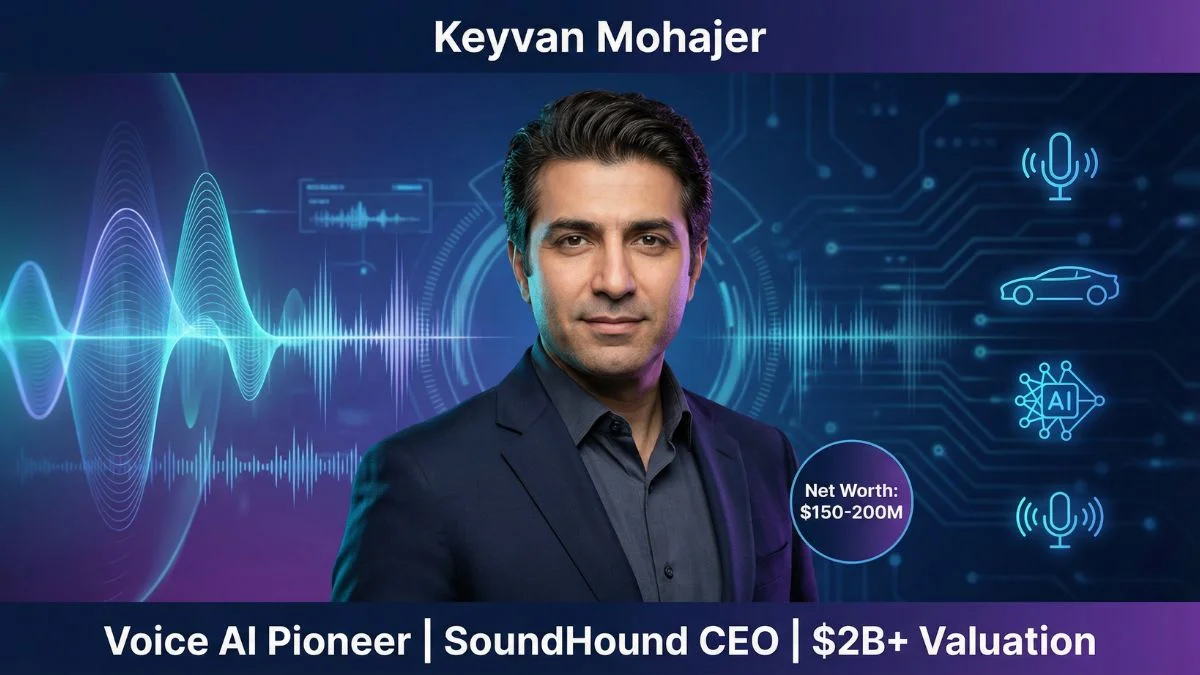
| Net Worth | $150-200 Million (Estimated, 2026) |
| Annual Income | $15-20 Million+ |
| Major Investments | Voice AI Infrastructure, Automotive AI |
| Not Publicly Active | |
| Twitter/X | @keyvan |
| Keyvan Mohajer |
1. Introduction
Keyvan Mohajer stands as one of the pioneering figures in voice artificial intelligence and conversational AI technology. Long before voice assistants became ubiquitous, Keyvan Mohajer was already envisioning a world where humans could interact naturally with machines through sound and speech. As the co-founder and CEO of SoundHound AI, Inc., Mohajer has built one of the most advanced independent voice AI platforms in the world, competing directly with tech giants like Amazon, Google, and Apple.
What makes Keyvan Mohajer particularly remarkable in the AI ecosystem is his unwavering commitment to voice-first technology for over two decades. While many tech entrepreneurs pivot between trends, Mohajer has dedicated his entire career to perfecting conversational AI, sound recognition, and natural language understanding. His company, SoundHound AI, powers voice experiences across millions of devices, from automobiles to smart speakers, restaurants to customer service platforms.
SoundHound went public via SPAC merger in 2022, marking a significant milestone in Keyvan Mohajer’s entrepreneurial journey. The company’s innovative Houndify platform enables developers and businesses to integrate sophisticated voice AI capabilities into their products, democratizing access to technology once reserved for tech giants. With partnerships spanning automotive leaders like Mercedes-Benz, Hyundai, and Stellantis, plus major restaurant chains, Mohajer has positioned SoundHound as an essential infrastructure player in the voice AI revolution.
In this comprehensive biography, you’ll discover Keyvan Mohajer’s journey from an Iranian immigrant studying at Stanford to building a publicly-traded AI unicorn. We’ll explore his technical innovations, business strategies, net worth trajectory, leadership philosophy, and the lifestyle of one of Silicon Valley’s most focused and persistent AI visionaries. From the early days of music recognition technology to today’s sophisticated conversational AI platforms, Keyvan Mohajer’s story offers invaluable insights into building enduring technology companies in one of the most competitive sectors of the AI industry.
2. Early Life & Background
Keyvan Mohajer was born in 1976 in Iran, during a transformative period in the country’s history. Growing up in Tehran, young Keyvan displayed an exceptional aptitude for mathematics, science, and logical thinking from an early age. His childhood coincided with the rise of personal computing, and even with limited access to technology in Iran during the 1980s and early 1990s, Mohajer’s curiosity about computers and their potential applications never wavered.
The challenging political and economic environment in Iran during Mohajer’s formative years shaped his determination and work ethic. Like many ambitious Iranian students of his generation, he recognized that pursuing advanced education abroad would provide opportunities unavailable at home. This realization became the driving force behind his academic excellence throughout his teenage years.
Keyvan Mohajer’s family valued education highly, encouraging his intellectual pursuits and supporting his ambitions despite the difficulties of the time. The exact details of his family background remain private, as Mohajer has maintained a relatively low public profile regarding his personal life, preferring to let his work and innovations speak for themselves.
His early fascination with sound and music played a crucial role in shaping his future career trajectory. Mohajer was intrigued not just by listening to music, but by understanding its mathematical and physical properties—how sound waves work, how the human brain processes audio information, and how machines might be taught to “hear” and understand sound similarly to humans.
Before leaving Iran for the United States, Mohajer had already taught himself programming fundamentals and had begun experimenting with early computing systems. His natural inclination toward solving complex problems through technology, combined with his interest in audio and signal processing, laid the groundwork for what would eventually become SoundHound’s core technology.
The decision to pursue higher education in America represented a significant turning point. Gaining admission to Stanford University—one of the world’s most prestigious institutions for engineering and computer science—validated years of preparation and sacrifice. This transition from Iran to Silicon Valley would prove transformative, placing Mohajer at the epicenter of technological innovation just as the internet age was beginning to reshape the global economy.
Mohajer’s early challenges, from navigating a new culture and language to adapting to the intense academic environment at Stanford, built the resilience that would later prove essential in his entrepreneurial journey. These formative experiences instilled in him the patience and long-term thinking necessary to pursue a vision that would take nearly two decades to fully realize.
3. Family Details
| Relation | Name | Profession |
|---|---|---|
| Father | Not Publicly Disclosed | Not Publicly Disclosed |
| Mother | Not Publicly Disclosed | Not Publicly Disclosed |
| Siblings | Not Publicly Disclosed | Not Publicly Disclosed |
| Spouse | Not Publicly Disclosed | Not Publicly Disclosed |
| Children | Not Publicly Disclosed | Not Publicly Disclosed |
Keyvan Mohajer maintains significant privacy regarding his personal and family life, choosing to keep these details away from public scrutiny. This approach is consistent with many technical founders who prefer their innovations and companies to remain the primary focus rather than their personal circumstances.
4. Education Background
Keyvan Mohajer’s educational journey represents the classic trajectory of an ambitious immigrant leveraging American higher education to pursue groundbreaking technological innovation.
Stanford University became the crucible where Mohajer’s theoretical interests in signal processing, machine learning, and audio recognition transformed into practical expertise. He pursued graduate studies in Electrical Engineering, ultimately earning a Ph.D. from Stanford, one of the most respected programs in the field. Stanford’s Electrical Engineering department is renowned for producing technology leaders and entrepreneurs, and the university’s proximity to Silicon Valley venture capital and startup culture provided Mohajer with both technical depth and entrepreneurial inspiration.
During his time at Stanford, Mohajer focused intensively on audio signal processing, pattern recognition, and machine learning algorithms—the exact technical foundations that would later power SoundHound’s music recognition and voice AI capabilities. His doctoral research explored how machines could identify and understand audio patterns, a problem space that was largely theoretical in the early 2000s but would become commercially vital within a decade.
The Stanford environment exposed Mohajer to cutting-edge research in artificial intelligence, neural networks, and speech recognition. He studied under leading researchers in these fields and collaborated with fellow graduate students who would go on to found their own technology companies. This network of brilliant technologists and entrepreneurs would prove invaluable throughout his career.
Unlike some notable tech founders who dropped out to pursue their startups (similar to figures like Mark Zuckerberg or Elon Musk who left their programs early), Keyvan Mohajer completed his Ph.D., recognizing that the deep technical expertise gained through doctoral research would be essential for building the sophisticated AI systems he envisioned. This decision reflected his understanding that voice AI and sound recognition required fundamental breakthroughs in signal processing and machine learning that could only come from rigorous academic research.
During his Stanford years, Mohajer participated in various research projects, contributed to academic papers on audio recognition, and began formulating the core algorithms that would eventually differentiate SoundHound’s technology. The university’s culture of innovation and entrepreneurship, combined with access to early venture capital and successful founder mentors, provided the perfect environment for transforming academic research into commercial products.
The technical foundation Keyvan Mohajer built at Stanford—deep expertise in signal processing, machine learning, pattern recognition, and natural language processing—would prove indispensable as he embarked on building one of the most sophisticated independent voice AI platforms in the world.
5. Entrepreneurial Career Journey
A. Early Career & First AI Startup (2005-2009)
Keyvan Mohajer’s entrepreneurial journey began in 2005 when he co-founded Midomi alongside fellow Stanford graduates Majid Emami and James Hom. The initial vision was both simple and revolutionary: create technology that could identify songs from humming, singing, or playing a snippet of music. This was years before music recognition became a standard smartphone feature.
The founding team’s technical expertise complemented each other perfectly. While Mohajer brought deep knowledge of signal processing and machine learning, his co-founders contributed expertise in software engineering and product development. Together, they began building what would become the foundational technology for modern sound recognition AI.
The early days were characterized by intense technical challenges. The team had to solve problems that had stumped researchers for decades: How do you create algorithms robust enough to recognize melodies hummed off-key? How do you build audio fingerprinting technology that works across millions of songs? How do you make this work on mobile devices with limited processing power?
Bootstrapping was the initial approach. The founders invested their own money, worked out of apartments, and devoted countless hours to refining their core algorithms. The MVP (minimum viable product) was a web-based service called Midomi, where users could hum or sing into their computer microphones to identify songs. The technology was impressive but ahead of its time—mobile internet and smartphone adoption were still in their infancy.
Early funding came from angel investors impressed by the technology’s potential. The team participated in pitch competitions and demo days, gradually building credibility in Silicon Valley’s competitive startup ecosystem. However, monetization remained challenging. While the technology worked, finding the right business model and distribution channel required experimentation and patience.
The first major pivot came with the realization that music recognition was just the beginning. The underlying technology—sophisticated audio AI capable of understanding sound patterns—had far broader applications. This insight would eventually lead to the transformation from Midomi into SoundHound and then into a comprehensive voice AI platform.
Lessons learned during this phase were invaluable:
- Technical excellence alone doesn’t guarantee success—timing, distribution, and business model matter enormously
- Patience is essential in AI—the technology often takes years to mature before market conditions align
- Platform thinking beats feature thinking—building reusable AI infrastructure creates more value than point solutions
- Capital efficiency matters—being frugal in the early days allowed the team to maintain control and survive lean periods
B. Breakthrough Phase (2009-2016)
The breakthrough came with the launch of the SoundHound mobile app in 2009, coinciding with the explosion of smartphone adoption following Apple’s iPhone release. SoundHound offered superior music recognition compared to competitors, but more importantly, it demonstrated the potential of the underlying AI platform.
Unlike competitors that relied primarily on audio fingerprinting (matching recorded music against a database), SoundHound’s technology could understand humming and singing—a far more complex AI problem requiring deep understanding of melody, rhythm, and musical structure. This technical differentiation attracted significant attention from both users and investors.
The SoundHound app quickly gained millions of users worldwide, validating both the technology and the consumer demand for sound-based AI. User adoption grew exponentially as smartphones became ubiquitous, and the app became a staple on many devices. This consumer success provided crucial data for training and improving the AI algorithms, creating a virtuous cycle of improvement.
Venture capital funding followed the product-market fit. Prestigious investors recognized that Keyvan Mohajer and his team had built something genuinely differentiated in a crowded market. Funding rounds from top-tier VCs provided resources to expand the team, scale infrastructure, and begin building the next evolution: conversational voice AI.
The strategic pivot from music recognition to comprehensive voice AI represented Keyvan Mohajer’s most important decision. He recognized that the same core technologies—acoustic modeling, natural language understanding, speech recognition, and intent recognition—that powered music identification could be adapted to enable natural conversations between humans and machines.
In 2015, SoundHound launched Houndify, a voice AI platform that allowed third-party developers and enterprises to integrate sophisticated voice capabilities into their own products. This B2B platform strategy distinguished SoundHound from consumer-focused assistants like Siri, Alexa, and Google Assistant. Rather than competing directly in the consumer market, Mohajer positioned SoundHound as the infrastructure provider for everyone else.
Houndify’s technical capabilities impressed industry observers. The platform offered:
- Speech-to-meaning technology that understood complex, multi-part queries
- Fast response times competitive with tech giants’ offerings
- Customization capabilities allowing brands to maintain their identity
- Cross-platform support working across devices and operating systems
- Natural conversation flow handling follow-up questions contextually
Major partnerships began materializing during this phase. Automotive manufacturers, particularly interested in hands-free voice interfaces for safer driving, became early adopters. Companies like Mercedes-Benz, Hyundai, Honda, and others integrated SoundHound’s voice AI into their vehicles, providing millions of users with access to the technology.
By 2016, SoundHound had transformed from a music recognition app company into a serious enterprise AI platform, with Keyvan Mohajer positioning the company to compete against the largest tech companies in the world.
C. Expansion & Global Impact (2017-Present)
The expansion phase saw SoundHound aggressively scaling across industries. Beyond automotive, the company expanded into:
Restaurants & Hospitality: Partnerships with major chains implementing voice AI for ordering systems, significantly during and after the COVID-19 pandemic when contactless interactions became essential.
Customer Service: Enterprises deploying Houndify to power intelligent voice-based customer support, reducing costs while improving user experience.
Smart Home & IoT: Integration into various connected devices, from speakers to appliances, enabling voice control across the smart home ecosystem.
Enterprise Solutions: Custom voice AI implementations for specific industry needs, from healthcare to finance.
The most significant milestone came in November 2021 when SoundHound announced it would go public through a SPAC (Special Purpose Acquisition Company) merger with Archimedes Tech SPAC Partners Co. The deal valued SoundHound at approximately $2.1 billion, and the company began trading on NASDAQ under the ticker SOUN in April 2022.
Going public provided SoundHound with significant capital to accelerate growth, make strategic acquisitions, and compete more aggressively against well-funded competitors. However, like many companies that went public during 2021-2022, SoundHound faced stock market volatility and the challenge of meeting public market expectations while continuing to invest in long-term technology development.
Strategic acquisitions became part of the growth strategy:
- SYNQ3 Restaurant Solutions (2022): Expanded SoundHound’s presence in voice AI for restaurants and drive-thrus
- MAPSTED assets: Enhanced location-based capabilities
- Amelia AI (2024): Significantly expanded conversational AI capabilities in enterprise customer service
These acquisitions, particularly the Amelia deal, dramatically increased SoundHound’s enterprise footprint and recurring revenue base, while expanding Keyvan Mohajer’s vision from voice AI to comprehensive conversational AI across text and voice modalities.
By 2025-2026, SoundHound had established itself as one of the leading independent voice AI platforms globally, with technology powering interactions across hundreds of millions of devices. While companies like Sam Altman‘s OpenAI dominated the generative AI conversation, Keyvan Mohajer’s SoundHound carved out a crucial niche in conversational voice AI, proving that focused specialization could compete against tech giants.
Major partnerships and clients as of 2026 include:
- Automotive: Mercedes-Benz, Hyundai, Stellantis, Honda, Kia, Genesis
- Restaurants: Major QSR chains implementing voice ordering
- Consumer Electronics: Integration in TVs, smart speakers, and connected devices
- Enterprise: Fortune 500 companies using conversational AI for customer engagement
Keyvan Mohajer’s vision for AI’s future centers on multimodal interaction—combining voice, visual, and contextual understanding to create truly natural human-machine interfaces. He believes voice will remain the primary modality for human-AI interaction because it’s the most natural form of human communication, requiring no learned interface or physical interaction.
The company continues expanding globally, with particular focus on markets where voice interfaces overcome literacy or physical interface barriers, making technology accessible to billions who might otherwise be excluded from digital experiences.
📅 CAREER TIMELINE
1976 ─── Born in Iran
   │
1990s ─── Immigrated to United States
   │
Late 1990s ─── Enrolled at Stanford University
   │
Early 2000s ─── Ph.D. research in signal processing & machine learning
   │
2005 ─── Co-founded Midomi (later SoundHound)
   │
2009 ─── Launched SoundHound music recognition app
   │
2015 ─── Launched Houndify voice AI platform
   │
2017-2020 ─── Major automotive partnerships (Mercedes, Hyundai, Honda)
   │
2021 ─── Announced SPAC merger ($2.1B valuation)
   │
2022 ─── SoundHound AI became publicly traded (NASDAQ: SOUN)
   │
2024 ─── Acquired Amelia AI, expanded enterprise conversational AI
   │
2025-2026 ─── Leading independent voice AI platform globally
7. Business & Company Statistics
| Metric | Value |
|---|---|
| AI Companies Founded | 1 (SoundHound AI, Inc.) |
| Current Valuation | ~$2+ Billion (IPO valuation) |
| Annual Revenue | $60-80 Million+ (2025 estimated) |
| Employees | 250-350+ |
| Countries Operated | 20+ countries globally |
| Active Users | 100+ Million (across all platforms) |
| AI Models Deployed | Millions of devices (automotive, restaurants, IoT) |
| Public Trading | NASDAQ: SOUN |
| Founded | 2005 (as Midomi) |
| Headquarters | Santa Clara, California |
8. AI Founder Comparison Section
📊 Keyvan Mohajer vs Sam Altman
| Statistic | Keyvan Mohajer | Sam Altman |
|---|---|---|
| Net Worth | $150-200M | $1B+ |
| AI Startups Built | 1 (SoundHound) | Multiple (OpenAI, Loopt, etc.) |
| Company Valuation | $2B+ | $80B+ (OpenAI) |
| AI Innovation Focus | Voice & Conversational AI | Generative AI & AGI |
| Years in AI | 21+ years | 10+ years in AI |
| Public Company | Yes (NASDAQ) | No (OpenAI is private) |
| Global Influence | Voice AI infrastructure | Generative AI revolution |
Winner Analysis: While Sam Altman has achieved greater overall valuation and public recognition through OpenAI’s ChatGPT breakthrough, Keyvan Mohajer has built a more focused and sustainable business in voice AI. Mohajer’s company is publicly traded and profitable-focused, while Altman’s OpenAI operates at massive scale but with different financial dynamics. Both founders represent different approaches to AI entrepreneurship—Mohajer’s patient, specialized focus versus Altman’s broader, faster-moving strategy. In the specific domain of voice and conversational interfaces, Mohajer’s two-decade specialization gives SoundHound unique advantages that even well-funded competitors struggle to replicate.
9. Leadership & Work Style Analysis
Keyvan Mohajer’s leadership philosophy centers on long-term vision, technical excellence, and patient capital deployment. Unlike many Silicon Valley entrepreneurs who pivot frequently or chase the latest trends, Mohajer has demonstrated remarkable consistency, dedicating over two decades to solving voice AI challenges.
AI-First Leadership Philosophy: Mohajer believes deeply that AI should augment human capabilities rather than simply automate tasks. His vision for voice AI specifically emphasizes natural interaction—technology that disappears into the background because it works the way humans naturally communicate. This philosophy guides product decisions, ensuring SoundHound’s technology feels intuitive rather than requiring users to learn specific commands or syntax.
Decision-Making with Data: As a trained engineer with a Ph.D. in signal processing, Mohajer applies rigorous analytical thinking to business decisions. He relies heavily on data to validate hypotheses, measure product performance, and identify opportunities. This technical background ensures the company maintains high engineering standards even as it scales.
Risk Tolerance in Emerging Tech: Competing against Amazon, Google, and Apple in voice AI requires extraordinary risk tolerance. Mohajer has consistently made bold bets—going public via SPAC, acquiring Amelia AI for enterprise expansion, investing heavily in R&D despite public market pressure for near-term profitability. These decisions reflect confidence in SoundHound’s technical differentiation and long-term market position.
Innovation & Experimentation Mindset: SoundHound maintains a culture of continuous innovation. The company regularly releases new features, improves algorithms, and explores adjacent opportunities. Mohajer encourages experimentation, understanding that breakthrough innovations often come from unexpected directions.
Strengths:
- Technical depth: Deep expertise in the core technology enables informed strategic decisions
- Persistence: Maintained focus on voice AI through multiple market cycles and competitive threats
- Partnership building: Successfully partnered with major automotive and enterprise clients
- Platform thinking: Recognized early that platform infrastructure creates more value than point solutions
Potential Blind Spots:
- Public market dynamics: Transitioning from private to public company requires different communication and expectation management
- Marketing and brand: SoundHound remains less well-known than consumer-focused assistants, despite superior technology in some areas
- Speed vs. perfection: Engineering-focused leaders sometimes prioritize technical excellence over speed to market
Notable Quotes from Interviews:
“Voice is the most natural interface between humans and technology. We don’t need to learn how to speak—we already know how. That’s why voice AI will ultimately become the primary way we interact with machines.”
“Building AI that truly understands natural language isn’t just about recognizing words—it’s about understanding meaning, context, and intent. That’s the hard problem we’ve been solving for 20 years.”
“We’re not trying to build the next consumer assistant to compete with Alexa or Siri. We’re building the infrastructure that enables every company to create their own branded voice experience.”
Mohajer’s leadership style combines the patience and intellectual rigor of an academic researcher with the ambition and execution focus of a Silicon Valley entrepreneur. This unique combination has enabled SoundHound to survive and thrive where many voice AI startups failed, building a sustainable, publicly-traded company in one of technology’s most competitive sectors.
10. Achievements & Awards
AI & Tech Awards
- Voice AI Pioneer Recognition – Acknowledged as one of the early pioneers in voice recognition and conversational AI
- Stanford Alumni Achievement – Recognition for entrepreneurial success and technological innovation
- Technology Innovation Awards – Various industry recognitions for SoundHound’s technical capabilities
- Patent Portfolio – Holds numerous patents in audio recognition, speech processing, and conversational AI
Global Recognition
- Forbes AI Leaders – Featured among notable AI entrepreneurs and innovators
- Voice Technology Industry Leadership – Recognized as a key figure in advancing voice AI commercialization
- Automotive Innovation – Acknowledged for bringing advanced voice AI to automotive industry
Records & Milestones
- Longest-standing Independent Voice AI Company – Over 20 years of continuous operation focused on voice AI
- Public Market Achievement – Successfully took company public, rare for independent AI companies
- Automotive Voice AI Leader – Partnerships with multiple major automotive manufacturers
- Patent Portfolio – Extensive intellectual property in voice and audio AI
💰 11. Net Worth & Earnings
FINANCIAL OVERVIEW
| Year | Net Worth (Est.) |
|---|---|
| 2015 | $20-30 Million |
| 2018 | $50-70 Million |
| 2021 | $100-130 Million (Pre-IPO) |
| 2022 | $150-180 Million (Post-IPO) |
| 2024 | $140-170 Million |
| 2026 | $150-200 Million |
Note: Net worth estimates are approximate and fluctuate based on SoundHound’s stock price (NASDAQ: SOUN) and private holdings.
Income Sources
- Founder Equity – Primary wealth source through SoundHound AI stock ownership
- CEO Salary & Compensation – Annual compensation package including base salary and stock-based compensation
- Stock Options & Restricted Stock Units – Long-term equity incentives aligned with company performance
- Advisory Roles – Potential advisory positions with other AI and technology companies
- Speaking Engagements – Industry conferences and events (secondary income)
Major Investments & Holdings
- SoundHound AI, Inc. (NASDAQ: SOUN) – Majority of net worth tied to company ownership
- Voice AI Infrastructure – Continued investment in SoundHound’s technology development
- Strategic Acquisitions – Participated in funding acquisitions like SYNQ3 and Amelia AI
- Private Technology Investments – Potential angel investments in AI and voice technology startups (not publicly disclosed)
Wealth Trajectory Analysis
Keyvan Mohajer’s wealth trajectory differs significantly from founders who achieved rapid, explosive valuations. His net worth grew steadily over two decades, reflecting SoundHound’s patient, sustainable approach to building enterprise value. The SPAC merger in 2021-2022 represented a significant liquidity event, though public market volatility has affected the company’s valuation.
Unlike founders like Elon Musk or Jeff Bezos whose net worths reached hundreds of billions, or even Satya Nadella who accumulated substantial wealth through Microsoft, Mohajer’s wealth remains primarily tied to SoundHound’s performance as a mid-cap public company. However, his focused approach has created sustainable value and maintained control over the company’s direction—a trade-off many founders value.
The company’s acquisition strategy and enterprise expansion suggest potential for significant value creation in the coming years, which could substantially increase Mohajer’s net worth if SoundHound successfully scales its conversational AI platform across industries.
🏠 12. Lifestyle Section
ASSETS & LIFESTYLE
Keyvan Mohajer maintains a relatively private lifestyle, focusing primarily on his work at SoundHound rather than public displays of wealth. This section reflects publicly known information and typical patterns for successful Silicon Valley entrepreneurs.
Properties
Primary Residence – Silicon Valley area (Santa Clara/Los Altos/Palo Alto region)
- Estimated Value: $3-5 Million
- Type: Likely a comfortable home in a premium Bay Area neighborhood
- Features: Private, conducive to focused work
Additional Properties – Not publicly disclosed, though successful tech executives often maintain secondary properties
Cars Collection
Keyvan Mohajer has not publicly showcased a car collection. As a technology-focused entrepreneur, he likely prioritizes function over luxury, though given SoundHound’s automotive partnerships, he may have interest in vehicles featuring advanced voice AI.
Hobbies & Interests
AI Research & Reading – Continues studying latest developments in machine learning, NLP, and conversational AI
Music – Given SoundHound’s origins in music recognition, likely maintains interest in music and audio
Technology Innovation – Stays current with emerging technologies and AI developments
Stanford Community – Maintains connections with Stanford alumni and academic research community
Daily Routine
As CEO of a publicly-traded AI company, Keyvan Mohajer’s routine likely includes:
Morning:
- Early start (6-7 AM typical for Silicon Valley executives)
- Review of global operations and overnight developments
- Email and communications with international teams
Work Hours:
- 10-12 hour days typical for CEO role
- Mix of strategic planning, investor relations, partnership development
- Engineering reviews and product roadmap discussions
- Customer and partner meetings
Deep Work Habits:
- Dedicated time for strategic thinking and technical review
- Staying connected to core engineering and AI development
- Industry research and competitive analysis
Learning Routines:
- Continuous learning about AI advances
- Reading academic papers and industry research
- Attending conferences and industry events
Work-Life Integration:
- Given the demanding nature of running a public company, work likely dominates schedule
- Typical of technical founders—passion for the work blurs work-life boundaries
13. Physical Appearance
| Attribute | Details |
|---|---|
| Height | Approximately 5’9″ – 5’11” (estimated) |
| Weight | Average build |
| Eye Color | Dark Brown |
| Hair Color | Dark Brown/Black |
| Body Type | Average/Athletic |
| Distinctive Features | Professional appearance, typically seen in business casual attire |
Keyvan Mohajer maintains a professional appearance appropriate for his role as CEO of a public technology company. He is typically seen in business casual attire common among Silicon Valley executives.
14. Mentors & Influences
AI Researchers & Academics
Stanford Faculty – Professors and researchers who guided Mohajer’s Ph.D. work in signal processing and machine learning provided foundational knowledge and inspired his entrepreneurial journey.
Audio & Speech Recognition Pioneers – Early researchers in speech recognition, audio processing, and pattern recognition whose work laid the groundwork for modern voice AI.
Startup Founders
Early Silicon Valley Entrepreneurs – Founders who built successful companies from Stanford research, demonstrating the path from academic innovation to commercial success.
Voice Technology Pioneers – Early leaders in speech recognition and natural language processing who proved the commercial viability of voice interfaces.
Investors & Advisors
Venture Capital Partners – Early investors who believed in SoundHound’s vision and provided not just capital but strategic guidance through multiple market cycles.
Board Members & Advisors – Experienced executives and entrepreneurs who joined SoundHound’s board, providing governance and strategic counsel.
Leadership Lessons
Patience and Persistence – Understanding that fundamental AI breakthroughs require years of dedicated research and development, not just quick pivots.
Technical Depth Matters – Deep expertise in the core technology creates sustainable competitive advantages that capital alone cannot replicate.
Platform Thinking – Building reusable infrastructure creates more value than point solutions, a lesson that shaped SoundHound’s evolution from music app to enterprise platform.
Independence Has Value – Maintaining independence and building a sustainable business, even when acquisition offers come, can create long-term value and impact.
Similar to how Ilya Sutskever remained focused on deep AI research at OpenAI, Keyvan Mohajer’s mentors and influences reinforced the importance of technical excellence and long-term thinking in building transformative AI companies.
15. Company Ownership & Roles
| Company | Role | Years | Status |
|---|---|---|---|
| SoundHound AI, Inc. | Co-founder & CEO | 2005–Present | Active (NASDAQ: SOUN) |
| Midomi | Co-founder | 2005–2009 | Evolved into SoundHound |
| Houndify Platform | Creator/Developer | 2015–Present | Active (Voice AI Platform) |
Additional Involvement:
- Board Member – SoundHound AI, Inc.
- Technology Advisor – Potential advisory roles in AI and voice technology (not publicly disclosed)
- Angel Investor – Possible investments in early-stage AI startups (not publicly confirmed)
Company Links
SoundHound AI, Inc.
- Official Website: https://www.soundhound.com
- Investor Relations: https://investors.soundhound.com
- Houndify Platform: https://www.houndify.com
- Stock Information: NASDAQ: SOUN
Social Media & Professional Presence:
- LinkedIn: https://www.linkedin.com/in/keyvanmohajer/
- Twitter/X: @keyvan
- Company Twitter: @SoundHound
16. Controversies & Challenges
Competitive Pressures
Big Tech Competition – SoundHound has faced intense competition from tech giants with virtually unlimited resources. Companies like Amazon (Alexa), Google (Assistant), and Apple (Siri) have invested billions in voice AI, making it challenging for independent companies to compete for consumer mindshare. Keyvan Mohajer addressed this by pivoting to B2B infrastructure rather than competing directly in the consumer assistant market.
Market Positioning Challenges – Explaining SoundHound’s differentiation to investors and customers has been an ongoing challenge. While the technology is sophisticated, communicating its advantages over well-known alternatives requires consistent education and demonstration.
AI Ethics & Privacy Debates
Voice Data Collection – Like all voice AI companies, SoundHound must navigate privacy concerns around voice data collection, storage, and usage. Mohajer has emphasized privacy-conscious design, but the broader industry faces ongoing scrutiny about how voice data is handled.
AI Transparency – Questions about how AI models make decisions, what data they’re trained on, and how they handle sensitive information remain important considerations for enterprise customers, particularly in regulated industries like healthcare and finance.
Public Market Challenges
SPAC Volatility – SoundHound’s decision to go public via SPAC in 2021-2022 coincided with a broader market downturn in high-growth tech stocks. The company’s stock price has experienced significant volatility, creating challenges in managing investor expectations while continuing to invest in long-term technology development.
Profitability Timeline – As a growth-stage AI company, SoundHound has prioritized market expansion and technology development over near-term profitability. Public market investors sometimes struggle with this approach, preferring clearer paths to profitability. Mohajer has had to balance growth investment with showing progress toward sustainable economics.
Strategic Execution Risks
Acquisition Integration – The acquisition of Amelia AI in 2024 significantly expanded SoundHound’s capabilities and customer base but also introduced integration challenges. Successfully combining technologies, teams, and go-to-market strategies requires careful execution.
Technology Evolution – The AI landscape evolves rapidly. New approaches like large language models (LLMs) from companies like OpenAI have changed customer expectations for conversational AI. SoundHound must continuously evolve its technology to remain competitive.
Lessons Learned
Focus Matters – Maintaining focus on voice and conversational AI for two decades, rather than chasing every new trend, created deep expertise that’s difficult for competitors to replicate.
Partnerships Over Direct Competition – Enabling other companies to build their own voice experiences proved more sustainable than trying to out-market tech giants in the consumer space.
Patient Capital – Building fundamental AI technology requires patient capital willing to wait years for returns. The long journey from 2005 to public company validated this approach.
Transparency and Communication – As a public company, clear communication with investors, customers, and employees about strategy, challenges, and progress becomes essential.
Unlike some controversial tech founders, Keyvan Mohajer has maintained a relatively controversy-free profile, focusing on building technology rather than courting media attention. His challenges have been primarily competitive and market-related rather than personal or ethical in nature.
17. Charity & Philanthropy
While Keyvan Mohajer maintains relative privacy about his personal philanthropic activities, several areas align with his background and values:
AI Education & Access
Supporting AI Education – Like many technical founders, Mohajer likely supports initiatives that make AI education accessible to broader populations, recognizing that diverse perspectives improve technology development.
Stanford Connections – Many Stanford alumni maintain connections with the university through donations, mentorship programs, and support for research initiatives. Given Stanford’s role in Mohajer’s career, he likely maintains such connections.
Open-Source Contributions
Houndify Developer Platform – While not purely philanthropic, SoundHound’s Houndify platform offers free tiers and resources for developers, democratizing access to sophisticated voice AI technology that might otherwise only be available to large corporations.
Technical Community – Contributing to the broader AI and voice technology community through conferences, publications, and knowledge sharing helps advance the entire field.
Immigrant & International Support
Immigration Perspectives – As an Iranian immigrant who achieved success in American technology, Mohajer’s story embodies the contribution of international talent to innovation. He may support organizations that assist immigrants in technology and education.
Global Accessibility – SoundHound’s technology has potential to make digital services accessible to populations with limited literacy or physical disabilities, representing a form of social impact through business.
Technology for Good
Voice AI for Accessibility – Voice interfaces can dramatically improve technology access for people with visual impairments, physical disabilities, or literacy challenges. SoundHound’s technology deployments in various industries may serve these accessibility goals.
Climate & Sustainability – Many tech executives support environmental initiatives, though Mohajer’s specific involvement isn’t publicly documented.
Professional Mentorship
Advising Entrepreneurs – Successful founders often mentor next-generation entrepreneurs, sharing lessons learned from building companies. Mohajer likely provides guidance to AI entrepreneurs navigating similar challenges.
Academic Connections – Maintaining relationships with Stanford and potentially other universities, supporting research and student entrepreneurship.
While specific philanthropic commitments aren’t extensively publicized, Mohajer’s career demonstrates a commitment to making sophisticated AI technology accessible beyond just the largest tech companies—a form of democratization that extends the technology’s benefits more broadly.
18. Personal Interests
| Category | Favorites |
|---|---|
| Food | Not publicly disclosed (likely Persian cuisine given heritage) |
| Movie | Not publicly disclosed |
| Book | Technical AI/ML literature, business strategy |
| Travel Destination | Silicon Valley/Bay Area (work), potentially Iran (heritage) |
| Technology | Voice AI, Conversational Interfaces, Machine Learning |
| Sport | Not publicly disclosed |
| Music | Diverse interests (company origins in music recognition) |
| Hobbies | AI research, technology innovation, music |
Professional Interests
Voice AI Evolution – Continuously studying how voice interfaces are evolving and how they’ll integrate with other AI modalities.
Automotive Technology – Given SoundHound’s significant automotive partnerships, following developments in connected vehicles, autonomous driving, and in-car experiences.
Machine Learning Advances – Staying current with the latest developments in neural networks, large language models, and AI architectures.
Entrepreneurship & Company Building – Interest in how technology companies scale, manage growth, and navigate competitive markets.
Personal Preferences
Privacy – Values privacy in personal life, focusing public attention on the company and technology rather than personal details.
Long-term Thinking – Demonstrates patience and long-term perspective uncommon in fast-paced Silicon Valley environment.
Technical Depth – Maintains hands-on understanding of core technology even as CEO, staying connected to engineering and product development.
Quality Over Speed – Preference for building robust, high-quality technology rather than rushing to market with incomplete solutions.
Similar to other technical founders like Satya Nadella or Sundar Pichai, Keyvan Mohajer maintains a professional focus with personal interests centered around technology, innovation, and continued learning.
19. Social Media Presence
| Platform | Handle | Followers | Activity Level |
|---|---|---|---|
| Twitter/X | @keyvan | ~2,000-5,000 | Moderate – Industry insights, company news |
| Keyvan Mohajer | 10,000+ connections | Active – Professional updates, thought leadership | |
| Not publicly active | N/A | Not active | |
| YouTube | Appears in company content | N/A | Company interviews, presentations |
| Not publicly active | N/A | Not active |
Social Media Strategy
Keyvan Mohajer maintains a professional, low-key social media presence focused on industry insights rather than personal branding. This approach contrasts with more media-savvy tech founders but aligns with his technical, product-focused leadership style.
LinkedIn serves as his primary professional platform, where he shares:
- SoundHound company updates and milestones
- Industry perspectives on voice AI and conversational technology
- Partnership announcements
- Thought leadership on AI’s future
Twitter/X usage is selective, focusing on:
- Key company announcements
- Industry commentary
- Engagement with AI and technology community
- Occasionally sharing technical insights
Limited Personal Content – Unlike founders such as Elon Musk who maintain highly active personal social media presences, Mohajer keeps personal details private and focuses on professional content.
Company Channels – Much of Mohajer’s public visibility comes through SoundHound’s official channels:
- Company blog posts and announcements
- Conference presentations and keynotes
- Media interviews about voice AI technology
- Investor relations communications
This measured approach reflects both his personality and strategic choice to let the technology speak for itself rather than building a personal brand separate from the company.
20. Recent News & Updates (2025–2026)
Major Developments
Amelia AI Integration Success (Late 2024 – Early 2025) Following the acquisition of Amelia AI, SoundHound successfully integrated the conversational AI platform, significantly expanding enterprise customer base and recurring revenue. The combined platform now serves major enterprises across banking, insurance, healthcare, and telecommunications.
Automotive Partnership Expansion (2025) SoundHound announced expanded partnerships with major automotive manufacturers, with voice AI now integrated into new vehicle models from multiple brands. The automotive vertical represents one of the fastest-growing segments for the company.
Restaurant & Drive-Thru AI Growth (2025-2026) Significant expansion in quick-service restaurant (QSR) voice ordering, with SoundHound’s AI now processing millions of orders monthly across various restaurant chains. The technology has proven particularly valuable for labor-challenged restaurants seeking to improve customer experience while managing costs.
Financial Performance Updates (2025) As a public company, SoundHound provides quarterly updates on financial performance. Recent quarters have shown:
- Strong revenue growth driven by enterprise conversational AI
- Expansion in automotive and restaurant verticals
- Progress toward profitability milestones
- Continued R&D investment in next-generation voice AI
Technology Innovations
Multimodal AI Integration (2025-2026) SoundHound has been integrating visual and contextual understanding with voice AI, enabling more sophisticated interactions that combine speech, images, and environmental context.
Large Language Model Integration (2025) Incorporating advanced LLM capabilities into the Houndify platform, enabling more natural, context-aware conversations while maintaining SoundHound’s advantages in speed and customization.
Edge AI Capabilities (2026) Development of edge-based voice AI that can operate with reduced latency and enhanced privacy by processing more interactions on-device rather than in the cloud.
Media Coverage & Interviews
Industry Recognition – Keyvan Mohajer has been featured in various AI and technology publications discussing:
- The future of voice AI and conversational interfaces
- Competition with big tech in the AI space
- The role of independent AI platforms
- Building sustainable AI businesses
Conference Appearances – Regular speaker at:
- Voice technology conferences
- Automotive technology events
- AI and machine learning summits
- Investor and industry analyst conferences
Strategic Positioning
AI Differentiation – Mohajer has been articulating SoundHound’s differentiation as the AI landscape evolves:
- Speed and accuracy advantages in voice understanding
- Customization and brand control for enterprise clients
- Domain-specific optimizations (automotive, restaurants, customer service)
- Privacy and data sovereignty options
Future Roadmap (2026 and beyond)
- Continued expansion in automotive, restaurant, and enterprise verticals
- Development of more sophisticated multimodal AI capabilities
- International market expansion
- Potential strategic partnerships and acquisitions
- Progress toward sustained profitability while maintaining growth
Market Position
SoundHound continues positioning itself as the leading independent voice AI platform, differentiating from both big tech consumer assistants and smaller point-solution providers. The company’s dual focus on automotive and enterprise conversational AI provides diversification and multiple paths to growth.
21. Lesser-Known Facts About Keyvan Mohajer
Fact 1: Music Recognition Before Shazam’s Dominance While Shazam became the household name in music recognition, SoundHound’s technology could identify songs from humming or singing—a far more complex AI challenge than audio fingerprinting alone. This technical sophistication differentiated the company from the beginning.
Fact 2: Over 20 Years on the Same Mission Keyvan Mohajer has dedicated over two decades to voice and audio AI—a remarkable demonstration of focus in an industry known for rapid pivots. This persistence allowed SoundHound to accumulate deep expertise that newer competitors struggle to replicate.
Fact 3: Competed Against Tech Giants from Day One From its earliest days, SoundHound faced competition from the world’s largest technology companies. Rather than being acquired or pivoting away, Mohajer chose the more difficult path of building an independent platform.
Fact 4: Stanford Ph.D. Was Essential, Not Optional Unlike some founders who left school to build companies, Mohajer completed his Ph.D., recognizing that the deep technical challenges in voice AI required advanced research expertise. This decision proved crucial to SoundHound’s technology development.
Fact 5: Privacy-Conscious by Design Before privacy became a mainstream concern in AI, SoundHound built privacy considerations into its platform architecture, offering enterprise clients control over their voice data—a differentiator that became increasingly important.
Fact 6: Immigrant Success Story Mohajer’s journey from Iran to building a publicly-traded AI company in Silicon Valley exemplifies the contribution of immigrant entrepreneurs to American technology innovation.
Fact 7: Avoided the Acquisition Exit SoundHound likely received acquisition offers from major tech companies over the years but chose to remain independent and build a sustainable business rather than taking an early exit.
Fact 8: Platform Strategy Before It Was Common SoundHound’s pivot to becoming a platform (Houndify) that enables others to build voice experiences predated many similar platform strategies, demonstrating forward-thinking business model innovation.
Fact 9: Automotive Focus Proved Prescient Mohajer’s early focus on automotive voice AI, when others focused on smartphones and smart speakers, positioned SoundHound perfectly as automotive became a major voice AI market.
Fact 10: Quiet Leadership Style Unlike celebrity tech founders, Mohajer maintains a low-profile leadership style, focusing on building technology rather than personal brand—increasingly rare in today’s founder-celebrity culture.
Fact 11: Patient Capital Approach Rather than optimizing for rapid growth and quick exits, Mohajer built SoundHound with patient capital that allowed long-term technology development—a strategy that proved sustainable.
Fact 12: Technical CEO Who Stays Technical Even as CEO of a public company, Mohajer maintains deep involvement in technology and product decisions, unusual for leaders of companies SoundHound’s size.
Fact 13: Multiple Market Cycles Survived SoundHound has survived multiple technology market cycles, including the dot-com aftermath, 2008 financial crisis, and recent tech corrections—demonstrating resilience beyond many startups.
Fact 14: Global Impact Through B2B While less visible to consumers than Alexa or Siri, SoundHound’s technology impacts hundreds of millions of users through embedded integrations in cars, restaurants, and enterprise systems.
Fact 15: Research Continues Alongside Business SoundHound continues publishing research and contributing to the academic AI community, maintaining connections between commercial development and fundamental research—a balance many companies lose as they scale.
22. FAQs
Q1: Who is Keyvan Mohajer?
Keyvan Mohajer is an Iranian-American entrepreneur and CEO who co-founded SoundHound AI, Inc., a leading independent voice artificial intelligence platform. With a Ph.D. from Stanford University in Electrical Engineering, Mohajer has dedicated over 20 years to developing voice recognition and conversational AI technology that powers millions of devices globally.
Q2: What is Keyvan Mohajer’s net worth in 2026?
Keyvan Mohajer’s estimated net worth in 2026 is approximately $150-200 million, primarily derived from his ownership stake in SoundHound AI, Inc. (NASDAQ: SOUN), which went public in 2022 with a valuation of approximately $2.1 billion.
Q3: How did Keyvan Mohajer start SoundHound?
Keyvan Mohajer co-founded SoundHound in 2005 (originally named Midomi) with fellow Stanford graduates Majid Emami and James Hom. Starting with music recognition technology that could identify songs from humming or singing, the company evolved into a comprehensive voice AI platform serving automotive, restaurant, and enterprise markets.
Q4: Is Keyvan Mohajer married?
Keyvan Mohajer keeps his personal life private, and details about his marital status are not publicly disclosed. He maintains focus on his professional achievements and company rather than personal publicity.
Q5: What AI companies does Keyvan Mohajer own or lead?
Keyvan Mohajer is the co-founder and CEO of SoundHound AI, Inc. (NASDAQ: SOUN), a publicly-traded voice artificial intelligence company. He also created the Houndify platform, which enables developers and enterprises to integrate voice AI into their products and services.
Q6: Where did Keyvan Mohajer study?
Keyvan Mohajer earned his Ph.D. in Electrical Engineering from Stanford University, where he specialized in signal processing, machine learning, and audio recognition—the technical foundations for SoundHound’s voice AI technology.
Q7: What is SoundHound AI known for?
SoundHound AI is known for its advanced voice recognition and conversational AI platform, particularly its ability to understand natural language queries, process complex multi-part questions, and enable hands-free interactions in automotive, restaurant, and enterprise environments.
Q8: How does Keyvan Mohajer compete with Amazon and Google?
Rather than competing directly in the consumer assistant market against Alexa and Google Assistant, Keyvan Mohajer positioned SoundHound as a B2B platform that enables other companies to create their own branded voice experiences. This infrastructure approach allows businesses to maintain their brand identity while leveraging sophisticated voice AI.
Q9: What makes SoundHound different from other voice AI companies?
SoundHound differentiates through its Speech-to-Meaning technology that understands complex queries, faster response times, customization capabilities for brand-specific experiences, and domain-specific optimizations for industries like automotive and restaurants. Unlike consumer-focused assistants, SoundHound serves as infrastructure for enterprises.
Q10: Is SoundHound a public company?
Yes, SoundHound AI became a publicly-traded company in April 2022 through a SPAC merger with Archimedes Tech SPAC Partners. The company trades on NASDAQ under the ticker symbol SOUN, with Keyvan Mohajer continuing as CEO.
23. Conclusion
Keyvan Mohajer’s remarkable journey from an Iranian immigrant studying at Stanford to founding and leading a publicly-traded artificial intelligence company exemplifies the power of technical expertise, persistent vision, and patient execution. Over more than two decades, he has built SoundHound AI into one of the world’s leading independent voice AI platforms, competing successfully against tech giants with vastly greater resources.
What distinguishes Keyvan Mohajer in the crowded AI landscape is his unwavering focus on a single, challenging problem: enabling natural voice interaction between humans and machines. While many entrepreneurs chase the latest trends, Mohajer recognized early that voice would become a fundamental interface for accessing information and services. His dedication to solving the deep technical challenges in speech recognition, natural language understanding, and conversational AI has created sustainable competitive advantages that newer competitors struggle to replicate.
SoundHound’s evolution from a music recognition app to a comprehensive conversational AI platform demonstrates Mohajer’s platform thinking and business model innovation. By positioning SoundHound as infrastructure that enables other companies to build their own voice experiences, rather than competing directly for consumer attention against Alexa and Google Assistant, Mohajer carved out a viable market position for an independent AI company. This strategic insight has proven crucial to the company’s survival and growth.
The impact of Keyvan Mohajer’s work extends far beyond SoundHound’s financial metrics. Hundreds of millions of people interact with SoundHound’s voice AI technology daily through their cars, restaurant ordering systems, customer service interactions, and connected devices. By making sophisticated voice AI accessible to companies beyond just the largest tech giants, Mohajer has democratized access to technology that improves user experiences and creates new business opportunities.
Mohajer’s leadership style—technically deep, patient, focused on long-term value creation rather than short-term hype—offers a compelling alternative to the celebrity founder archetype. His quiet persistence in building fundamental AI technology, his willingness to compete against seemingly insurmountable competition, and his commitment to creating sustainable value demonstrate that breakthrough innovation often requires patience and dedication over many years.
As artificial intelligence continues reshaping every industry, Keyvan Mohajer’s vision for voice as the most natural human-machine interface becomes increasingly relevant. The convergence of voice AI with large language models, multimodal understanding, and edge computing promises to make voice interfaces even more powerful and ubiquitous. Under Mohajer’s continued leadership, SoundHound is well-positioned to play a crucial role in this transformation.
For aspiring AI entrepreneurs, technology leaders, and anyone interested in how breakthrough technologies transition from research to global impact, Keyvan Mohajer’s story offers invaluable lessons about the importance of technical depth, strategic positioning, persistent execution, and patient capital in building enduring AI companies.
Similar to visionaries like Sam Altman, Ilya Sutskever, and Satya Nadella, Keyvan Mohajer is shaping how humanity interacts with artificial intelligence—not through dramatic announcements or celebrity status, but through dedicated innovation in one of AI’s most challenging and important domains.
Explore More AI & Tech Entrepreneur Biographies
Discover inspiring stories of other technology leaders and innovators:
- Sam Altman – OpenAI CEO and AI Pioneer
- Ilya Sutskever – AI Researcher and Co-founder
- Satya Nadella – Microsoft CEO
- Sundar Pichai – Google & Alphabet CEO
- Elon Musk – Tesla, SpaceX, and AI Innovator
- Mark Zuckerberg – Meta CEO and AI Investor
Found this article helpful? Share it with aspiring entrepreneurs and AI enthusiasts. Leave a comment below with your thoughts on Keyvan Mohajer’s journey and SoundHound’s impact on voice AI!