QUICK INFO BOX
| Attribute | Details |
|---|---|
| Full Name | Yann André LeCun |
| Nick Name | The Godfather of AI, Father of Convolutional Neural Networks |
| Profession | AI Researcher / VP & Chief AI Scientist at Meta / Professor |
| Date of Birth | July 8, 1960 |
| Age | 65 years (as of 2026) |
| Birthplace | Soisy-sous-Montmorency, France |
| Hometown | Paris, France |
| Nationality | French-American |
| Religion | Not Publicly Disclosed |
| Zodiac Sign | Cancer |
| Ethnicity | Caucasian |
| Father | Not Publicly Disclosed |
| Mother | Not Publicly Disclosed |
| Siblings | Not Publicly Disclosed |
| Wife / Partner | Not Publicly Disclosed |
| Children | Not Publicly Disclosed |
| School | ESIEE Paris |
| College / University | Pierre and Marie Curie University (Sorbonne University) |
| Degree | PhD in Computer Science |
| AI Specialization | Deep Learning / Convolutional Neural Networks / Computer Vision |
| First AI Startup | N/A (Academic & Corporate Research Career) |
| Current Company | Meta AI (Facebook AI Research) |
| Position | VP & Chief AI Scientist |
| Industry | Artificial Intelligence / Deep Learning / Research |
| Known For | Convolutional Neural Networks, Deep Learning Pioneer, Turing Award Winner |
| Years Active | 1983–Present (43+ years) |
| Net Worth | $10–15 Million (estimated) |
| Annual Income | $1–2 Million+ |
| Major Investments | Various AI research initiatives and academic programs |
| Not Active | |
| Twitter/X | @ylecun |
| Yann LeCun |
1. Introduction
When Yann LeCun accepted the 2018 Turing Award—often called the “Nobel Prize of Computing”—alongside Geoffrey Hinton and Yoshua Bengio, the world recognized what AI researchers had known for decades: LeCun’s pioneering work on convolutional neural networks (CNNs) fundamentally transformed artificial intelligence. From enabling machines to recognize handwritten digits in the 1980s to powering today’s facial recognition, autonomous vehicles, and generative AI systems, Yann LeCun’s contributions have shaped the modern AI revolution.
Unlike many contemporary AI entrepreneurs who build unicorn startups, Yann LeCun carved his legacy through groundbreaking research at Bell Labs, New York University, and Meta AI (formerly Facebook AI Research). As Meta’s Chief AI Scientist and a Silver Professor at NYU, Yann LeCun continues to push the boundaries of machine learning while openly challenging narratives around AI existential risks and advocating for open-source AI development.
In this comprehensive biography, you’ll discover Yann LeCun’s journey from a curious French engineering student to one of the most influential figures in artificial intelligence, his philosophy on AI safety, his role in shaping Meta’s AI strategy, his estimated net worth, and his vision for the future of intelligent machines.
2. Early Life & Background
Yann LeCun was born on July 8, 1960, in Soisy-sous-Montmorency, a suburban commune north of Paris, France. Growing up in France during the 1960s and 70s, young Yann developed an early fascination with mathematics, science, and how machines could replicate human intelligence. Unlike many of his peers who were content with traditional educational paths, Yann LeCun exhibited an insatiable curiosity about the fundamental nature of learning and perception.
His childhood coincided with the early era of computing, and Yann LeCun was captivated by the potential of machines to process information. He voraciously read science fiction and scientific literature, imagining futures where machines could see, understand, and learn from the world around them. This wasn’t mere fantasy—it was the seed of a lifelong mission that would eventually revolutionize computer vision and deep learning.
Yann LeCun’s early experiments with mathematics and rudimentary computing laid the groundwork for his theoretical approach to AI. He was particularly drawn to understanding how biological neural networks in the brain processed visual information, a question that would become central to his PhD research and subsequent career. The young researcher faced the typical challenges of pursuing unconventional ideas—neural networks were largely dismissed by the AI establishment in the 1980s—but Yann LeCun’s determination to prove their potential never wavered.
His role models included pioneering cyberneticists and early AI researchers who believed in learning-based approaches to intelligence, rather than the rule-based expert systems that dominated the field. This early philosophical foundation would prove crucial when Yann LeCun later developed convolutional neural networks that could learn visual patterns directly from data.
3. Family Details
| Relation | Name | Profession |
|---|---|---|
| Father | Not Publicly Disclosed | Not Publicly Disclosed |
| Mother | Not Publicly Disclosed | Not Publicly Disclosed |
| Siblings | Not Publicly Disclosed | Not Publicly Disclosed |
| Spouse | Not Publicly Disclosed | Not Publicly Disclosed |
| Children | Not Publicly Disclosed | Not Publicly Disclosed |
Yann LeCun maintains significant privacy regarding his personal family life, choosing to keep details about his parents, siblings, and immediate family out of the public spotlight. This discretion is consistent with his professional focus on research and scientific contributions rather than personal celebrity.
4. Education Background
Yann LeCun’s formal education established the theoretical foundation for his revolutionary work in deep learning:
ESIEE Paris (École Supérieure d’Ingénieurs en Électrotechnique et Électronique): Yann LeCun completed his undergraduate engineering education at ESIEE Paris, one of France’s prestigious engineering schools, where he developed expertise in electrical engineering and computer science.
Pierre and Marie Curie University (Sorbonne University): Yann LeCun earned his PhD in Computer Science in 1987 under the supervision of Maurice Milgram. His doctoral research focused on learning algorithms for neural networks, specifically addressing how machines could learn hierarchical representations of data—work that directly led to the development of convolutional neural networks.
During his graduate studies, Yann LeCun became convinced that the brain’s approach to learning—building increasingly abstract representations through layers of neurons—was the key to artificial intelligence. While expert systems and symbolic AI dominated the field, Yann LeCun pursued the contrarian path of connectionism and neural networks.
Yann LeCun participated in research collaborations and presented early papers on backpropagation and neural network architectures that challenged conventional wisdom. His PhD dissertation laid crucial groundwork for CNNs, though the computing power and datasets needed to fully realize their potential wouldn’t arrive for another two decades.
After completing his PhD, Yann LeCun joined AT&T Bell Laboratories as a postdoctoral researcher, where he would develop the landmark LeNet architecture that proved neural networks could solve real-world problems.
5. Entrepreneurial Career Journey
A. Early Career & Bell Labs Revolution
Unlike typical AI startup founders, Yann LeCun’s career began in research laboratories rather than garages or accelerators. After earning his PhD in 1987, Yann LeCun joined AT&T Bell Laboratories in Holmdel, New Jersey, one of the world’s premier industrial research facilities.
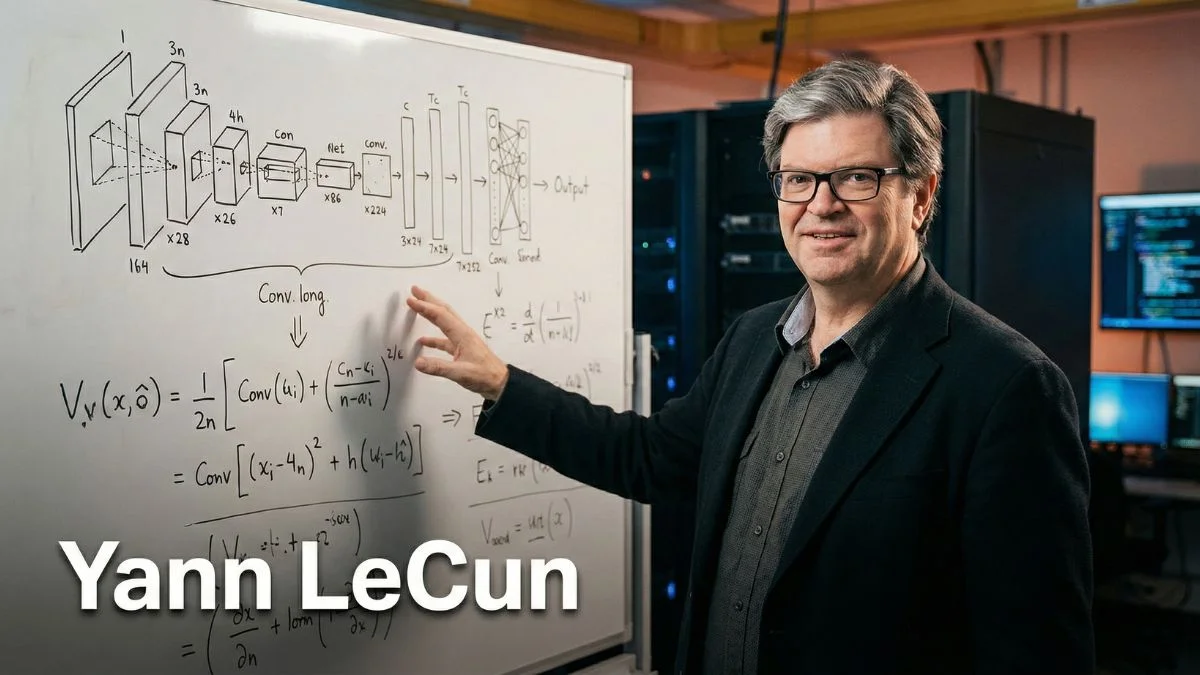
At Bell Labs, Yann LeCun developed LeNet, a convolutional neural network designed to recognize handwritten digits. This wasn’t merely an academic exercise—LeNet was deployed by banks to automatically read checks, processing millions of transactions. The system achieved over 99% accuracy, demonstrating that neural networks could solve commercially valuable problems. However, Yann LeCun faced skepticism from the broader AI community, which largely dismissed neural networks during the “AI winter” of the 1990s.
The early failures included limited computing resources, small datasets, and the dominance of support vector machines and other techniques. Despite commercial success with LeNet, Yann LeCun struggled to convince the research community that deep learning would eventually dominate AI. These years taught him patience and persistence in pursuing ideas that seemed decades ahead of their time.
B. Breakthrough Phase: Deep Learning Renaissance
The breakthrough for Yann LeCun and deep learning came in the 2010s when three factors converged: powerful GPUs, massive datasets (ImageNet), and improved training techniques. In 2012, when Geoffrey Hinton’s team won the ImageNet competition using deep convolutional networks inspired by Yann LeCun’s work, the AI world finally recognized what LeCun had been advocating for decades.
In 2013, Yann LeCun made a pivotal career move by joining Facebook (now Meta) to establish and lead the Facebook AI Research (FAIR) lab. As founding director of FAIR, Yann LeCun built one of the world’s leading AI research organizations, attracting top talent and publishing groundbreaking research on computer vision, natural language processing, and reinforcement learning.
Under Yann LeCun’s leadership, FAIR pioneered open research in AI, publishing papers and releasing open-source tools like PyTorch, which became one of the most popular deep learning frameworks globally. This philosophy of open science contrasted sharply with more secretive approaches at some AI labs, reflecting Yann LeCun’s belief that AI progress benefits from collaborative, transparent research.
Yann LeCun was promoted to Chief AI Scientist at Meta and now holds the title of Vice President and Chief AI Scientist, overseeing AI strategy across Meta’s products including Facebook, Instagram, WhatsApp, and emerging technologies like augmented reality and the metaverse.
C. Expansion & Global Impact
Beyond Meta, Yann LeCun maintained his academic position as Silver Professor at New York University’s Courant Institute of Mathematical Sciences and Center for Data Science, where he continues to mentor PhD students and conduct research. This dual role allows Yann LeCun to bridge cutting-edge industry applications with fundamental research questions.
Yann LeCun’s vision for AI centers on “self-supervised learning” and building machines with common sense reasoning. He has become increasingly vocal in public debates about AI, particularly challenging what he calls exaggerated claims about AI extinction risks. Yann LeCun advocates for regulatory approaches focused on actual harms rather than speculative scenarios, and he champions open-source AI development against calls for restricting model releases.
His global impact extends beyond research papers. Yann LeCun has trained generations of AI researchers, many of whom now lead major AI efforts at companies worldwide. His work enabling computer vision has applications in autonomous vehicles, medical imaging, content moderation, accessibility tools, and countless other domains affecting billions of people daily.
6. Career Timeline Chart
📅 CAREER TIMELINE

1960 ─── Born in Soisy-sous-Montmorency, France
   │
1987 ─── PhD in Computer Science, Sorbonne University
   │
1988 ─── Joined AT&T Bell Laboratories
   │
1989 ─── Developed LeNet (Convolutional Neural Networks)
   │
2003 ─── Joined New York University as Professor
   │
2013 ─── Founded Facebook AI Research (FAIR)
   │
2018 ─── Awarded Turing Award (with Hinton & Bengio)
   │
2019 ─── Promoted to Chief AI Scientist at Meta
   │
2023 ─── Continued leadership in AI research and open-source advocacy
   │
2026 ─── VP & Chief AI Scientist at Meta, driving next-gen AI
7. Business & Company Statistics
| Metric | Value |
|---|---|
| AI Companies Founded | 0 (Research career at corporations & academia) |
| Current Organization | Meta AI (FAIR) |
| Research Papers Published | 200+ peer-reviewed publications |
| H-Index | 150+ (highly cited researcher) |
| Patents | 50+ patents in AI and machine learning |
| PhD Students Supervised | 50+ doctoral graduates |
| Global Impact | Billions of users benefit from CNN-based technologies |
| Major Open-Source Contributions | PyTorch framework (co-developed at FAIR) |
8. AI Founder Comparison Section
📊 Yann LeCun vs Sam Altman
| Statistic | Yann LeCun | Sam Altman |
|---|---|---|
| Net Worth | $10–15 Million | $500 Million–$1 Billion+ |
| AI Approach | Open-source research, academic rigor | Commercial AI products, controlled access |
| Primary Organization | Meta AI (FAIR) | OpenAI |
| Notable Achievement | Turing Award, CNN inventor | ChatGPT launch, AGI pursuit |
| AI Philosophy | AI safety concerns overblown, pro-regulation | AGI alignment critical, existential risk focus |
| Global Influence | Foundational research shaping entire field | Product deployment affecting millions directly |
Analysis: While Sam Altman has built significant commercial success through OpenAI and ChatGPT, Yann LeCun’s influence operates at a more fundamental level. His invention of convolutional neural networks underpins not just Meta’s AI but virtually every modern computer vision system, including those used by OpenAI. Yann LeCun prioritizes open research and challenges the narrative around AI existential risks, contrasting with Altman’s more cautious public stance on AGI dangers. In terms of pure scientific impact on AI as a field, Yann LeCun’s foundational contributions arguably exceed any single product or startup, though Altman’s commercial achievements have created greater immediate financial value and public awareness.
9. Leadership & Work Style Analysis
Yann LeCun’s leadership philosophy centers on scientific rigor, intellectual honesty, and open collaboration—principles that have shaped both his research approach and his management of Meta AI.
Scientific Truth Over Hype: Yann LeCun is known for his willingness to challenge popular narratives about AI, even when they generate controversy. He has publicly disputed claims about AI posing near-term existential risks, arguing that such fears distract from addressing real AI harms like bias, misinformation, and privacy violations. This commitment to what he sees as scientific truth over politically expedient messaging demonstrates intellectual courage, though it sometimes generates friction with others in the AI safety community.
Open Research Culture: Under Yann LeCun’s direction, FAIR pioneered a culture of publishing research openly and releasing tools like PyTorch as open-source software. This approach reflects his belief that AI progress accelerates through collaboration rather than secrecy. Unlike some AI labs that restrict access to models, Yann LeCun advocates for openness, arguing that widespread access enables better safety research and prevents concentration of AI power.
Long-term Vision: Yann LeCun demonstrates remarkable patience in pursuing research directions that may take years or decades to bear fruit. His work on self-supervised learning and world models for AI represents bets on approaches that may not yield immediate products but could fundamentally advance machine intelligence. This contrasts with shorter-term product development cycles typical in startups.
Data-Driven Decision Making: As a researcher, Yann LeCun emphasizes empirical evidence and experimental validation. He applies this same rigor to evaluating AI capabilities and limitations, often pushing back against anthropomorphized descriptions of current AI systems.
Strengths: Deep technical expertise, commitment to scientific integrity, ability to identify transformative research directions decades before mainstream adoption, exceptional talent development.
Potential Blind Spots: Yann LeCun’s confidence in his technical assessments sometimes leads to dismissive rhetoric toward those with different perspectives on AI risks. His focus on fundamental research occasionally creates tension with product development timelines. Some critics argue his optimism about AI safety may underestimate potential downsides of increasingly powerful systems.
Notable Quote: “The idea that AI systems will take over the world is not only false, it’s also counterproductive because it distracts from the real issues.” – Yann LeCun, reflecting his pragmatic approach to AI development and governance.
10. Achievements & Awards
AI & Tech Awards
- A.M. Turing Award (2018) – Often called the “Nobel Prize of Computing,” awarded jointly with Geoffrey Hinton and Yoshua Bengio for breakthroughs in deep learning
- IEEE Neural Networks Pioneer Award (2021) – Recognizing foundational contributions to neural network research
- AAAI Fellow (2019) – Association for the Advancement of Artificial Intelligence Fellowship
- IEEE Fellow – For contributions to machine learning and computer vision
- Harold Pender Award (2016) – University of Pennsylvania’s highest honor in engineering
- IJCAI Award for Research Excellence (2018) – International Joint Conference on Artificial Intelligence
- Legion of Honor (Chevalier, 2022) – France’s highest civilian distinction
- Princess of Asturias Award (2022) – Spanish award for technical and scientific research (with Hinton, Bengio, and Hassabis)
Global Recognition
- Forbes AI List – Regularly featured among most influential AI researchers
- Time 100 AI – Listed among most influential people in artificial intelligence
- Thomson Reuters Citation Laureate – Recognized as likely future Nobel Prize candidate before Turing Award
- Foreign Member of National Academy of Engineering (NAE)
- Member of National Academy of Sciences
Records & Milestones
- Most cited AI researcher – Over 200,000+ citations to his work
- LeNet deployment – First large-scale commercial deployment of neural networks (processed 10-20% of US checks in 1990s)
- PyTorch adoption – Framework developed under his leadership now used by millions of AI researchers and developers
- Academic lineage – Supervised or influenced multiple generations of leading AI researchers
11. Net Worth & Earnings
💰 FINANCIAL OVERVIEW
| Year | Net Worth (Est.) |
|---|---|
| 2020 | $8–10 Million |
| 2022 | $10–12 Million |
| 2024 | $12–15 Million |
| 2026 | $10–15 Million |
Note: Yann LeCun’s net worth is modest compared to AI entrepreneurs and even some industry peers because his career has focused on research rather than startup founding or equity accumulation. Unlike figures like Elon Musk or Mark Zuckerberg, who built companies from scratch, Yann LeCun has primarily earned through academic and corporate research salaries.
Income Sources
- Meta AI Salary & Compensation: As VP and Chief AI Scientist at Meta, Yann LeCun receives a competitive executive salary, likely in the $1-2 million range annually including base salary, bonuses, and potentially RSUs (Restricted Stock Units)
- NYU Academic Salary: As a Silver Professor at New York University, Yann LeCun earns additional academic compensation
- Speaking Engagements: High-profile appearances at AI conferences and industry events
- Advisory Roles: Participation on academic and industry advisory boards
- Awards & Honors: Prize money from prestigious awards like the Turing Award ($1 million shared among three recipients)
Major Investments & Assets
Yann LeCun has not publicly disclosed significant investment portfolios or startup investments. His wealth appears primarily derived from salary compensation rather than equity stakes or venture investments. Unlike Sam Altman or other AI entrepreneurs with diverse investment portfolios, Yann LeCun maintains focus on research rather than financial asset accumulation.
12. Lifestyle Section
🏠 ASSETS & LIFESTYLE
Properties
Yann LeCun maintains a relatively private lifestyle compared to high-profile tech executives. He is known to reside in the New York area to accommodate both his Meta work and NYU professorship.
- Primary Residence: New York metropolitan area (specific details not publicly disclosed)
- Estimated Property Value: Information not publicly available
Transportation
Unlike tech billionaires known for luxury vehicle collections, Yann LeCun keeps transportation preferences private. No public information exists about car collections or transportation choices.
Hobbies & Personal Interests
- Reading AI Research Papers: Yann LeCun continuously engages with the latest research across machine learning, neuroscience, and cognitive science
- Hiking & Outdoor Activities: Known to enjoy nature and outdoor activities
- Photography: Has expressed interest in photography and visual arts
- Classical Music: Appreciation for music and cultural pursuits
- Intellectual Debates: Actively engages in public discussions about AI, often via social media
Daily Routine
Yann LeCun’s daily routine reflects his dual commitments to Meta and NYU:
- Morning Deep Work: Focused research time, reading papers, reviewing team projects
- Research Meetings: Collaboration with FAIR researchers on ongoing projects
- Teaching & Mentoring: Regular interaction with NYU PhD students and postdocs
- Strategic Planning: Meta AI roadmap discussions and cross-functional meetings
- Social Media Engagement: Active on Twitter/X discussing AI research and policy
- Evening Learning: Staying current with rapidly evolving AI landscape
Unlike startup founders maintaining extreme work schedules, Yann LeCun appears to maintain a sustainable routine balancing research, teaching, industry work, and personal life.
13. Physical Appearance
| Attribute | Details |
|---|---|
| Height | Approximately 5’9″ (175 cm) |
| Weight | Not Publicly Disclosed |
| Eye Color | Brown |
| Hair Color | Grey/White (previously dark brown) |
| Body Type | Average build |
| Distinctive Features | Distinguished grey hair, glasses, warm demeanor |
Yann LeCun presents a professional, academic appearance typical of senior researchers. Now in his mid-60s, he maintains an active research schedule and public presence at conferences and media appearances.
14. Mentors & Influences
Academic Mentors
- Maurice Milgram – PhD advisor at Pierre and Marie Curie University who supported Yann LeCun’s neural network research when it was unfashionable
- Geoffrey Hinton – Fellow deep learning pioneer; while not a formal mentor, Hinton’s parallel work and collaboration influenced Yann LeCun’s thinking
- Yoshua Bengio – Third member of the “deep learning trio,” exchanging ideas and building the field together
Intellectual Influences
- David Marr – Neuroscientist whose computational theory of vision influenced Yann LeCun’s approach to visual processing
- Kunihiko Fukushima – Japanese researcher whose Neocognitron architecture inspired aspects of convolutional networks
- Warren McCulloch & Walter Pitts – Early neural network theorists whose foundational work shaped Yann LeCun’s understanding
Leadership Lessons
Yann LeCun learned the importance of persistence from observing neural networks’ journey from dismissal to dominance. The decades-long arc from his PhD work to mainstream acceptance taught him that transformative ideas often require patience and faith in scientific principles over prevailing fashions. His mentors demonstrated that rigorous research focused on fundamental questions ultimately creates more lasting impact than chasing immediate applications.
From his time at Bell Labs, Yann LeCun absorbed the value of industrial research environments that balance basic research with practical applications—a philosophy he brought to FAIR.
15. Company Ownership & Roles
| Company/Organization | Role | Years |
|---|---|---|
| Meta AI (FAIR) | VP & Chief AI Scientist | 2013–Present |
| New York University | Silver Professor, Courant Institute | 2003–Present |
| AT&T Bell Labs | Researcher (Historical) | 1988–2003 |
| College de France | Honorary Professor | Recent years |
Company Links:
- Meta AI: https://ai.meta.com
- NYU Center for Data Science: https://cds.nyu.edu
Yann LeCun does not hold equity ownership in Meta as a founder but receives RSU-based compensation as an executive. His primary “ownership” lies in intellectual contributions rather than financial stakes.
16. Controversies & Challenges
AI Safety Debates
Yann LeCun has generated significant controversy through his public criticisms of what he calls “AI doomerism”—the belief that artificial intelligence poses near-term existential risks to humanity. He has sparred publicly with figures like Elon Musk, Yoshua Bengio (his Turing Award co-recipient), and AI safety researchers who advocate for strong precautionary measures around advanced AI development.
Critics argue Yann LeCun downplays legitimate safety concerns and that his position at Meta creates conflicts of interest in AI governance debates. Supporters contend he provides necessary scientific grounding against exaggerated claims that could lead to counterproductive regulation.
Open Source AI Disputes
Yann LeCun’s advocacy for releasing powerful AI models openly has drawn criticism from those who fear such releases enable misuse or accelerate dangerous AI development. The tension between open science values and potential security risks remains an ongoing debate in which Yann LeCun is a prominent voice for openness.
Meta’s AI Ethics Issues
As Meta’s Chief AI Scientist, Yann LeCun faces criticism regarding Meta’s content moderation challenges, algorithmic amplification of harmful content, and privacy concerns. While Yann LeCun focuses on fundamental research rather than product deployment, his leadership position makes him a target for broader frustrations with Meta’s AI applications.
Technical Disagreements
Yann LeCun has publicly questioned the scalability of large language model approaches and argued that current AI systems lack true understanding. Some researchers find these criticisms dismissive of significant progress in language AI.
Lessons Learned
These controversies have reinforced Yann LeCun’s commitment to evidence-based discussion of AI capabilities and risks. He has become more active in public communication, recognizing that scientific leaders have responsibilities to shape public understanding of their fields, even when that generates friction.
17. Charity & Philanthropy
AI Education & Access
Yann LeCun contributes to democratizing AI education primarily through:
- Open Educational Resources: Advocating for freely available AI education materials
- PhD Student Mentorship: Training the next generation of AI researchers, many from diverse backgrounds
- Public Lectures: Regularly delivering free public talks on AI to increase scientific literacy
Open-Source Contributions
Rather than traditional philanthropy, Yann LeCun’s most significant contribution to public good comes through:
- PyTorch Development: Leading the creation of open-source deep learning tools used globally
- Published Research: Making FAIR research publicly available rather than proprietary
- Open Model Releases: Advocating for and supporting public release of AI models
Academic Support
Through his NYU position, Yann LeCun contributes to:
- Scholarship Support: Helping secure funding for graduate students
- Research Accessibility: Making cutting-edge research available to academic community
- Global Collaboration: Facilitating international research partnerships
Yann LeCun’s philanthropic approach emphasizes knowledge sharing and capability building rather than financial donations. His philosophy holds that advancing AI as an open, collaborative scientific endeavor creates more social benefit than traditional charitable giving.
18. Personal Interests
| Category | Favorites |
|---|---|
| Food | French cuisine (heritage), diverse culinary experiences |
| Movies | Science fiction, intellectually engaging films |
| Books | Scientific literature, AI research papers, neuroscience |
| Travel Destination | France (homeland), international AI conferences |
| Technology | Deep learning frameworks, computer vision applications |
| Sport | Hiking, outdoor activities |
| Music | Classical music, eclectic tastes |
| Intellectual Pursuits | Neuroscience, philosophy of mind, cognitive science |
19. Social Media Presence
| Platform | Handle | Followers (2026 Est.) |
|---|---|---|
| Twitter/X | @ylecun | 600,000+ |
| Yann LeCun | 500,000+ | |
| Active on Meta platforms | Not primary channel | |
| Not actively used for professional content | N/A | |
| YouTube | Lectures available via conferences/NYU | N/A (no personal channel) |
Yann LeCun is most active on Twitter/X, where he regularly engages in discussions about AI research, policy, and occasionally debates critics. His social media presence reflects his role as a public intellectual in AI, sharing research insights, critiquing misconceptions, and advocating for evidence-based AI policy.
20. Recent News & Updates (2025–2026)
Latest Research Developments
- Self-Supervised Learning Advances: Yann LeCun continues pushing research on AI systems that learn from observation rather than labeled data, viewing this as crucial for achieving human-level intelligence
- Joint Embedding Predictive Architecture (JEPA): Recent publications on new approaches to world modeling in AI systems
Meta AI Strategy
- Llama Model Releases: Under Yann LeCun’s scientific leadership, Meta continues releasing open-source large language models, contrasting with closed approaches
- Multimodal AI: Driving research combining vision, language, and other modalities in unified systems
- AR/VR AI Integration: Contributing AI research to Meta’s metaverse and Reality Labs efforts
Public Advocacy
- AI Regulation Testimony: Yann LeCun has participated in discussions with policymakers about appropriate AI governance frameworks
- Open Source Defense: Continued vocal advocacy for open AI research and model releases
- AI Safety Debates: Ongoing public exchanges about proportionate responses to AI risks
Academic Leadership
- NYU Center for Data Science: Continuing to mentor PhD students and advance academic AI research
- International Collaborations: Expanding research partnerships between Meta AI, NYU, and global institutions
Future Roadmap
Yann LeCun has articulated vision for next generation AI focused on:
- Common sense reasoning – Moving beyond pattern matching to genuine understanding
- Energy-efficient learning – Developing AI that learns more like biological systems
- Embodied AI – Creating systems that understand physical world through interaction
- Causal reasoning – Building AI that comprehends cause and effect relationships
21. Lesser-Known Facts About Yann LeCun
- Early Computer Experience: Yann LeCun built his first computer in high school from a kit, sparking his interest in how machines process information
- LeNet Banking Impact: The LeNet system developed by Yann LeCun processed approximately 10-20% of all checks in the United States during the 1990s, handling millions of financial transactions
- AI Winter Perseverance: Yann LeCun continued neural network research through the 1990s and 2000s when many others abandoned the approach due to limited interest and funding
- Multilingual Communication: As a French native working in American institutions, Yann LeCun regularly delivers lectures and writes in both French and English
- Not a Startup Founder: Unlike many prominent AI figures, Yann LeCun never founded a startup, choosing instead to work in research labs and academia
- PyTorch Co-Creation: While often associated with Meta AI leadership, Yann LeCun was instrumental in supporting the development of PyTorch, now one of the world’s most popular AI frameworks alongside TensorFlow
- Photography Background: Yann LeCun’s interest in computer vision was partly motivated by his fascination with photography and how cameras capture visual information
- Backpropagation Pioneer: While multiple researchers contributed to backpropagation, Yann LeCun was among the first to successfully apply it to practical problems in pattern recognition
- Cross-Disciplinary Approach: Yann LeCun draws insights from neuroscience, physics, and cognitive psychology, not just computer science
- Public Science Communication: Despite being a deep technical expert, Yann LeCun actively works to explain AI concepts to general audiences through social media and public lectures
- Energy Efficiency Focus: Long before it became a mainstream concern, Yann LeCun emphasized developing AI systems that could learn efficiently rather than just at massive computational scale
- Contrarian Thinker: Throughout his career, Yann LeCun has been willing to pursue unfashionable research directions that later proved transformative.
- Bell Labs Legacy: His time at Bell Labs, one of history’s most productive research institutions, shaped his belief in the value of long-term fundamental research
- Academic Loyalty: Despite lucrative full-time industry opportunities, Yann LeCun maintained his NYU professorship, demonstrating commitment to academic research and teaching
- Open Disagreement: Yann LeCun is unusual among tech executives for publicly disagreeing with his former Turing Award co-recipients on AI safety issues, prioritizing what he sees as scientific accuracy over diplomatic unity
22. FAQs
Q1: Who is Yann LeCun?
A: Yann LeCun is a French-American computer scientist, Vice President and Chief AI Scientist at Meta, and Silver Professor at NYU. He is widely recognized as one of the “Godfathers of AI” for inventing convolutional neural networks (CNNs), which revolutionized computer vision and deep learning. He received the 2018 Turing Award alongside Geoffrey Hinton and Yoshua Bengio for breakthroughs that enabled modern artificial intelligence.
Q2: What is Yann LeCun’s net worth in 2026?
A: Yann LeCun’s estimated net worth in 2026 is approximately $10–15 million. Unlike AI entrepreneurs who built unicorn startups, his wealth comes primarily from executive compensation at Meta and academic salary at NYU rather than company equity or investments.
Q3: What did Yann LeCun invent?
A: Yann LeCun invented convolutional neural networks (CNNs), specifically the LeNet architecture developed in the late 1980s and early 1990s at AT&T Bell Labs. CNNs are now the foundation of modern computer vision systems used in facial recognition, autonomous vehicles, medical imaging, and countless other applications. His work on backpropagation and deep learning architectures transformed artificial intelligence from a niche academic pursuit into a practical technology affecting billions of people.
Q4: Is Yann LeCun married?
A: Yann LeCun keeps his personal life private. While it is known he maintains residency in the New York area, he has not publicly disclosed details about marital status or family.
Q5: What companies does Yann LeCun work for?
A: Yann LeCun serves as Vice President and Chief AI Scientist at Meta (formerly Facebook), where he founded and leads the Facebook AI Research (FAIR) lab. He simultaneously holds a position as Silver Professor at New York University’s Courant Institute of Mathematical Sciences and Center for Data Science. He previously worked at AT&T Bell Laboratories. Unlike many AI leaders, Yann LeCun has not founded commercial AI startups.
Q6: What is Yann LeCun’s stance on AI safety?
A: Yann LeCun is skeptical of claims that AI poses near-term existential risks to humanity. He argues current AI systems are fundamentally limited and that fears of AI “taking over” are scientifically unfounded. He advocates focusing on real, current AI harms like bias and misinformation rather than speculative future scenarios. This position has generated controversy, with critics arguing he downplays legitimate safety concerns while supporters praise his evidence-based approach.
Q7: What is LeNet?
A: LeNet is a convolutional neural network architecture developed by Yann LeCun in the late 1980s and early 1990s for recognizing handwritten digits. It was successfully deployed by banks to automatically read checks, processing millions of financial transactions. LeNet demonstrated that neural networks could solve real-world commercial problems and became a foundational architecture inspiring modern deep learning systems.
Q8: Why did Yann LeCun win the Turing Award?
A: Yann LeCun received the 2018 A.M. Turing Award (often called the “Nobel Prize of Computing”) jointly with Geoffrey Hinton and Yoshua Bengio “for conceptual and engineering breakthroughs that have made deep neural networks a critical component of computing.” His specific contributions included inventing convolutional neural networks and pioneering practical applications of deep learning.
Q9: What is Yann LeCun working on now?
A: As of 2026, Yann LeCun is focused on developing AI systems with common sense reasoning through self-supervised learning approaches. He is working on “world models” that would enable AI to predict consequences of actions, moving beyond current systems’ pattern recognition toward genuine understanding. He continues leading Meta’s AI research strategy while mentoring PhD students at NYU.
Q10: How can I learn from Yann LeCun?
A: You can learn from Yann LeCun through his publicly available lectures at NYU (many posted online), research papers published by FAIR, his active Twitter/X account where he discusses AI concepts, and the open-source tools like PyTorch developed under his leadership. He has also delivered numerous conference keynotes and interviews available on YouTube.
23. Conclusion
Yann LeCun’s journey from a curious French engineering student to one of artificial intelligence’s most influential figures demonstrates how foundational research can reshape entire technological landscapes. While contemporaries like Sam Altman, Elon Musk, and Mark Zuckerberg built commercial empires, Yann LeCun pursued a different path—one of scientific discovery that enabled countless others to build upon his breakthroughs.
His invention of convolutional neural networks didn’t just create a single product or company; it provided the foundational architecture for modern computer vision affecting billions of people daily. From smartphone facial recognition to medical imaging diagnosis, from autonomous vehicle perception to content moderation systems, Yann LeCun’s contributions permeate the digital infrastructure of contemporary life.
Beyond technical achievements, Yann LeCun has emerged as a crucial voice in AI governance debates, challenging what he sees as both exaggerated existential fears and calls for restricting open research. His advocacy for open-source AI development and evidence-based policy reflects commitment to scientific principles over expedient narratives. Whether one agrees with his specific positions on AI safety or not, his willingness to engage publicly demonstrates that scientific leaders bear responsibility for shaping how society understands and governs transformative technologies.
As Yann LeCun continues pursuing self-supervised learning and common sense reasoning at Meta AI while mentoring the next generation at NYU, his dual commitment to fundamental research and practical applications continues the legacy established at Bell Labs decades ago. In an era when AI capabilities and concerns evolve rapidly, having voices like Yann LeCun’s—grounded in deep technical expertise and committed to open scientific inquiry—remains essential for navigating the complex challenges ahead.
The story of Yann LeCun reminds us that the most transformative technological contributions often come not from chasing immediate commercial success but from patient pursuit of fundamental questions about intelligence, learning, and perception. His career stands as testament to the enduring value of basic research, intellectual honesty, and faith in scientific principles even when the path forward seems uncertain.
Explore More AI Pioneer Biographies
Want to learn about other leaders shaping artificial intelligence? Explore our comprehensive profiles of tech entrepreneurs and AI innovators:
- Sam Altman – OpenAI CEO and ChatGPT creator
- Ilya Sutskever – OpenAI Co-founder and Chief Scientist
- Satya Nadella – Microsoft CEO driving AI transformation
- Sundar Pichai – Google CEO leading AI research
- Mark Zuckerberg – Meta CEO investing in AI future
- Elon Musk – xAI founder and AI thought leader
- Jeff Bezos – Amazon founder pioneering AI in commerce